Subscribe now for full access and no adverts
There are countless tales of small detachments of soldiers taking on scores of enemy combatants, fighting bravely and desperately only to go down in defeat – from Roland and Charlemagne’s rear guard at the Battle of Roncevaux Pass to Napoleon’s Old Guard at Waterloo; and from the 44th Foot at Gandamak, during the 1842 British retreat from Kabul, to Jim Bowie and the Texicans at the Battle of the Alamo. Less numerous are the stories of those smaller forces that managed to triumph against the overwhelming odds stacked against them – most famously, perhaps, the members of the 24th Foot and their brilliant defence of Rorke’s Drift, during the Anglo-Zulu War of 1879. A little more than a decade prior to Lieutenant Bromhead’s celebrated stand in South Africa, however, an even smaller group of irregulars had their own baptism of fire on the southern plains of the United States.

In 1868, the American West was in a state of turmoil. The Civil War had ended three years previously. Since then, the Lakota chief Red Cloud had fought a deadly campaign, which included the 1866 massacre of 81 men under the command of Captain William J Fetterman (at the time, the worst military defeat suffered by the United States Army on the Great Plains) and the closure both of the Bozeman Trail (the important overland route connecting the gold rush country of southern Montana to eastern Wyoming) and the forts protecting it. Inspired by these Native American victories, other indigenous tribes – and especially their younger warriors – went on the warpath.
Among the Cheyennes, a warrior society known as the ‘Dog Soldiers’ followed the instincts of charismatic warriors such as Tall Bull and Roman Nose. In late July, these Dog Soldiers mounted a large raid through Central Kansas, directed initially against their rival Pawnee tribes. En route to Pawnee territory, however, the raid was diverted when several young warriors descended on a small farmstead, owned by a family named Shaw. Although welcomed cautiously by Mr Shaw, the warriors spurned his hospitality, beating him badly and assaulting Mrs Shaw and her sister. When they returned to the main body, the war party’s leadership – assuming the whites would hold the entire party responsible in any event – went on a destructive spree. The Dog Soldiers and their colleagues ravaged the Solomon and Saline River valleys, killing 15 whites, destroying stage stations, burning barns and houses, and butchering or stealing livestock. The governor of Kansas, Samuel J Crawford, appealed to President Andrew Johnson saying: ‘How long must we submit to such atrocities? Need we look to the Government for protection, or must the people of Kansas protect themselves? The savage devils have become intolerable…’.

No respite
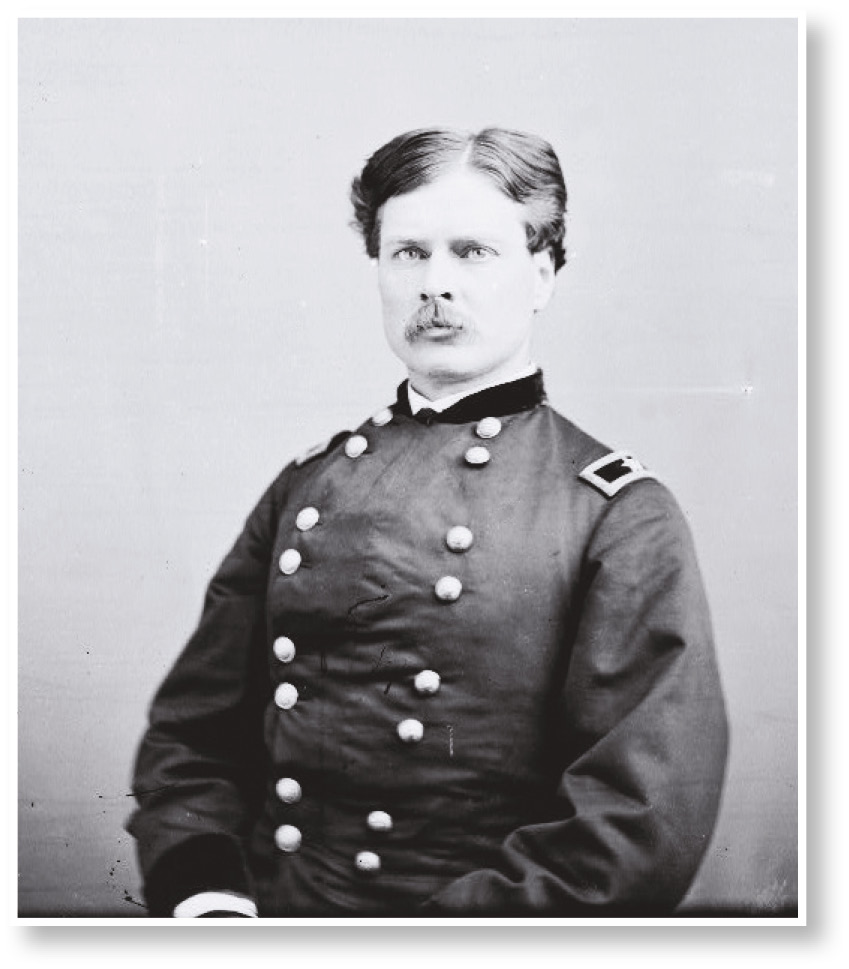
Newly appointed as commander of the Department of the Missouri, General Philip ‘Little Phil’ Sheridan, renowned cavalry leader of the Civil War, was livid. Surmising that the hostile tribes would probably cease raiding in the winter in favour of sheltering in their villages from the bitter weather, Sheridan planned a winter campaign for late 1868. As he gathered the needed forces and matériel, Sheridan decided to maintain pressure on the hostiles in the interim, in order not to allow them any respite. Believing that large forces of infantry and cavalry were too slow to react, he formulated a novel approach. For this, he turned to an old friend and former subordinate. Major George Forsyth had also distinguished himself during the Civil War. Beginning as a simple private, ‘Sandy’ Forsyth had proven himself a superb cavalryman, fighting in virtually every engagement involving the Army of the Potomac, and gaining laurels and promotions. During the Shenandoah Campaign, he became Sheridan’s aide-de-camp, and distinguished himself once again in September 1864 at the Third Battle of Winchester. Tough and unconventional, he was, in Sheridan’s estimation, the right man for the job.
In August 1868, Sheridan put a tentative plan into action. Rather than using regulars, he authorised Forsyth to form an unconventional ‘flying column’ made up entirely of volunteer irregulars. To that end, he wired him the following instructions: ‘The general commanding directs that you, without delay, employ fifty (50) first-class hardy frontiersmen, to be used as scouts against the hostile Indians, to be commanded by yourself, with Lieutenant Beecher, Third Infantry, as your subordinate.’
A much-decorated soldier of the Civil War, Frederick H Beecher, who still limped from a wound received at Gettysburg, came from a distinguished New England family, which had produced politicians, poets, clergymen, and composers. His aunt, Harriet Beecher Stowe, had done much to bring on the Civil War with her explosive novel Uncle Tom’s Cabin, originally published in 1852. Forsyth and Beecher lost no time in recruiting their command. Gathering the first 30 recruits at Fort Harker, they then moved 70 miles west to Fort Hays, also in Kansas but closer to the prospective area of operations. At Fort Hays, the remaining 20 men were recruited.
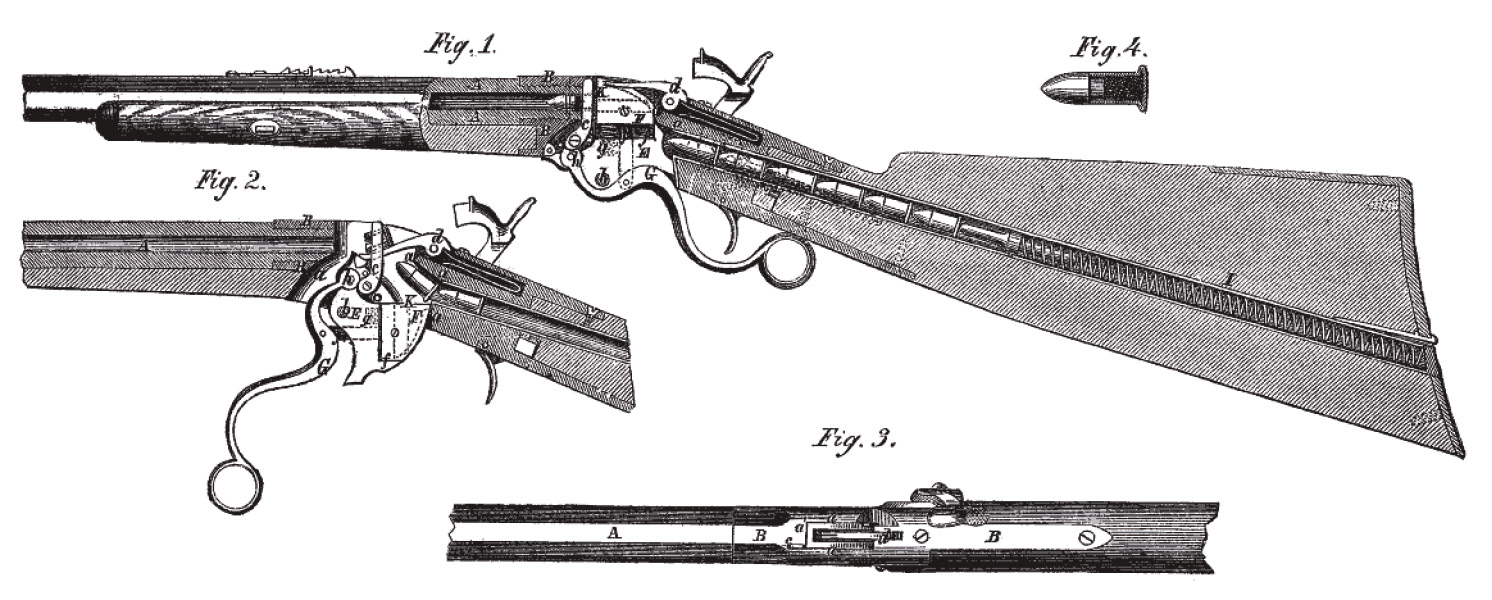
It was an unusual group, which included as their First Sergeant William McCall, a former Brigadier General of the Civil War, several veterans from both the Union and Confederate armies, and Martin Burke, an Irish veteran of British service in India, who reported for duty in the rather unusual garb of a complete British sailor’s uniform. The rest of the command included hunters, farmers, labourers, and even a former newspaper deliveryman. Each was issued a Spencer repeating carbine and a Colt Army revolver. In contrast to the Army’s traditional single-shot, muzzle-loading Springfield rifle, the Spencer fired a heavy .56-calibre bullet mounted in a copper cartridge, and was fed by a tubular magazine holding seven rounds. Designed in 1860, it was christened the ‘Sunday gun’ by Confederate soldiers who came up against it, because you could ‘load it on Sunday and fire all week’. Now it gave a decided advantage to the frontiersmen. Where the standard Springfield rifle could manage one or two shots a minute, the Spencer could spit out seven shots in less than that time. In addition to the 140 rounds each man carried for his Spencer, four pack mules were outfitted to carry the command’s supplies and an extra 4,000 rounds of ammunition. Forsyth enlisted the services of Dr John Mooers, too, to see to the health of the volunteers. By 29 August, Forsyth’s small command was ready, moving out of Fort Hays on its first patrol.

Hostile territory
Although the first mission was unsuccessful, it served a purpose as it allowed the unit’s members to work together and familiarise themselves with Forsyth’s leadership style. A hard taskmaster, he was also a self-assured leader and a first-rate soldier. The men, who had taken to calling themselves the ‘Solomon Avengers’, were well-pleased with their officers, and returned to Fort Wallace, 130 miles west of Fort Hays, weary but supremely self-confident. Within days of their return, however, a small band of hostiles attacked a caravan of freight wagons only a few miles away. News arrived at Fort Wallace on 10 September.
The next morning, the command launched out in pursuit. As the raiders had already retreated, Forsyth’s command tracked them on to the plains. Moving ever deeper into hostile territory, it soon became apparent that the raiders had joined up with a large force of Indians, and they were disconcertingly close. As the command passed out of Kansas and into the Colorado Territory, scouts discovered several abandoned campsites and ‘wickiups’ (small temporary shelters of interwoven branches), as well as a broad, heavily travelled trail. These Indians had their families with them. Forsyth’s men grew increasingly uneasy. They knew not only that they were outnumbered but also that the Indians would be more aggressive if they felt their families were threatened. The major dismissed the men’s fears, noting that they had signed on to fight Indians and would soon have their chance.
The command pushed on, arriving in the valley of the Arikaree Fork of the Republican River on the evening of 16 September. Here in the broad, grassy swales, they picketed their horses and mules, and prepared to spend the night. Bisecting the valley, the Arikaree forked in midstream around an island – 200 feet long and 40 feet wide, and covered with low grass, sagebrush, cottonwood, and young willow. The riverbed stretched 90 feet on either side of the island – but in this late season, the river itself had shrunk to a few feet in width and was shallow enough to wade.
Forsyth’s command settled in for the evening, brewing coffee and cooking beans over small campfires. The men, knowing that hostiles were in the area, slept in their clothes, their weapons alongside. They had good cause for apprehension. A few miles downstream was a large village of Southern Cheyennes, Dog Soldiers, Brulé and Oglala Lakota, Arapaho, and even a few Northern Cheyenne warriors and their families. While Forsyth’s party was unaware of their presence, the Indians knew full well that the hated wasichu (as they called non-indigenous people) were camped nearby. Their leaders Bull Bear, Tall Bull, White Horse, Pawnee Killer, and Roman Nose debated how to deal with the white interlopers. It was finally decided that there would be no small raiding parties, but rather the entire force would attack as a body and destroy the whites at one stroke. Just before dawn on 17 September, a small band of warriors ran off a few of the unit’s horses and two mules, one of which was still carrying its medical supplies. But the war chiefs’ plans were disrupted: shots were exchanged, and the element of surprise was lost. When a scout by the name of Abner ‘Sharp’ Grover rode to a nearby ridge to the west, he sighted a mass of warriors gathering on the plains below. Grover scrambled back to report to Forsyth that hundreds of Indians were headed their way.
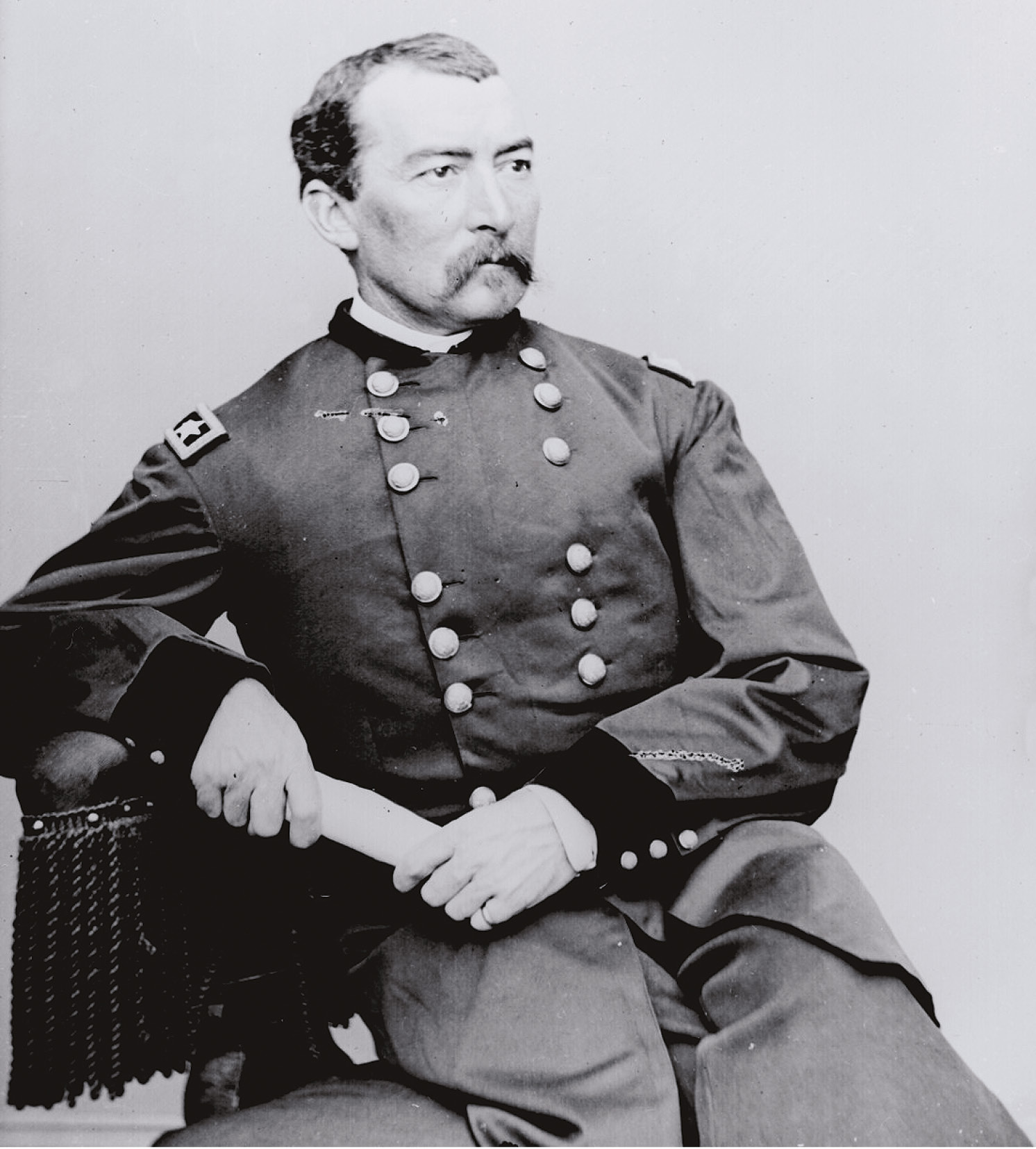
Above: A renowned cavalry leader of the American Civil War, General Philip ’Little Phil’ Sheridan authorised his old friend and subordinate Major George Forsyth (below) to form an unconventional ’flying column’ to take the fight to the hostile tribes.
Stand fast
In his 1895 poem ‘The Young British Soldier’, the writer Rudyard Kipling advised his readers: ‘Remember it’s ruin to run from a fight.’ Several decades earlier, Forsyth must have intuited this thought, for he determined to stand fast. He knew the Indians could not be outrun in the open country, and the only thing that offered even remotely defensible ground was the sandy island in the middle of the Arikaree – so the command splashed across the shallow river and settled in on the island. The remaining horses were picketed in the centre of the island, and the scouts began using knives and tin plates to dig rifle-pits in the sandy soil.
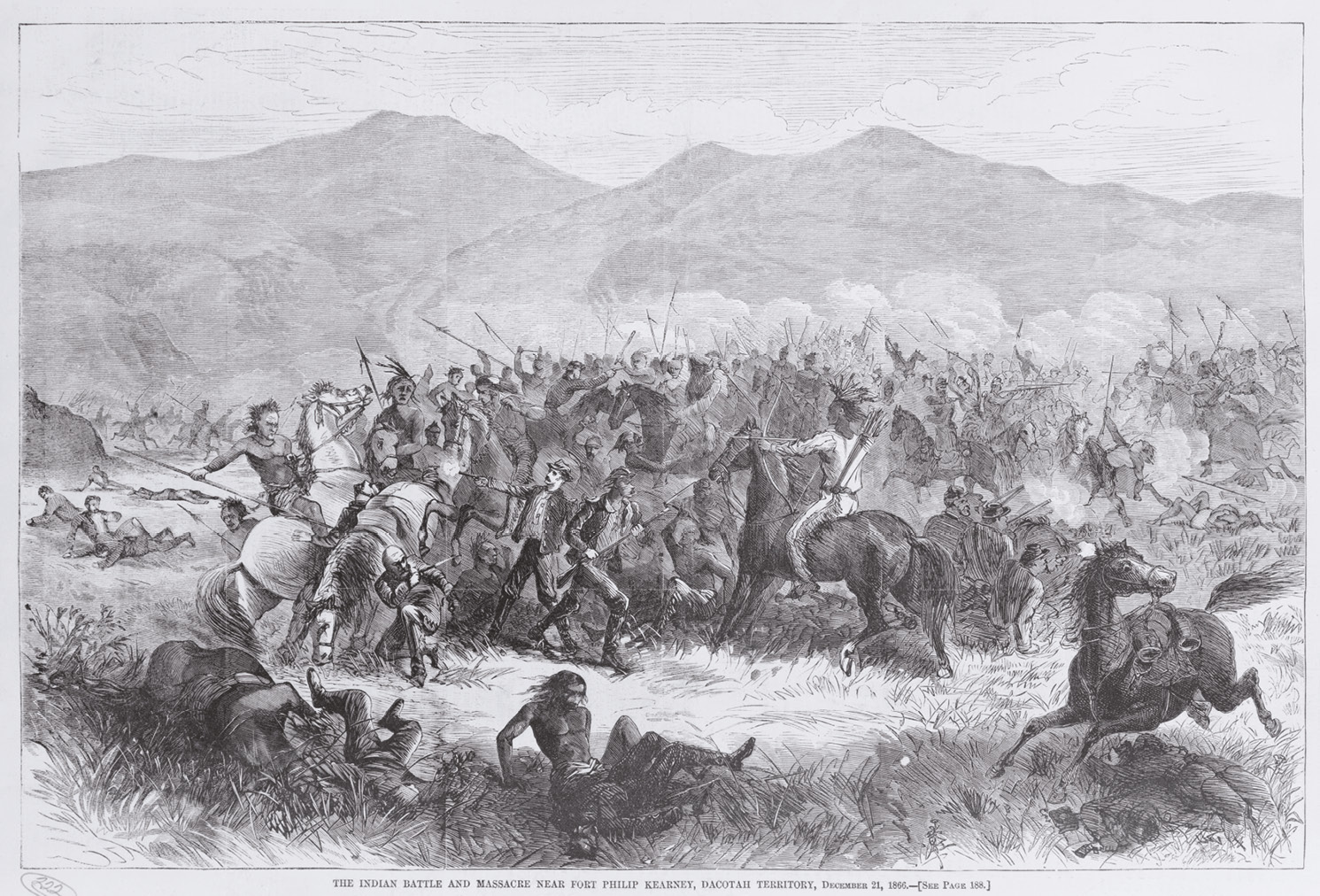
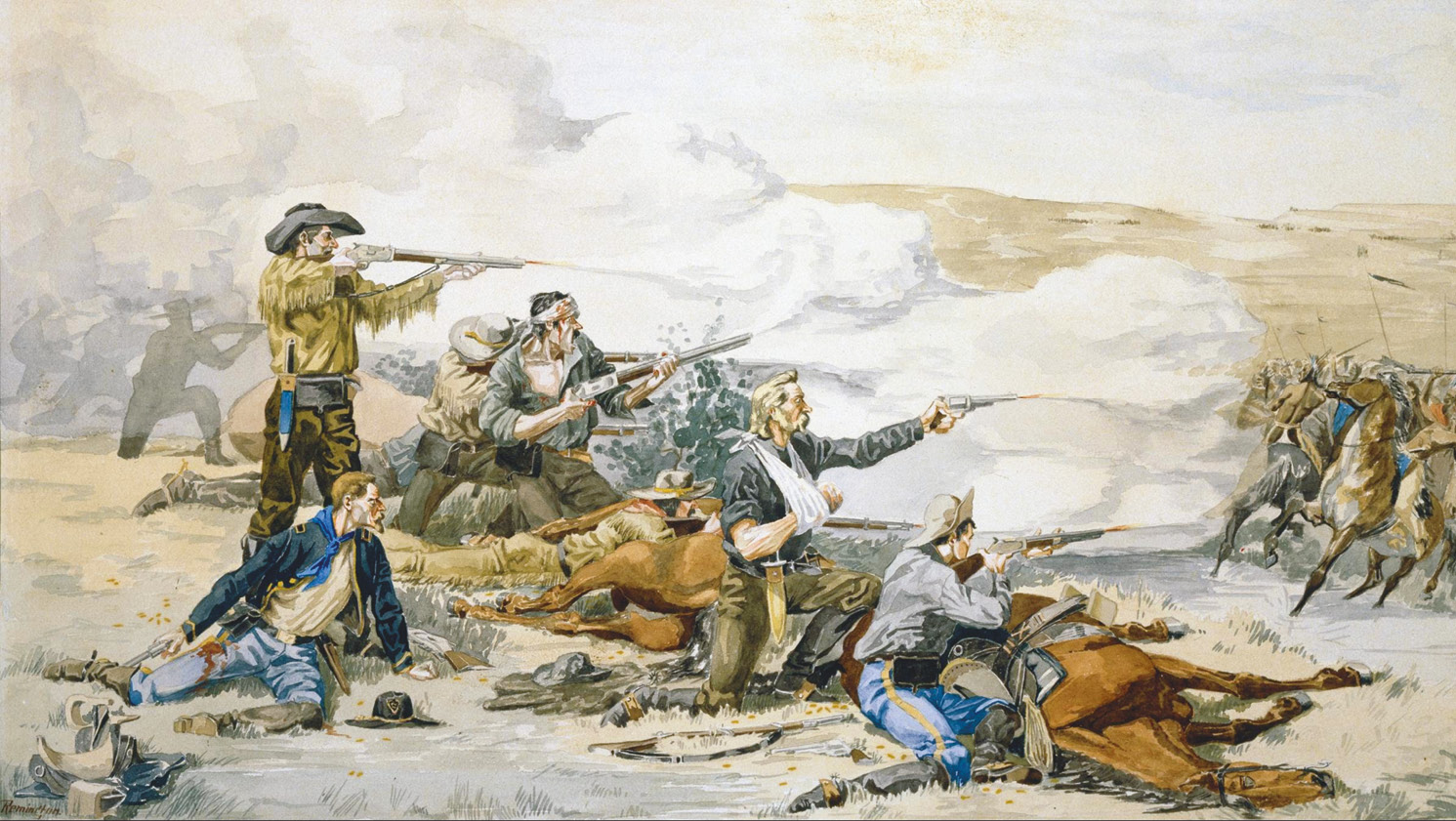
Within moments, however, nearly 600 screaming warriors launched a mounted charge at the men, hoping to scatter the band and cut them down as they ran. But the scouts did not run. Instead, they used their repeating carbines to open a withering fire on the infuriated Indians. The Dog Soldiers were stunned. Accustomed to the soldiers’ slower-loading Springfields, they had fully expected to sweep over their enemies as they reloaded. Instead, the Spencers’ sustained volleys wreaked havoc on their ranks. The first charge swept around the island to little effect. Some warriors leaped down into the tall grass of the prairie and crawled forward with rifles to begin firing into the scouts’ refuge.
One shot smashed Major Forsyth’s right thigh to send him rolling in the sand. As Dr Mooers tied off the wound, another round broke the major’s left shin. But the doctor could do no more, as an Indian bullet smashed into his head, dropping him in the sand. Mooers, mortally wounded, would linger in unconsciousness for the next two days. The scouts reloaded their weapons as the Indians regrouped for another charge. This new assault again swept around the island, as the defenders poured a deadly fire into the Indians, knocking many sprawling into the brush. Also mortally wounded in this exchange were Lieutenant Beecher and two other defenders. But the braves were frustrated by their inability to dislodge the whites. More braves slithered forward in the surrounding brush, popping up to fire their rifles at their enemies. Soon all of the command’s remaining horses had been killed. Forsyth made the mistake of raising himself to assess the situation. For his trouble, he received a third wound, when an Indian sniper creased his head with a bullet. He dropped back into the sand, momentarily knocked senseless.
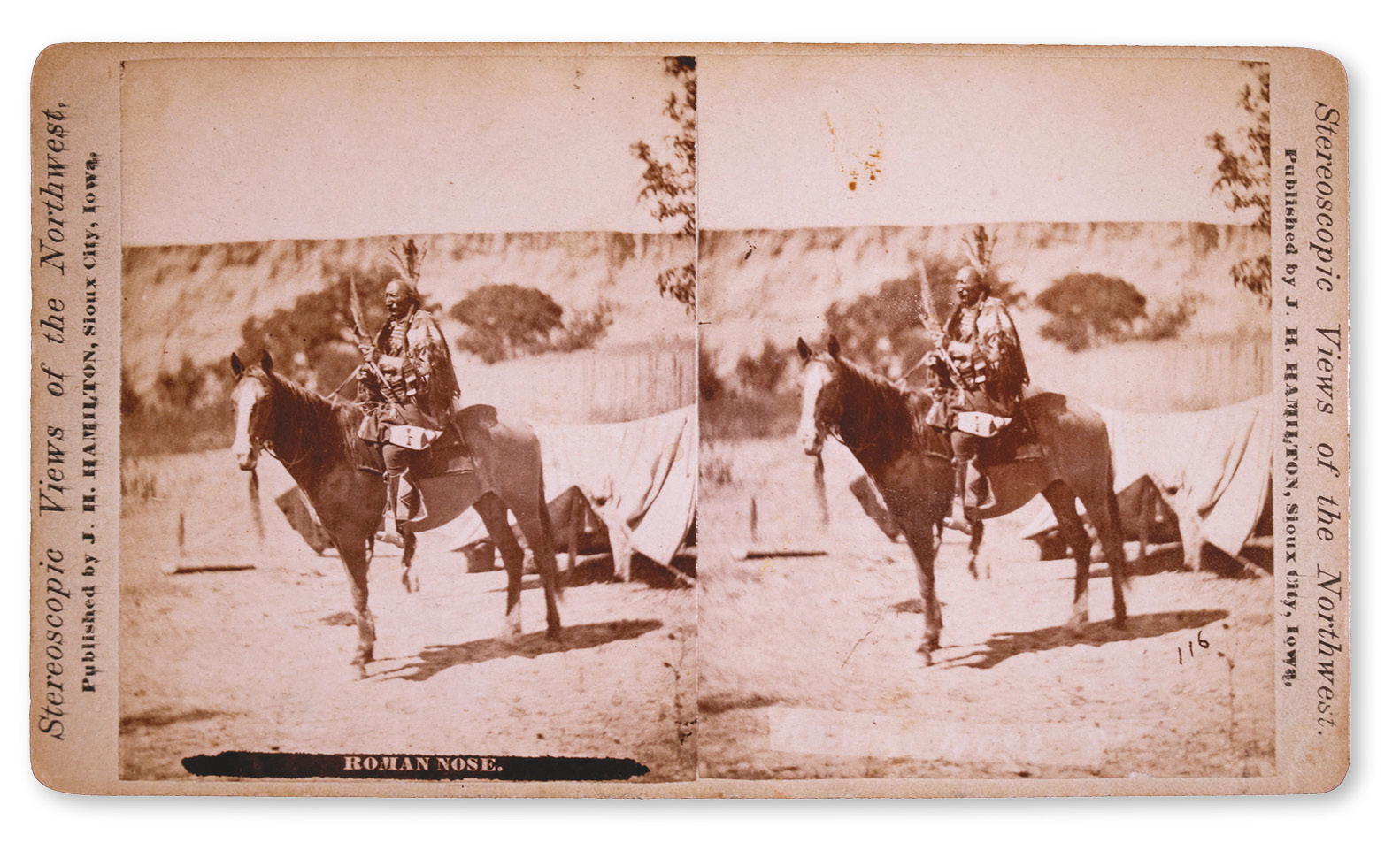
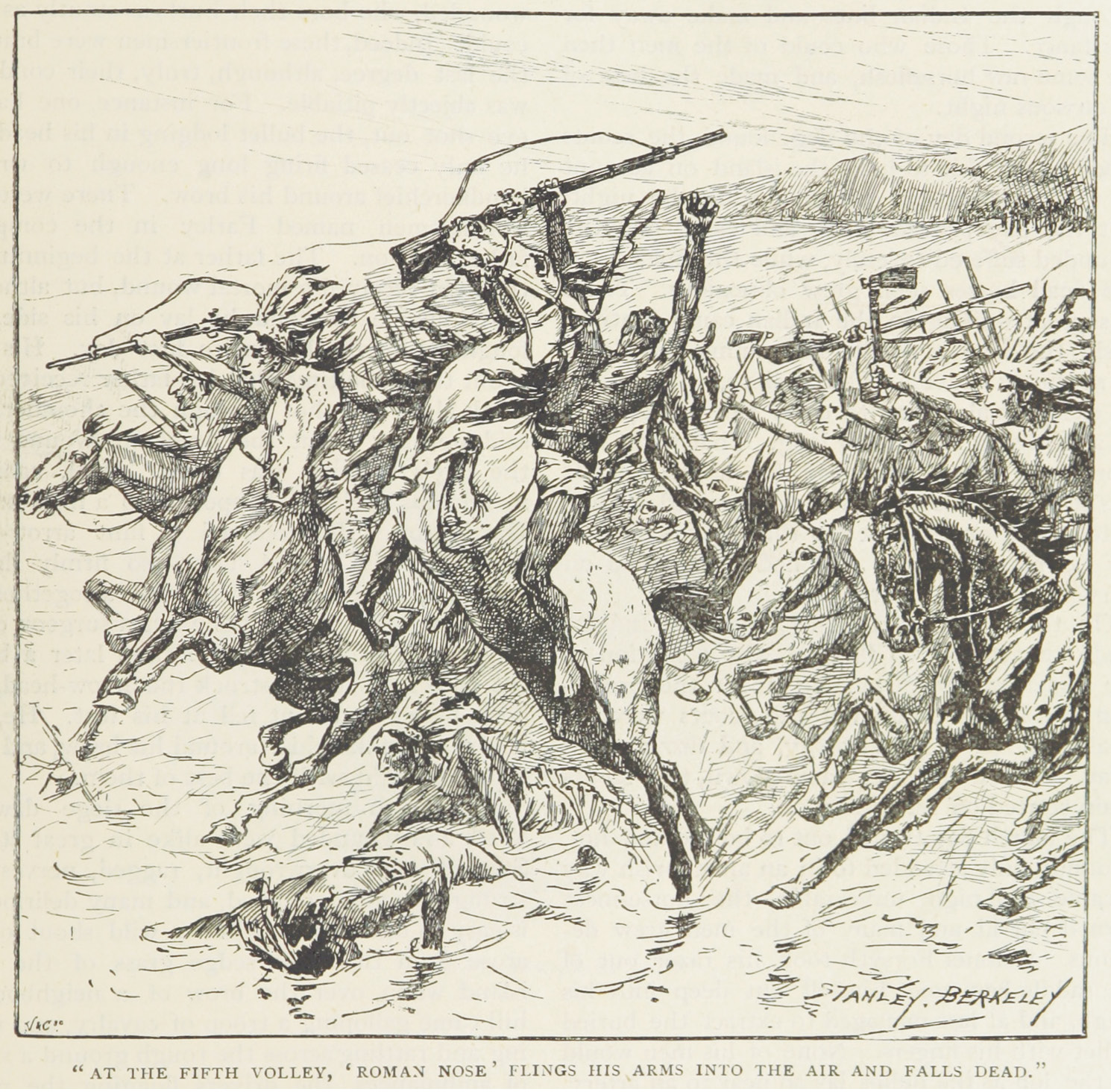
Meanwhile, the Cheyennes and Lakota had regrouped upstream. Angered by the enemy’s resistance, and puzzled by their rapid-firing weapons, they determined to try again. They were also chafing at the ineffectiveness of their own leadership. One warrior named White Contrary was especially cutting to the war leader Roman Nose, who had thus far only watched the fight. The latter was a very tall and formidable Northern Cheyenne warrior, known for his audacity in battle and hatred of the whites. But Roman Nose was fearful that his ‘medicine’ was broken. A few days earlier, he had dined at a friend’s lodge and unwittingly eaten bread that had been lifted from the fire by a metal fork. For him, this was a great taboo and something he could only rectify through a lengthy ceremony. Incensed by the unexpected losses, however, and stung by White Contrary’s mocking tone, Roman Nose donned his distinctive war bonnet and rallied the braves behind him. Screaming their war cries, they urged their ponies into a gallop, and swarmed the island, only to be met by successive crashes from the scouts’ repeating carbines, the heavy leaden slugs ripping through their ranks. Roman Nose provided an irresistible target in his flowing war bonnet, and his misgivings proved prophetic as a Spencer bullet wounded him fatally.
With their leader mortally wounded, and with many fellow warriors dead or seriously injured, the Indians retired from the battlefield for the day. Dusk fell on the Arikaree, and with it a cold rain. Some scouts looked to their dead, dying, and wounded comrades, while others worked to deepen the rifle-pits, and still others cut strips of meat from the dead horses knowing full well that, if it came to a siege, what few rations they had left would not last long. They were right. Soon after midnight, Forsyth dispatched two volunteers to carry a request for help the 75 miles to Fort Wallace; without horses, it was a journey that would take four days.
The next morning, the hostiles resumed their assaults. After a few half-hearted and unsuccessful attempts to storm the island, the Indians settled down to sniping at the defenders. A desultory exchange of gunfire characterised the following two days. The attackers had suffered unexpected losses, and were unsure how to come to grips with Forsyth’s command. That night, Forsyth sent out two more couriers. He knew that the little band was in desperate straits. The wounded – nearly half the command – were suffering terribly, and their doctor was unconscious and dying. The rations they had carried with them were exhausted, and they now depended entirely on what few plums and prickly pears they could gather, along with the meat of the dead horses, which was quickly growing rancid. When Forsyth examined his own wounds, he found them crawling with maggots.
The weather was growing less hospitable, with rain squalls, strong winds, and, one evening, a fall of snow. On the fifth day of the siege, Forsyth, wanting to assess the situation, had some of his men lift him from his rifle-pit on a blanket. A sudden fusillade of shots caused them to drop their commander, which resulted in the bone protruding from his broken leg. It was the Indians’ last effort. By the sixth day, the Indian snipers had disappeared. But without medical supplies, rations, or horses, and with a third of his command wounded, the Major knew that his men were still in serious trouble. It wasn’t until the ninth day that a relief column arrived on the scene. The couriers had made it through the Indians’ positions and managed to summon help. Forsyth looked up to see a detachment of the all-black 10th US Cavalry ‘Buffalo Soldiers’ coming to the rescue. He recognised their commander as Captain Louis Carpenter, a former colleague from Sheridan’s staff during the Civil War. Attempting to display an air of sang-froid, Forsyth reached into a saddlebag and retrieved a battered copy of Dickens’ Oliver Twist, which he pretended to read. Carpenter was not fooled, and observed that the book was upside down.
Final analysis
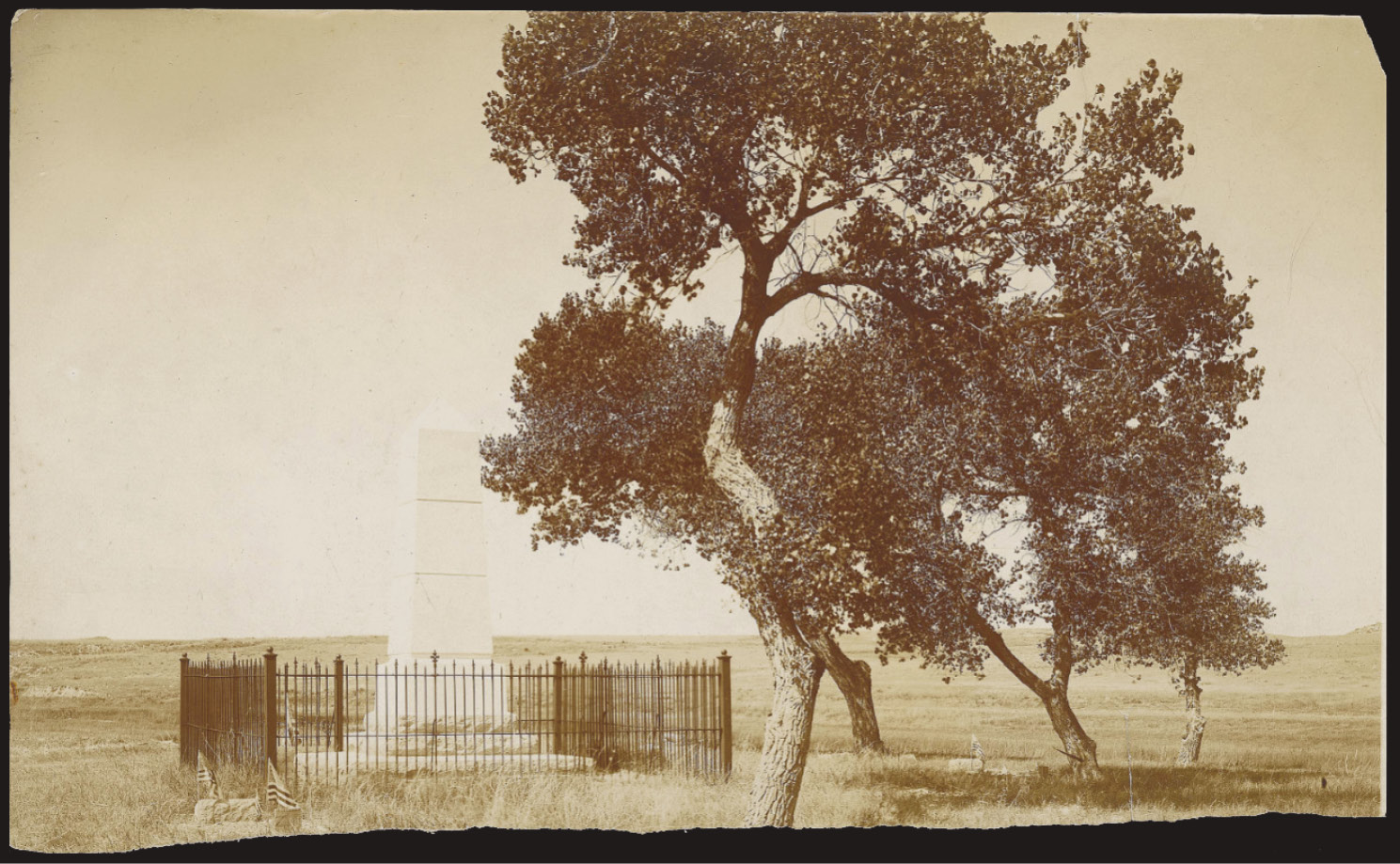
In the large scheme of things, the Battle of Beecher Island was of little significance, especially considering the magnitude of engagements during the recent Civil War. Forsyth had lost 6 killed and 15 wounded. The Indian losses were uncertain. The relieving columns claimed to have found 32 corpses en route. How many braves succumbed to their wounds cannot be determined. But the action caught the attention of the American public, with lurid headlines and detailed accounts in the newspapers throughout the country. The New York Herald lionised the survivors thus: ‘Surrounded by vastly superior numbers, without food and shelter, miles away from succor, starving, wounded and sick, the proud and merciless warriors of the Plains were defeated by a little band who knew their only chances of life were in looking death in the face and contesting with him the meed of victory.’
Two years after the stunning massacre of Fetterman’s command, and following the abandonment of the Bozeman Trail, the fight for Beecher Island captured the imagination of the public. But while it made for great head-lines, it had little impact on the struggle for the frontier. General Sheridan decided that the concept of employing such an unconventional force of volunteer irregulars as ‘Forsyth Scouts’ was flawed, and disbanded the unit. All future operations would be handled by Regulars. And in the final analysis, the episode did nothing to improve the lot of the frontier soldier.
Fred Chiaventone is a military historian, retired cavalry officer, and Professor Emeritus for International Security Affairs at the US Army’s Command and General Staff College.
All images: Wikimedia Commons, unless otherwise stated