
Subscribe now for full access and no adverts
In May 1915, Italy abandoned the neutrality that it had uneasily maintained for the first ten months of the Great War. For the Italian kingdom, which had been created barely two generations earlier, war with Austria-Hungary offered the enticing prospect of sweeping territorial gains on its northern border. It aimed to win control of a frontier zone that contained not only significant Italian-speaking populations but also people of German, Slovene, and Croat ethnicity. Italy had designs on an area stretching from the alpine Trentino-South Tyrol region eastwards to Trieste and down the Adriatic coastline into Dalmatia.
The opening of the Italian Front was an unwanted additional burden for the already overstretched Habsburg empire. In the spring of 1915, Germany was reluctantly preparing to provide Austria-Hungary with military aid on the Eastern Front, where it was struggling against Serbia and Russia. But the Germans refused to intervene against Italy until the autumn of 1917. As a result, Austria-Hungary found itself fighting alone in the theatre for more than two years, along a physically challenging front almost 400 miles long. It was a war in which the empire’s forces initially had the advantage, but which ended in their comprehensive defeat.
Strength in defence
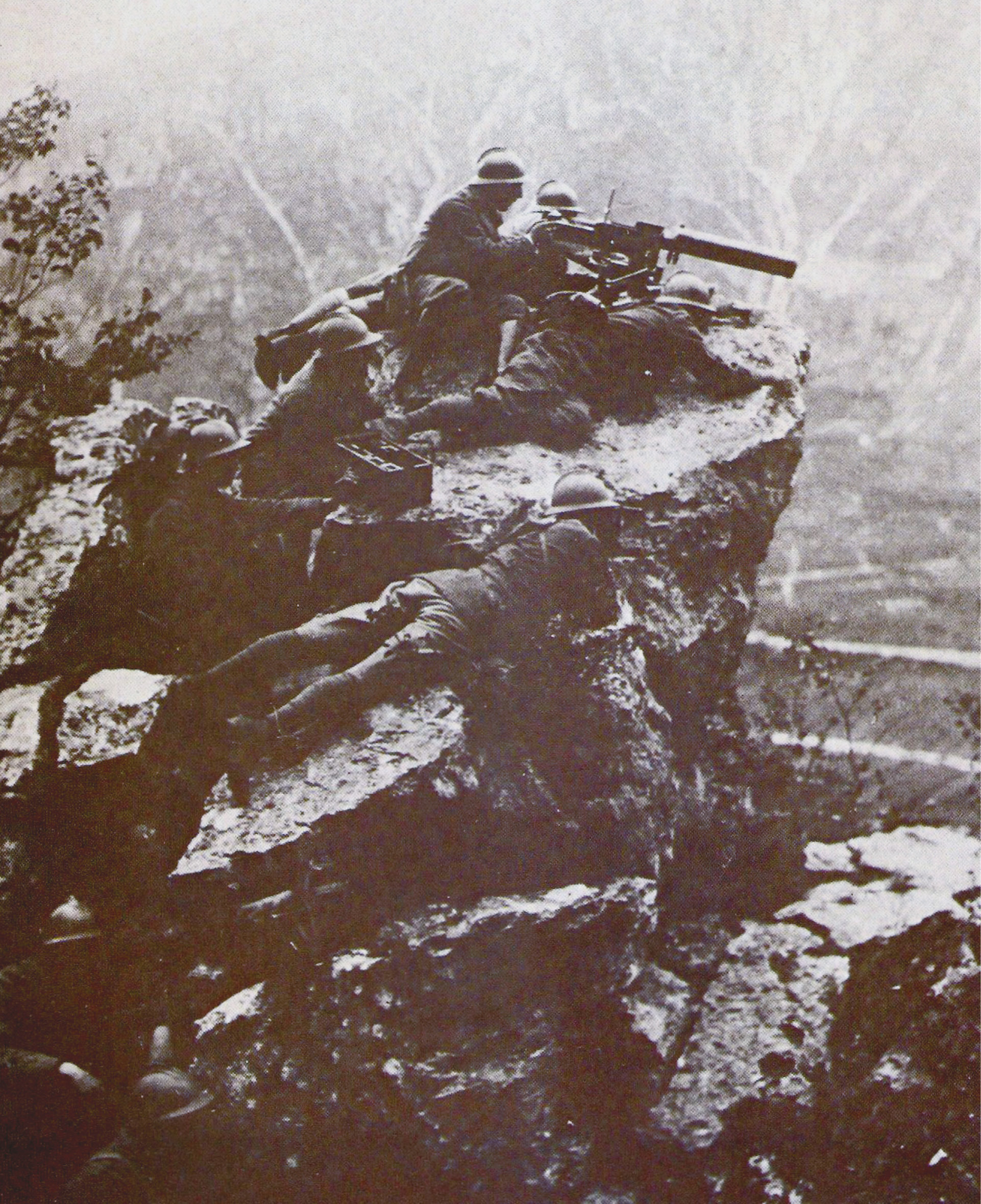
Much of the fighting took place in the mountainous South Tyrol, where peaks range from 6,000 to 12,000 feet in height. The campaign was commonly known as the ‘White War’ – because in summer, the steep limestone slopes turned a blinding white, while in winter they were covered in snow. Although the Italians had local numerical superiority, the forbidding Alpine topography restricted them to small-scale operations. Field guns had to be hauled by rope up almost vertical cliff faces. The Austro-Hungarians held the higher ground, where they strengthened the natural defences with barbed wire and improvised trenches and tunnels cut into the rock face. They also had an advantage in terms of heavy artillery, though not when it came to small and medium guns.
Mountain winds and exposure to extremes of temperature added to the misery. In the bitter winter of 1915/1916, more troops died from cold and avalanches than from mortar- and gun-fire. The American journalist E Alexander Powell wrote that ‘on no front, not on the sun-scorched plains of Mesopotamia, nor in the frozen Masurian marshes [in northern Poland], nor in the blood-soaked mud of Flanders, does the fighting man lead so arduous an existence as up here on the roof of the world’.
Thwarted in his hopes of a rapid push towards Vienna, the Italian Chief of Staff General Luigi Cadorna focused his attention on the sector at the eastern end of the front, between the Alpine foothills and the Adriatic, in modern Slovenia. For a stretch of some 50 miles, the mountains gave way to a high plateau bisected by the Isonzo river, running along the Italian–Austro-Hungarian border. Here, the Italians hoped that a narrow corridor through the Vipava Valley and along the edge of the Karst Plateau would afford a possible route into the Habsburg heartlands. But the Austro-Hungarian army was strongly entrenched on the eastern bank of the Isonzo. The stony terrain made entrenchment difficult and shell-fire caused splinters of rock to fly like shrapnel. Both armies endured rain and snow in autumn and winter, giving way to pitiless heat in summer.
Cadorna’s blind faith in the effectiveness of the offensive was mirrored by the emphasis on defence of the Austro-Hungarian commander, General Svetozar Boroevic´. On arriving at the front, this tough-minded Croat issued a simple order: ‘The troops should construct positions, place obstacles in front of them, and remain there.’ Between June 1915 and November 1917, no fewer than 12 battles were fought along the Isonzo, resulting in heavy loss of life for negligible gain.
In the first of these engagements, for example, the Italians gained roughly one mile of land for 1,900 dead, 11,495 wounded and 1,500 prisoners. The Austrians suffered 8,800 dead or wounded and 1,150 captured or missing. Habsburg losses were heavy because of the need to retake ground by open counter-attacks, and their inferiority in field artillery and munitions – at the end of the battle, they had half the number of guns deployed by the Italians.

Caporetto: false hope
There was a similar pattern in the ensuing battles on the Isonzo. Although the Italians improved their artillery tactics, they were unable to secure a decisive breakthrough. Shortages of ammunition for their heavy guns were a perennial problem. Meanwhile the Austro-Hungarians held their positions, but at a cost of losses that were practically unaffordable for an empire fighting on more than one front.
After the Italians won the 11th battle in August-September 1917, Austrian emperor Karl asked for German assistance. In response, Berlin approved a joint operation, involving equal numbers of German and Austrian divisions, but under overall German command. This was the 12th battle of the Isonzo, known as Caporetto in Italian.
The assault, which began on 24 October 1917, was a striking success, resulting in 40,000 Italians killed or wounded and 265,000 taken prisoner. The victory was the result of improved German tactics, with a short saturation bombardment followed by the rapid deployment of stormtrooper units, assembled under cover of darkness to maximise the element of surprise. Italian gas masks proved unable to withstand the use of poison gas. Austro-German units – among them elite Alpine Corps troops led by the future World War II field marshal Erwin Rommel – gained an outstanding victory. By early November, they had penetrated 50 miles behind the original Italian front line to the River Piave.
But the attackers were not well prepared to push home their advantage. The German high command was unwilling to release more troops to Italy and, lacking adequate transport and an agreed plan of advance, the assault ground to a halt. The Entente powers reinforced the beleaguered Italians, and added their voice to the pressures building in Rome for the replacement of Cadorna. He had combined limited leadership skills with a brutally disciplinarian attitude towards his troops, and he was not missed. His successor, Armando Diaz, managed to hold the line prior to a renewed and ultimately successful action the following June on the Piave.
The tide turns
Why did Austria-Hungary’s position decline so rapidly, leading to total collapse on the Italian Front, scarcely a year after the victory at Caporetto? Whereas the British and French each retained three divisions in the theatre, the Germans withdrew their forces to concentrate on the Western Front. Austro-German relations were key to the Habsburg high command’s decision to launch an offensive on the Piave in June 1918. Emperor Karl badly needed to recover his standing with Berlin, which had been damaged by the revelation of his attempt the previous year to negotiate a separate peace. A success on the Italian Front would demonstrate Austria-Hungary’s continuing worth as an ally.
In readiness for the assault, General Arz von Straußenburg, who had been appointed Chief of General Staff in March 1917, expanded and reorganised the Austro-Hungarian army. The troops were trained to copy the German tactic of rapid infiltration under cover of a creeping artillery barrage. But the army’s logistical support was not up to the task set for it. It did not have enough horses, and the rail network was overstretched. Food shortages meant that the troops lacked the stamina to follow up any initial success. During the summer of 1918, the bread ration almost halved and meat rations were one-quarter of their 1914 level. Many soldiers were clad in worn-out uniforms and, lacking overcoats and blankets, could not realistically fight on into the winter.
Nor was there agreement over where to concentrate Austria-Hungary’s forces. Former Chief of General Staff Conrad von Hötzendorf, now demoted to command the army in the Tyrol, called for a thrust into the Venetian plain to take the main Italian army in the flank. Boroevic initially recommended a defensive posture on the Piave, then proposed a frontal assault along the river. The compromise solution that was eventually agreed – to allocate equal numbers of troops to each objective – left both options critically short of men.

Meanwhile, Diaz re-equipped his army and invested resources in building defence in depth, creating three lines interspersed with machine-gun nests and concrete strongpoints. Artillery, rifles, and planes supplied by Britain and France helped to replace the losses suffered at Caporetto. Critically, Diaz developed a more positive relationship with his officers and men, drawing a line under the counterproductive harshness of the Cadorna era. Intelligence gave him advance warning of the planned Austro-Hungarian attack, through a combination of aerial reconnaissance, eavesdropping on telephone conversations, and information provided by deserters.
After a failed attack in the far west, the main Habsburg assault got under way on 15 June in the mountain and river sectors. In the former, the Austrian infantry broke through in places but were held by allied troops deployed in the thickly forested terrain. Since Caporetto, the Italians had acquired better gas masks and so that weapon was much less effective. The attackers paused, partly because they lacked the reinforcements to press forward.

The Austrians were initially more successful on the Piave. However, a lack of firepower, together with an inability to locate the Italian defences accurately, limited the effectiveness of their artillery bombardment. They managed to cross in two places, and took large numbers of prisoners in the early stages. But they struggled to bring heavy weaponry across the fast-flowing, swollen river, and found it hard to knock out well-concealed Italian guns. They resisted an Italian counter-attack, but by the night of 22/23 June their commanders had concluded that they could make no more headway, and they began to pull back.
The Italians had failed to stop the enemy both from crossing the river and then retreating in good order. But the battle was still a major setback for the Austrians, obliging them from now on to adopt a purely defensive posture. The high number of casualties – they lost an estimated 118,000 men killed, wounded or captured over nine days – led to calls for a change of leadership. The subsequent sacking of Conrad as theatre commander failed, however, to address the deeper problems of the Austro-Hungarian army.
Collapse at Vittorio Veneto
Despite pressure from his allies and Italian government ministers to launch an assault, Diaz delayed. He was unwilling to strike until assured of success. It was only in mid-October 1918, with Germany now clearly losing in the west, Bulgaria knocked out of the war, and Austria-Hungary seeking an armistice, that the Italian commander agreed to move. His plan entailed an advance across the Piave towards the town of Vittorio in the Veneto region – it was renamed Vittorio Veneto after the war. The aim was to divide the Austro-Hungarian forces on the Adriatic plain from those in the mountains.
The allied numerical advantage was slender on the eve of battle: 54 Italian and three British and French divisions faced 55 Austro-Hungarian infantry and six cavalry divisions. The Austro-Hungarian army had used the summer to deploy more machine-guns and heavy artillery along the front, and to strengthen their defensive works. Although its depth varied, the wide Piave would be difficult for attackers to cross as a result of heavy autumn rains. But Austria-Hungary’s front-line strength had been depleted by desertions, and the German high command had no reinforcements to spare – in fact, they wanted Austrian assistance on the Western Front.


The battle started on 24 October, the anniversary of Caporetto. An assault on Austrian positions on Monte Grappa, in the alpine foothills, went badly after poor weather conditions affected the accuracy of the preliminary artillery bombardment. The Italian infantry met surprisingly strong resistance, resulting in 21,000 casualties for almost no territory gained. The crossing of the Piave proved no less challenging. British troops were ferried across in flat-bottomed boats to Papadopoli, an island in the middle of the river. Under cover of darkness, they overcame its small garrison. Then, as the still-high river waters subsided a little, allied troops waded across under cover of a creeping barrage to establish precarious footholds on the other side.
By 29 October, the allied bridgeheads were being joined up, helped by the progressive breakdown of order in the Austro-Hungarian army. Hearing of Bulgaria’s exit from the war, which left their own homeland exposed to attack, Hungarian soldiers abandoned their positions – an example that was soon followed by South Slav and Czech units. Austro-Hungary’s high command ordered the evacuation of the Veneto, and by the end of the month their forces were in general retreat. Some 80,000 Austrians had been killed or wounded – more than twice the number of casualties suffered by the Italians – and 450,000 troops had been taken prisoner.
The Austro-Hungarian air force
Austria-Hungary possessed just 48 first-line aircraft and 27 training machines at the start of the war, compared to 250 German planes. Its aviation industry was dogged throughout the war by supply problems and labour shortages. The two-seater Brandenburg C1 biplane, which accounted for about a quarter of all Austro-Hungarian wartime aeroplane manufacturing, was serviceable. For fighter aircraft, however, the empire was dependent on German designs built under licence. Lack of fighter cover was felt acutely during the Battle of Vittorio Veneto, when the combined British, French, and Italian forces mustered more than 400 air frames to just 29 at the disposal of the Austrians.
Final Breakdown
Austro-Hungarian failure on the Italian Front can be traced to the army’s deep-seated internal weaknesses and lack of resources, both in manpower and matériel. The collapse of Russia and Romania had taken some pressure off the overstretched Habsburg military. But, although 60 of Austria-Hungary’s 82 divisions were stationed on the Italian Front in mid-1918, it still retained some forces in eastern Europe. Other troops were required to maintain order on the home front in face of growing civilian unrest. Austria-Hungary even contributed a small force to support the German effort on the Western Front.
The inability of the Austro-Hungarian economy to provide the army with adequate supplies was a critical problem. The discipline of front-line troops held for the most part until October 1918, when it became clear that the empire was collapsing. In the interior, however, it was a bleaker picture. Here, driven by hunger and the influence of radicalised prisoners of war returning from captivity in Russia, mutinies and desertions were a growing problem. The total number of front-line troops on the Italian Front fell from 406,000 to 238,000 between July and October 1918.

Italian forces, on the other hand, had access to the resources that Britain and France could provide. They had an advantage in terms of artillery – at Vittorio Veneto, Diaz had 7,700 guns at his disposal, compared to just over 6,000 on the Austro-Hungarian side. Although he was criticised for being over-cautious, the Italian commander had enabled his army to recover from the trauma of the previous year and to become once again a viable fighting force.
Air power played a part in the victory. Italy had temporarily lost air superiority during the Caporetto campaign, with many of its airfields overrun and machines downed by ground fire. By June 1918, however, strengthened by British and French reinforcements, the Italians had regained control of the air space. At the Piave, allied aircraft destroyed the Austrians’ pontoon bridges. British Sopwith Camel fighters outclassed anything fielded by the Austro-Hungarian air arm.
As the Austro-Hungarian infantry retreated from Vittorio Veneto, aircraft strafed them, leaving a trail of death and destruction several miles long. Soldiers, horses, and lorries jostled each other as they strove to escape along the valleys and mountain passes. The broken remnants of the once-proud army were heading north-eastwards into what had once been the Habsburg empire. They found themselves in a world very different from the one for which they had fought during the past four years.
Graham Goodlad has taught history and politics for more than 30 years. He is a freelance writer and a regular contributor to MHM.
Find out more:
• Nick Lloyd, The Eastern Front: a history of the First World War (Penguin Viking, 2024)
• Mark Thompson, The White War: life and death on the Italian Front, 1915-1919 (Faber & Faber, 2008)
In the next issue of MHM: Continuing our series on Imperial Germany’s Great War allies, Graham Goodlad examines the record of Ottoman Turkey’s army.
All images: Wikimedia Commons, unless otherwise stated