
Subscribe now for full access and no adverts
The Book of the Dead (or the Book of Going Forth by Day as it should more properly be called) was designed to assist the spirit of the deceased in his or her progress to resurrection in the afterlife. In order to achieve this rebirth, the deceased had to overcome a number of obstacles through the use of spells, rituals, and invocations. The origin of the Book of the Dead can be traced to the Pyramid Texts, which appear on the walls of the pyramids of the Fifth and Sixth Dynasties, but which relate solely to the afterlife of the king and his family. Subsequently these texts were further developed for private use by wealthy individuals, and inscribed on the sarcophagus – hence their modern name: ‘Coffin Texts’. By the New Kingdom, these texts were inscribed on papyrus scrolls, which were then inserted into the coffin. It is these rolls of papyrus that we refer to as Books of the Dead.
Ani’s Book of the Dead
The papyrus of Ani and his wife Tutu is dated to the Nineteenth Dynasty (c.1250 BC). It came from Ani’s tomb, which is now lost somewhere on the West Bank at Luxor. The papyrus was bought illegally by E A Wallis Budge in 1888 (who was paid £150 for its acquisition by the British Treasury), and shipped to the British Museum where it now resides. It measures nearly 24 metres in length, but was cut up by Budge into 37 sections or plates – not ideal in terms of preservation and flow. Nearly all the plates are composed of vignettes with associated text below, but sometimes it is not clear to what extent the text relates to the vignettes. Budge himself translated the whole papyrus, although his work has since been updated by other scholars, notably Raymond Faulkner. The papyrus is particularly noteworthy and famous because of the high quality of the vignettes, and the fact that it is virtually complete (with few lacunae).
Who was Ani?
Ani’s papyrus was acquired by the deceased or his family ready-made, written in cursive hieroglyphs, with only the name and title of the deceased to be inserted in the blank spaces provided – in this case, ‘Osiris scribe Ani’. Ani’s full title is ‘veritable royal scribe, accountant of the divine offerings of all the gods, overseer of the granary of the lords of Abydos, scribe of the divine offerings of the lords of Thebes’. Adding the word Osiris before his name in nearly all cases does not necessarily mean he had become Osiris, but rather that he is like Osiris, or maybe just that he is dead. His full title indicates that he held high offices in Egypt, particularly his role in looking after the finances of the holiest temples in Egypt. Ani’s wife Tutu is described as ‘lady of the house, singer of Amun’ – another important role.
Layout
Each section of the papyrus normally begins as a rubric (in red ink) denoting the start of a particular spell or invocation. The spells are divided into chapters, which in modern times have been numbered. The hieroglyph used for an introduction to a chapter was the letter ‘r’, which normally means ‘mouth’, but here means ‘spell’ or ‘speech’.
The blank spaces left for name and title usually occur at the top or the end of a column of text, thus making it easier for the scribe to carry out the insertion. In some parts of the papyrus, the scribe seems to have forgotten to insert Ani’s name and title, and the space is therefore left blank. There are even some instances where the name has been misspelt.
Many parts of the papyrus are difficult to follow in terms of their meaning. It is likely that Ani and/or his relatives were able to choose the spells they thought to be more relevant to him, or only selected some for more economic reasons; there was no canon, and there are other Books of the Dead which are more complete, notably in the Third Intermediate Period.
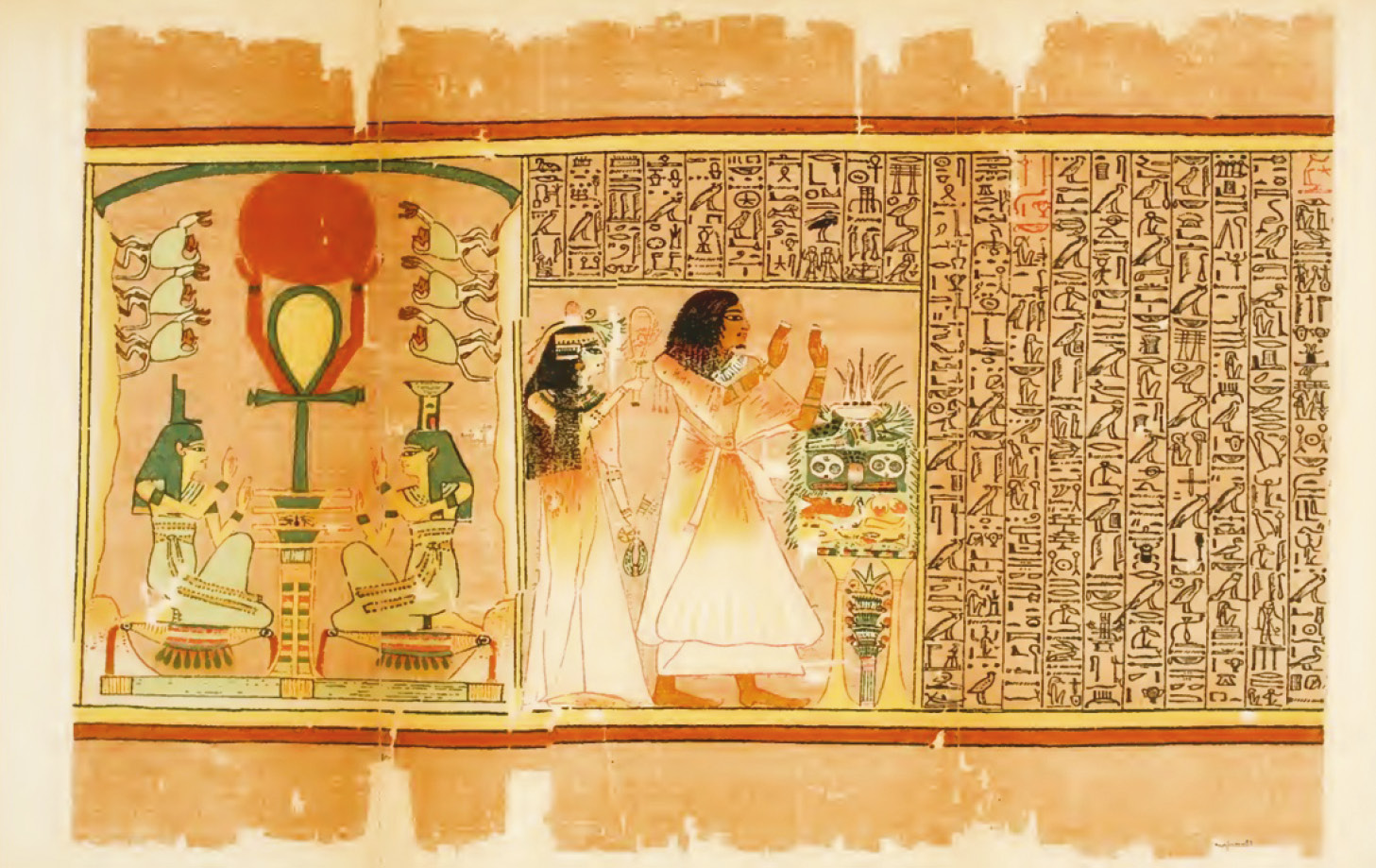
The ‘Hymn to Osiris’ vignette
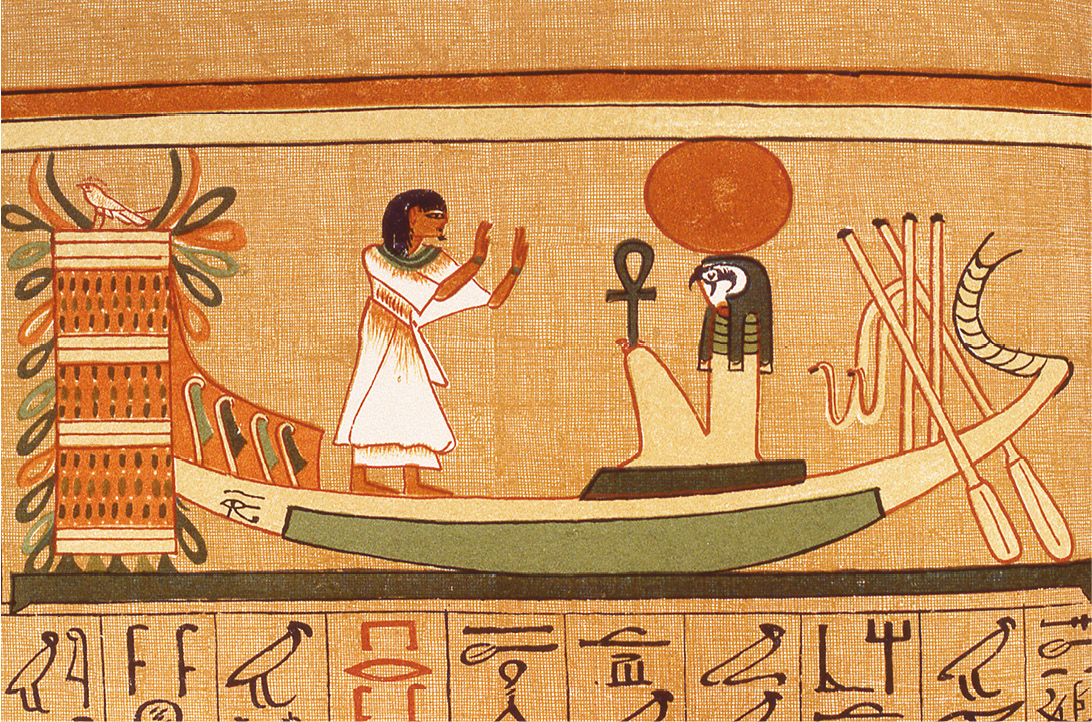
The book begins with two hymns: the first to Ra (Plate 1) and the second to Osiris (Plate 2). These were the two key gods in the afterlife, although there are many more major and minor gods portrayed in the papyrus. Ra is the solar god with whom the deceased will journey through the night to be reborn at dawn (Ani is shown with Ra in Plate 21, worshipping the sun god in his boat). Osiris is the god who will judge whether the deceased is worthy of having an afterlife and thus able to pass through the underworld to be resurrected daily with the sun god.
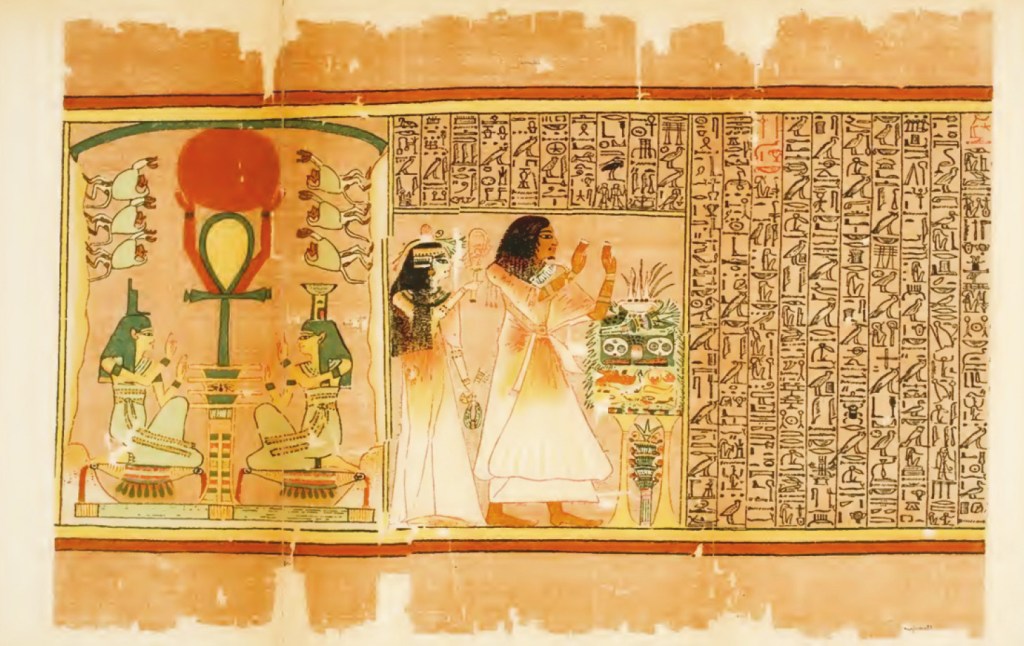
The vignette shows a strange configuration of the djed pillar (sacred to Osiris) supporting the ankh, which in turn holds up the sun. To the left and right, six baboons raise their arms in worship, standing on a line attached to the symbol for ‘mountain’. Baboons were symbols of the sun rising in the east. So what we seem to have here is a combination of Ra and Osiris: Osiris in the underworld supports the symbol of life, which in turn lifts the sun (Ra) so it can start its journey through the sky (shown in green above the disc), having emerged from the underworld of Osiris. Below this, the adoring figures of the goddesses Isis (to the left) and Nephthys (to the right), sisters of Osiris, each sit on a symbol for gold (nbw).
To the right of this scene, Ani and Tutu are shown presenting offerings to the god, with Tutu holding the menat-collar (associated with Isis) and the sistrum. The accompanying text (reading from the right) is a hymn to Osiris Wennefer (an epithet of Osiris). Ani asks to be allowed to go in and out without being repelled at all the gates of the Duat (the underworld). He also asks for bread in the house of cool waters, and offerings from Heliopolis. The text ends (above Tutu) with Ani asking for the barley and wheat in the Field of Reeds to be for his ka. The ka is a concept difficult to understand, but seems to have been a life-force that is born at the same time as the person and accompanies them during their life and after death.

Andrew Fulton studied Theology at the University of Cambridge and holds the Certificate in Egyptology from the University of Manchester. He is a regular contributor to AE magazine, including articles on Vespasian in Egypt (AE 129) and the Fourteenth Dynasty (AE 133).
Notes:
• Andrew’s translations are based on E A Budge’s The Book of the Dead (1895), while facsimiles of all 37 plates were published in Budge’s The Papyrus of Ani (1913).
• R Faulkner, O Goelet, et al (1994) The Egyptian Book of the Dead: The Book of Going Forth by Day (Chronicle Books, San Francisco) also contains facsimiles of all 37 plates, commentary by Goelet, and translations, based on Ani and several other manuscripts, by Faulkner.
Images: from E A Budge (1913) The Papyrus of Ani: a reproduction in facsimile, vol.I