Subscribe now for full access and no adverts
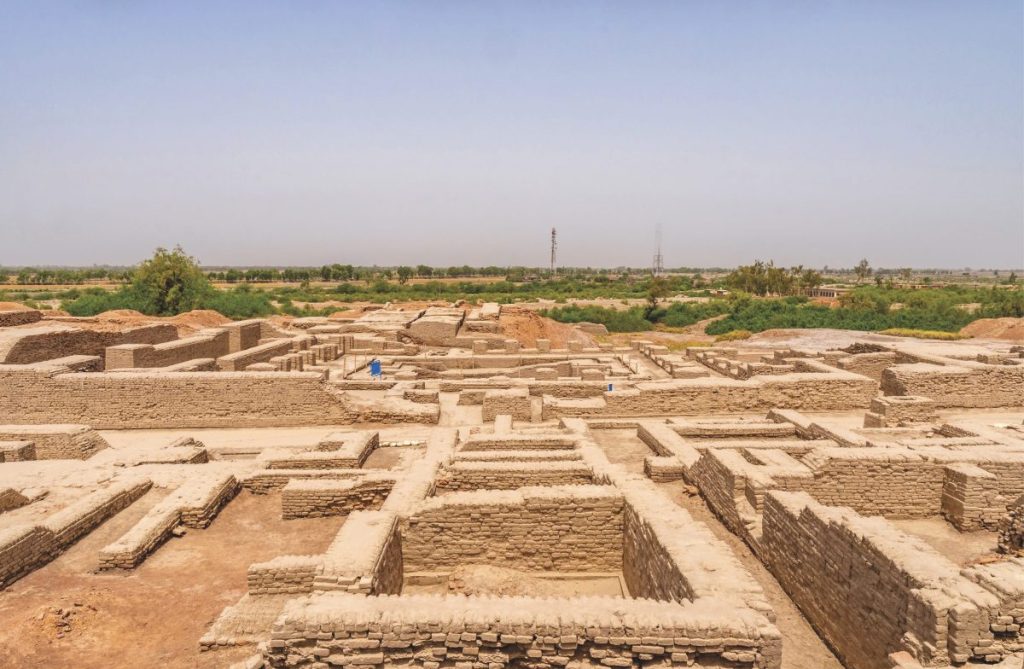
Mohenjo-daro (c.2600-1900 BC) has long invited questions about the relationship between urbanisation and social inequality. With an estimated population of 40,000 at its peak, it was one of the largest cities of the Indus Valley Civilisation. However, unlike other ancient urban centres around the world, Mohenjo-daro has no palaces or private temples, no ostentatious tombs or statues of rulers; in fact, markers of a ruling class or elite are entirely absent.
A recent study, published in Antiquity (https://doi.org/10.15184/aqy.2026.10359), set out to investigate levels of inequality in the ancient city. Researchers analysed house sizes across Mohenjo-daro to calculate its Gini coefficient, an economic statistic developed by the Global Dynamics of Inequality (GINI) project, which uses residential disparities to determine levels of wealth in past populations: the higher the score, the higher the degree of inequality. The results revealed that Mohenjo-daro’s score was well below sites with clear evidence for stratification like ancient Greek Knossos or Classic Maya Palenque, as well as contemporaneous cities in west Asia like Ur and Ugarit.
Even more interestingly, they found that Mohenjo-daro appears to have become more egalitarian as it developed over time. The study’s authors suggest that this could be the result of collective governance that focused resources on projects like drainage and street organisation, which benefited the whole population. This is supported by the presence of seals and stamps in many ordinary homes, indicating that trade was not monopolised by a small powerful group, in contrast to sites in Mesopotamia. Similarly, the standardised system of weights and measures found across the region could have been part of an effort to ensure fair exchange for everyone.
Although further research is needed, these findings have the potential to challenge the idea that increased inequality is an unavoidable consequence of economic development – Mohenjo-daro is one place where this does not seem to be the case.
Text: Amy Brunskill / Image: Aleksandar Pavlovic, Dreamstime.com
Please send your images to cwa@world-archaeology.com. They must be high resolution (300 dpi) and in landscape format, ideally 20cm high by 30cm wide.