Subscribe now for full access and no adverts
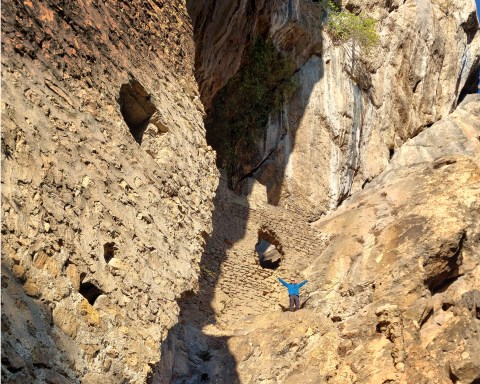
It was found by a walker in a rock crevice.
What is it?
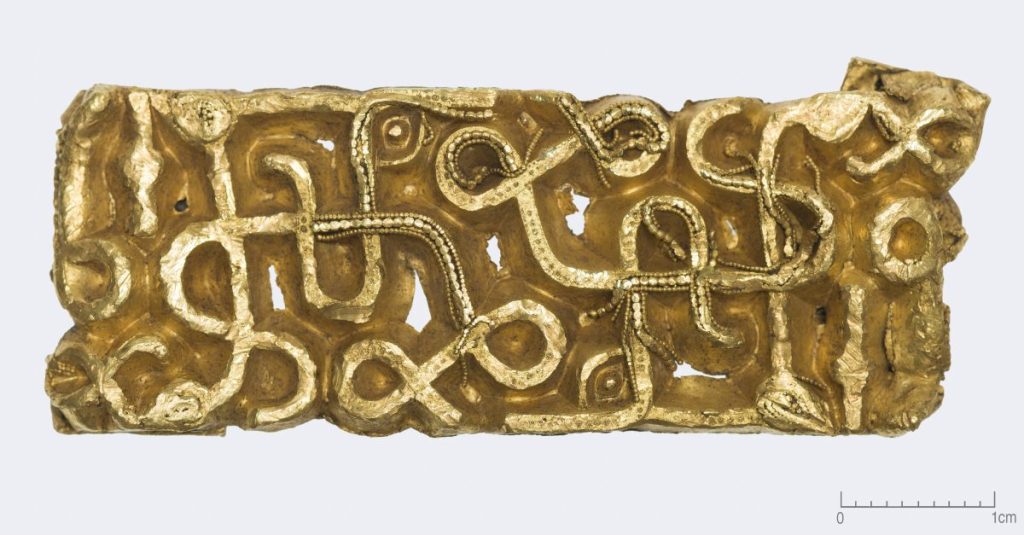
This spectacular sword scabbard fitting dates to the 6th century, during Norway’s Migration Period. The rectangular object measures 6cm wide by c.2cm high and is just a few millimetres thick; made of solid gold, it weighs 33g. The ends of the fitting are bent and compressed, and the surface is very worn, but it was once richly decorated with filigree ornamentation. Triple-beaded gold wires outlined a design comprising two figures with narrow, ribbon-shaped bodies, possibly representing hybrid human-animal creatures. The figures are shown in profile facing each other, one with its head along the upper edge of the fitting, the other along the lower edge.
Where was it found, and when?
The object was found by a walker in a rock crevice revealed by a tree blown over in a storm, at the top of Riaren hill in the Austrått area of Sandnes, Norway. This is the third spectacular votive find made around Riaren hill, after a silver neck-ring discovered in the 19th century and a large Roman bronze cauldron found in 1907. This area around Hove in Sandnes is known to have been a power centre in the Late Roman and Migration Period; archaeological and place-name research indicates that it was home to a group of elites, as well as, probably, a place of religious significance.
Why does it matter?
The craftsmanship of this ‘exceptionally rare’ object places it among the finest works of the period, made by highly skilled goldsmiths. Its decoration can be compared to a group of enigmatic objects called gullmunnblikk (gold scabbard fittings), occasionally found in Scandinavia among deposited gold finds, which look like sword or dagger scabbard fittings but have never been found attached to these items. The find from Riaren also bears similarities to scabbard fittings known from other impressive swords from the Migration Period, such as the Snartemo sword.
If this fitting was once attached to the scabbard of such a sword, it must have been a magnificent weapon, probably belonging to the chieftain of this area c.1,500 years ago. Gold scabbard fittings usually show little wear, but this example appears to have been heavily used by its high-status owner. Then, at some point in the 6th century, it was deposited in a rock crevice, probably as an offering to the gods during a time of climatic change and poor harvests.
This discovery fills in another piece of the puzzle surrounding the centre of power in this area of Norway between AD 200 and 550, as well as enhancing our wider understanding of the Migration Period and the mysterious gullmunnblikk objects.
FIND OUT MORE: The object will be placed on display at the Museum of Archaeology at the University of Stavanger as soon as possible.
Text: Amy Brunskill / Photo: Annette Græsli Øvrelid, Museum of Archaeology, University of Stavanger