Subscribe now for full access and no adverts
The people of Cornwall are so proud of their great engineer, Richard Trevithick, that when the Cornish Engines Preservation Committee and the Cornish Waterwheel Preservation Society decided to merge in 1971, they named the new organisation the Trevithick Society (Kowethas Trevithick, in Cornish) in his honour. And where else would you find a whole day devoted to the memory of one man: Trevithick Day is celebrated in Camborne every April (the month of his birth in 1771 and of his death in 1833) with a steam parade, funfair, vintage bus rides, dancing, and street food.

They would also like you to remember that their man developed the first steam locomotive. David Gwyn, in The Coming of the Railway (2023), says that the first attested run of a railway locomotive took place on 21 February 1804, when a loaded coal waggon with Trevithick himself as the sole engine driver was hauled on a tramway from Merthyr Tydfil to Abercynon and back, a journey of 19 miles.
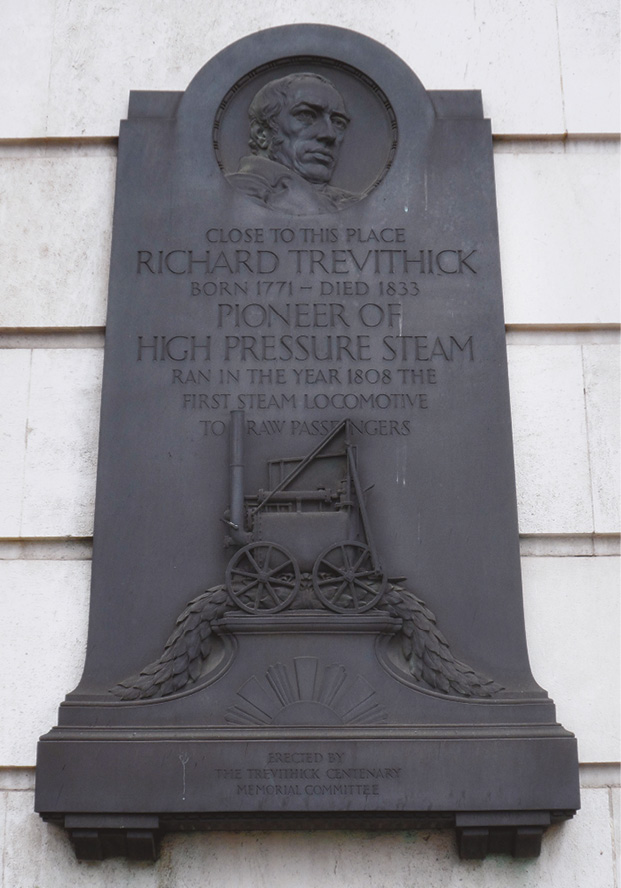
A plaque on the front of what is now University College London, on Gower Street, records another Trevithick achievement: the world’s first passenger railway. This operated as a steam circus attraction that opened on 8 July 1808. Passengers were charged a shilling for the novelty of travelling round the circular track. Unfortunately, heavy rain caused the track to subside and the locomotive to derail after just over two months of service.
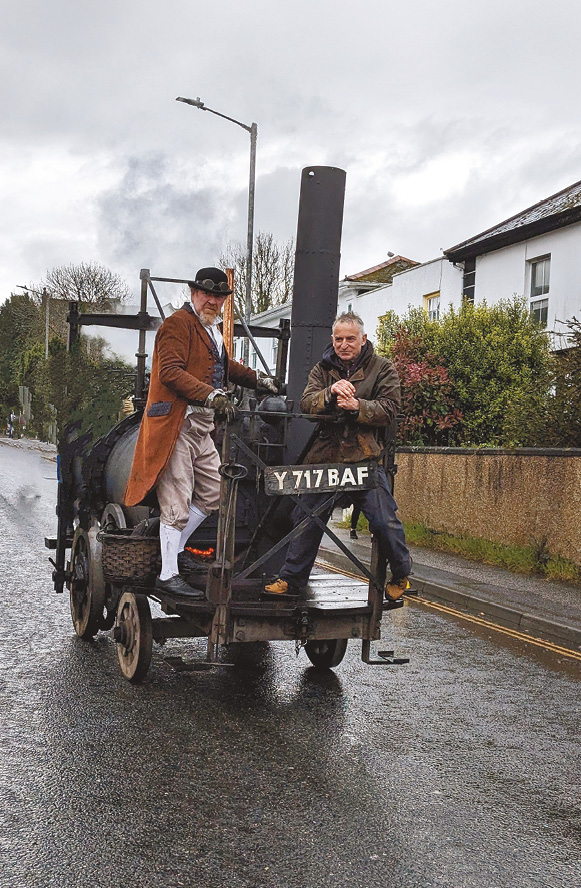
Trevithick’s contribution was to turn the linear motion of the static pumps used to drain deep mines into circular motion, and to design high-pressure steam engines light enough to be able to move more than their own weight. His early experiments were then taken up and developed by engineers in the north-east of England, leading eventually to the claim that the 26-mile Stockton and Darlington line, which opened on 27 September 1825, was the first to carry passengers.
Becoming a member of the Trevithick Society ‘opens up the fascinating history of Cornwall’s industrial past and its global impact’ by means of an annual journal, quarterly newsletter, regular lectures (held in Camborne and Liskeard), and its field trips.
Further information: http://www.trevithicksociety.info
Is there a society that you would like to see profiled? Write to theeditor@archaeology.co.uk

Images: The Trevithick Society; Spudgun67