
Subscribe now for full access and no adverts
The Burma Front in World War II was one of the toughest of all for combatants on both sides: tropical heat, disease, unforgiving terrain. For the Allies, it was their first encounter with a Japanese adversary that never gave up. All these factors made the whole experience uniquely dreadful.
The campaign was under-reported at the time, and dropped into the memory hole soon afterwards. Once the war was won, the cause for which the Allies had fought so bitterly – Burma – was handed over to the Burmese themselves within three years. Most of the soldiers who fought and suffered for Britain soon became the nationals of independent countries: Indian and African soldiers, the exhibition tells us, outnumbered Brits by more than four to one.
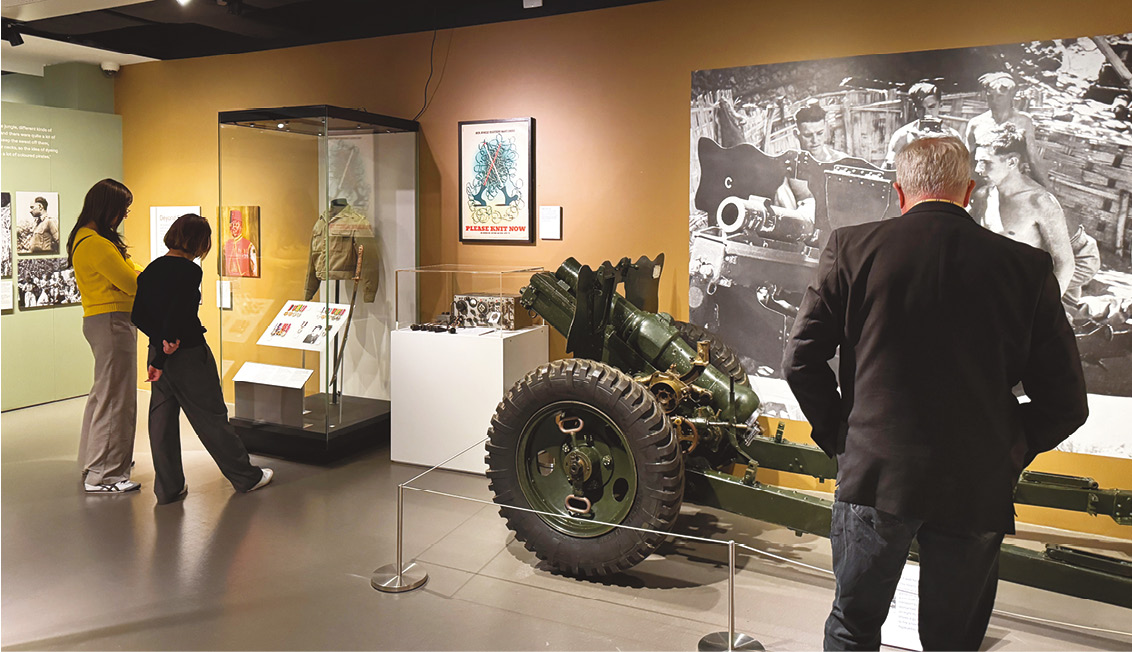
So, it is fitting that, to mark the 80th anniversary of VJ Day, London’s National Army Museum is staging an exhibition that brings into focus the Burma theatre, where General William Slim and his Fourteenth Army converted a desperate rout into a famous victory.
An orphan in the storm
Burma (modern-day Myanmar) had been a late addition to the Indian Empire, and while the variations of religion and culture across the subcontinent are vast, what they have in common – notably Hinduism – has helped secure the political integrity of India through the nearly 80 years since independence. Most of Burma, by contrast, is Buddhist, and though the religion originated in India, it declined as a living faith there many centuries ago. Ethnically and linguistically, too, the Burmese are distinct, and a massive migration of Indian capital and labour into Burma after its integration into the Indian Empire led to a fierce rebellion against British rule. To stem the problem, it was decided to slice Burma off from India administratively, leading to the first partition of the Indian Empire on April Fool’s Day 1937.
Whatever merit that division might have had in political terms, militarily it was a disaster. ‘In Burma,’ Slim wrote in his memoir Defeat into Victory, ‘our unpreparedness when the blow [of Japanese invasion] fell was extreme… Not only did few people in Burma, and no one outside it, expect that it would be attacked, but there was no clear or continuous decision as to who would be responsible… for its actual defence.’
So, after the collapse of Singapore in 1942, the Japanese poured into Burma, seized Rangoon, and Burma found itself an orphan in the storm.

Slim, a seasoned professional, quickly grasped that, whatever the political arrangements, Burma was ‘a defensive outwork of India: it would depend on India for the bulk of its troops and India would be its base.’ Yet so hazy was its status that ‘in the space of about 16 vital months there had been five separate headquarters in turn responsible for the defence of Burma, and for practically the whole of that time administrative had been separated from operational control.’ Burma, he noted, ‘was last on the priority list… for everything.’
Yet, as the exhibition documents, under Slim’s imaginative and vigorous command an army was forged with the flexibility and dogged determination to regain the upper hand. Heroes such as Captain Sam Manekshaw are singled out: the Indian Parsi soldier, nicknamed ‘Bahadur’ (‘the Brave’), who led the counter-attack on Pagoda Hill on the Sittang River, and captured it despite being severely wounded and losing a third of his force. For these feats, he was awarded the Military Cross.
A brutal campaign
Along with medals, weapons, uniforms, equipment, and captured Japanese and Union flags that have been heavily scribbled over, the exhibition is dotted with artworks that bring the conflict to life. A watercolour by Leo Rawlings, an RAF gunner captured in Singapore who became a chronicler of the POWs’ life, shows one emaciated British prisoner asking another, ‘Got a light mate?’
A precious little drawing by the artist Ronald Searle of fellow POWs reminds one again of the brutal backdrop to the Burma campaign. As Searle later noted, ‘basically all the people we loved and knew and grew up with simply became fertiliser for the nearest bamboo.’
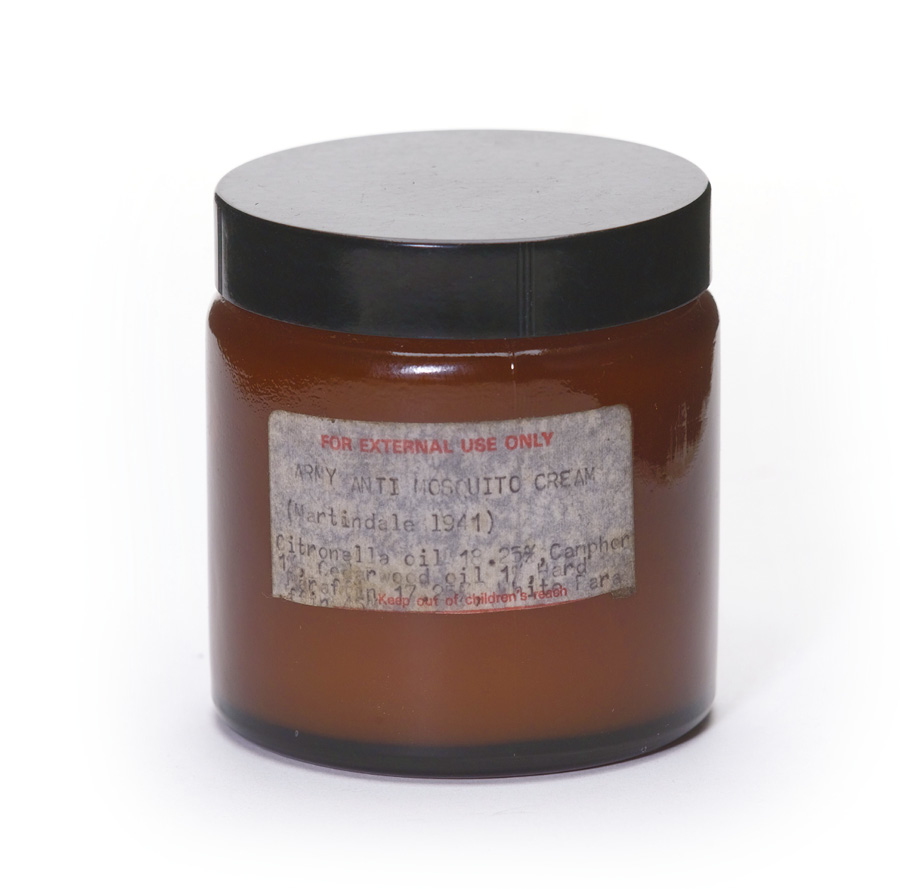
Above & below: Malaria posed a serious risk to soldiers fighting in this tropical environment: anti-mosquito cream and anti-malarial tablets were key.

In a vivid painting done during the fightback in 1944, troops of the Royal West African Frontier Force guard their camp while several of the ‘parajutes’ invented for the campaign in the absence of parachute silk (and fashioned entirely from the jute that was cheaply available in Calcutta) deliver matériel.
The Japanese invasion drove the Allied forces out of Burma with the shocking speed that characterised all their offensives. Fighting their way back in meant for all the troops – Indian, African, Gurkha, and British – operating in an utterly unfamiliar environment of tropical jungle, under monsoon rain, tormented by malaria, scorpions, and snakes, against a relentless and generally invisible enemy.
The response of the British authorities showed the stiff upper lip in its most absurd form. ‘His Majesty’s Government’, reads a fragment of official bumf on display, ‘appreciates the difficulties facing the civilian population while it is temporarily overrun by the Japanese…’.
With the Japanese threatening India, the Indian National Army led by Subhas Chandra Bose an ever-menacing fifth column to the rear, and Mahatma Gandhi demanding the British ‘quit’, light relief was hard to come by. So the visit by the well-known actor and entertainer George Formby – strumming his banjolele beside his wife Beryl in a jolly photo – must have been a moment of almost surreal gaiety.

Beyond Burma: forgotten armies
Until 13 April 2026 (Free entry)
National Army Museum, Royal Hospital Road, London, SW3 4HT
www.nam.ac.uk/whats-on/beyond-burma
+44 (0)20 7730 0717
MHM visits
EXHIBITIONS
• Emergency Exits: the fight for independence in Malaya, Kenya and Cyprus
Until 29 March 2026
IWM London, Lambeth Road, London, SE1 6HZ
http://www.iwm.org.uk/events/emergency-exits-the-fight-for-independence-in-malaya-kenya-and-cyprus
Free admission
The end of WWII did not mean peace for everyone – it accelerated the fight for independence across the British Empire. Emergency Exits focuses on three wars in the 1950s: in Malaya (now Malaysia), Kenya, and Cyprus, exploring how these conflicts shaped Britain, its former territories, and the modern world.
• Second World War
Until 18 January 2026
Canadian War Museum, 1 Vimy Place, Ottawa, ON, K1A 0M8
http://www.warmuseum.ca/exhibitions/last-voices-second-world-war
Admission CA$22 (adult)
Experience unforgettable stories and powerful first- person testimonies of WWII in this exhibition, which uses the veterans’ own words alongside photos and personal mementos to explore their journey, and discover how they rebuilt their lives, and made their experience meaningful.
• Swords of Lucknow
26 November 2025-22 March 2026
The Wallace Collection, Manchester Square, London, W1U 3BN
http://www.wallacecollection.org/whats-on/exhibitions-displays/swords-of-lucknow
Free admission
Five richly decorated Indian swords form the centrepiece of this new display at the Wallace Collection. Swords of Lucknow reveals the extraordinary craftsmanship in Awadh in the 18th and 19th centuries, when India’s cultural and political epicentres were shifting and Lucknow was flourishing as a courtly capital.