
Subscribe now for full access and no adverts

We’ve had the star-studded The Longest Day (1962), the restrained British independent movie made with the Imperial War Museum Overlord (1975), the supremely powerful Saving Private Ryan (1998), and TV features such as The Band of Brothers (2001), as well as many other modest movies, all of which focus on D-Day. Added to this now comes Pressure, which is emotionally very powerful and will stand up well alongside these others. But it takes a different perspective on D-Day by looking not at combat heroics but at the story of the weather-forecasting for early 1944, and the decision by Supreme Commander General Dwight D Eisenhower as to whether or not the invasion should go ahead.
The dramatic story of how meteorologists affected the date of the invasion was first told by Eisenhower himself in his memoir Crusade in Europe in 1948. The man at the centre of the story, Group Captain James Stagg, wrote his own memoir – with an extended introduction on the differences between weather-forecasting techniques in north-west Europe and the US – Forecast for Overlord in 1971. Two years later, he appeared in the Thames Television series The World at War. David Haig picked up on this extraordinary story, and after studying the documents and interviewing the Stagg family, wrote a stage play called Pressure, which ran in Edinburgh and in London’s West End in 2014.
Two people who saw the stage production were Joe Naftalin, head of UK film production at StudioCanal, the French production and distribution company, and Lucas Webb, of British film-production company Working Title. Both were fascinated by the human-led story of, as Webb says, ‘an individual who had to find the courage to do his job to the best of his abilities when everybody was saying one thing and he was a lone voice saying “But we have to do another”.’ Naftalin and Webb began discussing a possible film project with Haig, who had always thought his play would adapt powerfully into a movie. The final piece of the production jigsaw came with a visit by Australian film-maker Anthony Maras to London. His film Hotel Mumbai had deeply impressed Naftalin and Webb, and Maras soon became equally obsessed with the D-Day story and its theme of ‘speaking truth to power’ as he later put it. Maras came on board and worked on Haig’s draft script, giving it many of the cinematic elements that were needed in what had started as a stage production.
When it came to filming, the team had to find a location for Southwick House, Eisenhower’s advanced HQ outside Portsmouth. The original building still exists, but is surrounded by other newer buildings. They eventually settled on Mentmore Towers, a grand 19th-century country pile in Buckinghamshire, built originally for the Rothschild family. Everyone on the production was obsessed with getting period details absolutely right. A retired Deputy Chief of the Met Office, Martin Young, advised on exactly what a 1940s forecasting office would look like. The concern for detail extended from the exact pens used by 1940s meteorologists to the details of Eisenhower’s Map Room, complete with coloured telephones for direct lines to Washington and London, and the faded map on the wall; and from the slightly worn uniforms (it was four and half years into the war) to the pale lipsticks of the women who staffed many of the operations in Ike’s HQ. Shooting began in late 2024 and wrapped in 2025.
Unpredictable conditions
The film opens with the aftermath of Operation Tiger, a dress rehearsal for D-Day off Slapton Sands in Devon in April 1944 that had gone terribly wrong. More than 700 American servicemen had been killed. Bodies are lined up on the beach. The sea runs red with blood. The disaster haunted Eisenhower, knowing that small errors can result in a major tragedy.
John Stagg (emotionally played by Andrew Scott) leaves his pregnant wife at home, and is called to Eisenhower’s advanced HQ at Southwick House. He has been recommended to Eisenhower by Churchill as the best meteorologist in Britain. He was a civilian, but given status in the HQ as an RAF Group Captain. Eisenhower is played by Brendan Fraser, who is a good lookalike. Eisenhower has his own team of forecasters led by Colonel Irving Krick (Chris Messina), who has guided him successfully through his campaigns in North Africa.

Much of the tension in the film comes from the conflict between Stagg and Krick. The latter was used to the far more predictable weather conditions in North America and North Africa. He was accustomed to using what were called ‘analogues’ – that is, records from the same date in previous years where there were similar conditions. Stagg was used to the far more unpredictable conditions around the UK. Moreover, he was an early believer in the importance of the jet stream. Today, the jet stream as it blows across the Atlantic has an important place in forecasting, but in the 1940s it was little known or understood. While the American forecasters were confident of being able to predict conditions with total accuracy up to five days in advance, Stagg made it clear that anything beyond a 24-hour prediction relied on little more than guesswork. Stagg and Krick were also very different by temperament. Stagg was a dour Scot who rarely got excited or emotional. He spent hours studying data of barometric pressures, wind speeds, and the like as they came in from a variety of weather stations from Ireland across the Atlantic to Newfoundland. Krick was more flamboyant, with an American ‘can do’ attitude and the confidence that went with it. Stagg wrote in his memoir that Krick was not only ‘confident in his own diagnosis and prognosis’ but that he had ‘an aptitude for dogmatic assertions’. The movie portrays the conflict between them accurately and movingly.
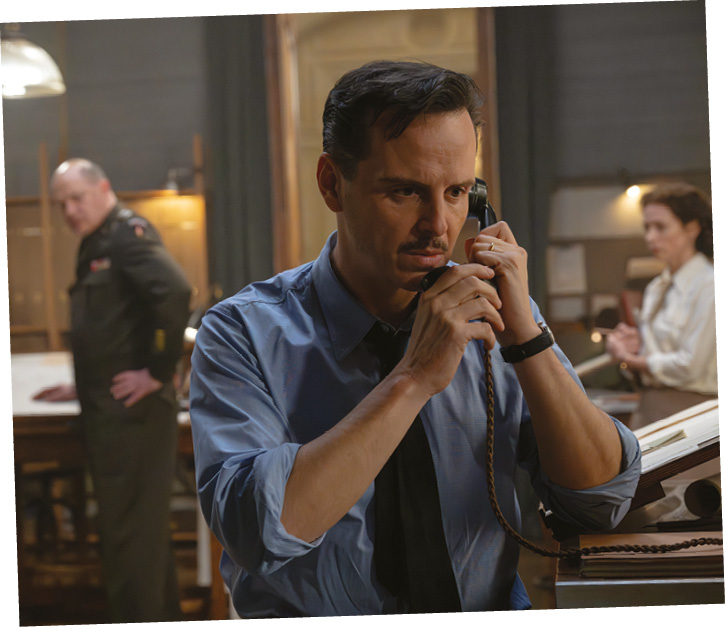
On arriving in the Forecasting Office at Southwick, Stagg takes charge as Chief Meteorologist by telling everyone they have hard work to do and throwing out a piano on which Krick had been entertaining the team with some boogie-woogie music. He soon encounters Lieutenant Kay Summersby (brilliantly played by Kerry Condon). Summersby was officially Eisenhower’s driver but in the film she plays a far more important position, almost as his ADC, controlling who would have access to the Supreme Commander. There were many rumours at the time that she was Eisenhower’s mistress. This was denied by Summersby in her own memoir, written after Eisenhower’s death in the late 1960s, and in the film there is no suggestion of a sexual relationship. Her presence in Pressure allows the film-makers to show Ike in relaxed mood, talking with Summersby after-hours while taking a whisky (he never seems to offer one to her), telling her what he is really thinking and sharing his doubts about the success of the upcoming operation.
Stagg is soon called into the Map Room, or Ops Room, where the great and good are gathered below the big wall map of the Channel and the Normandy beaches. Montgomery (amusingly played by Damian Lewis) is confident and arrogant, and never hesitant to remind Eisenhower that he has not experienced combat in the way he had – Monty had been badly wounded in the First World War trenches, and from El Alamein onwards led his men from near the front. As Commander of Land Forces, Monty just wants to get on with the invasion, and wants his men on the beaches as soon as possible. The other service commanders, Air Chief Marshall Sir Trafford Leigh-Mallory (Con O’Neill) and Admiral Sir Bertram Ramsay (Robert Portal), are concerned with their own specific interests of air and sea conditions.

To go or not to go
Two days before the planned invasion, Stagg has spotted two major cold fronts crossing the Atlantic, speeded by the jet stream. Krick shows that the same conditions had been present on 3 June 1925 and 1905, but the storm had blown away by 5 June. Stagg is not impressed, saying the weather does not repeat itself in the Channel. When he attends the next high-level meeting with Ike and the commanders, he says that a severe storm will hit the Normandy coast on 5 June, the day planned for D-Day. The clouds will be too low for Leigh-Mallory’s aircraft to provide cover and the waves of 8-10 feet will be too high for Ramsay’s landing craft to get ashore. Stagg is reminded that the invasion is the biggest in history, and if postponed might lose the Allies the war. ‘Do you want us to lose the war?’, shouts Eisenhower. ‘No sir.’ Ike asks if Krick agrees with him and Stagg has to admit he does not. Stagg says Krick’s claims are ‘horseshit’. Eisenhower screams at him, ‘Why should I trust you?’ Stagg has no clear answer but his sincerity impresses the assembly. For weeks, there has been high pressure over southern England – before the 2026 heatwave, the highest temperature ever recorded in the UK in May was in 1944. Although the sun is still shining outside, Eisenhower decides to follow Stagg’s advice. D-Day is postponed.
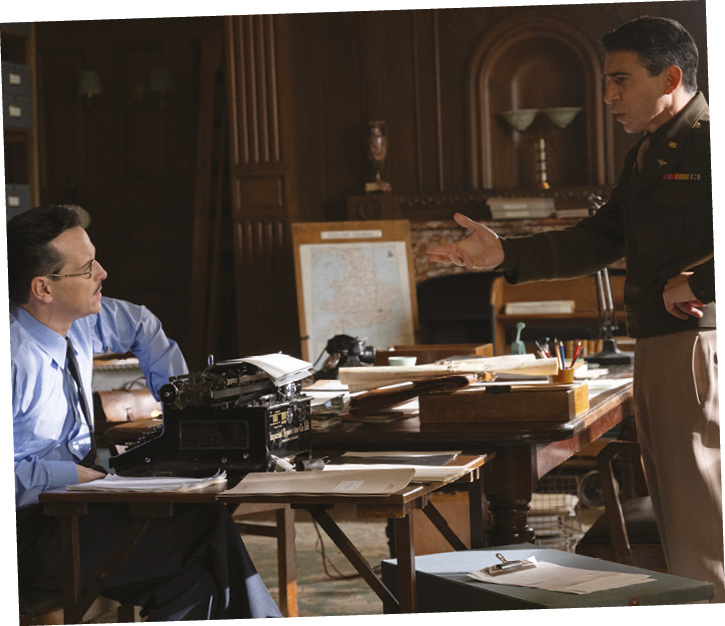
During the meeting, Stagg is called away to take an urgent telephone call. His wife has been admitted in labour to St Mary’s Hospital in London. But the hospital has been bombed and there have been casualties. She is missing. Stagg is distraught but knows he must carry on.
The next day, Sunday 4 June, the sun is still shining. But as the leaders gather for a church service, the wind blows up and torrential rain starts pouring down. Stagg’s predictions had been correct. The landings would have been a disaster had they gone ahead on 5 June.
Then, miraculously, Stagg spots a gap in the storm as the cold fronts veer to the north. With the rain lashing down, Stagg tells the commanders there will be a 36- hour respite along the Normandy coast from late on 5 June and through 6 June. Eisenhower asks him if he should ‘go’. Stagg says, ‘Yes’. The invasion is on.
Archive film of lines of ships crossing the Channel and aircraft filling the sky, some of it colourised, along with a dramatic reading of Eisenhower’s message to the troops is accompanied by the stirring music of Volker Bertelmann. As this massive invasion force crosses the Channel, there won’t be a dry eye in the house.

The only combat footage in the film is a Saving Private Ryan-type sequence of landing craft coming in, ramps going down, and enemy machine-guns opening fire. The soundtrack of gunfire is loud and horrific. Men are mown down. These Omaha scenes were, of course, not typical of D-Day. On most of the beaches, especially the British and Canadian, the main problem that morning was the traffic jams as vehicles poured ashore and could not be cleared quickly enough by the beach masters. Eventually word gets back to Southwick House. Allied troops have established themselves along the entire Normandy front. The staff cheer and congratulate each other. Amid the celebrations, Eisenhower goes to Stagg and shakes his hand.
The burden of leadership
Pressure is a powerful film and, judged on its emotional impact, will be a great success. It tells a relatively little-known story about the background to D-Day. Historically, it gets a lot wrong. First and foremost, Eisenhower was not a man who showed his anger or his fears to others. He would never have picked up a chair and thrown it angrily on the floor to call the room to silence. Second, despite being a dour and restrained Scot, the film has turned Stagg into a romantic hero, beautifully played, it has to be said, by Andrew Scott. But it is impossible to imagine him denouncing a colleague to superior officers for talking ‘horseshit’. Also, the big meetings in Southwick House did not take place in the open atmosphere of the Map Room. They occurred in the library, where Eisenhower and his Chief of Staff sat facing his commanders, who gathered in a semi-circle, with their staffs behind them. This set up was far more appropriate as a way for the Supreme Commander to seek the views of his service chiefs.
The real story of the meteorological background to D-Day is about leadership. The burden of deciding whether the invasion should go ahead or not fell on the shoulders of one man, the Supreme Commander. Eisenhower did what all good leaders should do: he asked for the advice of all his chief lieutenants, or, in this case, generals, admirals, and air chief marshals. He listened carefully to what they had to say. But he knew, in the end, the decision to go ahead with the invasion or postpone was his alone. All the accounts of these meetings by those present in the Southwick House library stress that Ike made the final call. This does not really come across in the film, where the final decision to ‘go’ is made in a sort of emotional, collective jamboree, which takes away from the personal pressure on Ike. It does, however, make for great drama, and by drawing in Stagg not just as an advice-giver but also as a decision-maker keeps the emphasis on his story.
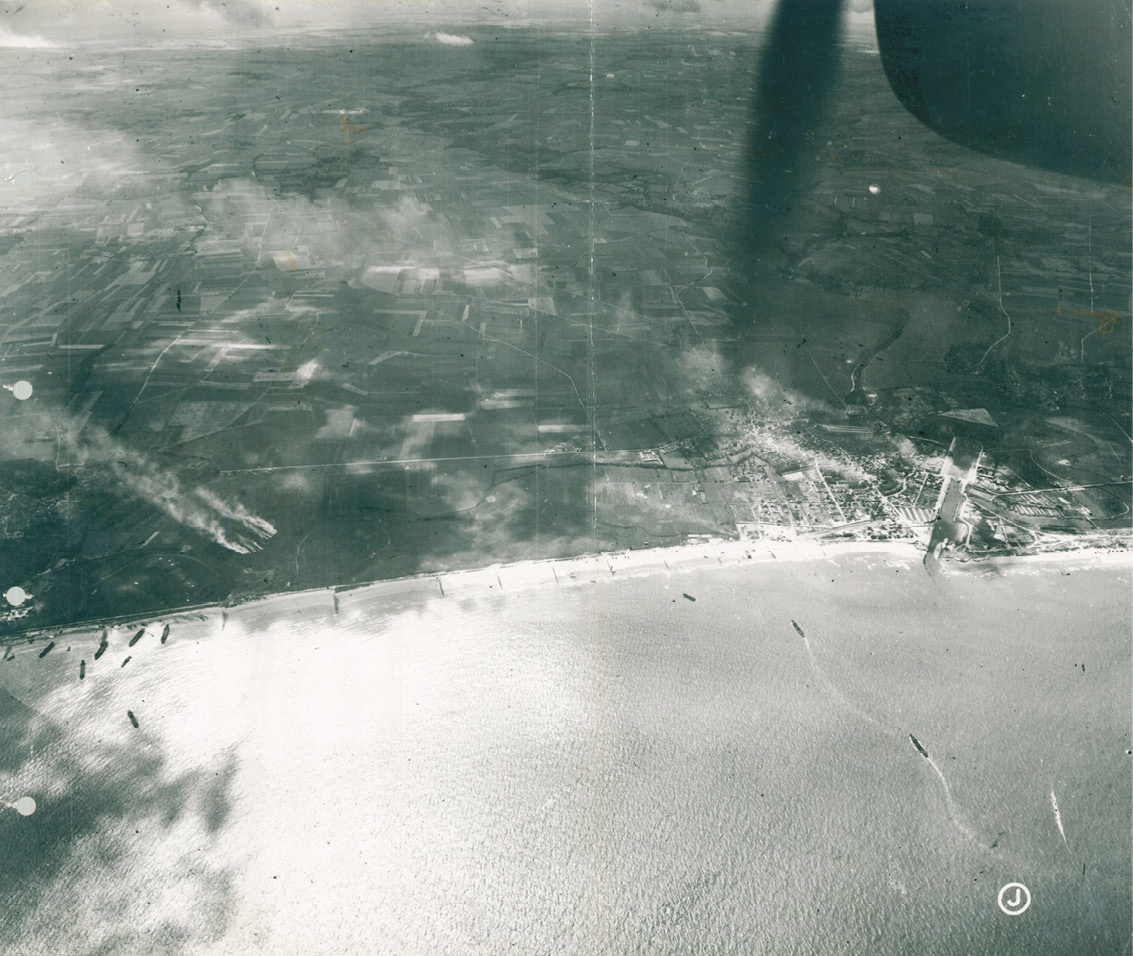
There were a multitude of elements that made for the success of D-Day. Overwhelming Allied air and naval power; the huge number of men who were able to get on to the beaches during the course of that morning; and commanding Allied firepower all contributed to victory. But the fact that the weather had been so bad and that the Germans did not pick up on the gap in the storms meant that they did not imagine an invasion could be possible. Rommel was away visiting his wife in Germany, planning to go on to meet Hitler. The commander of the only Panzers in the area, General Feuchtinger of the 21st Panzer Division, was in Paris with his mistress. Many senior German officers were away on exercises in Rennes. So knowing what the Germans did not know, that there was a break in the storms and that for 36 hours landings would be possible, played a significant part in the success of that day.
At the chit-chat following John F Kennedy’s presidential inauguration in 1961, Kennedy asked the man he was replacing in the White House what the key to success on D-Day had been. Eisenhower replied, ‘We had better meteorologists than the Germans.’
P ressure
Executive Producers: Ron Halpern, Joe Naftalin, Lucas Webb, Tim Bevan, Anthony Maras.
Screenplay: David Haig and Anthony Maras.
Directed and edited: Anthony Maras.
Music: Volker Bertelmann.
Photography: Jamie Ramsay.
Starring: Andrew Scott, Brendan Fraser, Kerry Condon, and Damian Lewis.
A StudioCanal, Working Title production, 2026.