
Subscribe now for full access and no adverts
As the Great War broke over Europe, Britain was painfully aware of its deficiencies, its army being far smaller than those of the Central Powers. ‘Your country needs you’ declared Lord Kitchener in a celebrated poster, and millions of young Britons rallied to the flag. But the Empire also cast hungry eyes over its domains. Australia, New Zealand, and Canada, the so-called ‘white dominions’, could be depended on to do their bit. But might India, too, lend a hand?
The idea must have generated debate. India’s independence movement was already stirring: not long before, a senior Raj official had been assassinated in London by an Indian student, and Mohandas Gandhi had been agitating in South Africa for the democratic rights of ethnic Indians for the past 20 years. But the bonds of Empire were still strong, as Gandhi himself demonstrated. His non-violent convictions prevented him from volunteering to fight, but in the Boer War he organised a corps of fellow Indian stretcher-bearers to serve Britain’s war effort. At the start of the world war, he volunteered for the same duty, though illness prevented him fulfilling it.
India was home to what Britain termed the ‘martial races’, those who over the past century and more had most stubbornly resisted the East India Company’s domination. So the call went out. ‘THE EMPIRE NEEDS MEN!’ read the poster of a lion roaring on a rock. ‘AUSTRALIA, CANADA, INDIA, NEW ZEALAND – All answer the call. Helped by the YOUNG LIONS the OLD LION defies his foes.’
The response was extraordinary. In all, more than a million Indian men volunteered to serve in the British Indian Army, and within weeks more than 140,000 of them had set sail for France, a three-week voyage. Most had never before left the subcontinent.
A different perspective
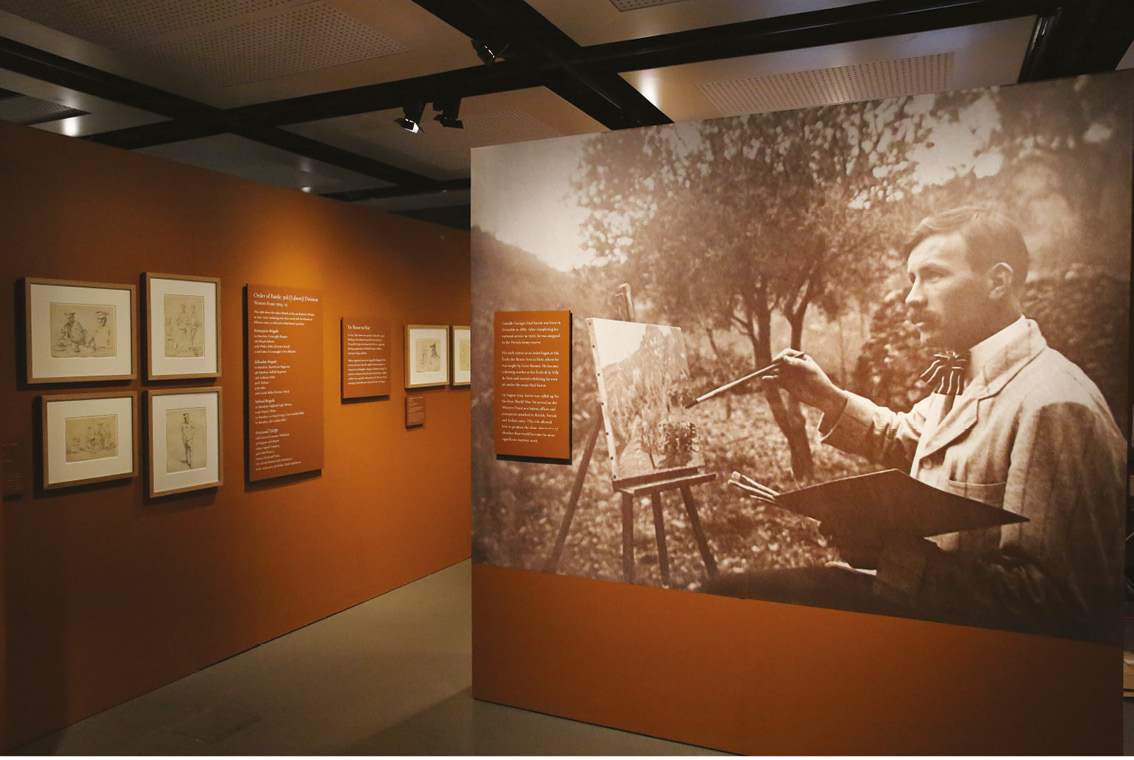
The Indian soldiers may have been numerous, but in historical terms they were rare, being non-Europeans fighting in a European war – and on hand to record them was the French artist Paul Sarrut. Now, for the first time, his vivid drawings of the Indian troops have been brought together in a fascinating and curiously tender exhibition at London’s National Army Museum, alongside related uniforms, photographs, archives, and medals.
Sarrut was an artist by training and trade, but never an official war artist. He was born and raised in the remote Cévennes region, for centuries a stronghold of France’s minority Protestants, known as Huguenots. His father, the pasteur or vicar of a Protestant church, had sent his son to England to master the language, and it was this which led to his being appointed liaison officer and interpreter between French and British forces. While carrying out his official duties, he never forgot his former calling, and carried a sketchbook with him at all times.

The first Indian recruits arrived in Flanders towards the end of 1914. Sikhs from Punjab, Pathans (today known as Pashtuns) from the North-West Frontier, Rajputs from Rajasthan – all were comfortable with India’s fierce summer heat, but their drill cotton uniforms were no match for 1914’s bitter and exceptionally wet north-European winter. ‘The wet was what they really struggled with,’ commented Victoria Lavelle, the exhibition’s lead curator. ‘There were stories of them wrapping their feet in bandages.’ The message was received in head office, and they were duly issued with khaki-coloured kurtas (the smocks worn by Indian men), made not of the traditional cotton but wool. A prototype of the garment is included in the exhibition.
Sarrut’s works offer a startling contrast to the way the Western Front is usually depicted: the mud, the barbed wire, the trenches – few images of wartime misery outdo Flanders for pathos and horror. Given the imbalance between the commanders’ sunny expectations and the bloody stalemate that ensued, with Britain’s first-day objective at the Battle of the Somme taking four months to achieve, pathos mingled with indignation is often the overriding emotion. The Army Museum has a truly tragic photograph, not included in this exhibition, of Indian cavalrymen on horseback with their lances and an assortment of headgear including turbans, awaiting the order to advance on the Somme in July 1916. How many of them can have survived?
But Sarrut’s work, which he did for his own pleasure and interest, is in a category of its own because it is free of pathos. Dignity, self-possession, comradeship, the simple pleasures enjoyed once the guns fall silent: these are the emotions his rapidly executed pictures capture. Turbaned soldiers at their ease together in camp, cross-legged, their boots cast off, as they listen to the reedy tune of the alghoza, the double Indian flute; warming hands before a fire; sweetly sleeping.

Living life
At the press preview, Sarrut’s granddaughter Adine described the exhibition as a ‘great honour’ for her family. Known in his time as a draughtsman and engraver, as well as a popular post-Impressionist painter, Sarrut had six of his portraits of Indian soldiers published in London’s The Illustrated War News magazine in 1915, and many of his other works are in private hands. ‘But the drawings of Indian soldiers are unknown in France,’ his grand-daughter explained, ‘because they are not of French soldiers.’
Sarrut does nothing to prettify Flanders. Yes, the Western Front was hell on earth. But much of the time it was also just life as it is lived anywhere. Brave men, backs against a wall, patiently awaiting medical treatment; a soldier squatting on the ground as the naai, the regimental barber, gives his hair a trim; a turbaned officer posing with his hand on the grip of his sword.
Included in the exhibition are portraits of Frank Alexander de Pass, an officer in the 34th Poona Horse, who became the first Jewish recipient of the Victoria Cross when it was awarded him posthumously, and Sepoy Khudadad Khan, the first Muslim and first soldier from the subcontinent to receive the medal. Most distinctive, however, in this museum full of weapons and warfare, are Sarrut’s elegant, intimate records of daily life, as lived by these brave visitors from afar in the most traumatic surroundings.

Drawn on the Western Front: Paul Sarrut and the Indian ArmyUntil 21 February 2027 (Free entry)
National Army Museum, Royal Hospital Road, London, SW3 4HT
https://www.nam.ac.uk/whats-on/drawn-western-front
+44 (0)20 7730 0717
Images: © The Estate of Paul Sarrut – courtesy the National Army Museum, London
MHM visits
EVENT
Chelsea History Festival
1-4 October 2026
Chelsea Heritage Quarter, London
https://chelseaheritagequarter.co.uk/chelsea-history-festival
Ticket prices vary
The Chelsea History Festival returns, bringing history to life in one of London’s most storied neighbourhoods. This year’s theme, World History, will be explored through around 100 talks, performances, concerts, walking tours, workshops, and family activities examining the people, events, and ideas that have shaped societies around the globe.
EXHIBITION
English Civil War Fortress and Sieges
2 November 2026-4 April 2027
The Cromwell Museum,
Grammar School Walk, Huntingdon, PE29 3LF
https://cromwellmuseum.orgAdmission free
This special exhibition at the Cromwell Museum, in conjunction with the Fortress Study Group, will explore the importance of sieges and fortifications during the Civil Wars of 1639-1660, explaining how and why these fortresses were built and how they were besieged. A selection of complementary activities will take place alongside the show.
EVENT
Battles through History
3-4 October 2026
South of England Showground, Selsfield Road, Haywards Heath, Sussex, RH17 6TL
https://battlesthroughhistory.co.uk
Ticket prices vary
Spread over 150 acres, Battles through History is a unique and exciting multi-period living-history military show. Featuring displays spanning 2,000 years, there will be military vehicles, authors, wargamers and model makers, live music and marching bands, interactive activities, and plenty of food and drink.