

Subscribe now for full access and no adverts
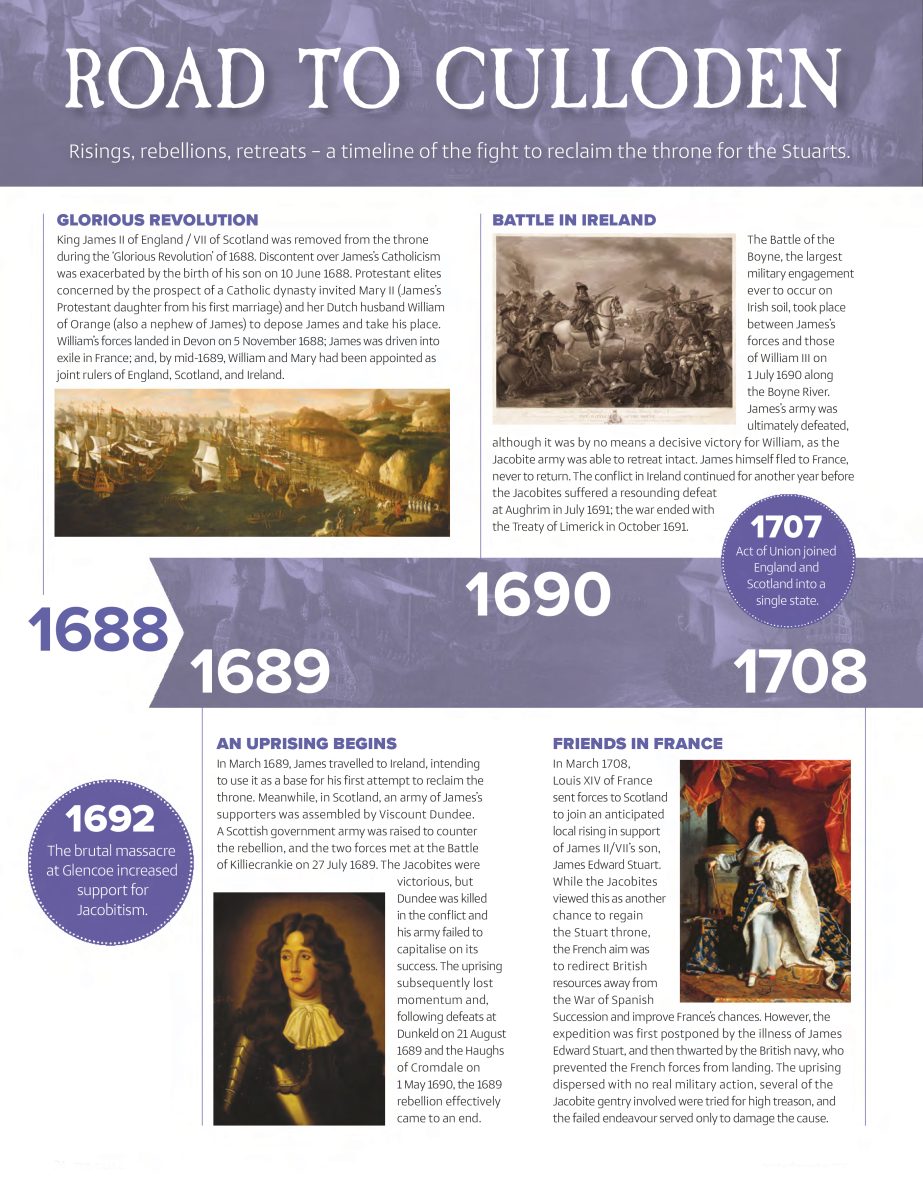
Between 1689 and 1746, the British state was challenged by a series of uprisings. Seeking to take control of the kingdom were the Jacobites. They were supporters of the exiled James II of England – also James VII of Scotland – who had been toppled in the so-called Glorious Revolution, and his heirs James Edward and Charles Edward Stuart.
Religious differences lay at the heart of this long-running struggle for power. Believing that James intended to introduce a French-style system of Catholic absolute monarchy, members of Britain’s staunchly Protestant landed elite first rose against him in November 1688. In his place, they installed his daughter Mary and her Dutch husband William of Orange – a safe pair of hands to ensure a Protestant succession. Problems arose after they died childless, and their successor, Mary’s sister Anne, also failed to provide an heir. In August 1714, Parliament turned to a distant connection, George, Elector of Hanover, in a final bid to exclude the Catholic Stuart line. Jacobitism emerged in opposition to this London-based regime. It drew its strength primarily from Scotland.
Jacobitism – the term derives from the Latin word ‘Jacobus’ for James – was for generations wrapped in a romantic aura that impeded objective analysis. It was the ultimate doomed cause, pitting heroic, wild Highlanders against the superior resources of the British government’s military machine. This image was reinforced by a plethora of fiction inspired by the period – from Sir Walter Scott’s 1814 novel Waverley to D K Broster’s The Flight of the Heron a century later, and the Outlander books and TV series in our own time.
Following several decades of research, Jacobitism now appears both more complex and more threatening than was once assumed. There was no simple clash between backward-looking Jacobite Highlanders and more sophisticated Lowland Scots. Jacobitism also contained an inner tension between supporters of an independent Scotland and those who saw it as a springboard for winning power in the United Kingdom as a whole. Its forces, especially in the later uprisings, were better organised and armed than was once believed. Jacobitism attracted support from Britain’s French and Spanish opponents, who intermittently promoted the Stuart cause as a way to undermine their historic adversary. This was a significant movement, not a futile historical dead end.
In later issues, we will look in depth at the most serious rebellions, known from the years in which they occurred as the ’15 and the ’45, but we begin the four-part series with a pair of articles. The first of these examines the origins of Jacobitism and the first abortive attempts, in the 1689 and 1708 risings, to restore James II/VII and then his son to the throne. A companion piece assesses the nature of the opposing armies – their organisation, arms, and equipment, and the associated infrastructure of military roads and forts. How evenly matched were the two sides? How close did the Jacobites come to changing the course of British history?
Stirrings of rebellion
Victors rarely erect monuments to their defeated foes. In the left aisle of St Peter’s in Rome, there stands a notable exception. Sculpted in 1819 by Antonio Canova in white marble, and fronted by two weeping angels, the memorial commemorates the last three Stuart claimants to the British Crown. It was partly funded by the Prince Regent (later George IV), representative of the Hanoverian dynasty that had crushed the Jacobite Stuart cause in battle 70 years earlier. By George’s time, Jacobitism had become a kind of historical curiosity, which could be harmlessly honoured in the European city where the movement’s leaders were buried.
This was not the case in the last decade of the 17th century and the first half of the 18th century. Backed at various times by France and Spain, the Jacobites posed an intermittent but sometimes serious threat to the London government. They aimed to topple William III and his wife Mary II, who became joint monarchs following the expulsion of England’s last Catholic king, James II (James VII of Scotland), in the ‘Glorious Revolution’ of 1688. After the deaths of William and Mary, and then of Mary’s sister Queen Anne, their enemy was the house of Hanover – invited by Parliament in 1714 to maintain the succession of Protestant sovereigns to the throne.
In 1689-1691, the Jacobites attempted to regain power in Ireland (see MHM 146, June/July 2025) but their main source of support lay in Scotland, where a series of uprisings took place. In this article, we examine the first of these, the events of 1689 and 1708. Later, more serious challenges to the London government’s authority were to emerge in 1715, 1719, and 1745-1746. What was the Jacobite movement like? Who supported it? And how close did it come to success?

Seeds of revolt
Jacobitism can be traced back to the birth in June 1688 of a son to James II/VII and his Italian wife, Mary of Modena. This was James Francis Edward Stuart, viewed by his supporters as the rightful heir to the throne, and by his opponents as the ‘Old Pretender’. Britain’s Protestant nobility had been prepared to tolerate James as an interim ‘papist’ ruler, while there was no male heir to continue the dynasty. The arrival of James Francis Edward transformed the situation.
The rules of succession meant that the new baby would take precedence over his two adult stepsisters, Mary and Anne – James’s children by an earlier marriage, who had been brought up as Protestants. Wild rumours circulated that the child was an impostor, smuggled into the royal bedchamber in a warming pan. A group of elite figures, the so-called ‘Immortal Seven’, invited the Dutch prince William of Orange, James’s Protestant son-in-law, to take the throne. This triggered the coup which saw James and his family driven into exile in France by the end of the year.
The Jacobites were united by their conviction that the country’s legitimate monarch had been illegally excluded from the throne. Beyond this, they held a range of sometimes contradictory ideas and goals. Many Jacobites fought for Scottish independence, whereas the Stuart claimants wanted to rule the whole of Great Britain. The historic notion of rule by divine right was replaced in time by acceptance of a constitutional monarchy, not dissimilar from that established by William and Mary and their Hanoverian successors.

It was a movement that found support among all classes, from the nobility to the poor. Contrary to popular myth, Jacobites were found not only in the Highlands but in the more prosperous Lowland and north-eastern areas of Scotland. Pockets of sympathisers also existed in parts of England, especially the North, the South-West, and the West Midlands. While most followers were sincere, some were opportunistic adventurers, short of funds and seeking to better themselves by joining a disruptive movement.
Jacobitism attracted a variety of groups with reasons to oppose the country’s ruling oligarchy. Many Catholics – at this stage only an estimated 2% of the population of England and Scotland – saw a Stuart restoration as a way of ending discrimination against their religion. More numerous were the Scottish Episcopalians – Protestants whose system of church government, led by bishops, was overthrown by their Presbyterian opponents following the Revolution. South of the border, they had an equivalent in the ‘non-jurors’ – members of the Church of England who refused on grounds of conscience to take an oath of loyalty to William and Mary.
This was an underground movement, scattered across the country and largely nurtured in secret. The penalties for active participation were severe: rebels risked the loss of their lives and property at the hands of the state. Some 200 individuals suffered execution for their Jacobite beliefs between 1689 and 1752. But loyalty to the Stuart cause was more commonly expressed in private social gatherings where the ‘king over the water’ was toasted. A wealthy adherent, like judge David Erskine, owner of the House of Dun in eastern Scotland, discreetly signalled his sympathies through the motifs in his home’s plasterwork decoration. In this article, though, we are concerned with the armed revolts that punctuated the history of Jacobitism.

Highland war
Distance from London, combined with the semi-feudal hold exercised by Highland chiefs over their clans, made Scotland a fertile breeding ground for Jacobitism. They were angered by the displacement of their rightful sovereign and encouraged by news of James’s arrival in Ireland in March 1689, which he aimed to use – in vain, as it turned out – as a launching pad for the recovery of the throne.
This was a potentially serious challenge to the Williamite regime. The regular army in England had virtually disintegrated as James’s position collapsed and it needed to be rebuilt. The new king also needed to muster forces to pursue his own rivalry with Louis XIV’s France – a key reason why he had accepted the invitation from the English magnates. It was vital for William to win control over both Ireland – where he campaigned against his predecessor in person – and Scotland, where his troops initially struggled in face of a small-scale but determined rebellion.
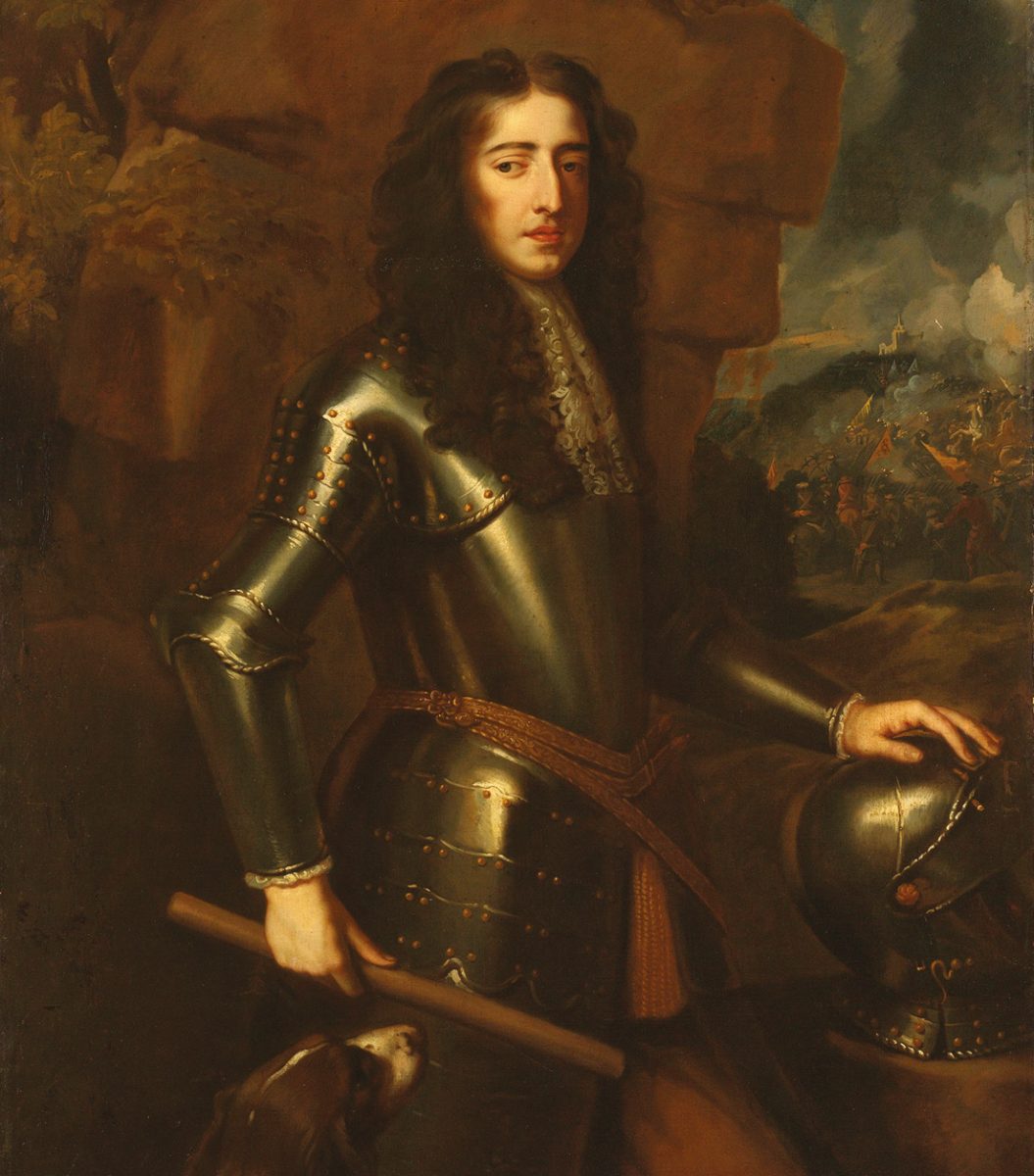
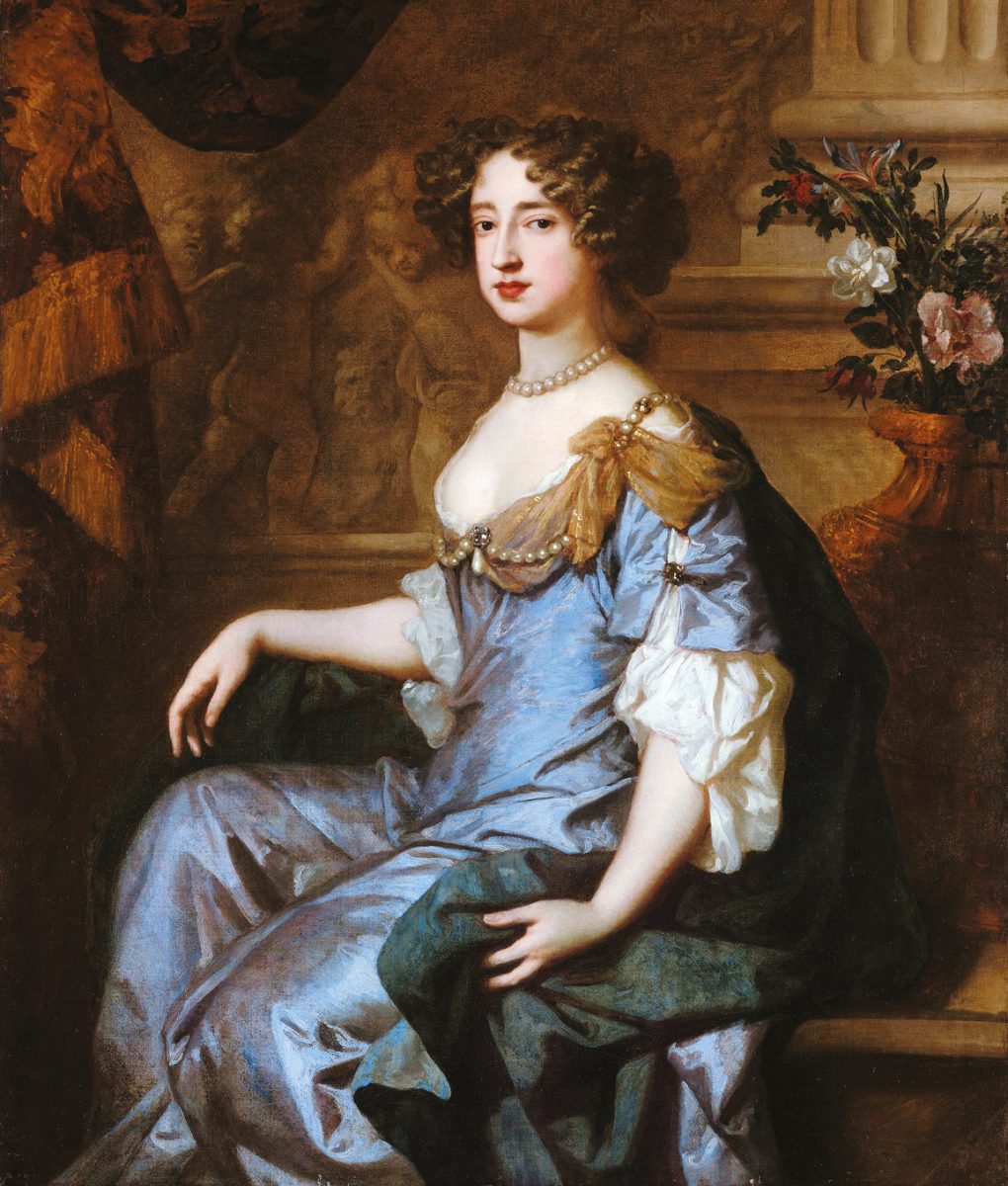
The key figure in the 1689 rising was James Graham of Claverhouse, Viscount Dundee – known as ‘Bluidy Clavers’ for his suppression of Presbyterians, and as ‘Bonnie Dundee’ for his good looks. After the national assembly known as the Scottish Convention declared William and Mary joint monarchs, Dundee withdrew northwards to link up with like-minded Highland clan leaders. Heading the Williamite army – which consisted of two battle-hardened companies and many untrained troops – was Major-General Hugh Mackay. Ironically, both men had served in an Anglo-Scots brigade on the Continent under William in the early 1670s, before going their separate ways. Claverhouse became commander of James’s army in Scotland, while Mackay joined the Dutch invasion in 1688. William then appointed him to replace Claverhouse, with a brief to command the force protecting the Scottish Convention.
Loyalty to the Stuarts was expressed in toasts to the ‘king over the water’.
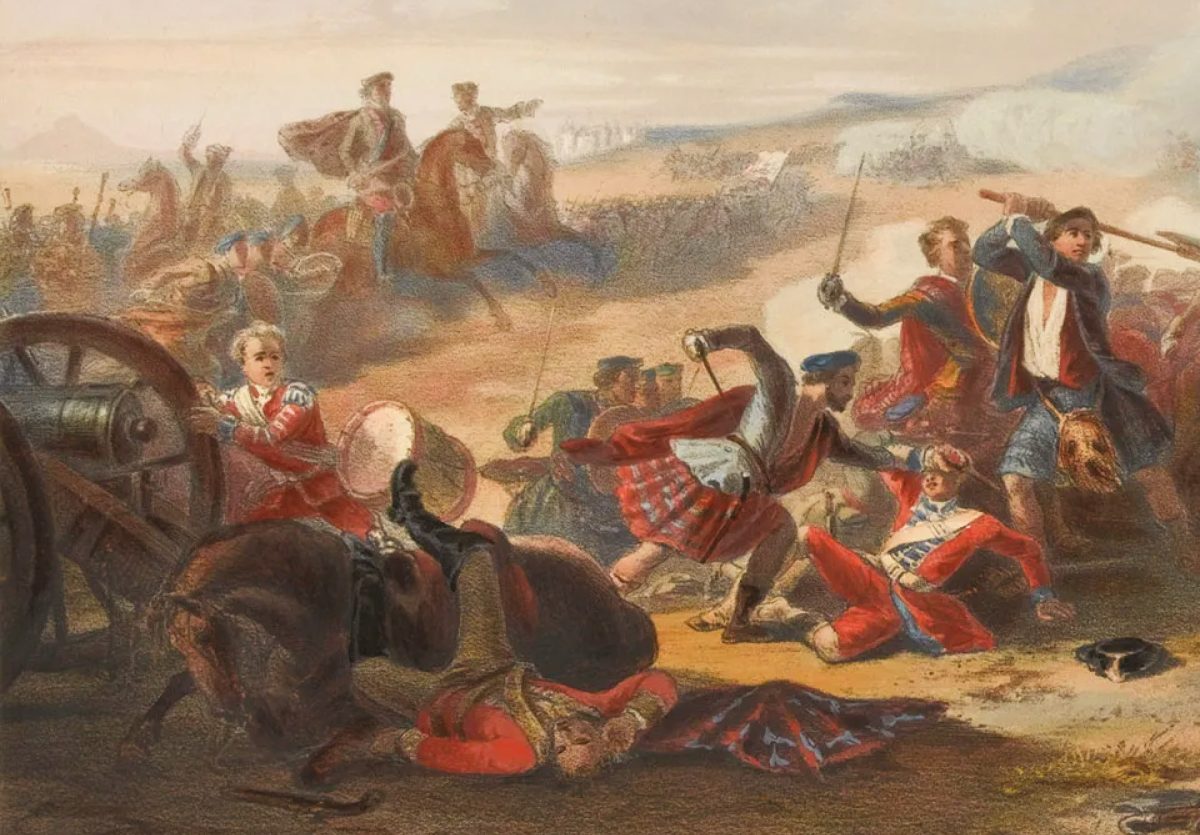
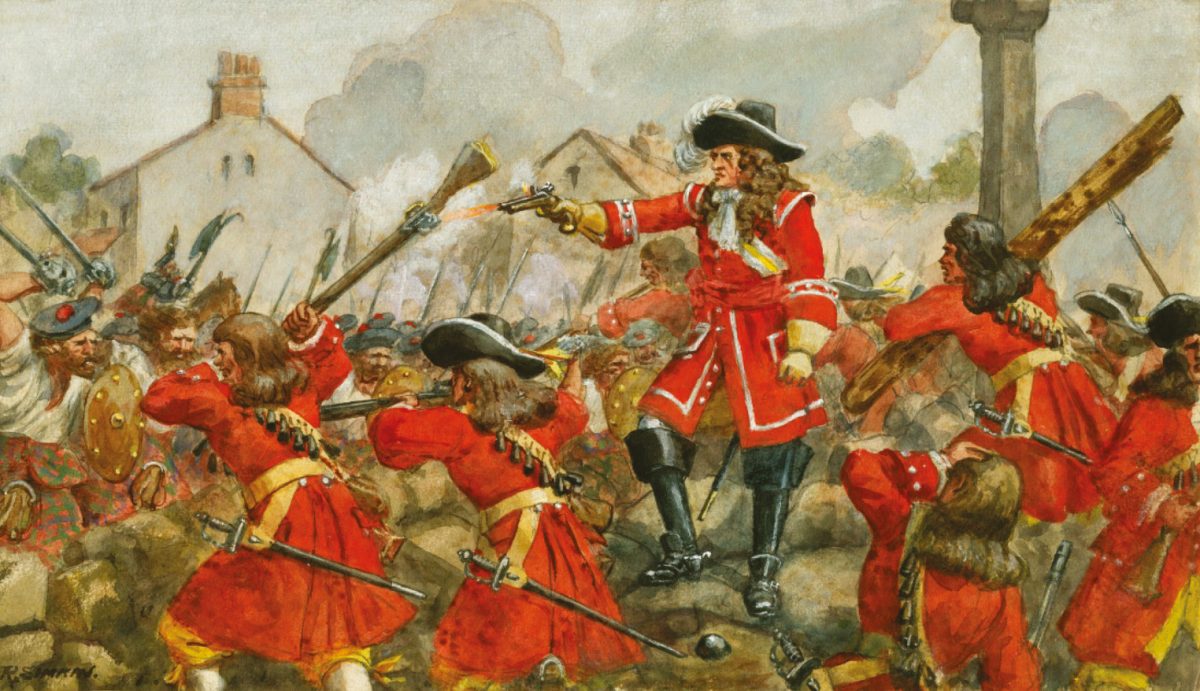
When the Jacobite rising broke out, Mackay aimed to contain the rebels as they moved southwards through Perthshire. Central to the conflict was control of Blair Castle, which commanded a key north–south route through the Highlands. Dundee had some 2,500 men, of which three regiments were Irish troops sent in support of the Scottish rising, while his opponents fielded between 3,500 and 5,000 soldiers. The two sides met on 27 July 1689 at the Pass of Killiecrankie, a steep-sided gorge almost two miles long. Dundee’s forces assembled on a ridge overlooking the pass, firing a single musket volley before dropping their firearms and sweeping down with swords and axes. Mackay’s troops deployed in three lines, facing uphill as the fury of the Highland charge broke upon them.
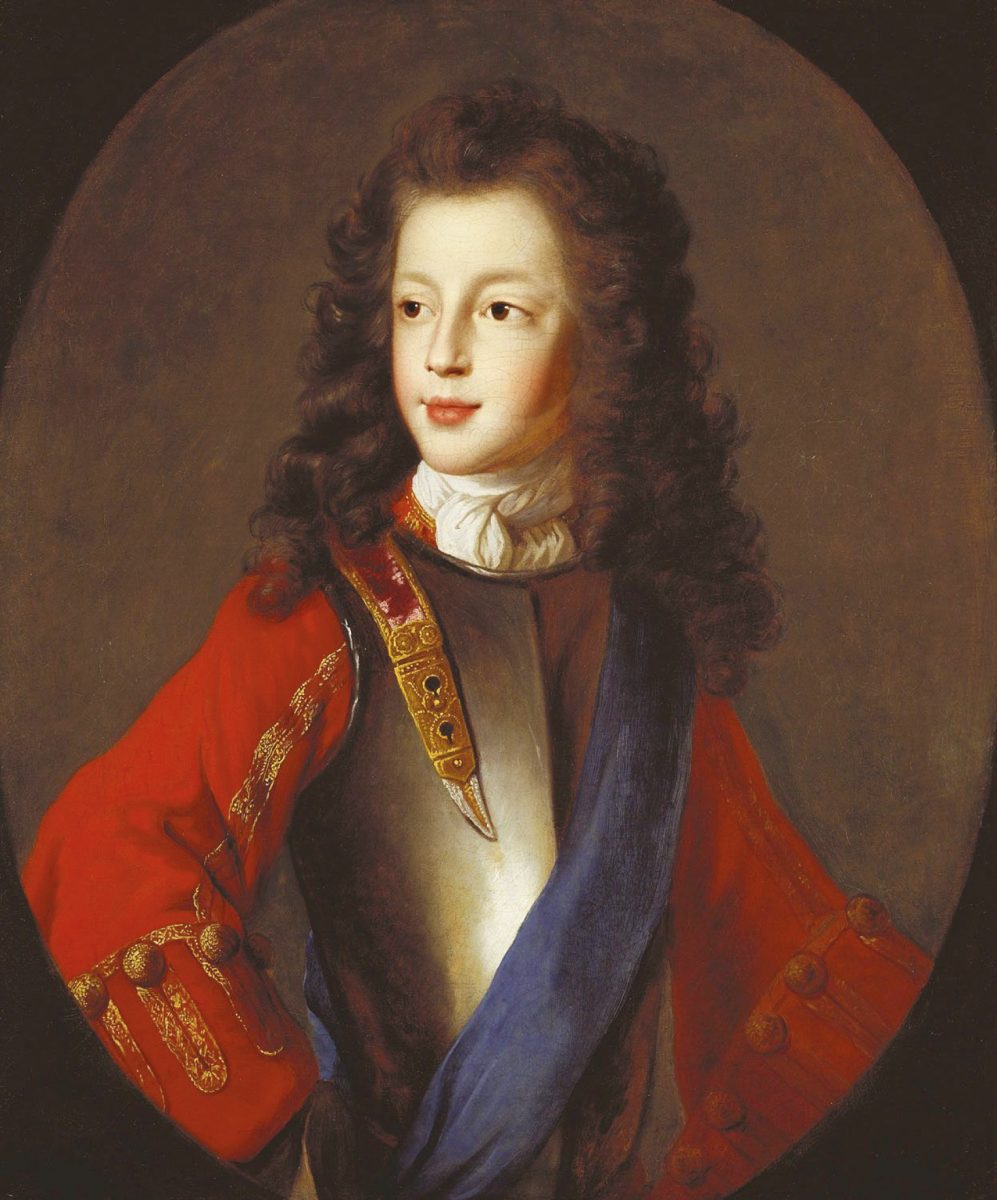
Thrown into confusion, the government forces rapidly retreated. Many failed to fix their plug bayonets in time to be of use. Unlike the later socket version, these fitted into the musket barrel, making further firing impossible, so that soldiers tended to wait until the last moment to fix them. In the final stages of the battle, Dundee was killed by a musket ball. Mackay suffered an estimated 2,000 casualties for some 500 Jacobites – a high loss rate for both sides, though it would in time appear a pyrrhic victory for the small rebel army.
Although success brought new recruits to their side, Dundee’s successors struggled to exploit their advantage, failing to take either Perth or Aberdeen. The new Jacobite commander, Colonel Alexander Cannon, lacked his predecessor’s charisma and skill. On 21 August, Mackay reversed the previous month’s disaster in a hard-fought battle at Dunkeld, north of Perth. Government troops occupied the town’s most prominent buildings, Dunkeld House and the cathedral, and awaited the arrival of the Jacobites. Although the latter outnumbered the defenders by four to one, the tactics that had prevailed at Killiecrankie were unsuited to the confines of an urban environment. In the ensuing street-fighting, both sides burned houses in a bid to dislodge their opponents, leaving much of the town destroyed before the Jacobites finally withdrew.

The Jacobites suffered a further defeat at the Battle of Cromdale, fought on 30 April- 1 May 1690. This took place 20 miles from Inverness, when a larger government force took General Thomas Buchan by surprise at dawn. Only the descent of thick fog prevented the Jacobites from suffering heavier losses in the ensuing pursuit. This was the last battle of the rising. With James’s supporters also heading for defeat in Ireland, the Scottish leaders had little incentive to carry on and they sought a truce.
There was one extraordinary footnote to the Highland War. While their peers sought terms with the British authorities, on 18 June 1691 four Jacobite prisoners on Bass Rock, an island in the Firth of Forth, seized control from their gaolers. Bass Rock is a steep-sided volcanic plug, about a mile offshore, which was used as a prison by successive governments. All the detainees had to do was to close the gates from the inside while the small garrison were busy unloading a consignment of coal on the island’s landing stage. The guards were obliged to sail away to the mainland. With supplies covertly brought in by sympathisers, and British navy ships unable to make an impression on the rock, the prisoners defied attempts to dislodge them for three years. With food finally running out, they managed to dupe their enemies about the real situation on the rock and negotiated a safe passage to France.
Aborted invasion
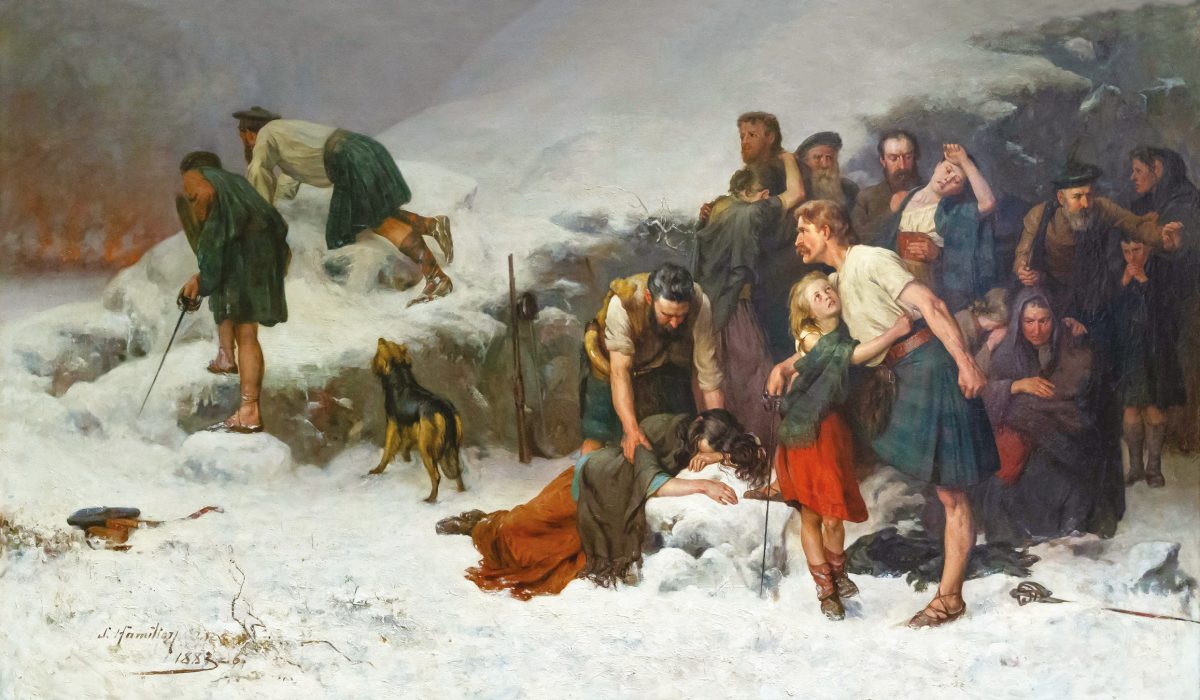
The Highland War may have been over, but Scottish society remained deeply divided. The most notorious incident was the Glencoe massacre on 13 February 1692, when government troops killed an estimated 38 members of the MacDonald clan, on the pretext that they had missed the New Year deadline to swear allegiance to William and Mary. A further 40 people escaped into the snowbound hills where they died of exposure.
The Glencoe massacre was shocking, even by the harsh standards of the time.
The reason was to make an example of a Highland kinship group with a reputation for lawlessness, whom government ministers mistrusted. The killings of men, women, and children were shocking, even by the harsh standards of the time. The murderers were soldiers who had been quartered in the village for almost two weeks, enjoying the Highland tradition of hospitality. A belated investigation failed to punish any of the participants or the government minister who instigated the massacre, John Dalrymple, Earl of Stair. The crime intensified suspicion of the new regime and fuelled support for Jacobitism.
The movement flickered into life again after the Act of Union of 1707, which fused England and Scotland in a single political entity and abolished the Edinburgh parliament. Resentment of the Act, and the level of bribery and corruption entailed in its passage, stimulated antagonism north of the border. Partly in response to allied successes in Flanders, Louis XIV of France discovered a sudden interest in the Stuart cause. In March 1708, he dispatched an expeditionary force of 30 ships and 5,000 troops, who were to land in eastern Scotland and link up with an anticipated local rising. An agent on the spot, Colonel Nathaniel Hooke, had given assurances that 30,000 Scots were ready to lend their support.
The scheme was postponed because of the sudden illness of James Francis Edward (James III/VIII to his supporters), who was to accompany the expedition. Finally putting to sea, the French commander, the Comte de Forbin, managed to evade a British naval blockade of Dunkirk. However, he overshot the agreed landing point in Fife and had to sail back down the coast. This gave the British squadron commanded by Admiral Sir George Byng time to arrive offshore. Forbin was in no position to fight a sea battle, having left many of his guns at Dunkirk to make room for soldiers and supplies, and decided to head northwards. An attempt to land at Inverness was then frustrated by a storm.
Forbin’s heart had never been in the project. Prioritising the safety of his royal passenger, he deemed it unwise to proceed and sailed home without making landfall. The Jacobites who had assembled in readiness for the invasion had no alternative but to disperse and deny all knowledge of the plot. The expedition had been a failure, but the fact that such a large force had appeared on Scotland’s undefended coast caused consternation. In response, the British undertook a military building programme, constructing new barracks at Edinburgh and Fort William, and strengthening the defences of Stirling Castle.
Future prospects
The prospects for Jacobitism were uncertain as the second decade of the 18th century began. The movement’s association with Catholicism and the French national enemy limited its appeal, especially in Lowland Scotland and England. Yet Jacobites could not count on foreign assistance. The French government’s attitude veered between support for a Stuart restoration and a pragmatic willingness to accommodate itself to the new regime.
There was another problem in organising a successful uprising. France expected the Jacobites to take the initiative in paving the way for an invasion, while those on the spot were understandably reluctant to declare themselves until French military support materialised. This conundrum would dog subsequent attempts to raise the Stuart banner.
Yet, in 1715 and 1745, the Jacobites proved able to raise far more troops than they had in the earlier risings. Popular anger at the abolition of the Scottish parliament, reinforced by economic stagnation and increased taxation, proved a powerful recruiting agent. Hardening religious conflict between Presbyterians and Episcopalians also boosted support for the ‘king over the water’. The challenge facing the Hanoverian government in those years will be the subject of later articles in this series.
• Tim Harris, Revolution: the great crisis of the British monarchy, 1685-1720 (Allen Lane, 2006).
• Daniel Szechi, The Jacobites: Britain and Europe, 1688-1788 (Manchester University Press, 2019).
You can read the second part by Graham Goodlad reviewing the organisation, tactics, and weaponry of the two armies here and find an infographic about the 'Road to Culloden' here.