How Albert Speer fooled the world

He was Hitler’s favourite architect and the man responsible for Germany’s wartime production – yet Albert Speer tried to portray himself as the ‘Good Nazi’. Sixty years after his release from Spandau, Nigel Jones examines his role in the regime’s atrocities.

Start
This article is from Military History Matters issue 154


Subscribe now for full access and no adverts

At midnight on 1 October 1966, a Mercedes limousine left the main gate of Spandau prison in Berlin: inside the car, blinking as the flash bulbs of the assembled press corps exploded around him, sat a silver-haired man in late middle-age. Albert Speer, principal architect and Munitions minister of Hitler’s Reich, and the Führer’s favourite acolyte, was tasting freedom for the first time in more than 20 years. What would he do with the rest of his life?

Speer spent the decade and a half left to him (before he expired in a London hotel room in 1981, of a stroke possibly brought on by sexual exertions with a still-unidentified young mistress) in erecting a rather different design than the grand edifices that had won him Hitler’s favour and patronage as an architect. He built a carefully constructed pyramid of untruths, half-truths, and downright lies to disguise his true role as one of the most able and important paladins of the Third Reich.

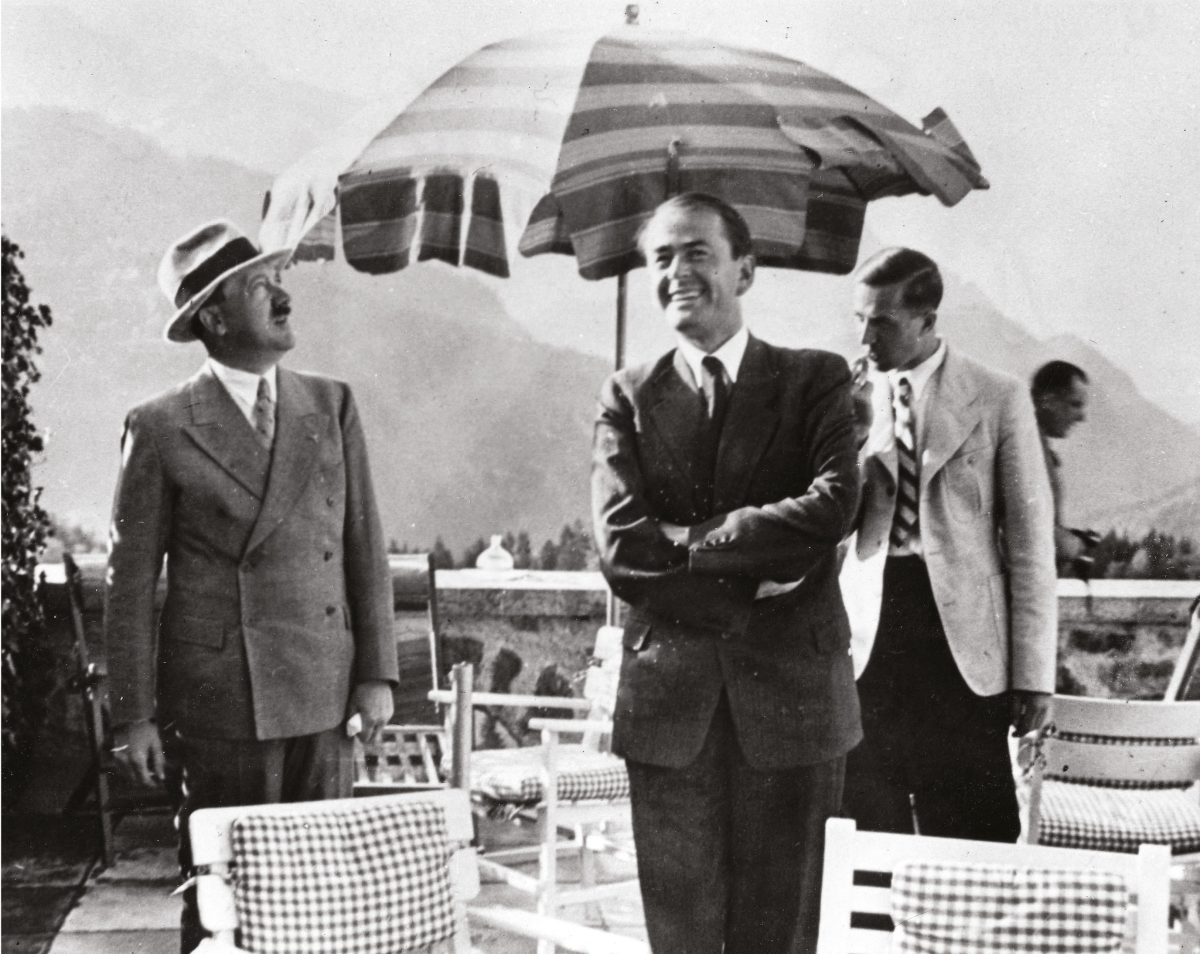
 Albert Speer (in the centre) with Adolf Hitler on the terrace of the Berghof, Hitler’s holiday home at Obersalzberg in the Bavarian Alps, where Speer also had a residence. Image: Alamy

Speer had begun to rehearse his part as the ‘Good Nazi’ during his trial before the Nuremberg International Military Tribunal in 1945-1946 (see MHM 151, April/May 2026). In stark contrast to the other defendants, he expressed generalised guilt and contrition over his role in the appalling crimes of the Nazi regime, while at the same time playing down and obfuscating his personal part in those atrocities. Still young at the time of Hitler’s rise, and undoubtedly handsome and dignified, he presented himself as an intelligent and ambitious man bedazzled and blinded by the ersatz glamour of National Socialism, and bewitched by the extraordinary charisma of the Führer himself into closing his eyes to the essential criminality of the enterprise that he had committed himself to following.

His play-acting paid off. He had feared the death penalty for his use of slave labour, his knowledge of Nazi-perpetrated mass murders including the Holocaust, and his part in facilitating the war that had been planned, launched, and conducted by him and his comrades. So taken in were the Tribunal’s judges by Speer’s avowals of semi-innocence that – apart from the Soviet justices, who vainly demanded the death penalty – they spared him the rope, and sent his unappealing and less articulate subordinate, Labour Minister Fritz Sauckel, to the gallows instead. Speer and the Hitler Youth leader Baldur von Schirach got 20 years in Spandau, alongside Hitler’s deputy Rudolf Hess, who got a whole-life sentence in the same jail.

Jealous rival Nazis called him the favoured son Hitler never had.

After his release, Speer set to work on embellishing the myth that he had begun to build at Nuremberg. Entitled Inside the Third Reich, his memoir of his time at the centre of Hitler’s realm, became an international bestseller, and he followed up with an equally successful second volume, Spandau: the secret diaries, describing his prison life and the methods he had used to outwit his guards and smuggle his writings out of the jail, with the aid, curiously enough, of a former slave labourer who believed Speer’s account.

 One of Speer’s first commissions was to design the parade grounds, searchlights, and banners for the vast 1934 Nuremberg rally, filmed by Leni Riefenstahl in Triumph of the Will.
Speer combed the country to requisition searchlights for the Nuremberg rallies. When switched on, the beams of light created what one observer called a ‘cathedral of ice’.

At the same time, Speer submitted willingly to the full gamut of modern PR methods to get his message across to a public fascinated by this apparently respectable survivor of one of the most evil creeds in history, whose warped purposes he had so eagerly and efficiently served. TV and newspaper interviews, book-signing tours, literary festivals, contributions to films and documentaries about Hitler and the war – Speer did them all and came over, as he had done at Nuremberg, as mild, charming and reasonable, moderate and coolly civilised, and a refreshing change from the screaming rants of Hitler, Goering, and Goebbels. Looking at this quiet, reassuring older gentleman as he was quizzed by such luminaries as the historian Hugh Trevor-Roper, few would imagine that Speer could possibly be bracketed with the racist maniacs whose policies had enslaved and devastated Europe and killed millions. And yet he had been one of them.

The favoured son

Albert Speer was born in the western city of Mannheim in 1905. Too young to fight in the Great War, he grew up in an upper-middle-class family under the shadows of defeat, revolution, inflation, and economic depression, and embarked on a career as an architect. Fearing the threat of Communism, Speer heard Hitler speak at a rally, was impressed, and joined the Nazi party in 1931– two years before his hero was appointed Chancellor of Germany.

Speer and Hitler discuss an architectural project at Obersalzberg in 1938. Image: Alamy

Speer first came to his future master’s attention when he was commissioned to remodel the Propaganda Ministry for Josef Goebbels after the Nazis had won power. Accepting the brief, Speer immediately displayed his characteristic habit of looking the other way, when he failed to ask what the rule of these thugs and criminals really meant. This attitude of deliberately ignoring unpleasant reality was encapsulated most succinctly when Hitler asked Speer to convert Berlin’s Borsig Palace into a new HQ for his SA stormtroopers. The palace had previously been the official residence of Vice-Chancellor Franz von Papen, the conservative politician who had brought Hitler to office in the vain hope of controlling and neutralising him. 

Days before Speer got the job, in July 1934, both Papen and the SA leadership had been brutally purged, and dozens were murdered in the Night of Long Knives. As Speer inspected the palace, he noticed a large pool of dried blood on the floor. In his own words: ‘There Herbert von Bose, one of Papen’s assistants, had been shot. I looked away and from then on avoided the room. But the incident did not affect me any more deeply than that.’ There we have it: not seeing what he didn’t want to see would be Speer’s default position as he rose to the commanding heights of the Third Reich. With ever-worse atrocities surrounding him, this cold indifference became his excuse and his survival strategy. The splinter of ice in his chilly heart expanded until it punctured his entire being.

The centrepiece of Hitler’s new German capital, the 950ft ‘Great Hall’ would have been 17 times the size of St Peter’s in Rome. Image: Alamy

Speer also had luck on his side when it came to unexpected deaths. Just as the demise in an air crash of Fritz Todt, the evil engineering genius who created the vast Nazi slave-labour network known as the Todt Organisation, would land Speer the job of Munitions minister in 1942, so he got his first big architectural break in 1934 after Paul Troost, Hitler’s previous pet architect, died prematurely, aged only 55. Troost had designed the major Nazi buildings in the party’s Munich birthplace, and Speer eagerly sought to continue and expand his work.

The young architect really grabbed Hitler’s attention with his next major commission: to set the stage for the vast Nuremberg rallies, the monster gatherings of the Nazi party that took place in the city every September. Speer combed the entire country to requisition searchlights, which he placed around the stadium perimeter. When switched on, the beams of light stabbing the sky produced a stunning theatrical effect, like the columns of a gigantic building, creating what British ambassador Sir Nevile Henderson called a ‘cathedral of ice’.

Hitler was hugely impressed, and gave Speer the job of designing his giant new Chancellery building in Berlin. It boasted enormous rooms, and marble walls and floors, and was specifically calculated to impress and intimidate visitors, who had to tread across seemingly endless expanses as they approached the Führer – even though Hitler, who hated routine office work, in fact spent very little time at his desk there.

Hitler asked Speer to design all of his buildings on a grand – even grandiose – scale, and to bear in mind what they would look like when they had become ruins, like the Classical piles of Greece and Rome that he so admired. But if the Chancellery was big, Hitler’s next commission for Speer was gargantuan: he was to turn central Berlin into a gigantic new city, Germania, the capital of the future Nazi Europe, with broad avenues converging on a huge central dome that would be 17 times the size of St Peter’s in Rome. This ‘Great Hall’, some 950ft high, would be so tall that it was feared the breath of the crowds inside would form interior rain clouds!

Speer (in the centre) enjoyed a privileged position at Hitler’s side on the Führer’s one and only visit to Paris, following the German occupation of France in June 1940.

Sadly for Speer, the vast hall and a gigantic Arch of Triumph – intentionally designed to dwarf its rival version in Paris – were never built, as the outbreak of World War II got in the way. Preliminary preparations, however, saw Jewish residents evicted from their homes to make way for the grand avenues: today all that remains of Speer’s grand plans are the distinctive lamp posts he designed that line the Siegesallee boulevard between the Brandenburg Gate and the Victory Column. Towards the end of the war, as the Reich collapsed around him, Hitler would still spend hours gazing at Speer’s models for the ideal city that would never be built.

Because of their shared architectural obsessions, and the rapid and efficient way that Speer brought Hitler’s visions to concrete life, he soon found a privileged position at the Führer’s side. He accompanied Hitler on his one and only visit to a newly conquered Paris; and he and his wife Marguerite built a mountainside holiday home on the Obersalzberg, close to Hitler’s own residence, the Berghof, where he was often at his master’s side as the dictator took his daily walks in the area. So close did the relationship become that Speer attracted the envy of other members of the Nazi elite, who called him the favoured son Hitler never had.

Knowledge and power

The architect happened to be with Hitler in February 1942, when news arrived that Fritz Todt had died in a mysterious and still-unexplained plane crash. Todt was the creative force behind much of the German war effort. He had conscripted thousands of slave labourers from occupied Europe, along with Russian prisoners-of-war, to work on such projects as the Atlantic Wall fortifications, and his Todt Organisation was the major economic component keeping Germany in the war. Desperate for a suitable successor to fill Todt’s shoes, Hitler appointed Speer on a whim as Armaments and Munitions minister, tasking him with keeping the war machine motoring at full throttle.

Speer more than fulfilled his brief. He even boasted during his trial at Nuremberg that his efficient efforts had prolonged the war by as much as two years – a claim that drew sniggers of disbelief from sceptical co-defendants like Hermann Goering. But if historians are agreed that German war production did indeed peak in 1943-1944, when Speer was running the machine, there is less agreement on how far Speer was responsible. Many believe that Todt had already put in place the main elements, such as providing coal for the steel industry, and that Speer merely carried out his programme. Some think that Speer actually made mistakes, such as continuing to mass-produce Messerschmitt Bf 109 fighter aircraft, when the more modern Focke-Wulf Fw 190s were needed.

 Speer wears the armband of the Todt Organisation, the vast Nazi slave-labour network, on a visit as Munitions minister to Finland in December 1943.

The main controversy, however, centres on Speer’s knowledge of the atrocities committed by the regime he served, and here an emerging body of evidence clearly suggests not only that he knowingly used slave labour in his plants and factories, but also that he was present in 1943 when SS Reichsführer Heinrich Himmler admitted that Jews were being exterminated in the Holocaust. When confronted by evidence that he had been present on that occasion, Speer lamely claimed that he had left before Himmler began his speech – but this lie was exposed later in a letter he wrote to a Jewish correspondent, in which he confessed that he had in fact heard Himmler’s speech.

Speer’s chief problem as a minister and overlord of war production was the Allied bombing offensive, in which the RAF by night and the USAAF by day were gradually grinding Germany’s cities to rubble. One answer was to transfer production to underground facilities such as the Mittelbau-Dora concentration camp in central Germany, where brutalised slaves toiled in atrocious subterranean conditions to produce war munitions, such as the V1 ‘doodlebug’ flying bombs. Speer certainly visited the camp, and may even have been present when inmates were executed.

As an intelligent man concerned for his own survival, as well as for that of his country, Speer knew early on that the war was irretrievably lost, and so cautiously began to take steps to distance himself from the looming catastrophe. He trod a narrow path between going through the motions of carrying out his ministerial duties as a loyal Nazi, and doing what he could to preserve Germany’s industries by disobeying Hitler’s scorched-earth orders from the Berlin bunker to blow up factories, bridges, and all infrastructure in the path of the Allied advance.

Once again, Speer claimed both at Nuremberg and in his memoirs not only to have acted as the ‘Good Nazi’, but also virtually to have become a member of the anti-Nazi resistance by defying Hitler. He even went further, bragging at his trial that he had planned to kill the Führer by popping a grenade down a ventilation pipe into his bunker – another dubious boast that drew derisive laughter from his co-defendants.

Days before Hitler’s suicide on 30 April 1945, Speer – at considerable personal risk – flew into embattled Berlin in a light aircraft to bid a personal farewell to his Führer. He claimed later that during their final private interview he confessed to his boss that he had disobeyed the scorched-earth order, though there is no independent confirmation of that. Hitler, he says, said goodbye without emotion, giving his protégé a listless handshake as they parted.

Speer then turned up at the northern town of Flensburg, where Hitler’s successor Grand Admiral Karl Dönitz was attempting to run what was left of the regime. Dönitz and Speer were arrested on 23 May 1945, when British troops finally took the town. 

Speer is pictured working on a typewriter in his cell during the Nuremberg trials. When published, his memoirs would become an international bestseller.

A man revealed

Fast forward two decades, and another cold handshake, like the one given to him by Hitler at their last meeting, was all that Speer offered to his wife as he was released from Spandau. He had spent 20 years inside, while Marguerite raised their six children alone, and she didn’t get so much as a peck on her cheek by way of reward. Speer admitted in his memoirs that he had been raised in a cold and loveless family, and did not know how to give or receive love; and, late in life, he told his publisher that despite fathering his children, he had had to wait until he was in his 70s before discovering the joys of erotic love with his young mistress.

One journalist who attempted to penetrate Speer’s icy armour was the Austrian-born British writer Gitta Sereny, an author who specialised in getting under the skin of those whom society condemned as evil. Invited into Speer’s home in Heidelberg over the course of three years of interviewing, Sereny got as close to Speer as it was possible to do. Her book, titled Albert Speer: his battle with truth (1995), does challenge Speer’s contention that he was ignorant of the Holocaust, but in the end lets her subject down gently. Clearly, Speer was able to charm even this sharp-eyed inquisitor.

The nearest Sereny got to discovering Speer’s ‘truth’ came in a drunken phone call that he made to her shortly before his death in London. ‘I was a great architect,’ he slurred. ‘I was Hitler’s favourite. I ran the war effort: I didn’t do so badly, did I?’


Nigel Jones is a historian, journalist, and broadcaster, who has published widely on topics ranging from the Tower of London to the Valkyrie Plot to assassinate Hitler. He is a regular contributor to MHM.

All images: Wikimedia Commons, unless stated otherwise; Alamy

By Country

Popular
UKItalyGreeceEgyptTurkeyFrance

Africa
BotswanaEgyptEthiopiaGhanaKenyaLibyaMadagascarMaliMoroccoNamibiaSomaliaSouth AfricaSudanTanzaniaTunisiaZimbabwe

Asia
IranIraqIsraelJapanJavaJordanKazakhstanKodiak IslandKoreaKyrgyzstan
LaosLebanonMalaysiaMongoliaOmanPakistanQatarRussiaPapua New GuineaSaudi ArabiaSingaporeSouth KoreaSumatraSyriaThailandTurkmenistanUAEUzbekistanVanuatuVietnamYemen

Australasia
AustraliaFijiMicronesiaPolynesiaTasmania

Europe
AlbaniaAndorraAustriaBulgariaCroatiaCyprusCzech RepublicDenmarkEnglandEstoniaFinlandFranceGermanyGibraltarGreeceHollandHungaryIcelandIrelandItalyMaltaNorwayPolandPortugalRomaniaScotlandSerbiaSlovakiaSloveniaSpainSwedenSwitzerlandTurkeySicilyUK

South America
ArgentinaBelizeBrazilChileColombiaEaster IslandMexicoPeru

North America
CanadaCaribbeanCarriacouDominican RepublicGreenlandGuatemalaHondurasUSA

Discover more from The Past

Subscribe now to keep reading and get access to the full archive.

Continue reading