
Subscribe now for full access and no adverts
Researchers from the Warsaw University of Technology and the Jagiellonian University Institute of Archaeology have located a military cemetery containing the remains of soldiers killed during battles in the Carpathian Mountains between 1914 and 1915.
The discovery began when the original design plans for the cemetery in Szczawne, south-eastern Poland, were found by a volunteer in the State Archives of Lviv Oblast. Archaeologists carried out a LiDAR survey based on this information, which revealed the outlines of former graves hidden beneath the earth. Excavations were then conducted, focusing on a small area of flat terrain next to a former Eastern Orthodox church.
More than 20 burial pits containing fallen soldiers have been unearthed so far. The objects found alongside them reveal that the individuals belonged to the Austro-Hungarian, Russian, and – more unexpectedly – German armies. It was previously assumed that the German ‘Beskid Corps’ operated mainly in the area of modern-day Slovakia, but these findings, combined with further archival research, reveal that heavy fighting also occurred in the vicinity of Rzepedź and Szczawne in May 1915.
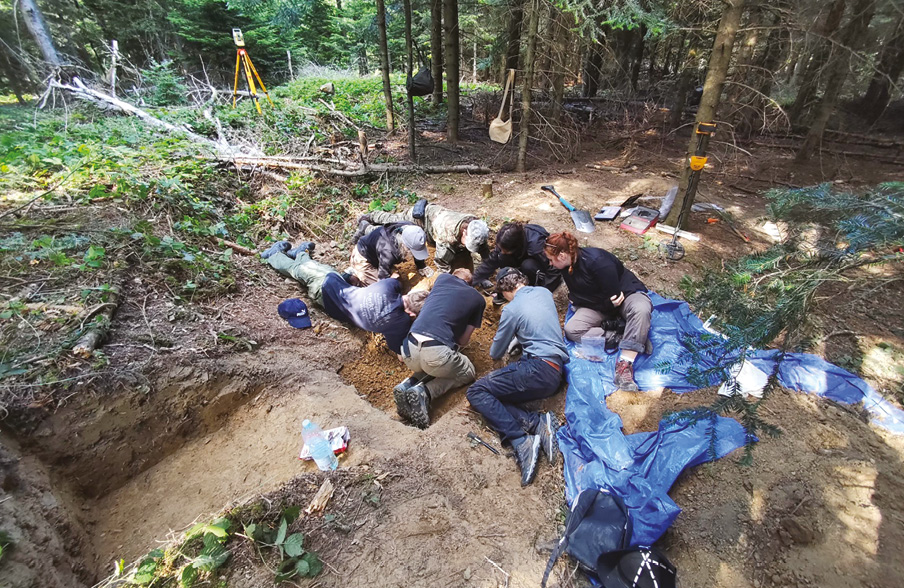
Of note, too, is the discovery that several of the soldiers buried here show lear signs of medical treatment and surgical procedures. This could represent the first material evidence that military cemeteries located along the strategic railway line connecting Przemyśl and Lviv with Budapest were also used to bury soldiers who died during medical evacuation to other hospitals.
In addition, the archaeologists uncovered the foundations of an earlier, late-19th-century church, which seems to have been destroyed by a fire before the official military cemetery was established on the site.
Researchers are currently analysing the results of the investigations and working to reconstruct the identities of the buried soldiers.
Text: Amy Brunskill / Image: Jagiellonian University