Subscribe now for full access and no adverts

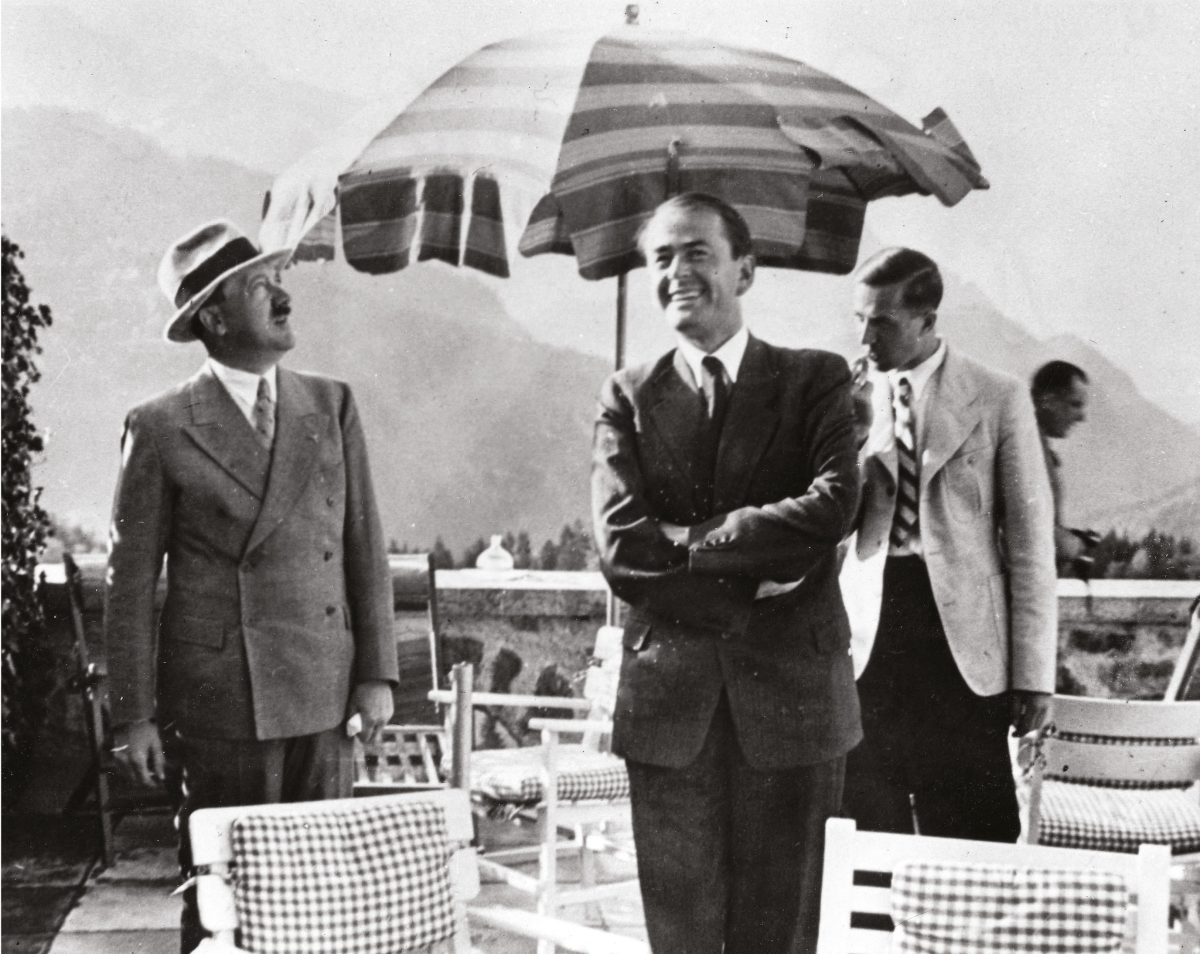
After the huge success of Saving Private Ryan in 1998, the film’s director Steven Spielberg and star Tom Hanks collaborated on an ambitious television project. They bought the rights to a book by historian Stephen E Ambrose that followed a single group of men, ‘Easy’ Company, in the 506th Regiment of the 101st Airborne, from training in the US, through D-Day, Operation Market Garden, the battle for Bastogne, and the liberation of a concentration camp, to the capture of Hitler’s Berghof in the Bavarian mountains. Ambrose’s book was itself based on the unpublished memoirs of Captain Dick Winters, the commanding officer of ‘Easy’ Company. The show was named after the book: Band of Brothers (2001).
HBO (Home Box Office) came up with what was then the biggest ever budget for a television project of $125 million for the ten-part series. Prime Minister Tony Blair himself encouraged Spielberg to bring this massive production to the UK, and it was shot almost entirely in and around Hatfield Aerodrome in Hertfordshire. A huge boost to the British film industry followed.
English actor Damian Lewis, as Captain Winters, led a vast ensemble cast who all went on a ten-day boot camp led by Dale Dye, a retired US Marine Corps Captain, to make the young actors believable as army soldiers. The series was magnificent and included anonymous interviews at the start of each film with veterans from ‘Easy’ Company, who were only named in the last episode. The series won seven Emmys, a Golden Globe, and a Peabody, among many other awards. In my view, Band of Brothers is one of the finest depictions ever of the Second World War on film, and still stands up superbly today.
Nine years later, in 2010, the same team – along with producer Gary Goetzman – came up with The Pacific, which followed three US Marines, this time in different units, through their war in that theatre. It was based on a set of books by marine veterans and was again funded lavishly by HBO.
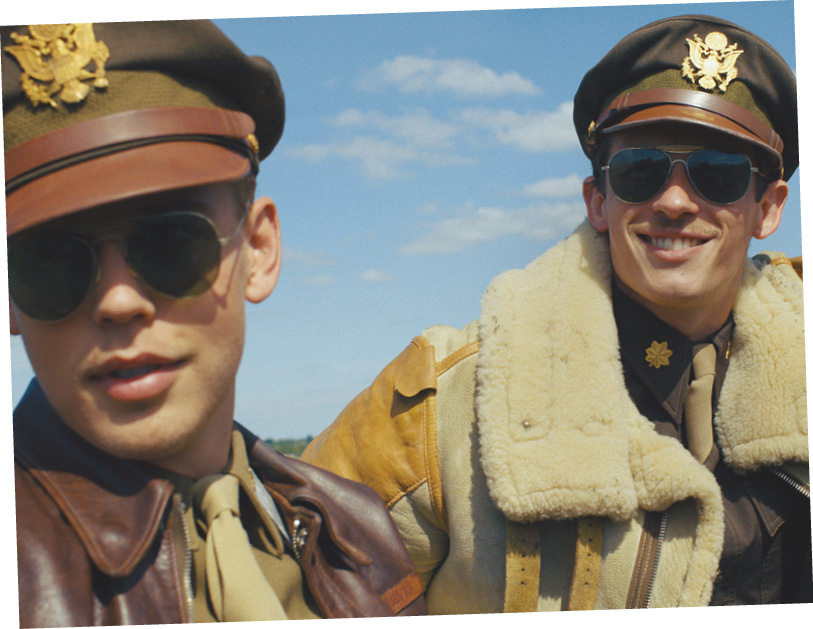
Spielberg’s father was in the US Army Air Force, and apparently asked his son on several occasions: ‘When are you going to tell our story?’ The result is the nine-part Masters of the Air, which follows the same formula as Band of Brothers. Again, Spielberg, Hanks, and Goetzman produced. Again, the story is based on a book by a historian, Donald Miller. Again, it follows a single unit, the 100th Bomber Group, known as the ‘Bloody Hundredth’ because of the scale of their losses. Again, it has a vast ensemble cast. And again, it was largely shot in England. Dale Dye once more trained the actors to look like they were in the military. This time it was made for Apple TV+ and, although there is much speculation about the budget, it seems to have been around $250 million – about $28 million per episode. Even the titles ape the theme music of Band of Brothers. There, however, the comparisons end.
A starry cast
Damian Lewis and the other stars of Brothers were not well known at the time, and were credited in alphabetical order. By contrast, Masters of the Air features many more famous actors. The two central characters who span the series are played by Austin Butler, who leapt to stardom playing Elvis Presley in last year’s biopic (for which he was nominated for an Oscar), and Callum Turner, the British actor who starred in the Fantastic Beasts movies and who has been nominated for a BAFTA. Many other stars appear in the series, including Barry Keoghan, the Irish actor BAFTA-nominated for Saltburn; Anthony Boyle, the Northern Irish actor from Game of Thrones; and Ncuti Gatwa, the current Doctor Who. The films consequently feel rather ‘starry’ in a way that Brothers never did.
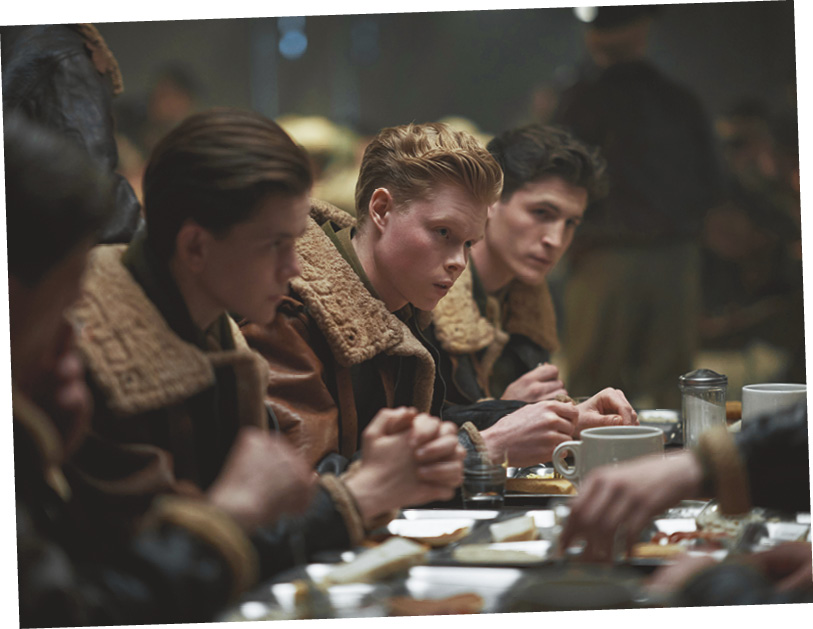
Obviously, the air war was different to the land war, and so the feel of Masters of the Air is different to its predecessors. The crews of the 100th drank in English pubs or in their mess on one night and were flying over Germany the next. Uniquely in wartime, they combined a semi-domestic country life with the terrors of combat. But the scripts by John Orloff are more showy and frankly more stereotyped than Brothers. The officers in the crew are constantly wise-cracking. Their macho personas are probably an accurate version of American ‘Flyboys’, but at times they are less sympathetic than their army equivalents. Many of the storylines are almost predictable. What does come across well, though, is their youth. The officers are in their mid-20s, and some of the aircrew in their late teens.
However, what distinguishes Masters of the Air and makes it unmissable for anyone interested in air warfare are the flying scenes, which combine computer graphics with models and live action. They are overwhelmingly powerful, immensely dramatic, and frequently terrifying. They convey the power of aerial combat in a way that has never been done before. The B-17 Flying Fortress bombers fly through walls of flak that throw rugged steel shrapnel through the air, and then encounter Luftwaffe fighters that flash by in an instant, spitting bullets at the bombers. Flying Fortresses explode in a ball of fire. Wings disintegrate, engines splutter, crew members are killed or horribly maimed. These scenes are the aerial equivalent of the opening 20 minutes of Saving Private Ryan, and will revolutionise how air warfare is presented on the screen.
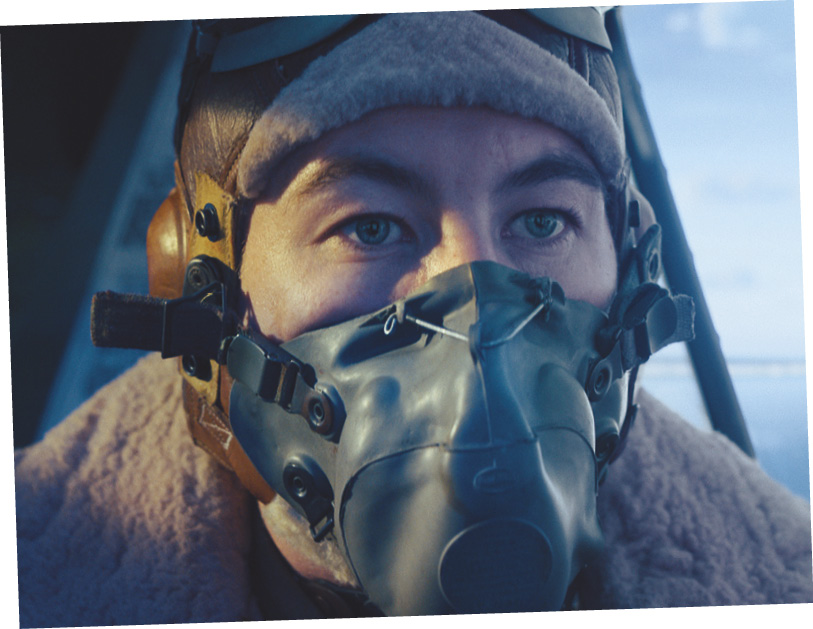
The series begins in the United States with a team of friends preparing to depart for England. They drink, dance to band music, and say farewell to their girlfriends. At the spine of the story are two close friends: the confident, handsome Major Gale ‘Buck’ Cleven (Butler) and the more volatile Major John ‘Bucky’ Egan (Taylor). The story transfers to Thorpe Abbots airbase in Norfolk, which from the spring of 1943 will be the home of the four squadrons of the 100th Bomber Group. Teams of Land Girls happily farm the pastures alongside the airfield. Local kids run around the base seeking amusement. But on the first raid over Bremen, the losses are heavy, and we get our first taste of the terrors of aerial combat.
The series is excellent in showing the mechanics of bomber missions, from the first dawn briefings to the final ‘interrogations’ by intelligence officers of every crew after their return. We get used to pre-flight checks, to the take-off procedures, to flight-runs over the target when the Bombardier takes control, and to the contribution made by every member of the ten-man crew. The ground crews also get their credit for repairing heavily damaged aircraft and working through the night to get the planes ready to fly. ‘No one gets a medal for patching up a plane,’ as one of the pilots says, ‘but nothing would happen without these guys.’
RAF Bomber Command rarely gets a mention in the series, except for a group of arrogant toffs who turn up in the mess one evening and tell the Americans that flying daylight raids is suicide. They say they inflict just as much harm on the Germans by indiscriminate bombing at night. The Americans insist that with the Norden bombsight (see below) and the defensive firepower of its heavy machine- guns, a Flying Fortress can carry out precision raids by day. Inevitably a fight breaks out. Equally inevitably, the American wins.
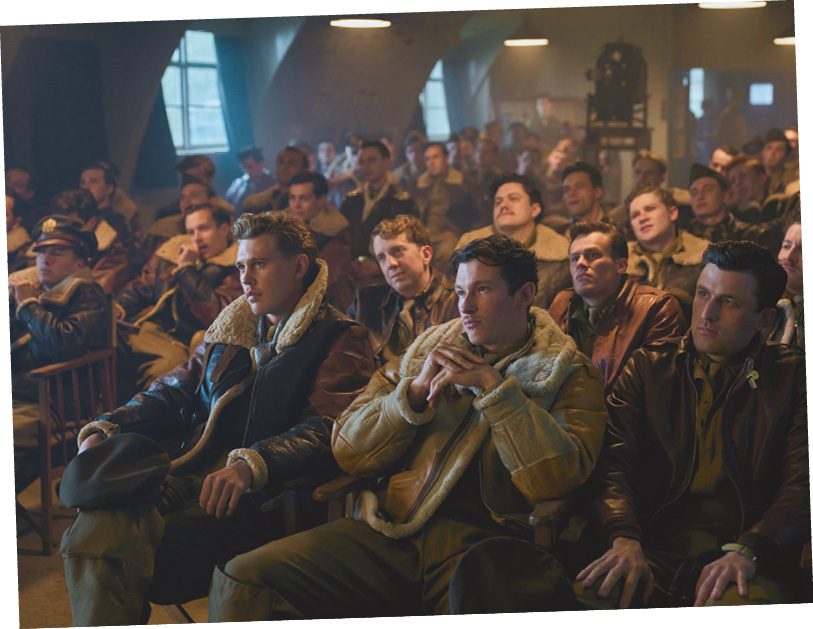
As the losses mount heavily, morale drops and Buck ends one episode by reflecting: ‘Perhaps that RAF prick was right – daylight raids are suicides.’ But the group flies on. The Americans fight hard and play hard. Especially ‘Bucky’ Egan, who drinks a lot, sings when he shouldn’t, and screams from the wing of his B-17 as dawn comes up.
More and more rookie pilots arrive to replace the heavy losses, including Robert ‘Rosie’ Rosenthal (Nate Mann) who, as the series develops, will become a central figure. On the Regensburg raid everything goes wrong: the group fails to rendezvous with the others, suffers severe losses, and the survivors fly on to a simple airbase in Algeria to land. In a single week in September 1943, the 100th lost 20 aircraft and 200 men.
Grounded crews
Meanwhile, parts of the action shift to occupied Europe, where some of the shot-down crew members get picked up by the Belgian or French underground, who help them escape. After a traumatic baling out, Sergeant Quinn (Kai Alexander – a British actor in one of his first screen roles) and Ron Bailey (Ian Dunnett) are smuggled from town to town, and realise that the courage they need in the air is nothing compared to the skills they need to survive on the ground.
Naturally there is some sex interest. In addition to the American and British girls who serve at Thorpe Abbots and are subject to much attention, ‘Bucky’ goes to London and meets a young Polish woman, Paulina (Joanna Kulig), whose husband was a pilot in the Polish Air Force who was shot down. ‘He’s either a POW or rotting somewhere in a potato field,’ she tells him. They end up in bed as London is bombed. In a surprisingly clichéd visual, the dome of St Paul’s is lit up by fire outside their hotel window. While in London, ‘Bucky’ sees the results of a bombing raid, as bodies are brought out of a bombed house and a woman screams in horror.

In the last few episodes, the series takes another turn. Several of the fliers who have been shot down end up in Stalag Luft III prisoner-of-war camp, a hundred or so miles south-east of Berlin in what today is Poland. Life is overwhelmingly drab: the food is dire, the guards are beastly, and the days drag on endlessly. ‘Buck’ and ‘Bucky’ think about escaping, but when they are told that 50 of the British prisoners who escaped, in what became known as the ‘Great Escape’, have been executed, they decide to stay put. In the final episode, they are taken on horrendous night marches westwards as the Red Army approaches. They don’t know if they will all be shot or traded with the Allies. These scenes are as gruesome as some of those of aerial combat.
In the penultimate episode, we get introduced to the black airmen of the Tuskegee squadrons. They are brilliant pilots, but are frustrated by the lack of action and the difficulty of promotion. ‘We all know why that is,’ the squadron captain says to one of his pilots. It’s hard not to see these scenes as a sop to diversity to prove that the ‘masters of the air’ were not all white and middle-class. Three of the Tuskegee airmen are shot down and end up in Stalag Luft III, where the white flyboys initially shun them. But, of course, it all ends well, and they become greatly appreciated for their talent and skills.
‘Rosie’ Rosenthal crashes but is picked up by the advancing Russians. While en route to a flight home, he wanders into a recently liberated concentration camp and is horrified by the piles of corpses. ‘We’ve found several of these camps,’ the Russian liaison officer tells him. As if we were in doubt, we are reminded why the war had to be fought and why the Nazis had to be defeated.
The series is reflective towards the end. Harry Crosby (Anthony Boyle), who began as a hopeless navigator, suffering from air sickness, but ends as a Major and chief navigator for the Group, reflects: ‘All this killing we do, day in day out, it does something to a guy. It makes him different. Not in a good way.’
All of the survivors of the 100th, which overall suffered a 77% loss rate (killed, wounded, or captured), have been affected by their experiences. But in a rather syrupy ending our central characters depart Thorpe Abbots to return to America and, leaving a group of Brits mourning their departure, fly off literally into the sunset. The series deserves better than this: it could have ended on a more reflective note.
Accuracy
There will be many who criticise Masters of the Air for historical inaccuracies, which abound. But none of the Spielberg–Hanks collaborations have ever made claims to absolute historical verisimilitude. To me, there is no point in counting the errors. The programmes are not documentaries, but spectacles, and the events in them have to be dramatised. There is plenty in Masters that is accurate and true. That’s good enough.
The series left me wondering if a British production company will pick up the baton and make a series about a squadron in Bomber Command? In the meantime, we have the flawed but fantastic Masters of the Air.
The Norden bombsight: America’s secret weapon
The Norden bombsight, which features prominently in Masters of the Air, had been developed before World War II from various gyroscope experiments. In simple terms, it was able to measure ground speed, wind direction, and, using an analogue calculator, could work out the moment at which to drop a bomb from a moving plane to hit a ground target with precision. The Americans were inordinately proud of the Norden, and the common boast was that ‘You can drop a bomb into a pickle barrel from 10,000 feet’. It was used extensively by the USAAF and the US Navy -but it had been developed in the clear skies of the American West, and was never anything like as accurate in the often cloud-obscured skies of Europe.
The Norden, combined with the ability of the B-17 (pictured) to fight off attackers with its eight heavy machine-guns in four turrets, prompted the USAAF to adopt a policy of daylight precision raids, in contrast to the RAF, who followed a campaign of carpet or indiscriminate bombing by night. The British had, of course, suffered the heavy bombing of London, Coventry, and many other cities, whereas mainland America had never been attacked. This meant that the British had no hesitation about area bombing and the killing of German civilians as a form of strategic revenge. ‘They who sow the wind will reap the whirlwind’ were the biblical terms in which Sir Arthur Harris, the head of Bomber Command, once put it.
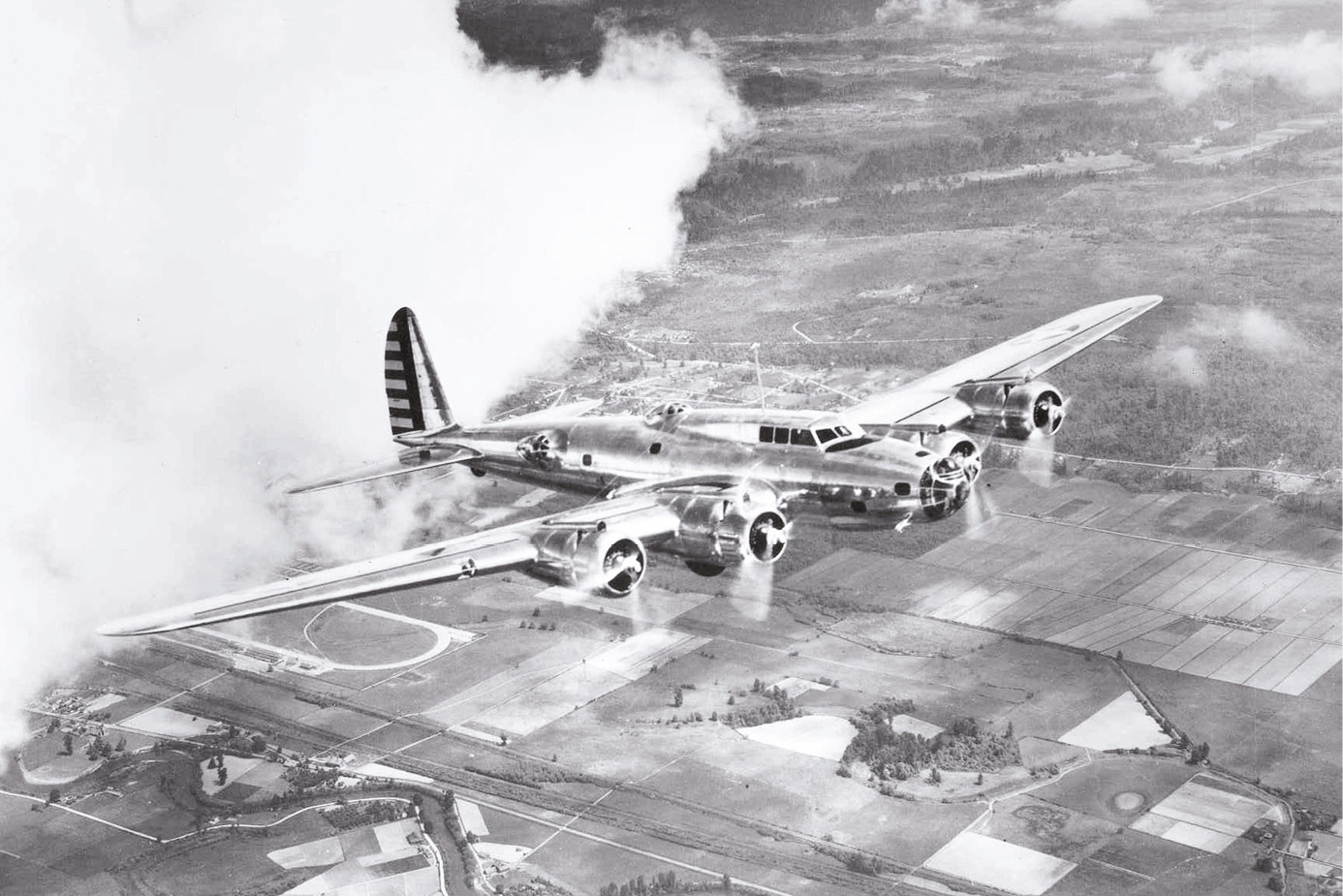
Initially, Churchill tried to persuade the Americans to join the RAF in night-bombing, but at the Casablanca Conference in January 1943 the Allies agreed that the Americans should bomb enemy targets by day, and the other Allies by night. This had the result of giving the Germans no let-up for two years, day and night, from enemy bombing missions.
MASTERS OF THE AIR (2024)
Executive Producers: Tom Hanks, Gary Goetzman, and Steven Spielberg.
Written by John Orloff.
Cinematography by Richard Rutkowski.
Starring Austin Butler, Callum Turner, Anthony Boyle, and many others.
An Apple Original Films, Amblin Television, and Playtone production.
Streaming now on Apple TV+.