
Subscribe now for full access and no adverts
When the Second World War broke out in 1939, the Luftwaffe was almost as heavily dependent on rifle-calibre machine-guns as the Imperial German Air Service had been in 1918. The Battle of Britain demonstrated the limitations of such weapons. By mid-1940, the Luftwaffe had upgraded its weaponry, fitting bombers with self-sealing fuel tanks as well as armour that gave a high degree of protection against the Browning .303 machine gun armament of Fighter Command’s Hurricanes and Spitfires.
As some bombers staggered back to their bases after taking more than 200 hits, the RAF launched a crash programme to refit its fighters with the far more powerful 20mm Hispano cannon, which fired HE (high-explosive) and AP (armour-piercing) ammunition. Some Luftwaffe aircraft were already armed with 20mm Oerlikon MG FF cannon by this point, but these were low-velocity weapons with very limited armour-piercing capability.
In 1941, the Luftwaffe encountered a similar problem when small numbers of the RAF’s Stirling heavy bomber first appeared in heavily escorted ‘Circus’ daylight raids against French targets. The best contemporary German fighter, the Focke-Wulf Fw 190 A-3, was armed with two Oerlikon MG FF, two of the new 20mm MG 151/20 cannon, and a pair of 7.92mm MG 17 machine-guns, able to deliver 130 rounds of 20mm ammunition and the same number of 7.92mm rounds in a three-second burst of fire. Luftwaffe analysts calculated that an average of twenty 20mm hits were needed to destroy a heavy bomber, but that the average fighter pilot was achieving no more than 2% hits. This meant that such a pilot would have to fire 1,000 rounds of 20mm ammunition to score 20 hits, far more than his total ammunition load. Initial attempts to solve the problem turned to the high-velocity MK 101 and MK 103 30mm cannon, but these turned out to be more suited to ground-attack and anti-tank use than as ‘bomber destroyers.’
When large-scale USAAF daylight raids began in 1943, it was recognised that better weapons capable of being mastered by average fighter pilots were crucial. Fortunately, a new 30mm cannon was available, which was hastily accepted for service as the MK 108. It proved to be highly effective – a quote from a Luftwaffe fighter pilot recalls that three hits ripped the wing off a B-24, while a single hit was enough to destroy a Mustang or a Thunderbolt. However, although destructive, the MK 108 was a low velocity weapon, inaccurate at long range and prone to jamming during violent manoeuvres.
Larger calibre high-velocity guns (37mm, 50mm, and even 75mm) were tried in both the anti-bomber and anti-tank roles. A few Fortresses and Liberators were shot down by Me 410s armed with the automatic 50mm BK-5 cannon, which fired 1.82kg HE rounds at 45rpm. Although these guns were able to destroy any bomber (or tank) with a single hit, their service life was brief, as their bulk and weight meant that the aircraft carrying them were sitting ducks for the ever-increasing numbers of Allied fighters.
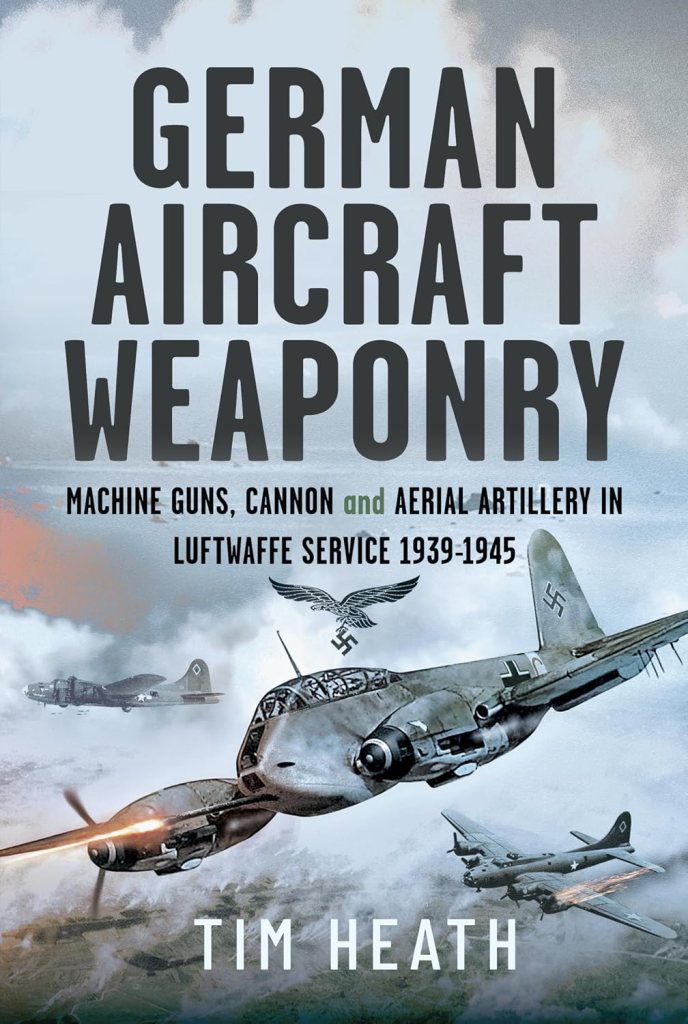
This is a detailed study of the Luftwaffe’s guns, ranging from rifle-calibre machine-guns to heavy cannon. The value of the book is greatly enhanced by the large number of quotes from veterans such as Arnold Gruhn, a retired Luftwaffe weapons instructor and former aircrew who used the various guns in action. Coverage of the vast variety of guns and ammunition is excellent, although some parts can be hard-going, largely due to masses of data being included in the text rather than separate tables. Despite this minor drawback, it is an excellent study and highly recommended.
REVIEW BY DAVID PORTER
German Aircraft Weaponry
Tim Heath
Pen & Sword, hbk, 256pp (£25)
ISBN 978-1399045728