Subscribe now for full access and no adverts
REVIEW BY HILARY WILSON
Histories of ancient Egypt have traditionally been written from a royal perspective, due largely to the availability of source material. This approach underestimates the role of the provinces, their administration and social structure, in the overall picture of state history. This new study draws on the ongoing work of the Spanish expedition to Qubbet el-Hawa, the elite cemetery of Elephantine, capital of Ta-Sety, Egypt’s southernmost province. Jiménez-Serrano describes recent excavations of the Old to Middle Kingdom tomb complexes, and reassesses earlier archaeological finds, including documentary sources from Elephantine Island, and the significant biographical inscriptions on funerary monuments. His stated aims are to set his historical study in a regional context, describing the provincial organisation of society, and the interaction of local elites with central government.
Ta-Sety, extending from Gebel Silsila to the First Cataract, was an area of strategic and economic significance. The governors of Elephantine were charged with conducting diplomatic relations with local peoples, overseeing border security, and protecting trade routes, with particular emphasis on access to resources. These roles were reflected in titles such as ‘leader of caravans’ and ‘overseer of non-Egyptian speakers’. At a distance from the central administration in Memphis or Thebes, the governors represented the king in political and religious affairs, acting as priests of the provincial gods. Their share of the revenue from local temples, together with royal rewards, enabled them to provide for their extended kin group by investing in substantial monuments and personal funerary cults.
The funerary chapel of the Sixth Dynasty governor Pepi-nakht, known as Heqaib, developed into a substantial cult sanctuary, illustrating the deification process that established him as the symbol of legitimate local rule. Well into the Twelfth Dynasty, successive governors claimed authority on the basis of their descent from Heqaib, the ‘Lesser God’ of the title. A detailed investigation into each governor’s relationship to this almost mythical forebear is this book’s central theme. New evidence from family graves at Qubbet el-Hawa reveals the part played by women in the cult of Heqaib, and the recognition of matrilineal descent. Governors claiming Heqaib as their ancestor to legitimise their position held political and religious power in Ta-Sety for five centuries, testament to the perceived importance of family connections.
The greyscale illustrations are disappointing, with the captions on some plans being faint and almost unreadable, but the focus on a provincial centre and its ruling elite provides a rewarding study.
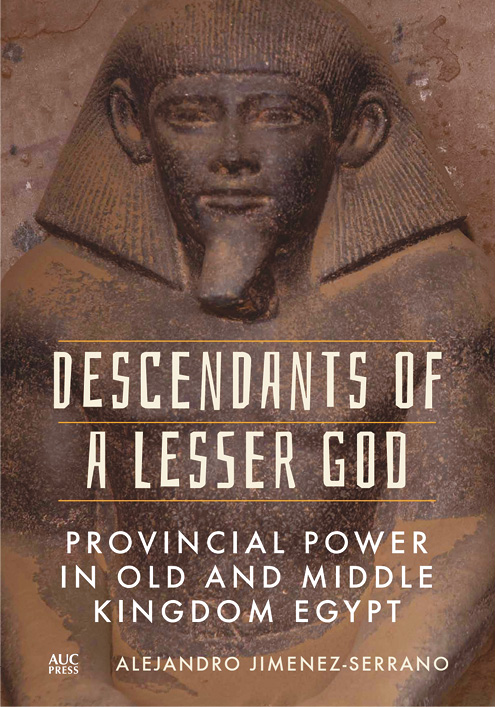
Descendants of a Lesser God: Provincial Power in Old and Middle Kingdom Egypt
by Alejandro Jiménez-Serrano
AMERICAN UNIVERSITY IN CAIRO PRESS, 2023
ISBN 978-1-6490-3175-4
Hardback, £60