
Subscribe now for full access and no adverts
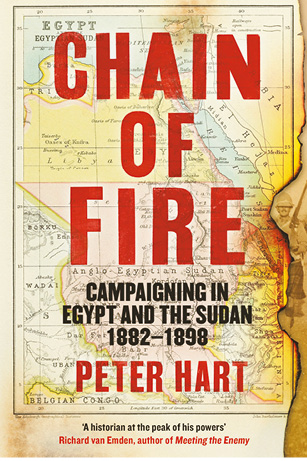
REVIEW BY PATRICK MERCER
If, as a youngster, you enjoyed those wonderful films Khartoum, The Four Feathers and Young Winston, you were not alone. I sat as transfixed as the spear that skewered General Gordon, as the bayonets that shimmered in the broiling sun, and the lances of the 21st Lancers at Omdurman. The whole saga enthralled me.
Then there were those wonderful sun helmets, the Martini-Henrys and Maxim guns: all symbols of an empire that was vanishing. But was anything connected? Did the sandy thread of imperial policy hang together? Of course not: it was all just splendid Victor comic stuff played out by square-jawed actors with a few, artistically applied dabs of sweat on their khaki.
If you want actually to understand the whole arc of what Britain was attempting to achieve in Egypt and the Sudan in the last quarter of the 19th century, Peter Hart’s latest book is an outstanding guide. Some of the author’s other works have been light on the political background to the various campaigns he describes, but not so here.
Prime Minister William Gladstone’s utter fall from grace – and how his popular nickname of GOM, the ‘Grand Old Man’, was reversed to become MOG, the ‘Murderer of Gordon’ – is particularly well explained. Similarly, the lunacy of what General Gordon was allowed to do in Khartoum in the mid-1880s, combined with the prime minister’s dithering, is laid bare. By the same token, the complexities of how London used what we would now call proxy forces, and all the tensions that that caused, are unpicked most skilfully.
Hart is rightly known for the way he uses first person accounts to illustrate the cut and thrust of battle. Obviously, it is easier to find officers’ letters than soldiers’, but there is some wonderful stuff here, not least from one Corporal Laurie of 1st Seaforth Highlanders who took no fewer than 162 hits at Atbara, a victory for the British over the Mahdist forces, in April 1898.
There must also have been a lot of discussion between the author and his editor about how much of the witnesses’ original language could be used, as elements of their vocabulary and attitudes would now be considered dubious by some readers. A careful line is trodden, which remains true, I believe, to the speech and sentiments of the time without being gratuitous.
Many of the officers who fought here, though, were later to become famous in South Africa and the First World War. The author uses their accounts to show how they cut their teeth in these savage campaigns.
Douglas Haig’s later career, for instance, needs no further expansion, but more junior officers like Major Horace Smith-Dorrien (subsequently sacked as an army commander) or Lieutenant Colonel Hector MacDonald (the crofter’s son whose suicide in 1903 as a major general rocked the nation) are remarkable for other reasons. Their subsequent tragedies would benefit from rather more attention than they get: footnotes or even an appendix?
The same rifles and machine-guns that so fascinated me as a boy, though, inflicted terrible damage. At Omdurman, one company fired 65 volleys in 45 minutes, creating a ‘curtain or sheet of lead’ that caused the company commander to assume that ‘not a single Dervish got nearer than 600 yards to the British infantry’.
The author doesn’t flinch from describing the shoals of dead this fire created, nor the summary execution of many of the wounded. This is quite correct. To gloss over the consequences of modern war inflicted on a hugely brave but unmatched army would be utterly misleading.
It often seems that too much time and ink has been spent on the Zulu War at the expense of operations in Egypt and the Sudan. But with Chain of Fire, the breadth of these hard-fought campaigns is properly explained in a deeply informative, but entertaining way. Do read this book.
Chain of Fire: campaigning in Egypt and the Sudan, 1882-1898
Peter Hart
Profile Books, hbk, 464pp (£30)
ISBN 978-1800810730