Subscribe now for full access and no adverts

REVIEW BY ANDREW MULHOLLAND
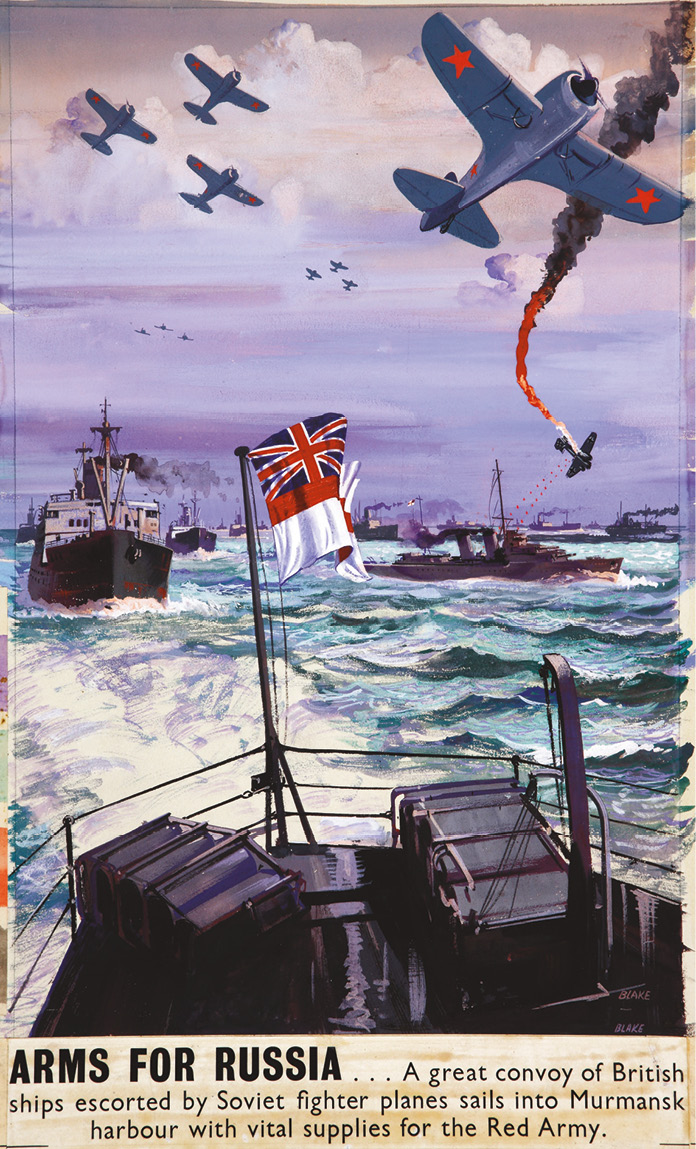
The Arctic campaign, fought between 1941 and 1945, saw Allied convoys battling through icy seas to deliver supplies to northern Russia. It was the stuff of legend. Yet more than 90 per cent of the cargo arrived safely. As for casualties, more German sailors perished when the battleship Scharnhorst was sunk than the Royal Navy lost during the entire campaign. This refreshing account, presenting an overview through the lens of the Bletchley Park Naval Section, nails many a myth.
Among his other roles, archaeologist and historian David Kenyon has worked at Bletchley as Research Historian since 2015. In 2019, he published Bletchley Park and D-Day, and this new volume is in a similar vein. Researching background material for a new exhibition on the Naval Section, Kenyon realised that the story of the Arctic convoys was more nuanced than might be imagined. The tragedy of Convoy PQ 17 (two-thirds of which was sunk by German aircraft and U-boats), Britain’s need to emphasise the difficulty of the Arctic run to Stalin, and a later historiographic tendency to exaggerate the submarine threat, have all contributed to such myth making. Television, film, and fiction have also played a part. Kenyon is not the first to have challenged it, but presenting such a compact and well-researched account fills an important gap.
It would be wrong to describe this as a book about cryptology, or even the wider activities of the Bletchley Park Naval Section. There is plenty to enjoy on this and, indeed, the book’s opening section provides a useful and layman-friendly narrative of the Section’s formation and role. Mostly, though, the story is that of the Arctic campaign itself. The Bletchley material is used as an analytical tool throughout, helping us to understand who knew what, and thereby better understand the decisions they took. The narrative is mostly zoomed out, as there is a great deal of ground to cover in a single volume. Readers looking for first-hand accounts from the sharp end may feel short-changed. Nonetheless the leaders, and many of those who worked at Bletchley, are brought to life convincingly.
As the story progresses, Kenyon’s accompanying analysis serves to get right under the skin of the tactical, strategic, and technological competitions that actually drove it: a deadly form of three-dimensional chess. In addition to the intelligence war, the tricky judgements about issues such as escort composition, climatic and seasonal light conditions, torpedo and anti-aircraft tactics are all well covered. If questions of leadership and the variables of warfare interest you, this account will deliver. In fact, in its intricacy, move and counter-move, it is reminiscent of the contest that took place in the skies over Germany during the same period.
Just one example is be the section on that famous Convoy PQ 17. The agonised decision making of those involved, what they knew or were told, the competing risks as they would have perceived them, and their misunderstandings and misjudgements, are meticulously reconstructed. The tortured complexity of these battles is thereby underscored. In particular the conduct of Admiral Sir Dudley Pound, generally blamed for the disaster, is well covered. With scrupulous fairness yet without full exoneration, Kenyon presents a more balanced account.
Above all, the reader is left with the sense of Allied progress – that, for all the stress and drama, they were slowly gaining the upper hand. Kenyon shows us that, judged in isolation, the Arctic campaign was an unambiguous Allied success.
Bletchley’s contribution
As with the campaign, the writing on the contribution of Bletchley Park itself also punctures a few common assumptions. Again the approach is sober and analytical. Kenyon is particularly good at setting out exactly how German codes were ‘attacked’, while eschewing much of the exaggeration and mystification one finds elsewhere. He also explains the breadth of the intelligence effort, from covert coast-watchers in Norway, through Swedish cooperation, to direction-finding, code-breaking and – importantly – analysis.
A fundamental constraint throughout seems to have been the fact that German code settings were changed every 48 hours. Therefore, for all their understanding of the Enigma machines, their own computing power and human expertise, the Allies were often in the dark for periods of a day or more. The tactical intelligence contribution from Bletchley was thereby diminished. At the operational and strategic levels, however, the use of inference and analysis helped to build an extremely useful picture. This could itself be distorted by command and other human factors, coupled with the fact that the Germans could react to their own intelligence on the Allies.
Those Axis intelligence capabilities are described in outline, although the book is, of course, a British study. Usefully though, the reader is reminded that the intelligence war was two-sided and that there were highly capable teams working on both sides.
Less impressive is the puzzling absence of accompanying diagrams. As with cryptology, Kenyon is very clear in his spatial account of the naval deployments and actions. One can frame most of it mentally, but some tactical maps would have helped. However, there is a useful map of the overall campaign and some very evocative photographs. At times too, the need to catalogue and account for almost every convoy – and the Axis response – can make for flat reading, especially when nothing much happens. Yet this is serious, exhaustive history. And mostly it flows along briskly.
The book is fully referenced, indexed, and it has a well-organised bibliography. It is therefore a great jumping-off point for those wishing to study the campaign in depth. It is also a good corrective for those (such as myself) brought up on stories of gritty merchant sailors facing overwhelming odds.
Kenyon has managed to weave the intelligence history into a more general military account of this neglected campaign. This works well for those who may be curious about the technicalities of the work of Bletchley Park, but could perhaps do without ‘full immersion’. It’s quite a balancing act, and neatly done.
Arctic Convoys: Bletchley Park and the war for the seas
David Kenyon
Yale University Press, hbk, 336pp (£20)
ISBN 978-0300269444