
Subscribe now for full access and no adverts
Excavations at Drumburgh, 10 miles (16km) from Carlisle, have unearthed a section of Hadrian’s Wall – the best-preserved part of the frontier fortification to be revealed west of the city.
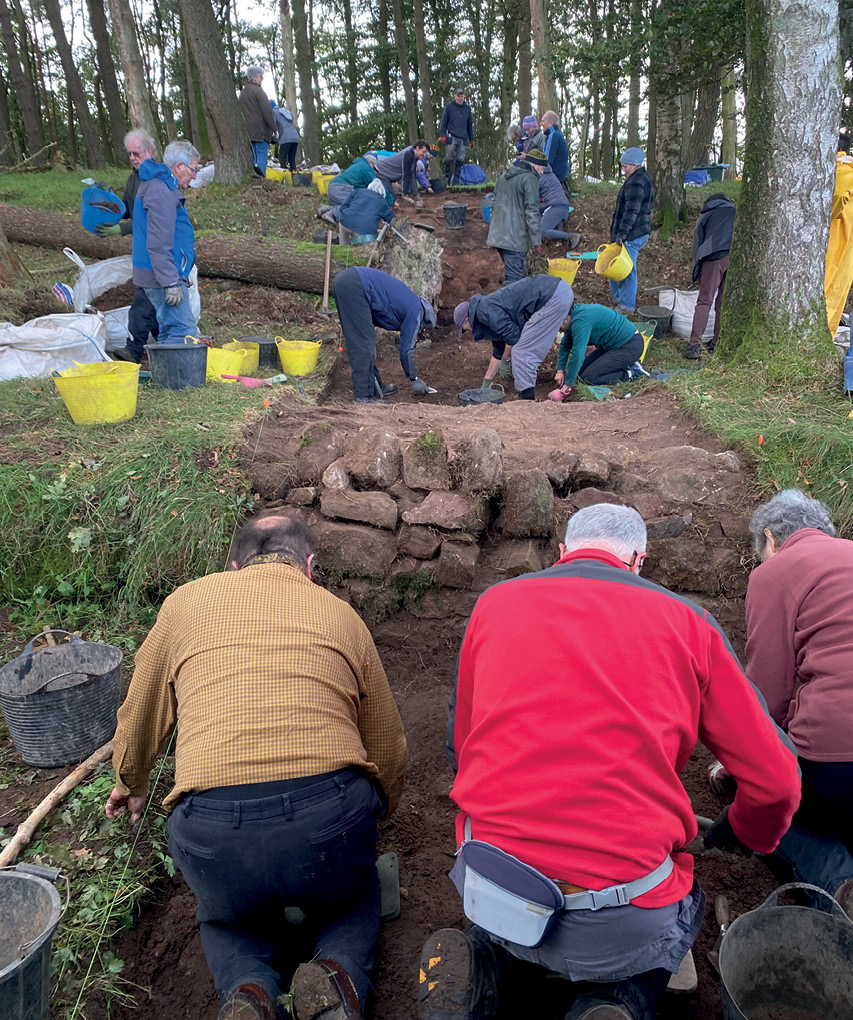
At the instigation of the landowners, who wanted to learn more about the archaeology on their holdings, the excavations were carried out over three weeks this past October by archaeologists from Grampus Heritage and Training, along with a number of community volunteers. The project was funded through DEFRA by the Solway Coast National Landscape’s ‘Farming in Protected Landscapes’ Scheme, and followed a geophysical survey undertaken earlier this year.
Two trenches were opened during the October investigations. The first was located over features that had been identified as the remains of Congavata Roman fort during excavations in 1947. This earlier investigation had reconstructed the fort’s plan based on a series of ditches, and the present team quickly came across two of these boundaries, which measured over 1m deep. There was little evidence of any Roman-period activity, as would be expected from such a large military structure, however, and, while radiocarbon dating is ongoing, the team are sceptical that this is indeed the right location of the fort.
The second trench proved more fruitful. This was placed over a linear feature that had been identified in the geophysical survey, and excavation revealed foundation slabs for a section of Hadrian’s Wall – although no masonry courses survived above these. As stone is scarce in this area of Cumbria, it is likely that the Wall was robbed for recycling in other building projects – probably during the medieval period, as finds of this date were discovered in the layers above the foundations. When the team extended their trench 5m (16ft) to the east, however, they were surprised to uncover an extremely well-preserved section of the Wall, surviving up to four courses high, with both faces as well as the rubble core still intact. The north side was found to be constructed of vertical facing stones (below), with evidence of at least one repair, while the south side had been built in a stepped fashion, with wide steps at the bottom and narrowing towards the top.
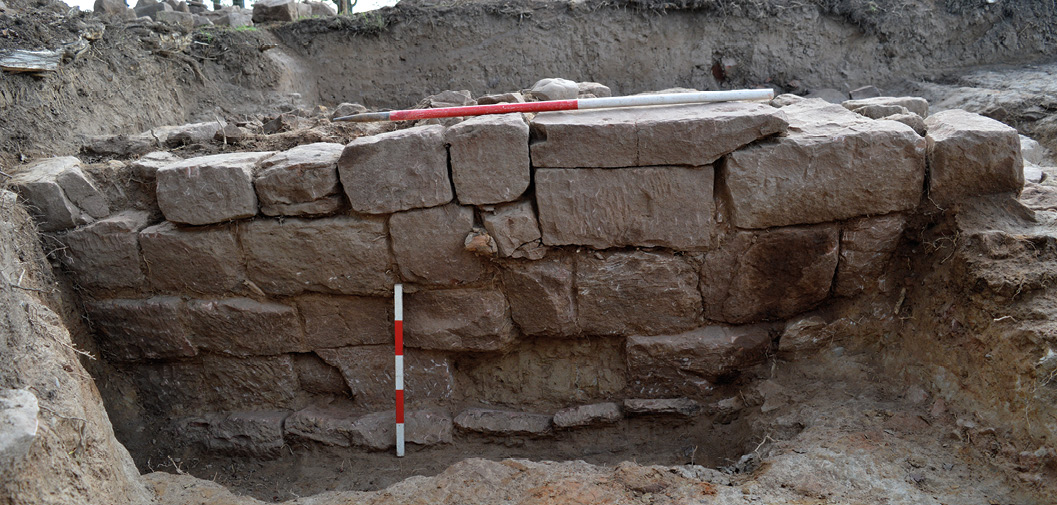
This portion of the Wall was found in an area where the land drops away down to Burgh Marsh. Its line appears to continue down towards the marsh and seemingly answers an important question about whether the Wall had been built across this wet land or diverted to the south to follow the higher ground. The newly found section seems to point to the former theory being correct, but to confirm this the team are looking to carry out further investigations on the marsh itself, pending permission from the relevant authorities.
Text: Kathryn Krakowka / Image: Grampus Heritage and Training