
Subscribe now for full access and no adverts
Further news from the frontier zone comes from Bremenium Fort – at High Rochester, north of Hadrian’s Wall – where recent excavations have revealed a wealth of finds to add to our understanding of how the fort sustained itself during the Roman period.
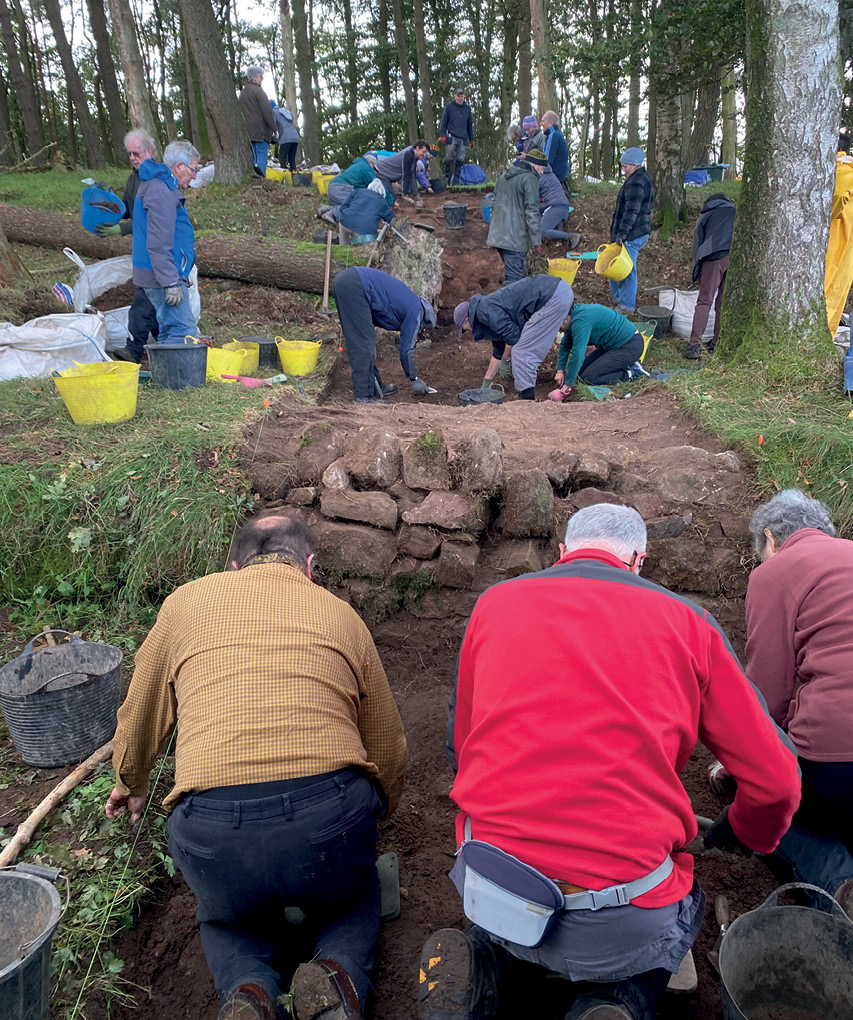
The fort – which is on Dere Street, the Roman road running from York to Scotland via Corbridge – was first excavated in the 1990s by Jim Crow (see CA 164). Since 2021, further excavations have been carried out by a team from the Archaeological Practice and Newcastle University, led by Richard Carlton, along with volunteers from the Redesdale Archaeology Group. Recent digging seasons have concentrated on a system of enclosures located outside the fort walls, which is believed to have supported the fort’s activities between the late 1st and 3rd centuries AD. Previous discoveries there included a gate in the turf ramparts of the outer enclosure, a 1.5m-wide wall bounding the inner enclosure, and a well-preserved lime kiln found close to the fort ramparts, which is one of only three such structures ever found on the Wall or its outpost forts.

This year the team was able to establish the full extent of a major building within the largest of these enclosures. It appears to have been in use until at least the 3rd century AD, and during that period was rebuilt at least three times, with each phase being demolished and covered in clay before new construction began. Within these layers numerous small finds were uncovered, including lots of Roman pottery from across the Empire (namely, Samian Ware, Black Burnished Ware, Grey Ware, Nene Valley Ware, and fragments of mortaria and amphorae). Speaking to the fort’s military function, a spearhead and a lead sling shot from a Roman auxiliary’s kit were found, while more religious and personal items were reflected by the discovery of a votive oil lamp and two intaglios – carved gems from finger-rings, one of which depicts a scene of grape-harvesting and is thought to be unique in Britain and northern Europe but has parallels in the Mediterranean, specifically Dalmatia. Additionally, waterlogged remains including lengths of timber and straw were encountered in the lower parts of the trench, which provide opportunities for further investigation. The team hope to continue excavating next year.
Text: Kathryn Krakowka / Image: The Archaeological Practice Ltd