Subscribe now for full access and no adverts
Over the past few years there have been several research papers that have made headlines because of their insights into major genetic shifts in the population of Britain throughout time (see CA 338 regarding the Bronze Age Beaker migration, CA 352 about changes between the Mesolithic and Neolithic periods, and CA 392 concerning early medieval DNA). These studies have revolutionised our understanding of mobility in the past, but they represent only one piece of the puzzle. While aDNA is very good at telling us about people’s ancestry, it cannot tell us about individual migration. For instance, a person buried in an early medieval cemetery in Britain might have DNA indicative of Mediterranean ancestry, but that cannot tell us whether such individuals migrated from the region themselves or, instead, were born in Britain to immigrant parents, or even immigrant grandparents. Isotope analysis is a better tool for showing us individual movement patterns, but until now most isotopic studies from the early medieval period were relatively small in scale. New research led by Dr Sam Leggett of the University of Edinburgh, however, has sought to rectify this by compiling and analysing the largest dataset of isotope results yet. The project’s findings, recently published in the journal Medieval Archaeology (https://doi.org/10.1080/00766097.2025.2583016) form the focus of this month’s ‘Science Notes’.
The project collated a total of 8,910 isotopic measurements taken from 2,046 samples of human tooth enamel, 931 samples of human tooth dentine, 4,149 human bones, and 1,799 animal bones. The samples ranged in date from c.AD 400 to 1200 and came from more than 100 sites across 26 modern countries in western Europe. Some 700 of the tooth-enamel samples in the study came from England, yielding 658 oxygen and 295 strontium measurements. In analysing the results of this subset, Sam and her team focused on establishing perceptible changes over time, as well as differences between the sexes and across regions of England. Overall, the results showed that, out of the 700 English samples, 296 (42.3%) indicated that they came from ‘non-locals’. The team stress this should be seen as a minimum percentage, as areas of the Low Countries, most of what was Francia, and southern Scandinavia have isotopic baselines that are virtually indistinguishable from southern Britain, making individuals from these regions appear ‘local’ in this context.
While homing in on the chronology of the samples, the team were particularly interested to see whether there were any noticeable peaks in movement during three discrete periods of known migration: the Adventus Saxonum, the Viking Age, and the Norman Conquest. Intriguingly, they found that the proportion of ‘non-locals’ appears to have remained relatively consistent over time. The only period in which they found a perceptible peak in mobility was between the late 6th and late 7th centuries, when non-locals increased from 38% of the samples to 47%. This was surprising as it does not align with any known period of migration: the Adventus Saxonum is believed to have occurred c.AD 450-500, and the first recorded Viking raids were late in the 8th century. In terms of sex differences, it appears that in the early part of the period men and women largely migrated in equal numbers, perhaps indicating that families moved as a whole. From the Viking Age through to the Anglo-Norman period, however, there was a shift, with more men than women migrating, and they increasingly came from Scandinavia, which would align with Viking invasions at this time. The team stress, though, that the Viking Age samples were highly biased by the fact that previous research has often chosen to analyse mostly male burials with clear Scandinavian-style grave goods.
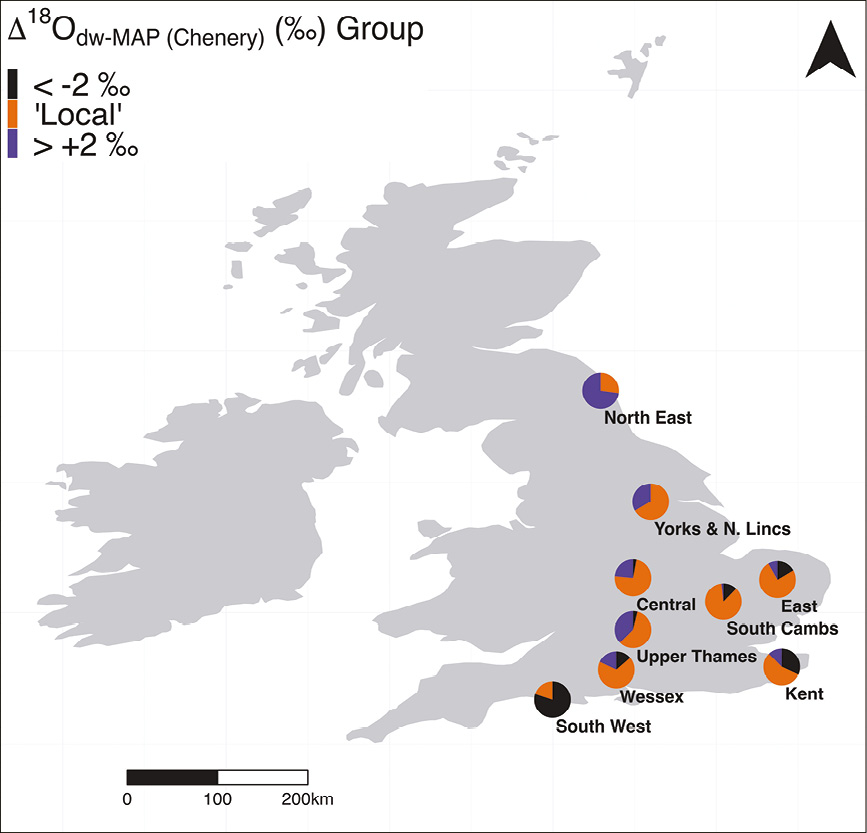
While the isotope results show large consistencies over time and between the sexes, the differences seen between the various regions of England were more notable (above). The team found that many samples from Kent, East Sussex, Wessex, south Cambridgeshire, and East Anglia had oxygen isotope ratios that are similar to those from northern Germany and the Jutland peninsula, which, the researchers note, ‘unexpectedly fit traditional narratives’ of early medieval migration patterns. Additionally, Kent and East Sussex, the Upper Thames and the Chilterns, and Wessex all had similar isotope ranges, suggesting a shared mobility history compared to other regions. Conversely, there was a larger number of individuals in the north-east with isotopic signatures suggesting mobility from more southerly regions of Britain, as well as possibly from further abroad.
The results highlight the complexity of migration. It was not a simple case of whole populations moving from one location to another and then staying in one place for the next couple of hundred years until another wave of migration followed. By combining isotope evidence with that from DNA analysis and grave goods, we see that early medieval communities were dynamic, with people moving in and out of them continually. Furthermore, these groups did not exist in isolation, instead forming part of a larger network of cross-cultural contact.
Text: Kathryn Krakowka / Image: adapted from Figure 3 in the journal article (https://doi.org/10.1080/00766097.2025.2583016) under a CC-BY 4.0 licence