Subscribe now for full access and no adverts
Analysis of a fragment of elephant bone, first discovered during excavations at Boxgrove, West Sussex, in the early 1990s (see CA 153), has revealed that it was used as a hammer by early hominins roughly 500,000 years ago, making it the oldest elephant-bone tool to be discovered in Europe.
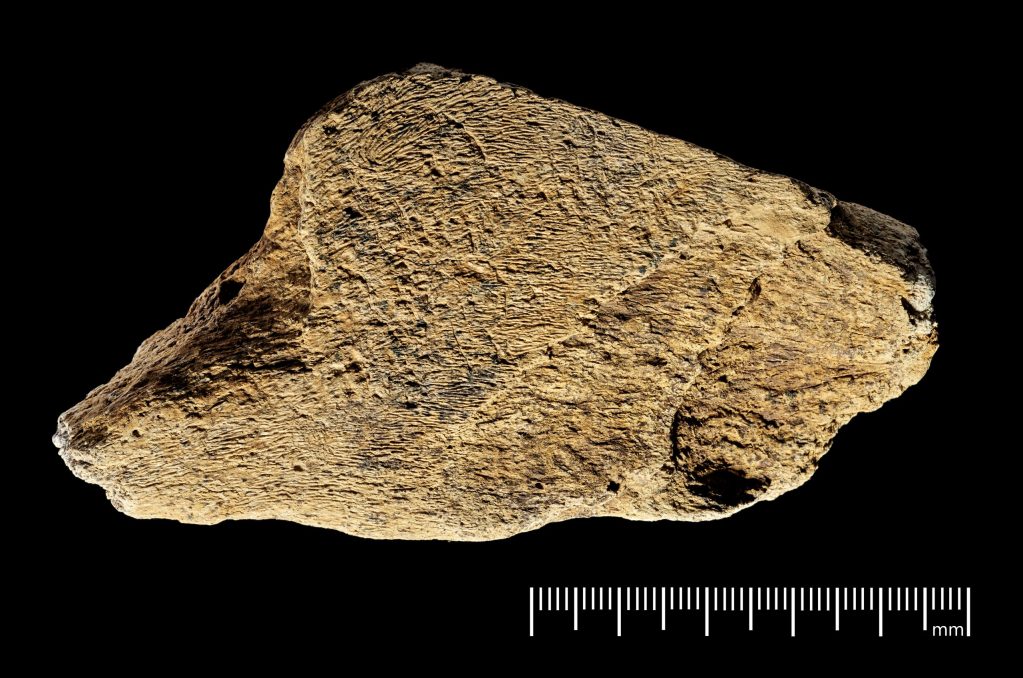
The bone’s full significance was not realised at the time of its original discovery, but a recent re-examination of artefacts from the Boxgrove excavations (carried out by researchers from UCL and the Natural History Museum, with the support of English Heritage and the Calleva Foundation) has transformed our understanding. The fossilised artefact is roughly triangular in shape and measures about 11cm long (4in), 6cm wide (2in), and 3cm thick (1in). It is made from the outer layer of bone, known as cortical bone, and the density of its material suggests that it comes from either an elephant or mammoth. It is not known whether this animal had been hunted, or if the bone was scavenged from a carcass, but aspects of the object’s shape suggest that it had been relatively ‘fresh’ at the time that it was turned into a tool. Closer examination of its surface using 3D scanning and electron microscopes revealed a number of impact marks and notches, some of which contained tiny fragments of flint, indicating that the bone had been used as a hammer to strike and shape stone tools. Since bone is softer than stone, the researchers believe that this tool was a ‘retoucher’ for restoring stone tools by knapping away knicks and dulled edges.
While much older elephant-bone tools (dating back 1.5 million years) have been found at Olduvai Gorge in Tanzania, only a small number pre-dating 41,000 BC are known in Europe. The Boxgrove bone is the only European example known to be older than 450,000 years. While the exact species of hominin that created the tool is unknown, it was probably either early Neanderthals or Homo heidelbergensis. Either way, this unusual object highlights the sophistication and ingenuity of our early ancestors.
Simon Parfitt, the lead author of the paper that reported these results in Science Advances (https://doi.org/10.1126/sciadv.ady1390), said: ‘This remarkable discovery showcases the ingenuity and resourcefulness of our ancient ancestors. They possessed not only a deep knowledge of the local materials around them, but also a sophisticated understanding of how to craft highly refined stone tools. Elephant bone would have been a rare but highly useful resource, and it’s likely this was a tool of considerable value.’
Text: Kathryn Krakowka / Image: NHM Photo Unit