Subscribe now for full access and no adverts
Recent fieldwork at the Durrington Walls ‘superhenge’ has explored a series of large pits forming what appears to be a 2km-wide (1.2 mile) circular boundary around the monument, revealing new evidence to suggest they were deliberately dug and not natural features.
News of the pits first broke in 2020, when the Stonehenge Hidden Landscapes Project (SHLP), led by researchers from the University of Bradford and the Ludwig Boltzmann Institute, published a paper about their discovery in Internet Archaeology (see https://doi.org/10.11141/ia.55.4; see also CA 366). There, the team identified a series of at least 20 – and perhaps as many as 30 – regularly spaced pits, each measuring around 10m (33ft) across and 5m (16ft) deep. These features form an arc to the north and south of Durrington Walls, covering an area roughly 3km2 (1.2 square miles), and also encompassing the Neolithic monuments of Woodhenge (CA 429) and Larkhill causewayed enclosure (CA 326).
While the team’s findings were initially met with scepticism from some colleagues, a new paper was recently published in Internet Archaeology (https://doi.org/10.11141/ia.69.19) outlining further research undertaken on the pits between 2021 and 2025. This subsequent work included magnetometer survey over two of the possible features, as well as ground-penetrating radar (GPR), electromagnetic ground conductivity (EM), electrical resistivity tomography (ERT), and drone surveys over nine pits, including the two that featured in the magnetometer survey. In addition, they drilled boreholes into five of the pits and carried out optically stimulated luminescence (OSL) dating and geochemical and sedaDNA analyses on each. Moreover, the researchers were able to reach the bottom of four features, allowing them to establish a more secure chronology for their construction.
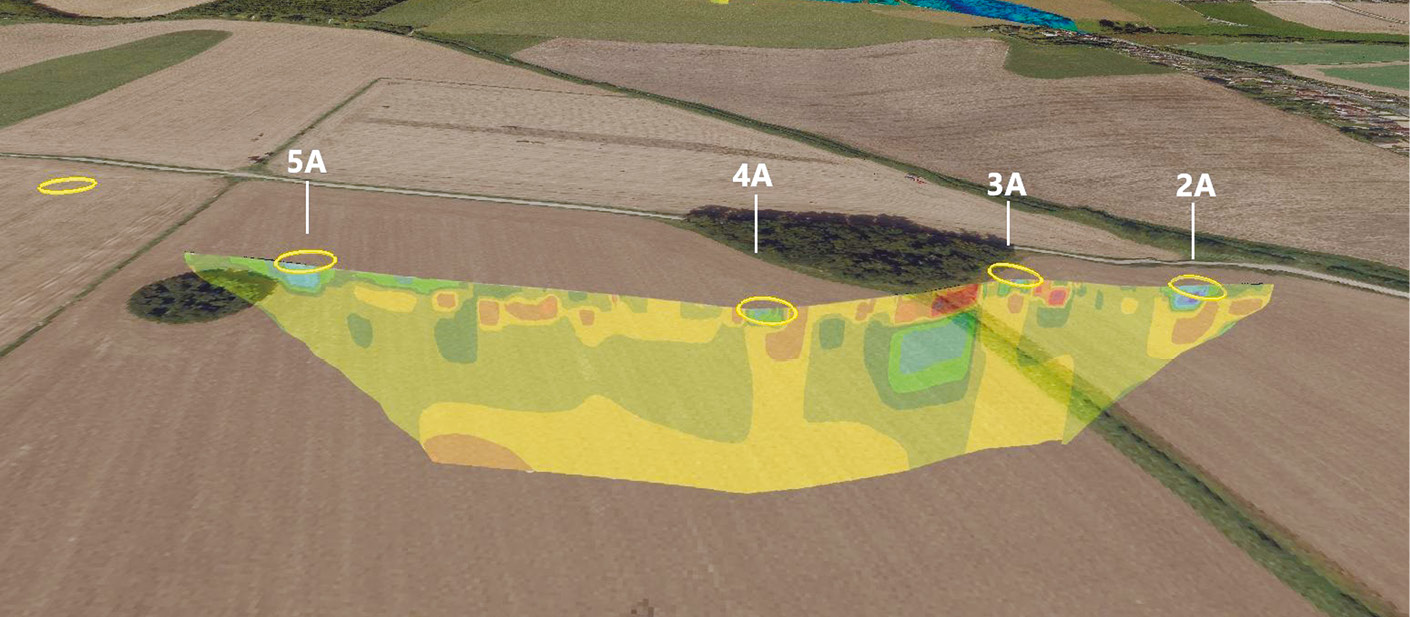
The results showed that these features were consistent in size, depth, morphology, and geophysical signature, and differed significantly from other nearby archaeological structures, such as mortuary enclosures and ring features. In particular, the OSL dates for the deepest fills were tightly clustered around c.2480±130 BC, indicating that the first sediments had entered the pits in the mid-3rd millennium BC, placing their likely construction in the Late Neolithic. The stratigraphic evidence then reveals a multi-phase history of infilling. While the first layers were created rapidly during the Late Neolithic, it appears that the pits may have then remained largely open for a number of centuries, with subsequent periods of infilling not occurring until the late Bronze Age and early Iron Age.
In addition to the dating evidence, the team discount the idea that the pits could be sinkholes or other natural features on geological grounds. Active sinkholes in the UK, they argue, tend to be small and of limited distribution (which these are not), while buried sinkholes are created by the presence of overlying Tertiary sediments (laid down 66 to 2.6 million years ago), of which there are none in this area. The pits also do not conform to the internal structure of sinkholes, being much more uniform in appearance and geographical distribution, which would be improbable if they had been made naturally, the team say. Overall, having mapped and surveyed the entirety of the surrounding area as part of the broader SHLP, the researchers confidently assert that none of the other features identified during the project are likely to conform to the pits, and that their distribution speaks to an intentional creation, which is in line with other evidence from Britain demonstrating there was a tradition of large pit-digging during the Mesolithic and Neolithic periods.
Text: Kathryn Krakowka / Photo: Gaffney et al. (2025) Internet Archaeology, overlain on aerial photograph backdrop © Google Earth