Subscribe now for full access and no adverts
The extraordinary diversity of modern dog types is often attributed to Victorian breeding practices, which led to a major increase in the number of dog breeds. A recent study looking into canine skull forms, however, has found that there was another, much earlier, jump in dog diversity during the early Holocene (c.11,000 years ago), with significant changes in skull morphology occurring at this time. In this month’s ‘Science Notes’, we will explore the full results of this project, which were recently published in Science: http://www.science.org/doi/10.1126/science.adt0995.
Recently, genetic studies have looked at when the first canines were domesticated, with the earliest confirmed dogs found at the Mesolithic site of Veretye in Russia, dating to c.11,145-10,724 years ago. Domestication does not show up in the DNA overnight, however, and it is thought that the first domesticates probably date to sometime during the Late Pleistocene (c.50,000-11,700 years ago). Indeed, two canines (an adult and a diseased puppy) found buried alongside humans at the site of Bonn-Oberkassel in modern-day German are often cited as the first evidence of domestication, having been dated to around 15,000 years ago (see CA 301).
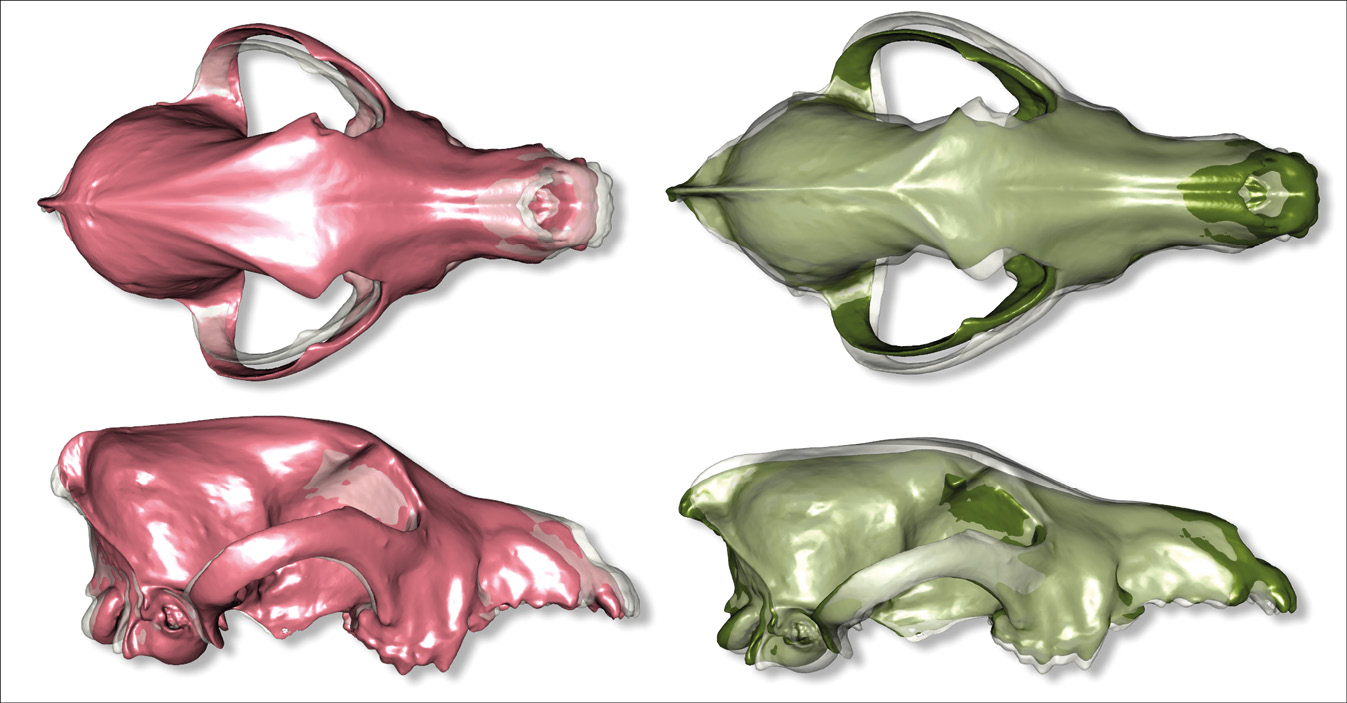
To see if morphological analysis of canid skulls could help add to our knowledge of the domestication process, an international team of researchers – led by Allowen Evin, from the University of Montpellier, and Carly Ameen, from the University of Exeter – analysed the skulls of 643 modern and archaeological canids, spanning in time from 50,000 BC to the present day. By using a geometric morphometric approach, they were able to create intricate 3D digital models that could both identify and quantify small-scale changes in the shape of the crania.
The main findings appear to correspond with the genetic evidence, revealing that there was a distinct divide, with modern wolves and Pleistocene canids having larger skulls, on average, than those of modern dogs and Holocene specimens. Additionally, while modern dogs had the greatest size range, this span did not significantly differ from their Holocene counterparts, with both groups showing greater variability in shape than either modern wolves or Pleistocene canids.
The team then turned to looking at more subtle differences in morphology. First, they calculated the mean skull shape of modern wolves, and then determined how much each specimen differed from this average. They found that 151 individuals, encompassing 81 Holocene specimens and 70 modern dogs, had a skull that was significantly different in shape to the average wolf. Using these as the baseline for a domestic shape, the study went on to identify a further 281 archaeological specimens as having this morphology, while all of the Pleistocene specimens had wolf skull shapes.
Delving further into the data, the researchers next looked to see if they could pinpoint when changes in size and shape occurred. To do this, they grouped the archaeological specimens into chronological periods: 50,000-25,000 years ago; 25,000-10,000 years ago; and then by consecutive 1,000-year windows that shifted by 100-year increments from 10,000 years ago to the present. They found that the reduction in skull size is first detectable from 9,700 to 8,700 years ago, while the increase in size variance is first noticeable between 7,700 and 6,700 years ago. An even greater variation in skull shapes then appeared c.8,200-7,200 years ago. The team suggest that these results indicate that domestic dog morphology was present by the early Holocene, and probably derived from existing wolf variability.
One of the most significant findings, however, had to do with the scale of this diversity. While the 43 earliest dogs identified in the study – who had lived in the Mesolithic and Neolithic periods – had, on average, smaller and less variable skulls than modern canines, there was still a large range of shapes in these early dogs with diversity doubling in the Mesolithic and Neolithic specimens compared with the Pleistocene skulls. As the team summarise in their paper: ‘Together, these results demonstrate that whereas Victorian breeding programmes are the origins of many of today’s most extreme morphologies, early Holocene domestic dogs exhibited more diverse skull forms than previously considered… this suggests that the pressures of human-induced selection alongside changing climatic conditions and food resource availability were sufficiently strong to lead to the appearance of diverse morphologies millennia before the definition of modern breeds.’
Text: Kathryn Krakowka / Image: C Brassard (VetAgro Sup/Mecadev)