
Subscribe now for full access and no adverts
New dendrochronological evidence has provided a minimum age for the tree that used to grow at Sycamore Gap on Hadrian’s Wall before it was illegally felled in September 2023.
It was not previously known how long the sycamore had been a feature of the landscape, with the National Trust suggesting it had been planted in the late 1800s by the previous landowner, John Clayton, while others had proposed an earlier date based on the unpublished journal of John Hodgson, a Northumbrian historian, in which an entry dated 18 October 1832 depicts the Gap with a stone enclosure and the outline of a tree.
To help provide a more definitive answer, a cross-section of the sycamore taken from the bottom end of the felled trunk was brought to Historic England’s Fort Cumberland Laboratories in Portsmouth. There, the tree rings were carefully counted along a series of transects from across the surface. This was necessary as it appears that the sycamore was not one tree, but was actually formed from multiple individual trunks that then fused together into two main stems – there are even distinctive lines of ‘internal’ bark still present in the middle of the cross-section. These two stems appear to have finally fused into the single tree with which we are familiar around the time it was 30-35 years old.
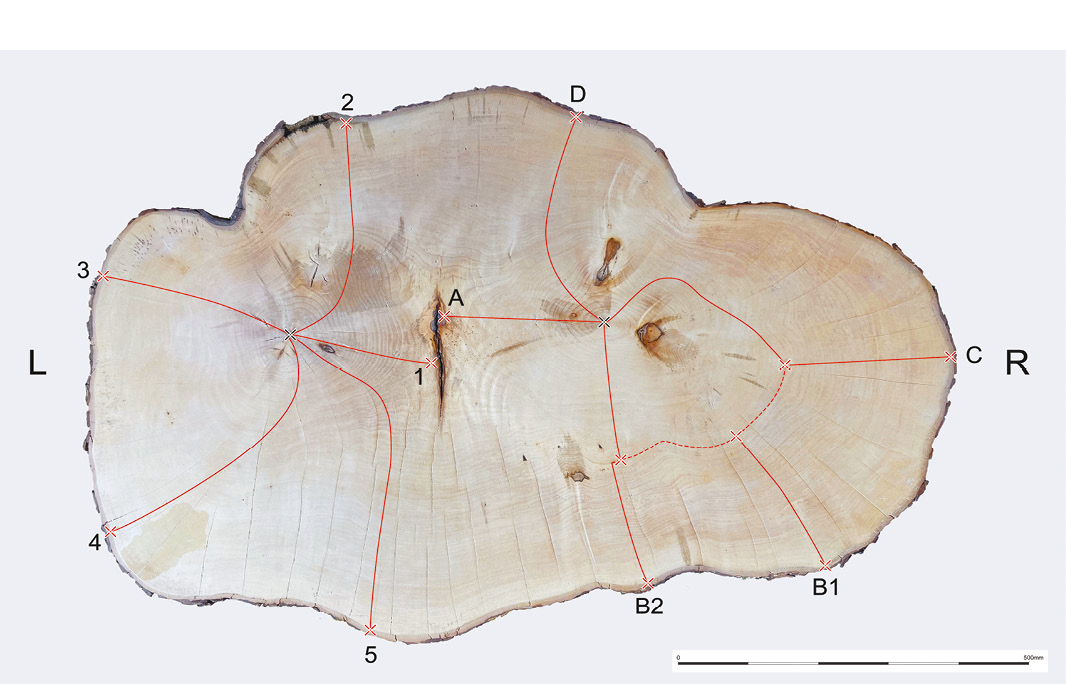
After carefully counting along these transects, the researchers were able to determine that there were an estimated 100-120 growth rings for the two main stems. With each ring representing one year of growth, this would make this part of the tree between 100 and 120 years old. Importantly, however, this section was not from the very bottom of the trunk, which is still in situ beside Hadrian’s Wall. It is estimated that, based on where this cross-section was located, the tree was probably first planted some time in the late 19th century. Counting the rings was not a straightforward process, however, and this can only be assumed to be a minimum age for the tree.
Now that the investigation is complete, the sample will be securely stored at Fort Cumberland and is expected to be added to the Historic England National Wood Collection so that it can be available for potential future research opportunities.
The full report is available at https://historicengland.org.uk/research/results/reports/58-2024.
Text: Kathryn Krakowka / Image: Historic England