Subscribe now for full access and no adverts
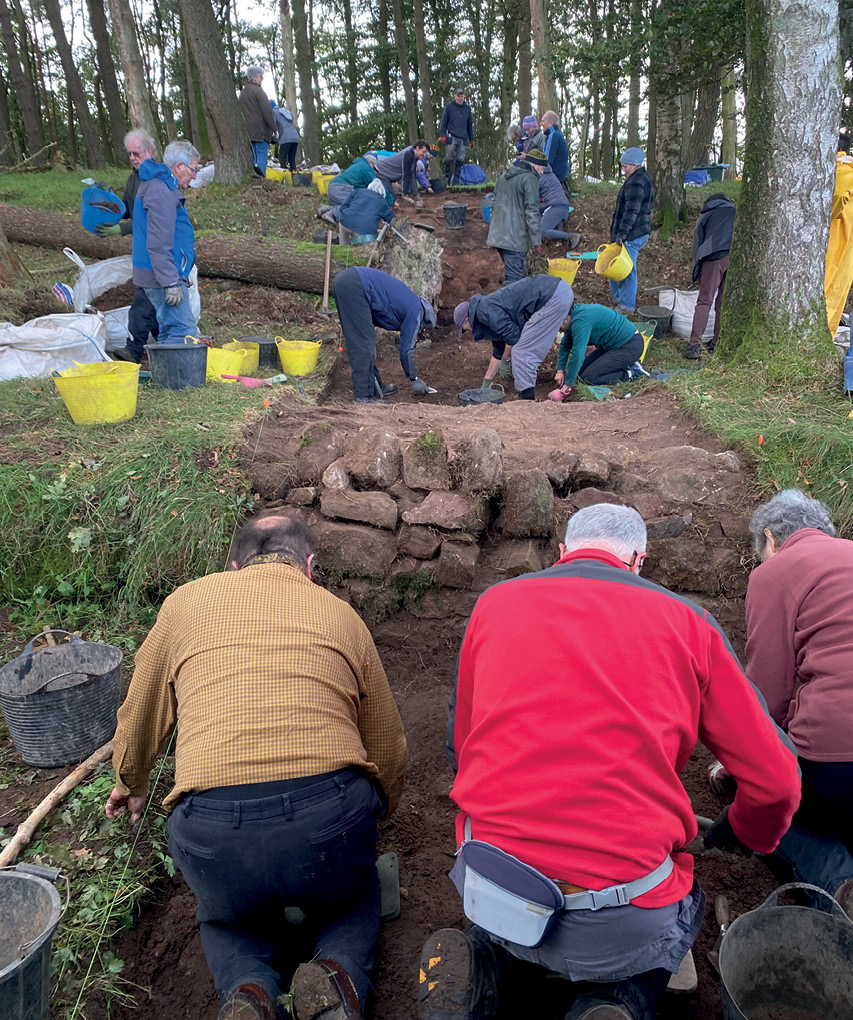
The hillfort of Dinas Powys, located about 9km south-west of Cardiff, was first excavated by Leslie Alcock in the 1950s. While the excavation and its subsequent report were pioneering for their time and led to Dinas Powys being widely considered a ‘type site’ for elite post-Roman settlements in western Britain, the proposed chronology for the site has been repeatedly called into question over subsequent decades. Now a new long-term project has re-analysed and re-dated the material excavated 70 years ago, establishing a new timeline for the site’s development that was recently published in Antiquity (https:// doi.org/10.15184/aqy.2023.156).
Dinas Powys is defined by four sets of banks and ditches (below). Based on their layout, it appears that Bank 2 was built first, followed by Banks 1 and 3, and then finally Bank 4. There is also a separate area of earthworks, located 140m further to the south, called the ‘Southern Banks’ or Ty’n-y-Coed earthworks. Alcock did not see Dinas Powys as a hillfort, and originally proposed a six-phase chronology of the site: Phases 1 and 2 were defined by undefended pre-Roman settlement activity, followed by Phase 3, characterised by a small quantity of Roman material; there was then an ‘early Christian’ Phase 4, associated with an impressive artefact assemblage but only small earthworks (Bank 2); and finally, after several hundred years of abandonment, there was a Norman-period Phase 5 and 6, when an multivallate ‘ringwork castle’ was constructed by the addition of the substantial Banks 1, 3, and 4.

Thus, while Alcock associated the most impressive earthworks with the Norman-period castle, the rich artefact assemblage, which included evidence for fine metalworking and high-status imported pottery and glass, was associated with the diminutive Phase 4 settlement, dating to the 5th to 7th centuries AD. It is this latter part of the chronology that has been revisited most frequently – first, because Alcock’s argument for Bank 1 being part of a Norman castle was largely based on just five sherds from a single Norman-style vessel, and also because there are no known parallels for such defensive works. With the advent of modern dating methods, which can use small samples for radiocarbon dating, such theories can be interrogated in more detail, and a team from the Universities of Cardiff, Glasgow, and Aberdeen have now re-dated eight charcoal samples from Alcock’s original excavation – six of which came from features that were supposedly from Phase 5 and 6. All the new radiocarbon dates fell within the 5th to 7th centuries AD, with Bayesian modelling indicating that activity began c.AD 510-600 and did not stretch beyond the 7th century (c.AD 590-680). This suggests that the site was relatively short-lived, being used for no more than 145 years.
Based on all the available evidence, the team have therefore put forward a new chronology for the site, with a new Phase 1 defined by Neolithic/early Bronze Age activity as evidenced by prehistoric pottery and flint-knapping. Phase 2 dates to the middle to late Bronze Age/early Iron Age, with post-holes dating to this period found, possibly enclosed by Bank 2. Phase 3 is then characterised by evidence of a late Iron Age/early Roman settlement ‘enclosure’ at Ty’n-y-Coed.
The most prominent period of activity, however, undoubtedly began in the early medieval period, which the team have split into sub-phases for greater clarity. The first, Phase 4a, is defined by high-status settlement activity within the area enclosed by Bank 2, including evidence of metalworking and Mediterranean imported pottery. Then, in the 6th-7th centuries (Phase 4b), Banks 1, 3, and 4 were most likely constructed and evidence of high-status occupation continued, although trade shifted from the Mediterranean region to focus more on southern France. Phase 5 relates to the abandonment of the site in the later 7th or 8th century, and Phase 6 is represented by late- and post-medieval pottery, which might be linked with either agricultural activity or casual visits to the site.
In all, this new phasing emphasises the importance of this site in the early medieval period, which may be linked with a short-lived kingdom in the Cardiff area. The team stress, however, that this is a very preliminary new timeline, which would greatly benefit from new excavations of the site.
Text: Kathryn Krakowka