Subscribe now for full access and no adverts
After almost 15 years of searching, the lost monastery of Deer may have finally been found, only 80m from the ruins of Deer Abbey in Aberdeenshire.
The search began in 2009 with a series of evaluations and small-scale excavations in and around the village of Old Deer. The existence of the monastery is known from landholdings written in the margins of the Book of Deer – a pocket Gospel book that contains the earliest surviving Gaelic writing and may be the oldest surviving manuscript from Scotland (a title that it contests with the Book of Kells) – but its exact location was unknown until now.
Until 2017, most excavations had been centred in and around the Old Deer Parish Church, but with little evidence of medieval activity found during these investigations, the team changed tactics and began to explore the fields surrounding the ruins of the Cistercian Deer Abbey, which are perched high on a natural terrace overlooking the river. This proved to be a fortuitous move, as the 2017 excavations quickly began to reveal 12th- to 13th-century remains including a stone hearth, charcoal, and pottery fragments, as well as a line of stake-holes from a possible post-and-wattle windbreak (see CA 338). This hinted that they were on the right track, and in 2018 more evidence presented itself in the form of post-holes dating to the mid-7th/mid-8th century and a track dating to the mid-10th to early 13th century, as well as a game board used to play the Norse strategy game hnefatafl (see CA 343).
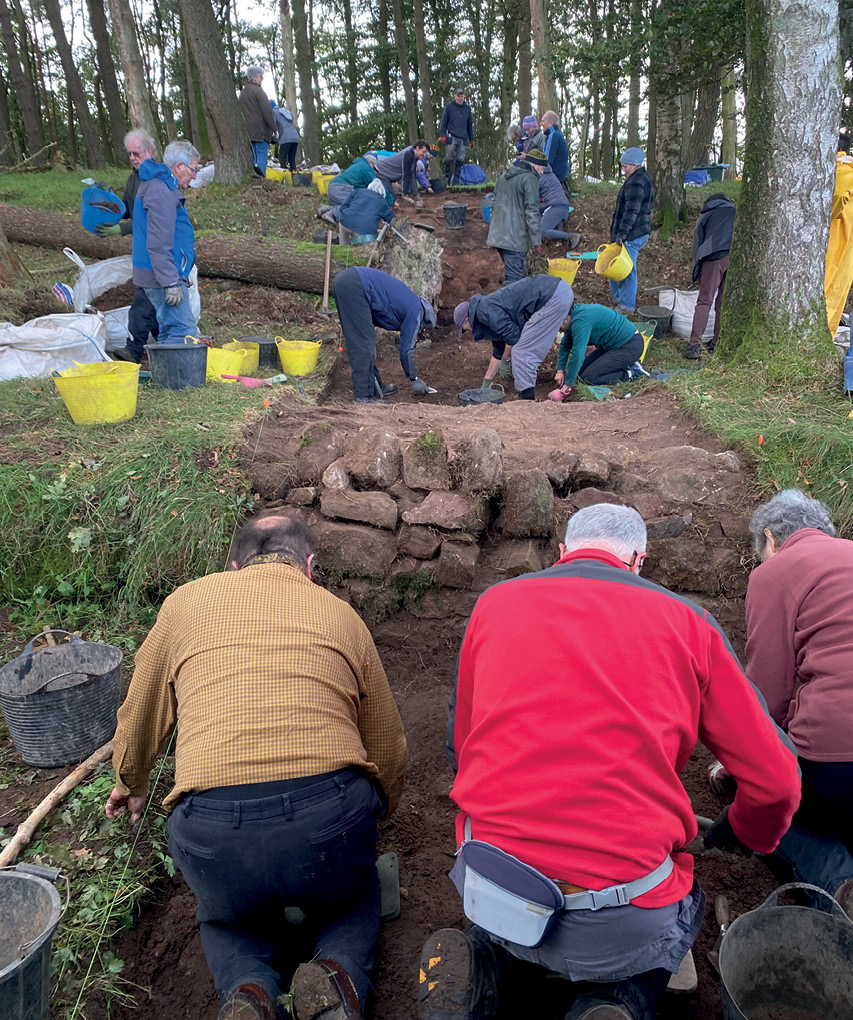
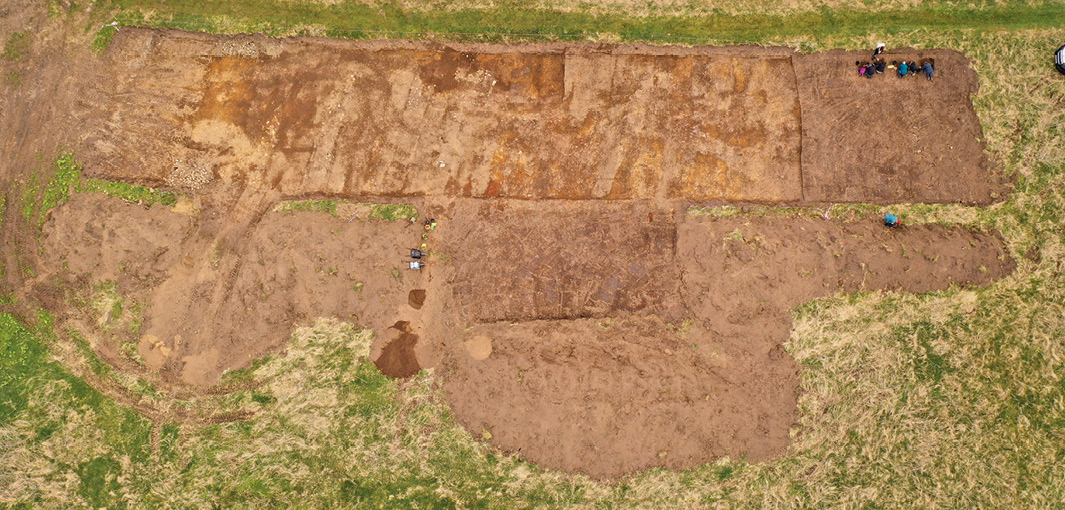
The latest excavations, carried out in 2022 – led by Alison Cameron of Cameron Archaeology and Alice Jaspars from the University of Southampton, and funded by the National Lottery Heritage Fund – have provided the clearest evidence yet for the lost monastery’s location. After expanding the scope of previous investigations in order to understand better the nature of the site, they opened two large trenches (above). These revealed a total of 19 post-holes (although they did not pick out the footprint of an obvious structure), as well as small finds including pottery, fragments of glass, a writing stylus, and more hnefatafl gaming pieces, which continued to point to early medieval activity on the site.
Radiocarbon analysis held the key to making sense of these remains, and, with the results now back, the team have been able to identify three distinct phases of medieval activity. Two post-holes and a ditch were found to date to the mid-7th to early 8th century, another series of post-holes had been created in the mid-10th to early 12th century and, most excitingly, three post-holes forming a straight line were found to date to AD 1150-1230, the period right before construction began on nearby Deer Abbey. With the two sites located just 80m apart, it is suggested that the lost monastery of Deer had originally been built in timber, and was then replaced in stone in the 13th century – a not-uncommon practice at this time.
While the 12th- to 13th-century activity is believed to be linked to the lost monastery, it is unknown how, or if, it relates to the earlier medieval activity. It is hoped that, as post-excavation analysis of the project continues, more details will emerge – watch this space for further news in CA, and you can hear more from Alison and Alice at our annual conference on 24 February (see here).
Text: Kathryn Krakowka