Subscribe now for full access and no adverts
Work by Cotswold Archaeology has revealed the evolution of a farmstead known as Cowfield Farm, from its medieval origins to its redevelopment in the 18th century.
When the centuries-old brick farmhouse at Cowfield Farm burnt down during a fire in 2004, subsequent redevelopment by Robert Hitchins Ltd provided the opportunity for Cotswold Archaeology to investigate the site. This location is first mentioned in documentary evidence in 1535, when it was part of a freehold estate belonging to Tewkesbury Abbey, but it has now been found that its origins lie much earlier in the medieval period.
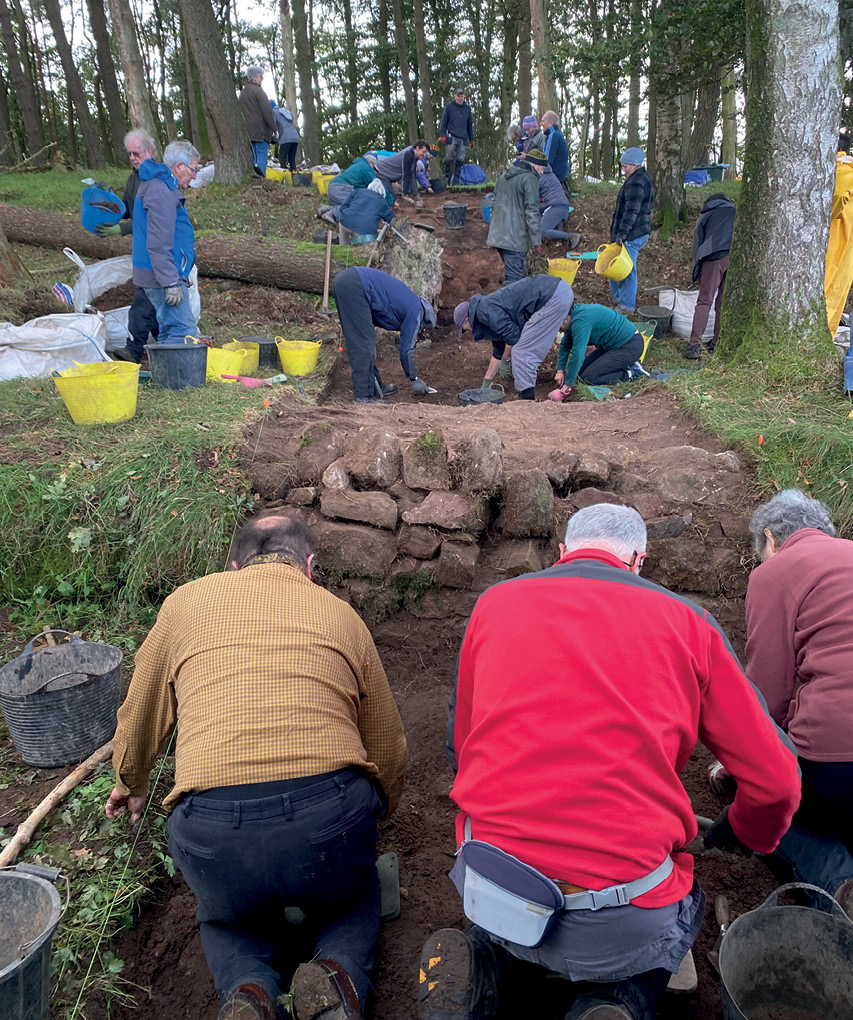
Cotswold Archaeology’s excavations have revealed this early history, showing that the original farmhouse was built within a rectangular enclosure and probably dates to the 12th to 13th centuries. While no buildings from this period survive, rubbish found in the enclosure ditch provided evidence of the farmhouse’s existence; this original structure must have been demolished at some point and a new, stone one built. Although there are only a few remains from this iteration of the farmstead, a large cornerstone suggests that it was a substantial house whose status might have reflected the wealth of the monks from Tewkesbury Abbey, who owned it. Encompassing the building was a large rectangular moat that would have been for protection as well as to serve as an additional symbol of the farm’s status (below). North of the moat, it seems that a large aisled building – possibly a cowshed – was built. Historical records from this period suggest that the farm was then a centre specialised in cattle rearing, known as a vaccary.
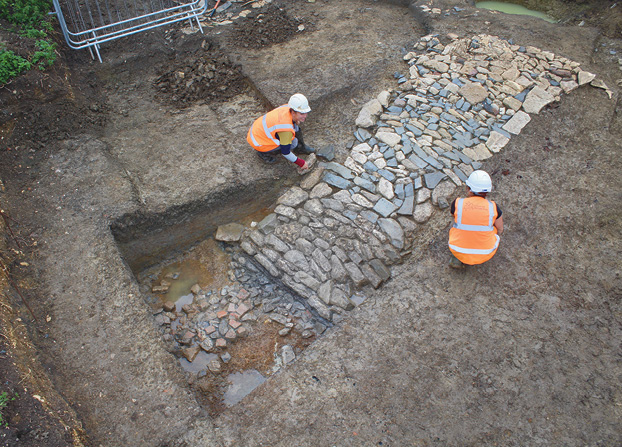
Although the moat has been dredged too many times to contain material that might provide an accurate date, part of a wooden bridge was discovered by the excavation team and dendrochronologically dated to the mid-15th century. While this provides a date for when the moat was in use, it – and the stone farmhouse – could have been constructed earlier.
Small finds from the site also attest to the farmstead’s relative wealth, including a ceramic dripping tray for roasting meat, a pilgrim badge depicting the Archangel Michael defeating the Devil (which might be from Mont St-Michel in France), as well as a copper-alloy book fitting, which may have been lost by a Tewkesbury Abbey monk recording aspects of the farm.
After several centuries of use, the medieval house and barn were then demolished to make way for the brick farmhouse in the mid-18th century, which then stood there until 2004. The full publication of the excavation is available for free on Cotswold Archaeology’s website: search for ‘Cowfield Farm’ on the database at https://reports.cotswold archaeology.co.uk.
Text: Kathryn Krakowka