Subscribe now for full access and no adverts
Egypt has an incredible number of surviving monuments, many still standing to a substantial height, but there are many others that have little or no trace remaining. One such is the so-called ‘Labyrinth’ (or maze). It has almost disappeared, but clearly impressed Classical writers. Herodotus (c.484-425 BC) and Strabo (c.64 BC-AD 24) both declared the monument to be equal to or greater than the pyramids in grandeur.
I have seen it myself, and indeed words cannot describe it…Though the pyramids beggar description and each one of them is a match for many great monuments built by Greeks, this maze surpasses even the pyramids.(Herodotus, Histories 2.148.1-3)
the Labyrinth, a work equal to the Pyramids…
(Strabo, Geographica 17.1.37)
Location
Herodotus describes the location of the Labyrinth as being ‘a little way beyond Lake Moeris, and near the place called the City of Crocodiles’ (the capital of the Fayum, also known as Arsinoë) and also writes that ‘near the corner where the Labyrinth ends stands a pyramid’. Strabo wrote that the Labyrinth had ‘adjoining to it the tomb of the king who constructed [it]’ and that he came across it ‘after proceeding beyond the first entrance of the canal [joining the Nile to Lake Moeris] about 30 or 40 stadia, [where] there is a table-shaped plain, with a village and a large palace’.
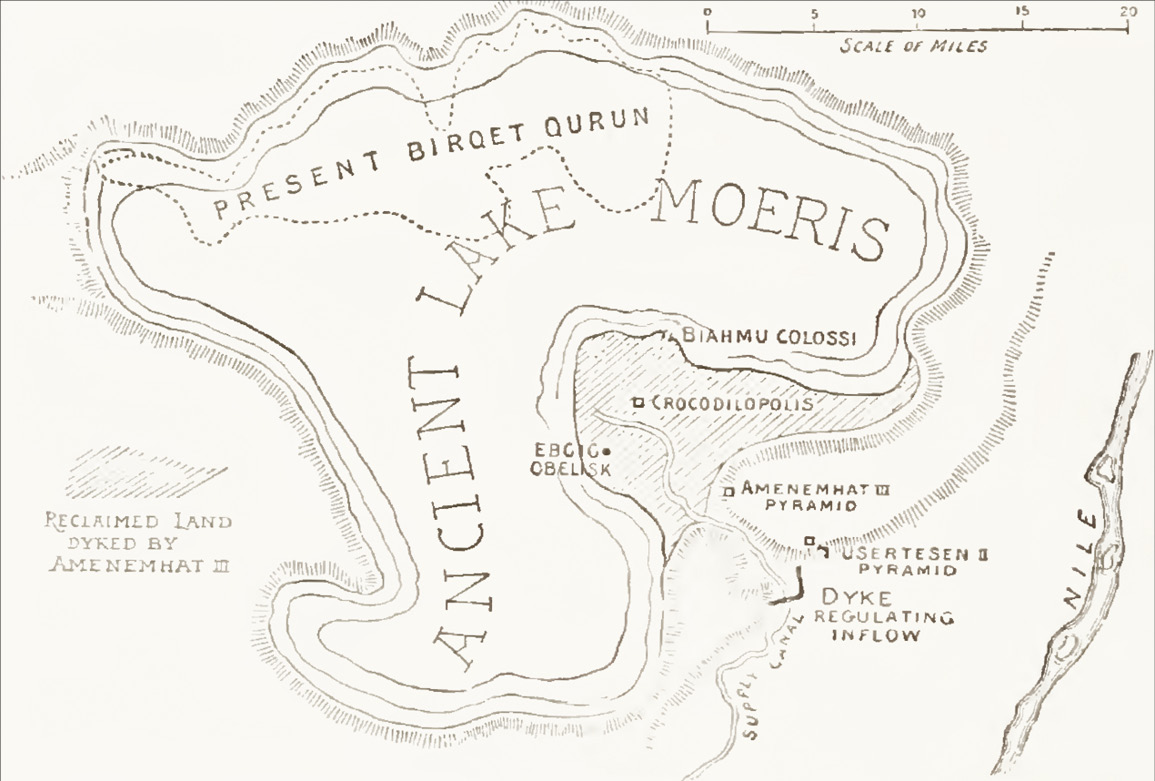
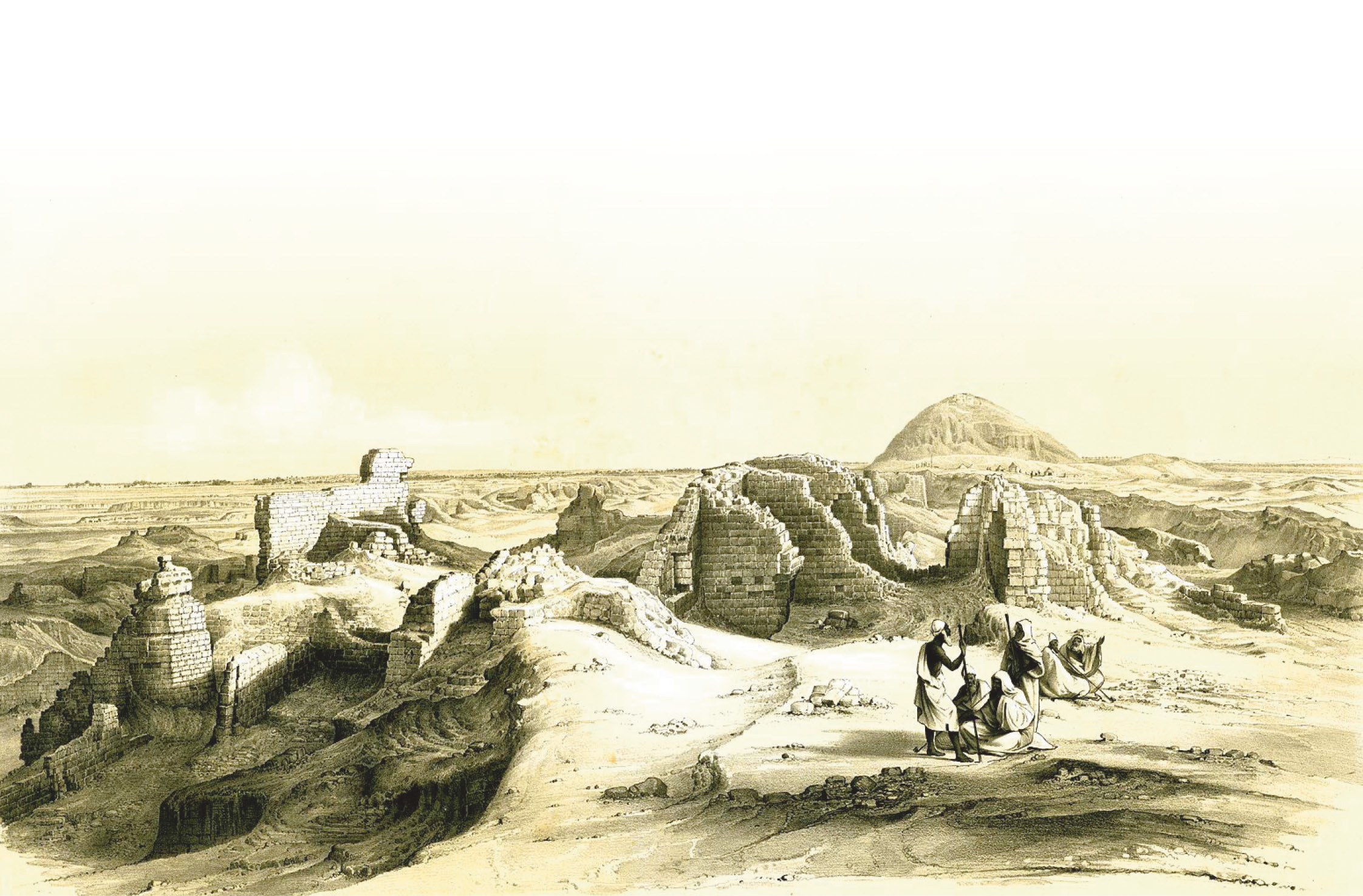
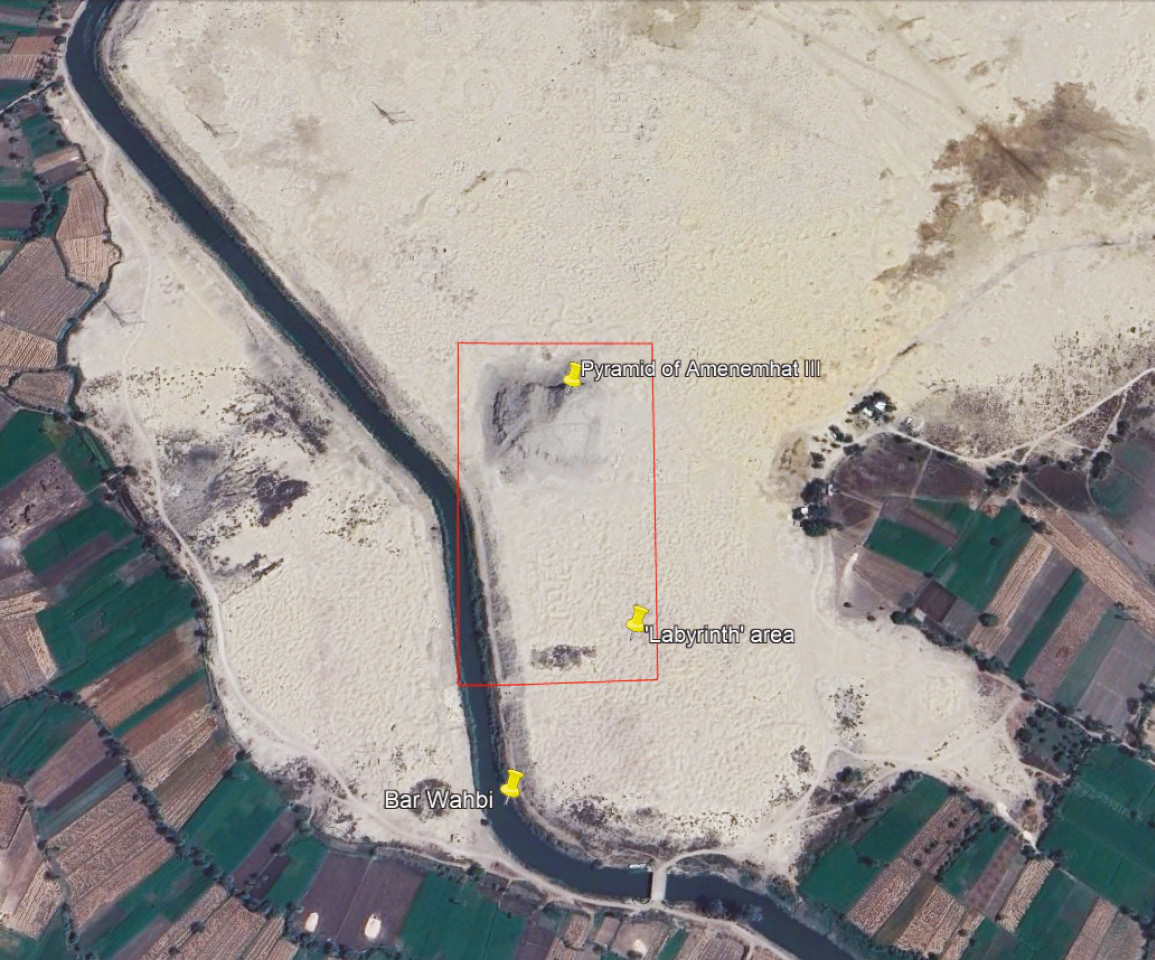
In the 17th century, the Jesuit priest Father Claude Sicard proposed modern-day Hawara as the location of the Labyrinth, based on ancient descriptions. Even though this area does not quite match the distance of the Labyrinth from the mouth of the canal given by Strabo, it seems the only likely candidate. What is more, Hawara is the location of the eroded mud-brick core of the pyramid of the Twelfth Dynasty pharaoh Amenemhat III (c.1855-1808 BC), which is probably the ‘tomb’ referred to by Strabo. Hawara is located on a projecting spur of land, within a gap in the hills through which the canal flows to the Fayum Oasis. A new, small canal was built across the site in the 13th century AD.
Ancient descriptions
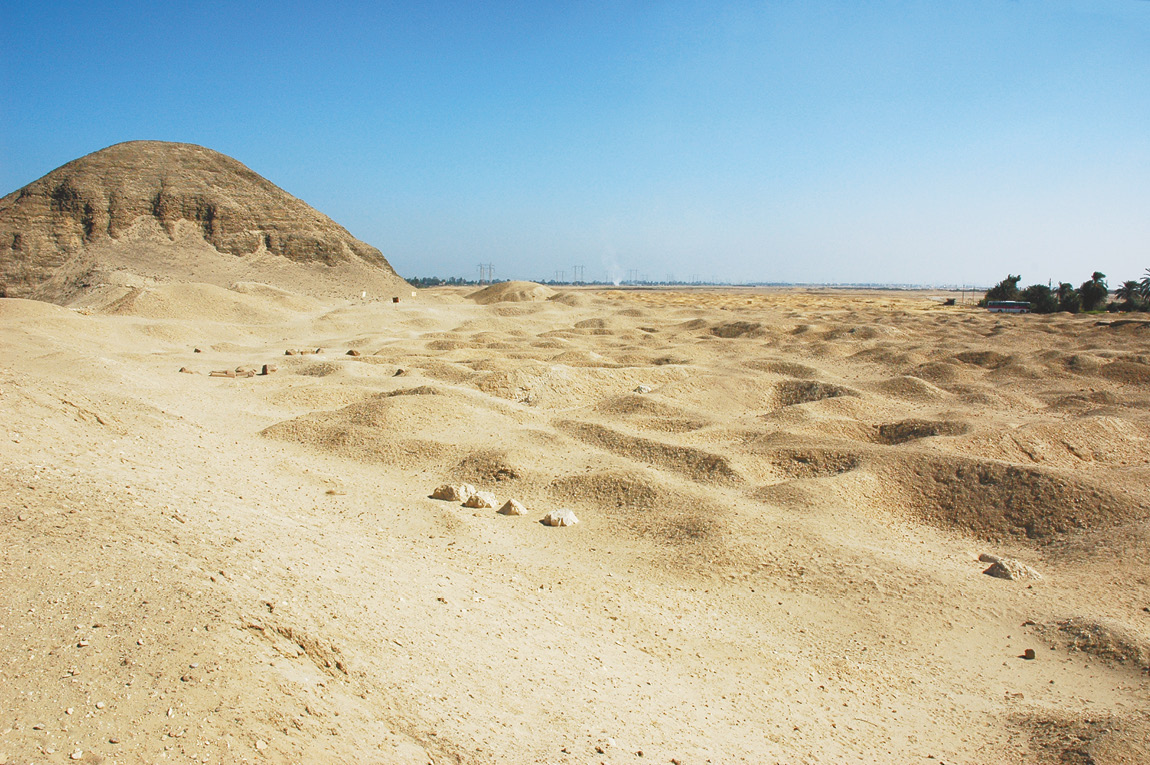
Today, only scanty archaeological remains surround the pyramid itself at Hawara, and, thus, any sense of what the Labyrinth was like depends mostly on the written descriptions from the six ancient authors who mention the Labyrinth, including the aforementioned Herodotus and Strabo, but also the 3rd century BC priest Manetho, Greek historian Diodorus Siculus (1st century BC), the Roman writer Pliny the Elder (c.AD 23-79), and the Roman geographer Pomponius Mela (writing c.AD 43).
The building near the pyramid at Hawara was referred to as a ‘Labyrinth’ because authors such as Pliny suggested ‘that Daedalus used this as the model for the Labyrinth which he built in Crete is beyond doubt, but it is equally clear that he imitated only the hundredth part of it which contains twisting paths and passages… all impossible to negotiate’ (Naturalis Historia 36.13). However, Manetho merely refers to the Labyrinth as a ‘tomb’. Further, Alan Lloyd has suggested that only Herodotus and Strabo actually visited the site of the Labyrinth, while the other reports are second-hand, being based only on hearsay.
Herodotus reported that the Labyrinth:
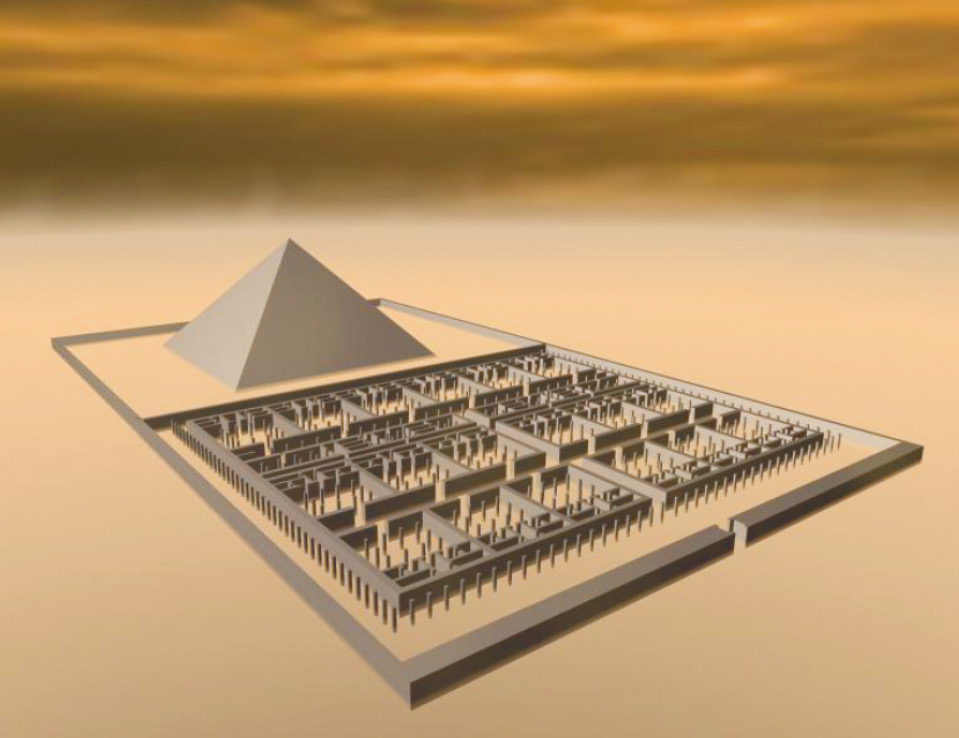
has twelve roofed courts with doors facing each other: six face north and six south, in two continuous lines, all within one outer wall. There are also double sets of chambers, three thousand altogether, fifteen hundred above and the same number underground… The exits of the chambers and the mazy passages hither and thither through the courts were an unending marvel to us as we passed from court to apartment and from apartment to colonnade, from colonnades again to more chambers and then into yet more courts. Over all this is a roof, made of stone like the walls, and the walls are covered with cut figures, and every court is set around with pillars of white stone very precisely fitted together.
In contrast, Strabo said that the Labyrinth consisted of:
a large palace composed of as many palaces as there were formerly nomes. There are an equal number of aulæ [courts/chambers], surrounded by pillars, and contiguous to one another, all in one line and forming one building, like a long wall having the aulæ in front of it. The entrances into the aulæ are opposite to the wall. In front of the entrances there are long and numerous covered ways, with winding passages communicating with each other, so that no stranger could find his way into the aulæ or out of them without a guide. The [most] surprising circumstance is that the roofs of these dwellings consist of a single stone each, and that the covered ways through their whole range were roofed in the same manner with single slabs of stone of extraordinary size, without the intermixture of timber or of any other material. On ascending the roof, which is not of great height for it consists only of a single storey, there may be seen a stone-field, thus composed of stones. Descending again and looking into the aulæ, these may be seen in a line supported by twenty-seven pillars, each consisting of a single stone. The walls also are constructed of stones not inferior in size to these.
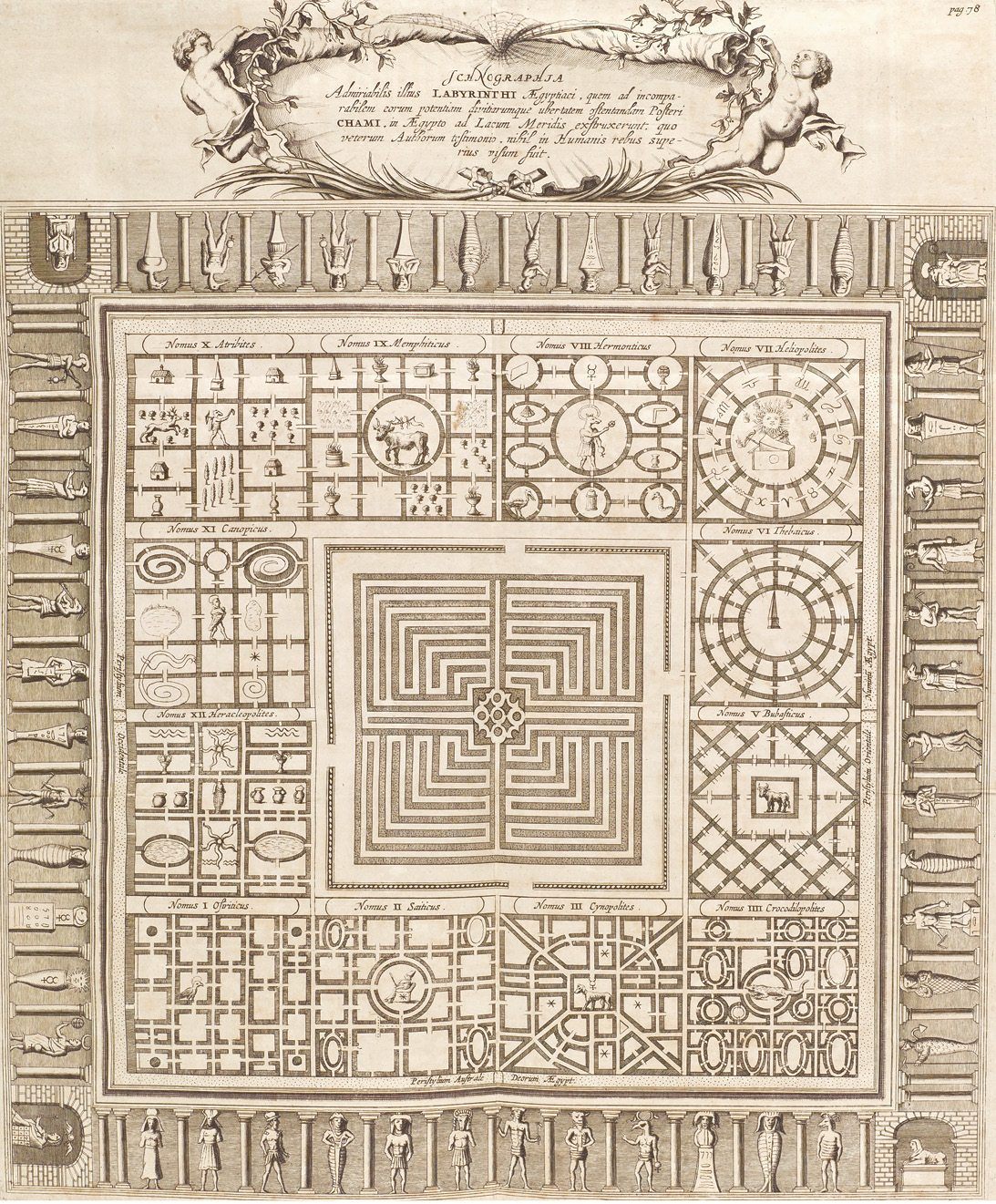
The sub-‘palaces’ referred to by Strabo were probably similar to the structures Herodotus called ‘courts’. Flinders Petrie suggested the total number of nomes in Egypt was 42, with 22 in the Fayum alone. The latter figure is more similar to Herodotus’ account, but is still significantly different. Hence, the accounts of even those authors perceived as the more reliable sources differ on the fundamental number of courts/chambers.
Some of the uncertainty in the descriptions arises from doubts around the correct translation from the original Greek of certain terms used in the ancient texts. For example, at the location in the text above translated as ‘roofed courts’, Herodotus used a Greek term that can be roughly transliterated as aulæ katastegoi. However, in Homeric Greek, the singular aula would refer to an open courtyard before a house, but the descriptor katastegoi means ‘roofed-over’, which Alan Lloyd regards as a contradiction in terms. However, this apparently self-contradictory term may have been used because Herodotus was struggling to describe the novel (to him) Egyptian architecture in terms meaningful to his intended Greek readership. The roofed part may have just been a peripheral colonnade surrounding an otherwise open space. Attempts to reconcile the descriptions of Herodotus and Strabo have suggested that Herodotus only got to see the outer part of the complex, while Strabo was allowed to get further in, perhaps because the outer parts had already been destroyed in the intervening period.

Petrie developed a reconstruction of the Labyrinth based on an attempted unification of his own observations, those of Lepsius before him, and the descriptions by Herodotus, Strabo, and the others. He accepted that the particular array of chambers that he reconstructed bore no similarity to the typical ground-plan of Egyptian temples, but he further proposed that this is what had led to the confusion experienced by the ancient Greek and Roman visitors, and, thence, the associations with the Cretan Labyrinth.

Finds from archaeology
The first recorded visit to the site of the Labyrinth was by the French engineers Caristie and Martin in 1800. They described a surrounding wall, and maybe the remains of the peristyle of a funerary temple, with eight to ten columns lying beside their bases. The Labyrinth was also visited by Vyse and Perring (in 1842), and by John Gardner Wilkinson, who published his description of the site in 1843. At the temple site, Wilkinson noted red granite capitals.

However, the most thorough account from the 19th century was by Prussian Egyptologist Karl Richard Lepsius. Lepsius observed a great platform on which the pyramid and buildings to the south of it had once stood. Lepsius found many Roman mud-brick remains, too, which at that time still existed on the western part of the site, mistaking these for the Labyrinth.

Petrie excavated on the site in 1888. Since the Labyrinth was built on open desert ground, Petrie did not have even the lines of a sand substratum remaining to aid him in reconstructing the ground plan, as would have been so if it had stood on Nile silt deposits. The site had been used as a limestone quarry since antiquity, with the last blocks removed to help build a railway in the 19th century. Hence, the whole site south of the pyramid was covered in a layer of limestone chips, reported by Petrie. He also wrote that the main rectangular structure would have been about 1,000 by 800 feet (304 by 244 metres), which would make it bigger than the temple of Karnak. This rectangle was divided roughly in half, east to west, by a wall running along its middle, and Petrie unearthed the foundations of a great retaining wall at the southern end as well. Further, along the western boundary of the site, Petrie also found the ruined traces of two stone walls, separated by a space. In the southern area of the rectangle, a large quartzite sandstone door jamb was discovered close to the extended middle axis of the pyramid, which suggested it was part of a great entrance to the Labyrinth building. Column fragments suggested that the roof had been barrel-vaulted. It seemed, too, that the red granite columns only occurred north of the central dividing wall. Since fragments of stone building materials were found, this suggested the site was a temple, rather than a palace or administrative centre, which would have been typically built in mud bricks.
Amenemhat III
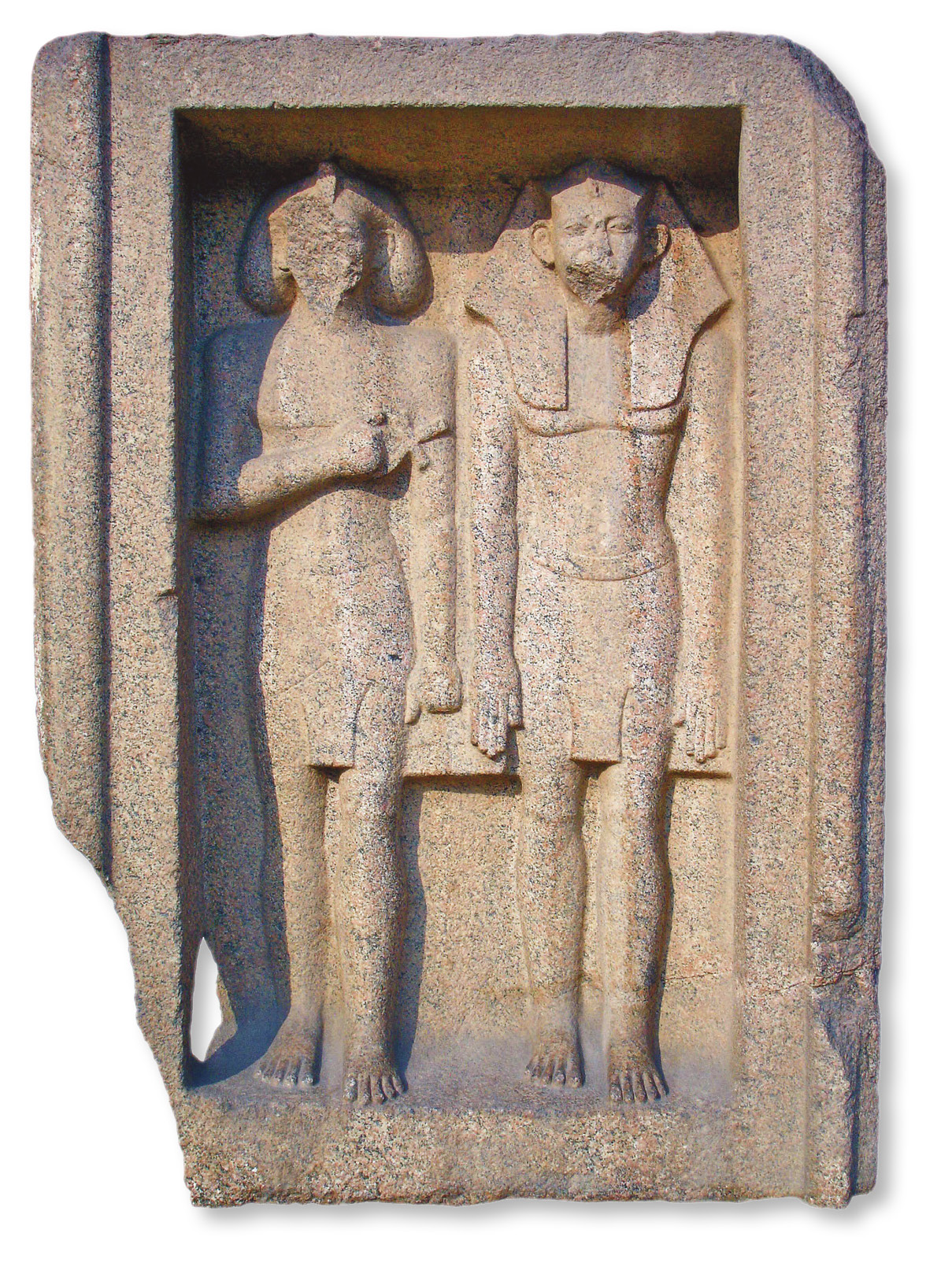
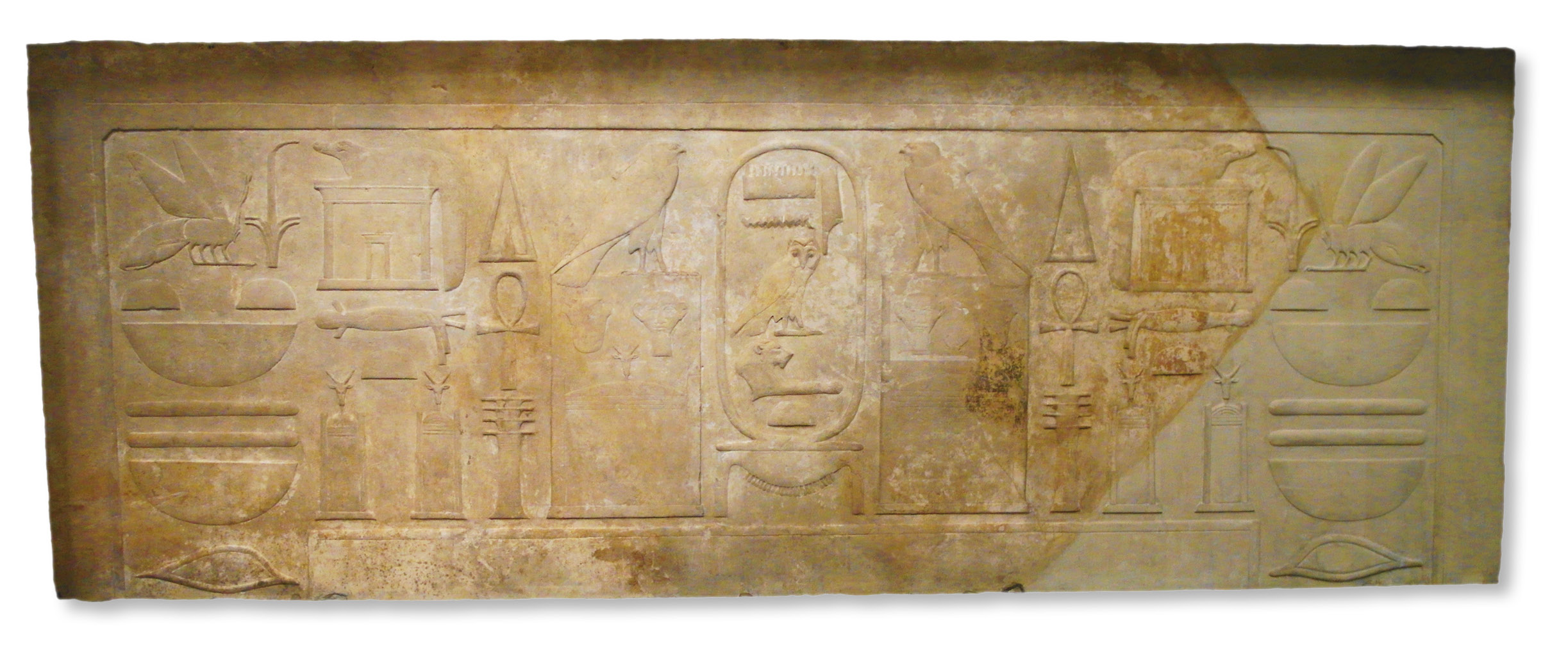
The site was identified as having been built by Amenemhat III due to fragments of red granite architraves bearing his cartouche and also the name of his daughter Sobekneferu found within the pyramid enclosure. To the south of the pyramid, just east of the central axis, two red granite shrines were discovered, with remnants of another one found to the west of the central axis. Each of these shrines contained two sculpted figures of Amenemhat III.
In addition, several other fragments of statues were unearthed to the east and south-east of the shrines, as far as the eastern edge of the pyramid. These included fragments of white limestone statues of the goddess Hathor, the god Sobek, a goddess wearing a tall headdress composed of four palms or feathers, and Amenemhat III accompanied by two goddesses holding fish. These statues suggest the presence of many shrines to the king and the gods that could have constituted Strabo’s many ‘palaces’. To the east and north-east of the pyramid, a great cemetery area was found containing shaft-tombs and mastabas. Petrie called this ‘the area of crocodile burials’, which may also be the pteron (or ‘wing’) that was mentioned by Pliny.
A different approach
Given the lack of archaeological remains, and the conflicting nature of the ancient written sources, Eric Parrington Uphill (1929-2018) attempted a different approach to reconstructing the original Hawara site. This was based on combining architectural elements derived from a comparative examination of, and making parallels with, the diverse remains of the other known Twelfth Dynasty pyramid complexes of Amenemhat I, Senusret I, Amenemhat II, Senusret II, and Senusret III, and also a second pyramid complex that Amenemhat III located for himself at Dahshur.

Uphill proposed that the Labyrinth had been much smaller than the ancient descriptions and Petrie had suggested. Instead, Uphill suggested the buildings south of the pyramid consisted of a collection of different structures, including a dock and quay by the canal, a valley temple, a causeway, and a mortuary temple next to the pyramid itself, which had originally possessed a colonnaded court and a sanctuary containing the shrines with images of the king. In addition, based on observations from Dahshur, Uphill proposed the novel idea that the causeway was lined on both sides by arrays of three subsidiary pyramids (for queens) and their accompanying walled enclosures. These enclosures included funerary shrines and their accompanying passageways and storage chambers to both the north and south of each queen’s pyramid, such that those of two neighbouring pyramids faced each other. It was these two sets of 6 structures that could have constituted Herodotus’s 12 covered courts.
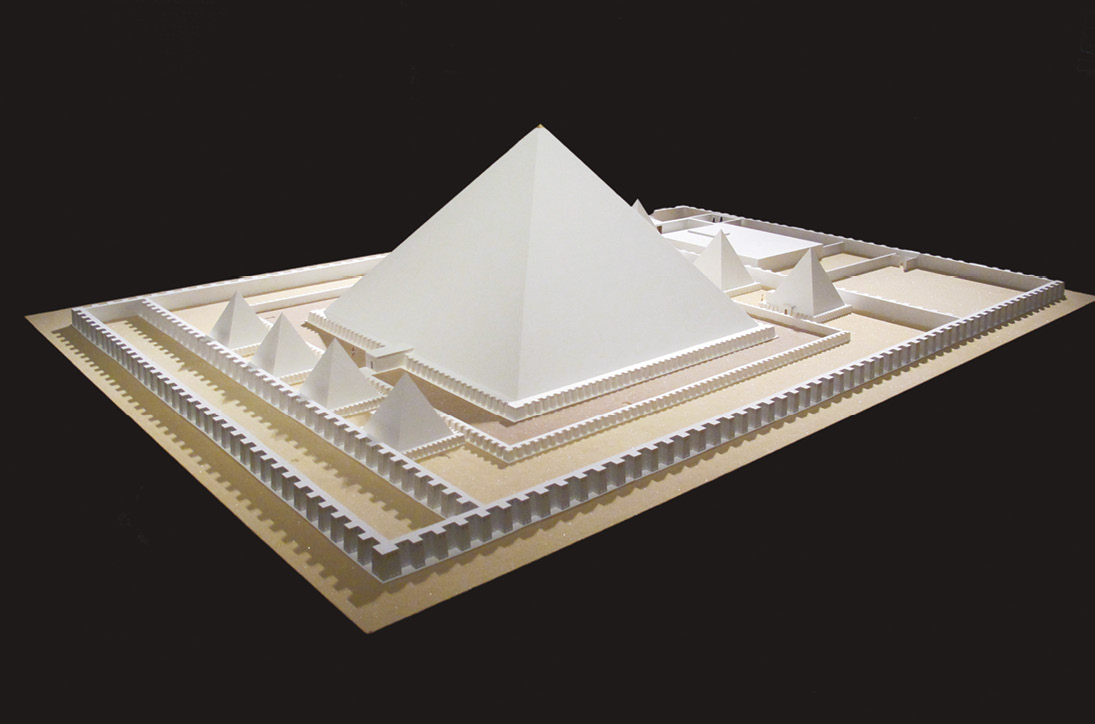
Further, Uphill suggested that the number of 1,500 chambers supposedly seen by Herodotus likely included the various chambers of the mastabas and other tombs to the north-east of the pyramid, and not just the mortuary temple complex to the south. The number of shafts down to tombs would have suggested a corresponding number of chambers underground, but it is possible too that Herodotus over-schematised his reports – a habit he is often accused of by modern historians. So, rather than one huge monument, it was the overall impact of this extensive and confusing mixture of monuments that may have impressed the ancient writers enough to liken it to the Labyrinth of Crete.
Mystery solved?
It seems likely that the rather over-exaggerated descriptions of the ancient authors may have arisen from their unfamiliarity with Egyptian architecture, and subsequent sensationalist attempts to describe the Labyrinth in terms their Graeco-Roman readership could comprehend, and find impressive. The current lack of definitive evidence means the Labyrinth can be reconstructed in many and diverse ways. Hence, until much more systematic and wide-ranging modern excavations are carried out at the site, a reliably authentic reconstruction of the Labyrinth is not possible.
Sean Rigby is Professor of Chemical Engineering at the University of Nottingham, UK, where his research interests include ancient glass manufacture. He holds MAs in Ancient History and Ancient Religions from the University of Wales Trinity Saint David (UWTSD).
Further reading:
• A B Lloyd (1970) ‘The Egyptian Labyrinth’, in Journal of Egyptian Archaeology 56: 81-100.
• W M F Petrie (1889) Hawara, Biahmu, and Arsinoë (London: The Leadenhall Press).
• E P Uphill (2016) Pharoah’s Gateway To Eternity (London: Routledge).