
Subscribe now for full access and no adverts
After the disappointing setbacks at the Battles of Trenton and Princeton, in December 1776 and January 1777 respectively (see MHM 149, December 2025/January 2026), Great Britain’s Secretary of State for the Colonies Lord Germain was no longer inclined to allow his country’s commanders on land and sea – General William Howe and his older brother, Admiral of the Fleet Richard Howe – to pursue a negotiated end to the fast-escalating rebellion on America’s eastern seaboard. While General Howe was in London for a visit, he was given a more determinative mission. With a greatly reinforced army available, he would now concentrate his efforts to split New England from the other rebellious colonies.
A three-pronged effort was devised, whereby two columns led by General John Burgoyne and Colonel Barrimore Matthew ‘Barry’ St Leger would move south from Canada, while General Howe (now Sir William) moved his forces north from New York City, thus encircling rebel forces in the north-eastern part of the colonies. The plan began well, with St Leger moving down the St Lawrence River and then into western New York State, and Burgoyne moving due south from Montreal, intending to link up with General Howe, who would be moving north. The prospective meeting point was Albany, 150 miles north of New York City.
Brash and fearless, General Burgoyne, who had originally convinced Germain of this plan, was convinced that he alone would be able to provide King George III with the complete victory over the rebels. ‘Gentleman Johnny’ (as he was known in London) cut quite a figure as an experienced soldier, playwright, and Member of Parliament – but, as his noted fellow parliamentarian and writer Horace Walpole observed sourly, he was also a ‘very vain, ambitious man with a half understanding which was worse than none’. These latter traits would come back to haunt the Crown.

Into the wilderness
Burgoyne’s campaign to slice off New England from the rest of the colonies began well. He had assembled an impressive force of nearly 8,000 men, including British regulars, Hessian professionals (German mercenaries hired by the British), assorted Loyalist volunteers, and nearly 1,000 Native American warriors, along with 138 pieces of artillery. Moving roughly parallel to this column was the command of Colonel ‘Barry’ St Leger, including some 1,800 men in a combined force of British regulars and Hessian infantry. They were accompanied by Loyalists and a smaller number of Seneca and Mohawk warriors as they generally followed the Mohawk River.
Launched in late June 1777, the campaign – later to be known as the Saratoga Campaign – got off to a very good start, as Burgoyne’s force floated down the length of Lake Champlain, which stretches around 100 miles south from the Canadian border to Fort Ticonderoga, which they took without having to fire a shot. Moving further south, they went on to capture Skenesboro and Fort Edward, and won a battle at Hubbardton, south-east of Fort Ticonderoga, where a small force of British and Hessian troops under Brigadier General Simon Fraser inflicted a number of casualties on the rearguard of the rebel forces. Although a British victory, the fight at Hubbardton had cost them as well as the rebels. The losses accentuated the toll being taken on Burgoyne’s army as supplies began to run low and troops found themselves working feverishly to cut through the American wilderness.
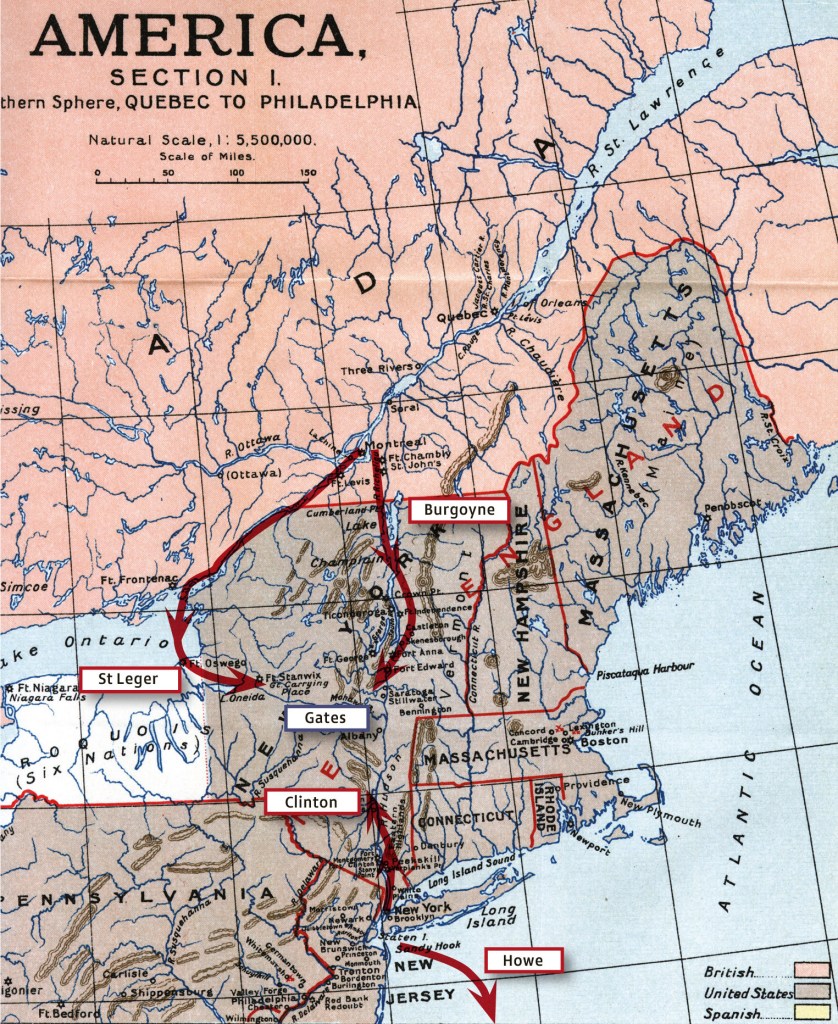
As Burgoyne’s column inched forward through the forests, St Leger’s force was facing difficulties of its own. Having successfully invested (surrounded) an American force established at Fort Stanwix, St Leger, unable to persuade the defenders to capitulate, laid siege to the place. The bulk of the attackers were Native Americans, who also bore the brunt of casualties inflicted by the rebel marksmen. Receiving word of an American relief force approaching, St Leger realised that his efforts would be fruitless and abandoned the siege to return to Canada. At roughly the same time as St Leger’s force was turning back, General Howe’s role as the third prong of the offensive was being drastically reduced. With the forces of his opposing commander-in-chief, George Washington, in retrograde, Howe had decided on making a bold stroke at the rebels’ capital in Philadelphia. While he was leaving some 7,000 troops with General Henry Clinton in New York, he embarked more than 13,000 others on ships for a move south, just as Burgoyne was manoeuvring painfully towards Albany.
Meanwhile, Burgoyne continued to pursue his objectives – which included an admonition to his Indian allies to ‘overtake the harden’d Enemies of Great Britain and America (I consider them the same) wherever they may lurk’. It sounded well but had deleterious results in that it provided a great stimulus to the colonists’ efforts at propaganda. Thus, when a young woman named Jane McCrea was killed and scalped, purportedly by a pair of Burgoyne’s Wyandot Indian allies, news of the death spread like wildfire through the colonists’ newspapers. It did not matter that the victim was engaged to a Loyalist lieutenant attached to Burgoyne’s command.

When Burgoyne considered prosecuting the warrior who had brought the dead woman’s scalp into camp, he was dissuaded by the thought that punishing an Indian ally would antagonise his other Indian allies, leaving him essentially blind in the wilderness. By then, however, the damage had been done – and, by late August 1777, reports of Miss McCrea’s death had been published as far away as Virginia. The effect on recruiting for rebel militias was electric, with thousands of men flocking to serve against the British and their Native American allies.
Also that August, the command of the Northern Department of the rebel forces was handed by Congress to General Horatio Gates, a former British army officer who had seen extensive service in North America during the French and Indian War. A meticulous commander, he was also a very cautious one, favouring defensive actions against the British. Even though his army had swelled to more than 25,000 men, he was leery of taking on Burgoyne’s offensive – basing this perhaps partly on the rather disorganised and unpredictable nature of his volunteer soldiers. Thus Gates was willing to establish strong defensive positions, and to await his enemy’s arrival.

Bitter ends, new beginning
Gates did not have to wait long for the confrontation, which began as Burgoyne, realising he was running low on supplies, dispatched a force of Hessian troops to seize rumoured stocks at Bennington, north-east of Albany. On 16 August, the German soldiers blundered into a strong force of rebels led by the pugnacious (and later to become infamous) Benedict Arnold and a coterie of frontier marksmen, who killed their commander and captured nearly all of the 1,000 men in the unit. Burgoyne was distraught and blamed his Indian allies for allowing the Hessians to be lured into this disastrous fight. As a result of his rancour, most of the Indians abandoned the campaign, adding to a major success for the Americans.
Realising that St Leger’s expedition had turned back to Canada, and that reinforcement from New York City was unlikely to arrive in time, Burgoyne elected to push on. But a planned reconnaissance in force stumbled into Gates’s picquets (pickets) near the town of Saratoga, and battle was quickly joined. Under fierce pressure, once again led by Benedict Arnold, the British and Hessian forces were battered into submission, losing more than 900 men killed, wounded, or captured. On the American side, total casualties amounted to roughly 150. One of those wounded was Arnold, whose horse had been shot out from under him, the bullet breaking his leg in the process. By 13 October, the remnants of Burgoyne’s command, which had fallen back under pressure to Saratoga, were surrounded. On 17 October, General Burgoyne surrendered his entire command of more than 6,000 men to Horatio Gates and was accorded the full honours of war.
With this stunning reversal of fortune, the rebels’ prospects improved markedly. When news of the American victory at Saratoga reached Europe, the French foreign minister, the Count of Vergennes, again petitioned the French king Louis XVI to assist the American cause. The king was delighted: ‘America is exalted and England abashed,’ he observed. Thus, in February 1778, France declared war on Great Britain and became an ally of the fledgling American republic. But the war for independence was not nearly ended, and more challenges lay ahead. Meanwhile, Benedict Arnold, the impetuous and volatile warrior, was also abashed. Slighted by Gates, and negated by a Congress which refused to promote him, the injured soldier brooded over his treatment, and listened to the siren entreaties of his Loyalist wife. It would prove to be a recipe for trouble.
With Burgoyne’s surrender, the rebels’ prospects improved markedly.
As Horatio Gates and Benedict Arnold were thrashing Burgoyne’s hapless forces, General Howe had already left New York by sea, sweeping around the southern tip of New Jersey and then up Maryland’s Chesapeake Bay, intending to capture Philadelphia. Washington moved hurriedly to intercept the British thrust. As Howe’s 15,500-man force moved north towards the rebel capital, members of the Continental Congress scattered into the countryside. Meanwhile, Washington moved his 14,600 soldiers into a defensive position at Chadds Ford, along Brandywine Creek, some 31 miles south- west of Philadelphia.
The opposing sides were fairly evenly matched, but the rebels’ reconnaissance was deficient. Taking a page from his playbook used previously on Long Island (see MHM 149, December 2025/January 2026), Howe had a portion of his army probing rebel defences at Chadds Ford, while he took the bulk of his forces several miles to the west, where they forded the Brandywine and crashed into the rebels’ exposed right flank. As this force attacked, Hessian troops under General von Knyphausen launched a fierce assault on the rebels’ left flank at Chadds Ford – and, at this point, the American defences began to crumble. Opting to save his army from total destruction, Washington withdrew his forces, depending on the efforts of Brigadier General Nathanael Greene and the French-born Marquis de Lafayette to block British forces while the bulk of the American army escaped.
Thus Washington’s efforts to defend Philadelphia were in vain, thwarted by Howe’s superior generalship. Although the rebel forces had acquitted themselves well, they had also sustained nearly twice as many casualties as the British – so, with cold weather beginning to settle in and Howe soon in possession of Philadelphia, Washington decided to pull his forces completely out of contact and seek winter quarters. He found them in Pennsylvania at Valley Forge, 18 miles north-west of Philadelphia. With Howe’s forces having stripped the countryside of provisions, it would prove a hard winter for the American soldiers.

Winter of discontent
Unable to keep the British from occupying the rebels’ capital of Philadelphia, Washington needed a place to reorganise, re-equip, and train his bedraggled soldiers into an efficient, capable fighting force – one that would be able to take on the seasoned army of British regulars and Hessian professionals. Valley Forge appeared to be the most appropriate area for this task. It was a small community, featuring an iron forge and mills, and surrounded by rich farmlands. A good many of the commercial structures had been destroyed by a brief British foray into the area shortly after seizing Philadelphia. However, Washington and his staff determined that Valley Forge was well situated to keep an eye on British activities around the city, was well-suited to defence, and provided sufficient open ground for both an encampment and a training area.
Into this area, Washington led some 12,000 soldiers, who would proceed to build between 1,500 and 2,000 huts for shelter. The winter weather was an uncomfortable mixture of rain and snow, while the army itself was in abysmal shape. A large proportion of the troops were dressed in little better than rags, and many were without shoes. Owing to disease and malnutrition, as many as 2,000 would succumb during the six-month encampment. The Marquis de Lafayette, who had been badly wounded at Brandywine, would later recall: ‘the unfortunate soldiers were in want of everything; they had neither coats, hats, shirts, nor shoes; their feet and legs froze till they had become almost black, and it was often necessary to amputate them.’ Rations were worse than short. As Washington noted in a letter to Patrick Henry: ‘the situation of the Commissary’s department and of the army, in consequence, is more deplorable than you can imagine.’
Following Washington’s impassioned entreaties, a five-man Congressional delegation finally arrived in January 1778. Realising the plight of the suffering army, they spurred their fellow representatives to institute reforms for the maintenance and supply of the troops. As a result of their intervention, Washington was able to turn to his trusted friend General Nathanael Greene, putting him in charge of securing provisions for a rapidly dissolving army. Greene, assisted by General ‘Mad’ Anthony Wayne, scoured the countryside, accumulating provender for the troops and overcoming the serious want of transportation to carry supplies back to Valley Forge. It was a Herculean task – but one that showcased Greene’s masterful grasp of improvised logistics.
In addition to Greene’s efforts, a new factor appeared in camp with the arrival of Baron Friedrich Wilhelm August Heinrich Ferdinand von Steuben – a Prussian-born, seasoned veteran of the Seven Years War (1756-1763), now seeking opportunities for advancement and promotion in the military arts. In truth, he was precisely what the Continental Army needed at this point: appointed as an Inspector General, he spent hours inspecting the troops, and their billets, rations, and equipment, and went about establishing a training programme to instil discipline and drill the army in European tactics and techniques. As one American soldier later wrote, ‘never before or since have I had such an impression of the ancient fabled God of War, as when I looked at the baron’. Schooled by the irascible and irrepressible German veteran, the rebels learned how to march, how to assume and change formations, how to skirmish. They learned how to volley-fire and use the bayonet. As they became proficient, their confidence grew along with their morale.

Nor were Baron von Steuben and the Marquis de Lafayette the only foreign-born men to join Washington’s army. Throughout the encampment at Valley Forge, for example, many individuals and groups of men could be found who spoke Welsh, Scottish or Irish Gaelic, French, Dutch, or German. These were joined by soldiers from Poland, including Casimir Pulaski (who would come to be known as the ‘Father of American Cavalry’) and Tadeusz Ko´sciuszko, and by Johann de Kalb from Bavaria, and Louis Lebègue Duportail from France. Some were soldiers of fortune, of course, but many more had been influenced by the writings of men such as John Locke, and were inspired by the American colonists’ quest for freedom from an overbearing monarchy.
Thus, when word came of the stunning American victory at Saratoga and the new alliance with France, there was a spirit of jubilation throughout the encampment. In honour of this profound development, a grand review was staged, wherein the soldiers demonstrated their newly mastered skills of manoeuvre. It included a massed firing of artillery and a celebratory feu de joie (literally ‘fire of joy’) – a massed sequential firing of muskets by the entire army. A newly inspired and invigorated army had come into its own.
The tables turned
As news spread of the outcome at Saratoga, the British army leadership, in consultation with London, determined that plans to focus the American war in the north-east needed to change. As Lord Germain wrote: ‘the war must be prosecuted on a different plan’. It was apparent to the Government in Whitehall that pro-British sentiment was much more pronounced in southern colonies including Virginia, the Carolinas, and Georgia. General Howe was recalled to London and replaced by General Sir Henry Clinton, who immediately evacuated Philadelphia and led his army back across New Jersey, heading for ports in New York to embark for operations in the south.
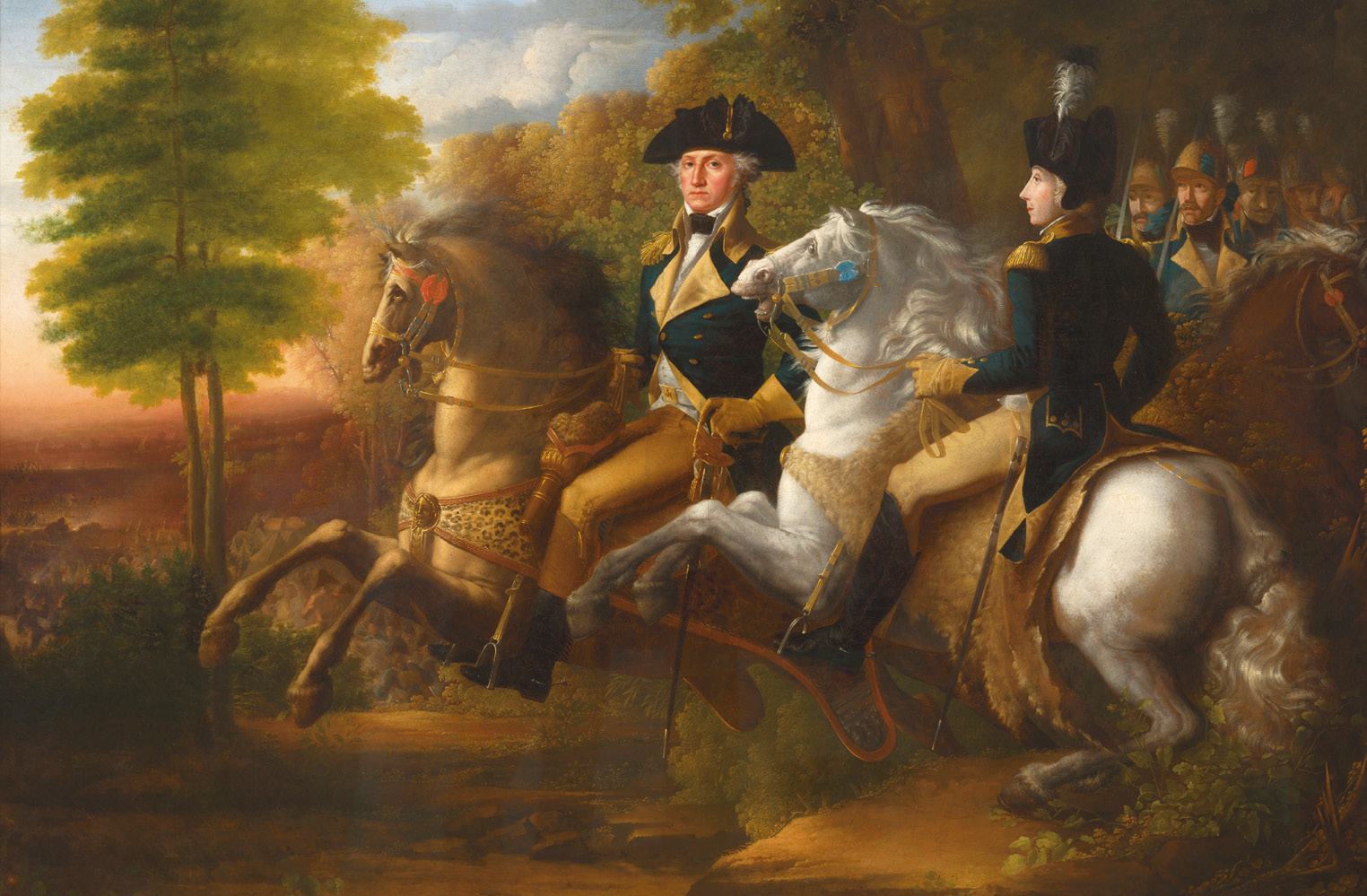
Clinton was closely pursued by Washington and his newly trained forces. The latter engaged the new British commander-in-chief, who had stopped to fight a severe rearguard action on 28 June at Monmouth Court House. A close-run fight in the broiling summer heat exhausted both sides until Clinton quietly withdrew that evening, leaving the exhilarated Americans in possession of the field. The efforts of George Washington, Nathanael Greene, the Marquis de Lafayette, Henry Knox, and Baron von Steuben had contributed to the formation of a formidable army that could finally hold its own against the British. Also contributing to this state was a reawakened interest and support among a previously inconstant and vacillating Congress.
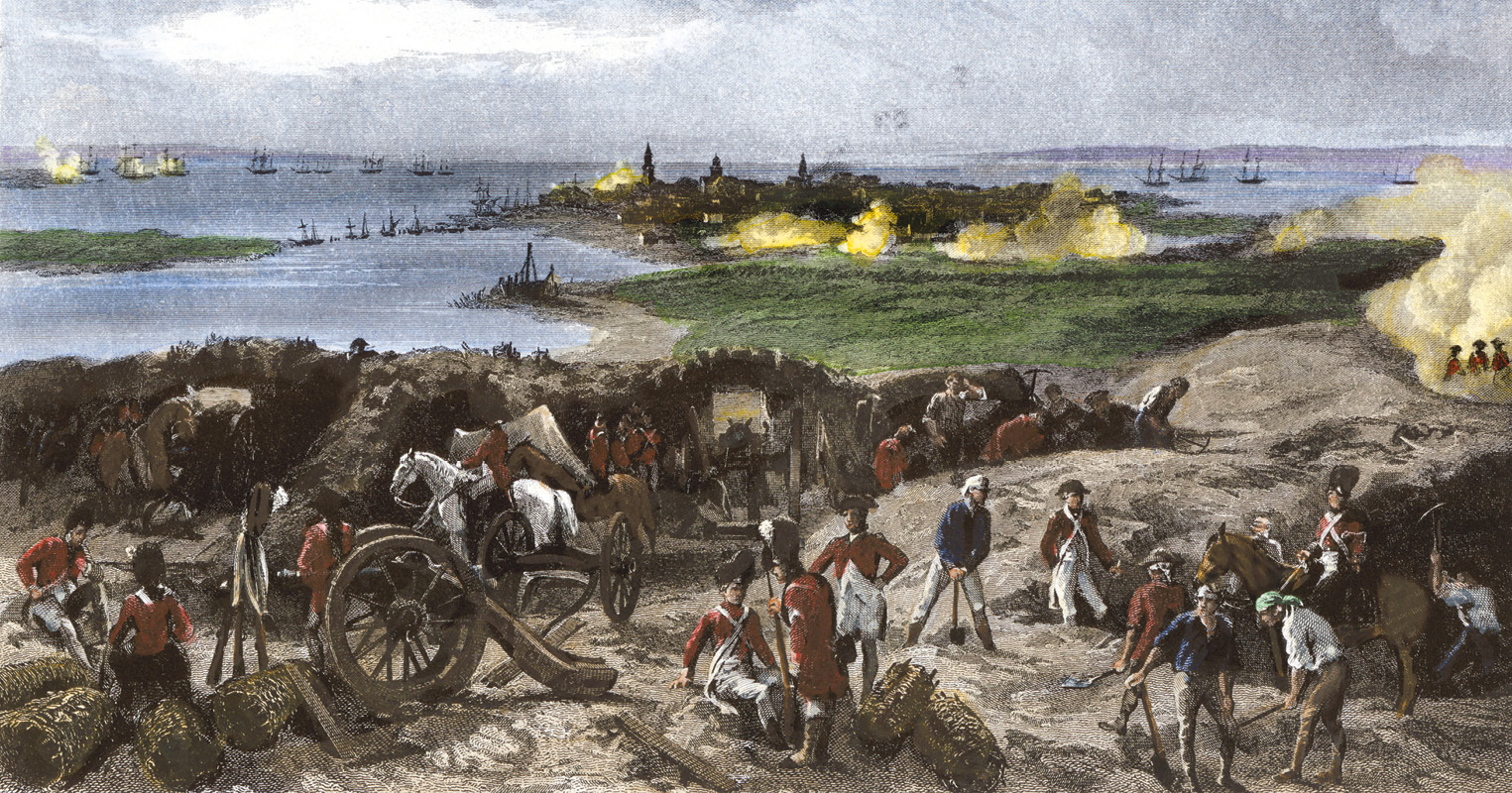
Despite the vicious encounter at the Battle of Monmouth, General Clinton managed to bring his force successfully to New York, where they were reorganised and resupplied. Then, in December 1779, he and his army set sail for the southern colonies. After several brutal weeks afloat on an uncooperative and storm-tossed sea, Clinton’s force landed south of Charleston, South Carolina, to begin the final phase of the war to suppress the rebellion. The campaign would start well for the British – as on 12 May 1780, after a siege of six weeks, American general Benjamin Lincoln was forced to surrender his entire garrison of more than 5,500 men at Charleston.
Hearing that a relief force of some 420 men headed towards Charleston had turned back on hearing of Lincoln’s surrender, Clinton decided to send a detachment called the British Legion and consisting mostly of colonial Loyalists after them. In charge of this unit of 170 cavalrymen was a firebrand young lieutenant-colonel named Banastre Tarleton, who led his men in a hell-for-leather pursuit of the American relief force. They caught up with them on 29 May at Waxhaw Creek, just short of the North Carolina border. When Tarleton demanded their surrender, the American commander Colonel Abraham Buford refused, and formed his men into line to resist.
The Americans held their fire until Tarleton’s dragoons were within 10 yards, then loosed a volley into the charging horsemen. It was a fruitless gesture, as the cavalry burst through the lines, and the Americans broke and fled, while some attempted to surrender. Undeterred, the British Legion slaughtered at least 113 of their enemies and wounded 150. An undisputed victory for the British Legion, the Battle of Waxhaws would nevertheless become a rallying cry for many patriots, and tales of ‘Tarleton’s Quarter’ (shooting after surrender) boosted resistance to British occupation. Colonial propagandists exploited this incident much as they had done with the murder of Jane McCrea, with the result that future clashes between rebel militia and Loyalist forces would prove especially sanguinary across the southern theatre.
General Clinton, however, was delighted with the outcome of operations in the south, and soon thereafter sailed back to New York leaving the accomplished and confident Lord Cornwallis in charge, certain that victory would soon be accomplished. As we shall see, he was being overly optimistic.
Fred Chiaventone is a military historian, retired cavalry officer, and Professor Emeritus for International Security Affairs at the US Army’s Command and General Staff College.
Further reading:
• Jack Kelly, Band of Giants: the amateur soldiers who won America’s independence (Palgrave Macmillan, 2014).
• Joseph G Ellis, The Cause: the American Revolution and its discontents, 1773-1783 (Liveright, 2021).
• John R Maass, From Trenton to Yorktown: turning points of the Revolutionary War (Bloomsbury, 2025).
In the next issue of MHM: The American Revolution: Part 4 – the world turned upside down.
All images: Wikimedia Commons, unless stated otherwise