
Subscribe now for full access and no adverts
By 1916, the Tsar’s armies were very different from the brave but ill-equipped forces of 1914. Despite widespread corruption and inefficiency, Russia’s war industries had massively expanded: artillery production was approaching 900 guns and more than 2,500,000 shells per month. The dire rifle shortages of 1914-1915 had been overcome, and all 2,000,000 frontline troops were fully armed. Battlefield communications had also significantly improved: the 1914 holdings of 10,000 field telephones had risen to 50,000 two years later.
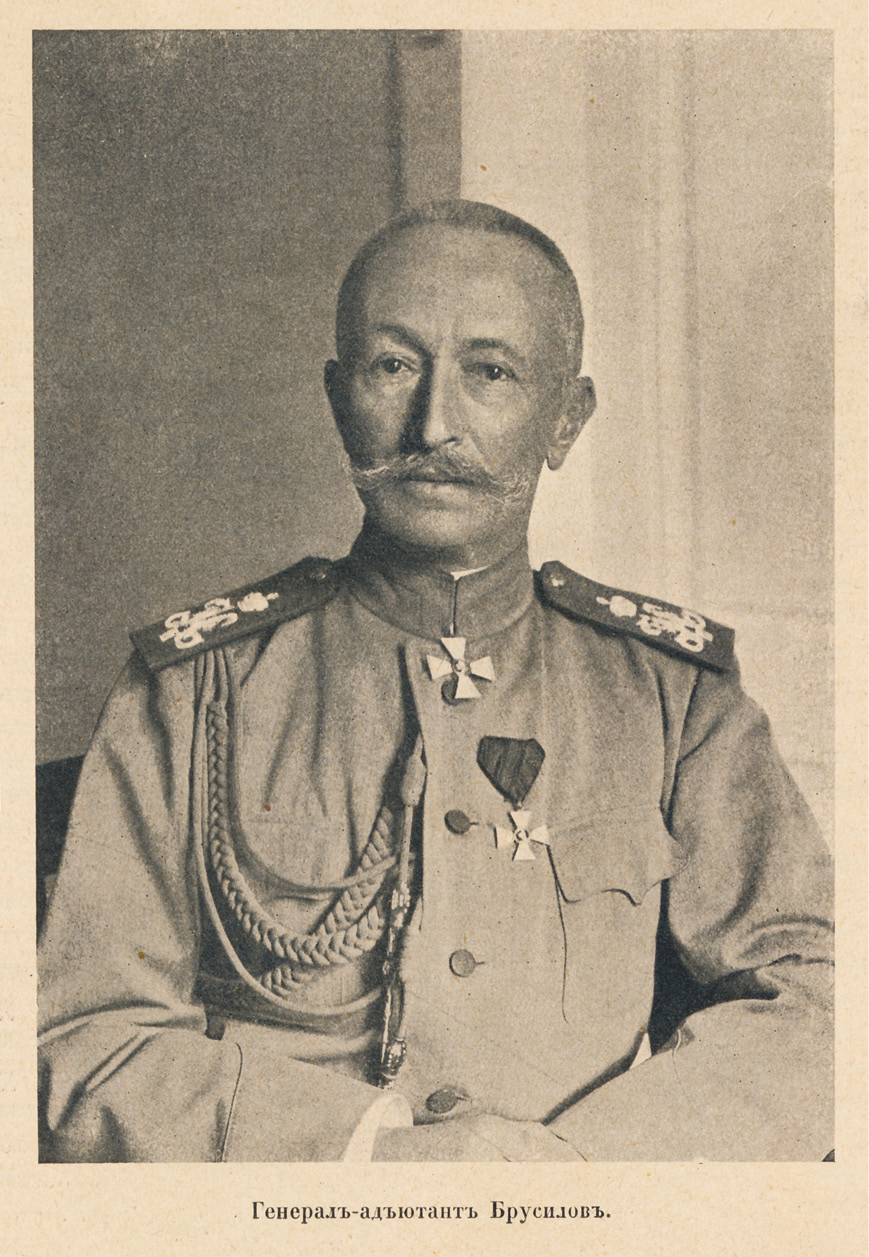
The real problem lay in utilising this equipment effectively. The higher echelons of the Russian command structure were bedevilled by inefficiency, with far too many generals appointed on the basis of their popularity at the Imperial Court rather than any military ability. There were some exceptions, however – most notably General Aleksei Brusilov, a veteran of the Russo-Turkish War of 1877-1878, who had commanded the 8th Army with considerable skill since 1914. On 29 March 1916, he was promoted to command the South-west Front (7th, 8th, 9th, and 11th Armies), which stretched along a front line of more than 600km (370 miles) across Ukraine, from what is now southern Belarus to northern Romania.
At 62, Brusilov, who was himself the son of a Russian general, had become a thoroughly efficient and professional commander. This sometimes put him at odds with his fellow officers, and tended to reinforce his reputation as a loner – someone who never quite fitted in with the routines and expectations of the Imperial Court. Unlike most of his contemporaries, he was not a graduate of the General Staff Academy, and he had always believed in the value of ‘preparedness’ – training his men for the realities of combat. Brusilov was convinced that the Russian soldier could fight well, if properly led, and strove to eradicate the brutal discipline common in other units.
In a conference at Stavka (Imperial GHQ, the high command of Russian’s armed forces) attended by Tsar Nicholas II in April 1916, Brusilov was authorised to include his South-west Front in the planned Russian summer offensive. He was not satisfied with leaving the fighting to other Fronts, and argued that they must strike the enemy everywhere at the same time, ‘so as to prevent him from using the advantage he has of acting along interior lines; with the result that, in spite of his numerical inferiority, he uses his railway system to move his troops from point to point as he pleases’.
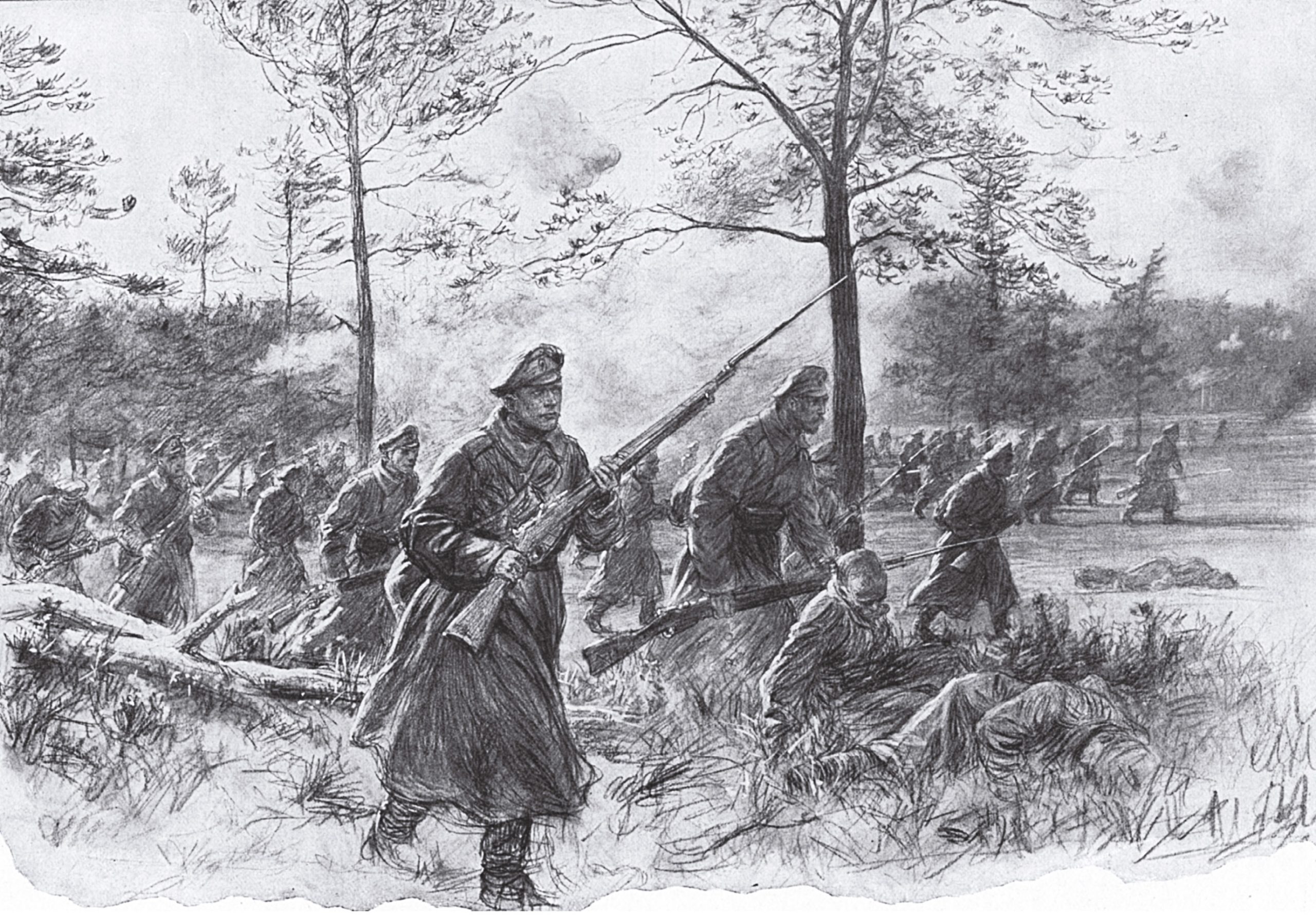
Russian infantry forces advance during the Brusilov Offensive. Eventual success would come at a huge cost. Image: Alamy
Serious problems
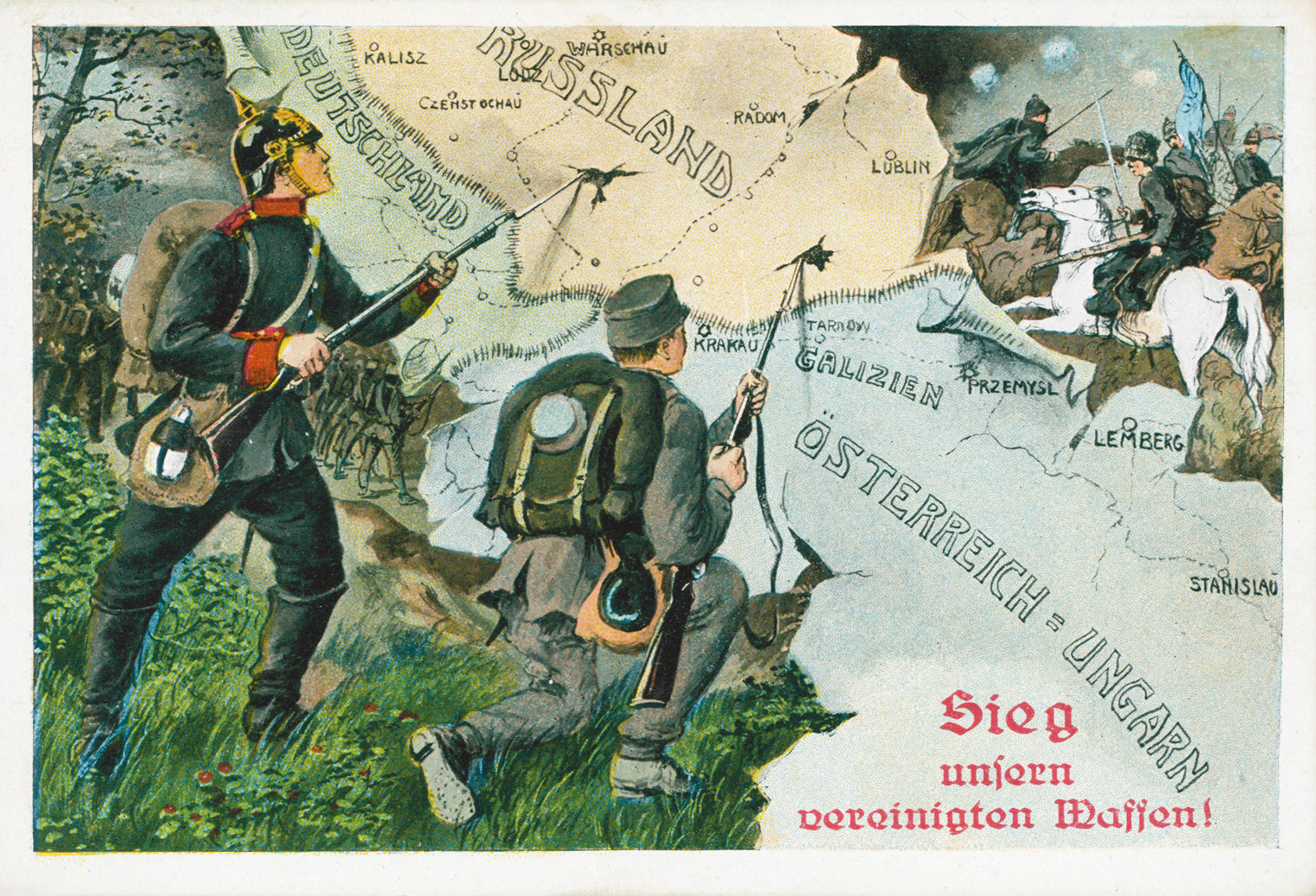
Brusilov was fortunate in facing a weak enemy: the vast majority of forces facing his South-west Front belonged to the Austro-Hungarian Army, which had serious problems even before the war. One of the most intractable issues was the sheer number of nationalities within the army: Austrian (29%), Hungarian (19%), Czech (15%), Polish (9%), Ukrainian (8%), Croat (5%), Romanian (5%), Slovak (4.5%), Slovenian (2.5%), Serb (1%), Italian (1%), and Bosnian (1%). Basic commands were given in German, but each regiment had at least one officially recognised ‘regimental language’ for day-to-day use. (Some had as many as three!) Friction between the various nationalities was commonplace and did nothing for overall efficiency. Soon after the war began, it was found that units with large numbers of Czechs, Slovaks, Serbs, Croats, and Slovenians were prone to desert, or at least readily surrender, to the Russians, with whom they sympathised as fellow Slavs.
Brusilov was fortunate in facing a weak enemy.
Austro-Hungarian artillery was also mediocre: a lack of funding had imposed serious delays on the pre-war programme to modernise the Empire’s artillery – which, apart from the formidable 305mm super-heavy howitzers, was largely obsolete by 1914. In theory, Austrian divisions could deploy a similar number of field-guns to Russian divisions (42 to 48), but many of these were outdated – notably the 8cm Feldkanone M5, first introduced in 1907, which was fitted with inferior ‘steel-bronze’ barrels because of the tight budget. This made the guns unduly heavy for their calibre, besides reducing their effective range and reliability, as the barrels tended to warp after prolonged firing. The army had severe shortages of modern medium artillery, too, with only eight 150mm howitzers per corps.
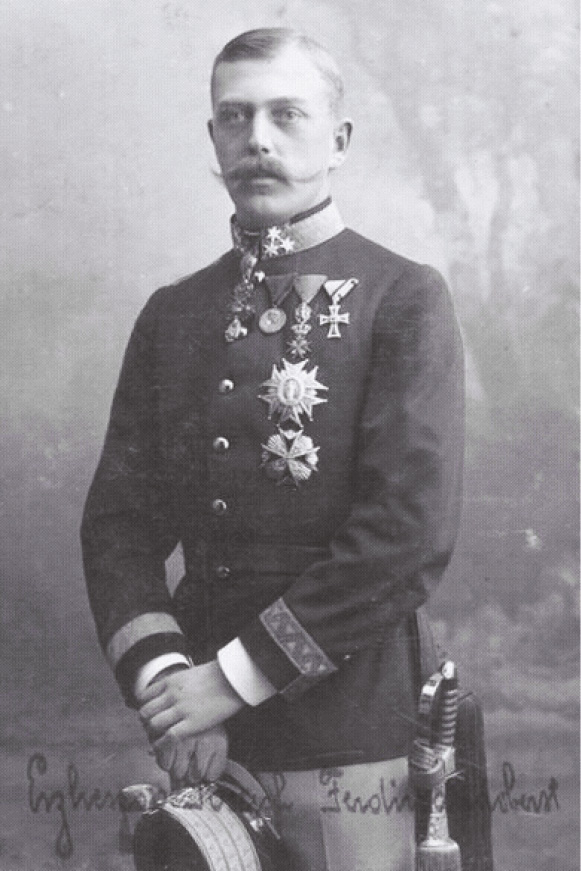
The long-serving Chief of the Austro-Hungarian General Staff, Franz Conrad von Hötzendorf, unwittingly aided Brusilov’s preparations by transferring six veteran divisions and 15 heavy-artillery batteries to the Tyrol for an offensive against Italy (see MHM 147, August/September 2025). They were replaced with newly raised units, as this part of the front in the historic regions of Galicia and Bukovina (now largely in Ukraine) was considered a quiet sector.
Tempting objectives
Immediately after the conference at Stavka, Brusilov began planning for the offensive, with careful air and ground reconnaissance of the enemy positions, mapping their artillery batteries and trench lines. On 18 April, he ordered that: ‘The attack must be carried out by the entire South-west Front in order to deprive the enemy of the opportunity to move all his forces towards one place and conceal the true direction of the main strike. To achieve this, each army and each corps must plan and prepare an attack on part of the enemy’s fortified line…’.
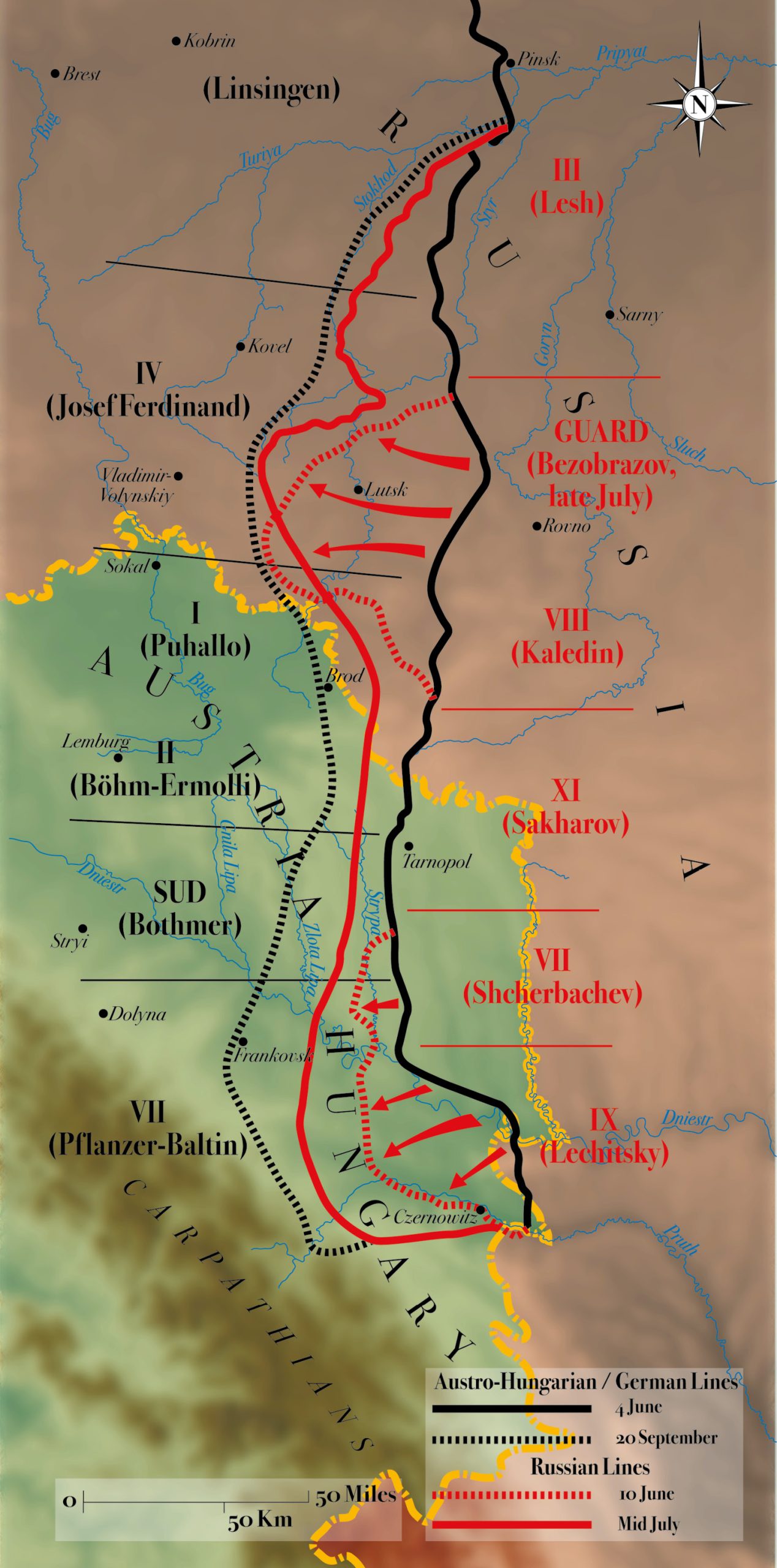
The main blow would be delivered by 8th Army towards the city of Lutsk, the location that Brusilov believed would be most helpful to the neighbouring Western Front’s attack. The rest of his armies would concentrate on taking the positions ‘currently occupied by the enemy’. In a five-page order issued the next day, he detailed the responsibilities of the artillery and infantry, insisting on the closest collaboration of both arms, which he believed would be crucial for success. With the bulk of Russian strength concentrated in the Western and Northern Fronts, covering Moscow and Petrograd respectively, South-west Front had only a small numerical superiority: 40 infantry and 15 cavalry divisions against 39 infantry and 11 cavalry divisions (mostly Austrian, with only a handful of German units) – about 600,000 to 500,000 men respectively. The Russians had an even smaller advantage in artillery: 1,938 guns compared to 1,846.
Final orders were issued at 1am on 4 June: all four armies would attack, from the area in the north around Pinsk to Czernowitz, close to the border with Romania. Although the assault was meant to be an ‘auxiliary’ operation, preventing the Central Powers from moving reserves to face Western Front’s main attack towards Vilnius (scheduled to take place on 10-11 June), there were plenty of tempting objectives to aim for, including Lutsk, the transport hub of Kovel, Stanislau, and even Lemberg (now Lviv, the largest city in western Ukraine). Brusilov refused to set further objectives, claiming that the offensive was simply intended to destroy the enemy in Galicia. However, he was well aware of the possibility that a truly crushing defeat could force Austria-Hungary out of the war.
The offensive begins
The Russian artillery opened fire at 4.30am on 4 June, with field artillery cutting lanes through the barbed wire while the heavier guns and howitzers concentrated on demolishing the frontline trenches before switching to counter-battery fire. This type of bombardment was not as intense as the furious ‘drumfire’ that preceded German assaults, but its power and accuracy were exceptional. One defender recalled that: ‘The Russian artillery fire continued all morning with increasing intensity. At times it sounded like railway trains crashing into each other at roaring speed. There was a wild raging, rumbling, crashing, and splintering that shook you to your very soul. Towards noon, the terrible fire subsided a little, only to swell again to the greatest intensity in the afternoon, and especially towards the evening.’
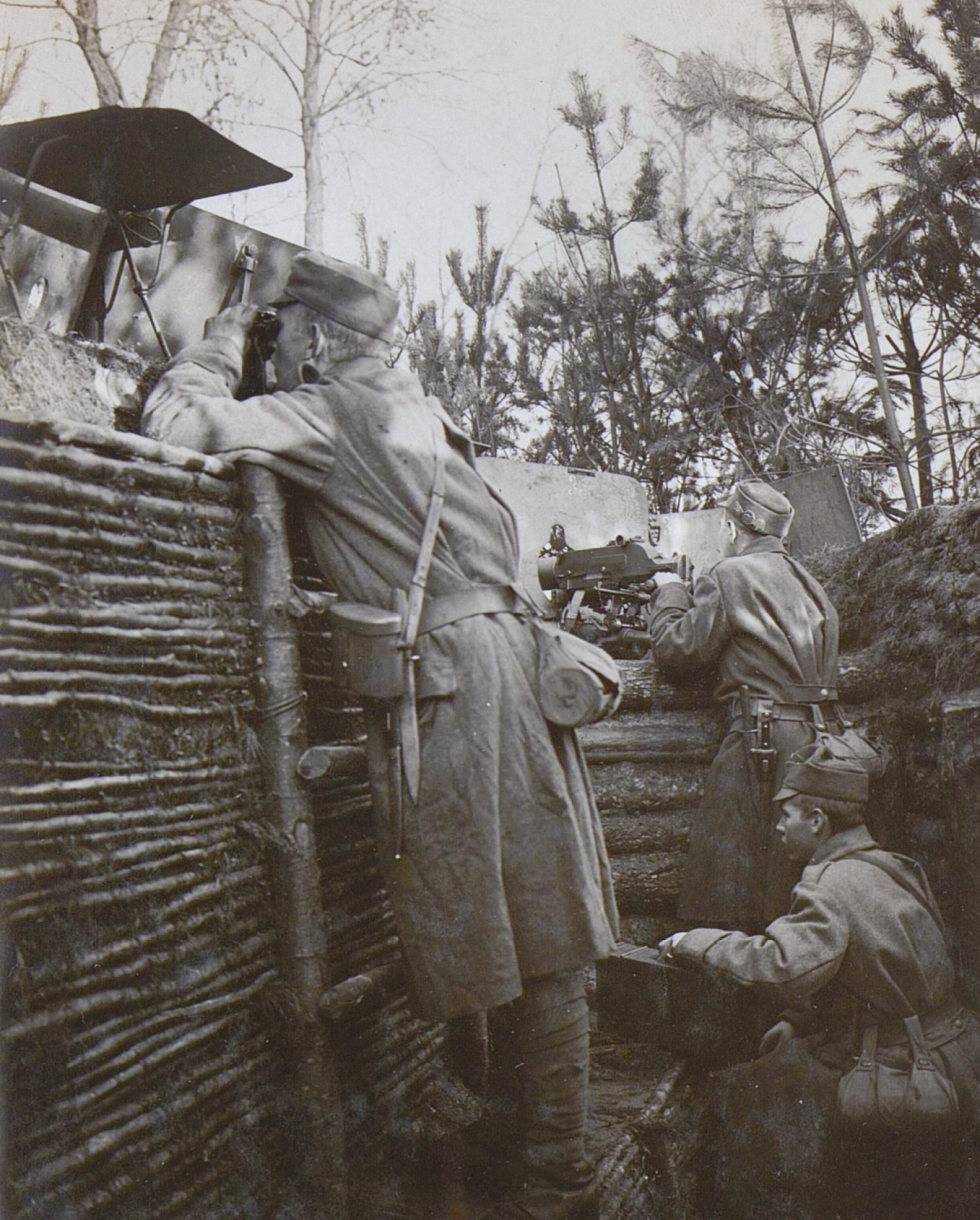
As the day wore on, a series of probing attacks were made to test the strength of the defences, with the artillery continuing to fire throughout the afternoon, despite the inevitable counter-bombardments, before numerous further battalion-strength attacks were launched. Most of these were beaten off by machine-gun fire, but the cumulative damage to the Austro-Hungarian defences had been extensive, with telephone lines cut, trenches demolished, and gaps blown through the barbed wire in many sectors.
Brusilov’s main assault, delivered by 8th Army towards Lutsk, was launched on 5 June against Archduke Josef Ferdinand of Austria’s 4th Army. Russian artillery had kept up a harassing fire overnight to hinder attempts to repair the defences, before intensifying the shelling shortly before 9am, raising a great cloud of debris and smoke over the trenches. Russian morale was boosted by the bombardment, and the knowledge that they were facing the Austrians also boosted the morale of the Russian attackers. As one company commander noted, a sigh of relief went around the trenches when they saw the ‘familiar pink haze’ that characterised Austrian shell bursts.
The first attacks were spearheaded by grenadier platoons – elite assault troops armed with carbines, revolvers, and grenades – and broke through rapidly. At Olyka, a village 32km (20 miles) east of Lutsk, 2nd Infantry Division was swamped by an entire Russian corps, which captured most of the garrison. The defending 82nd Infantry Regiment was virtually destroyed in a matter of minutes, losing more than 4,500 of its 5,000 men.
A disaster unfolds
It quickly became evident that once the defenders’ forward trenches had been taken, they had few well-prepared defences to fall back on. German experience on the Western Front had shown that, as even the strongest frontline could be breached, a deeper defensive zone was needed, with multiple trench-lines and mutually supporting strongpoints. Austro-Hungarian doctrine dictated that the frontline must be as strong as possible – and it usually was, with deep trenches and shelters, protected by thick belts of barbed wire. In theory, there should have been second and third lines forming a defensive belt 4km to 6km deep (2½-3½ miles). In practice, however, these were poorly constructed and incomplete.
As soon the initial penetration had been made, Brusilov was able to commit his 15 cavalry divisions and 33 armoured cars to exploit the breakthrough. The city of Lutsk was captured on 7 June – Major General Nikolai Stogov, 8th Army’s Quartermaster-General, was astonished by the extent of the enemy’s demoralisation: ‘A crowd of unarmed Austrian soldiers from various units fled in panic through Lutsk, leaving everything behind. Many prisoners testified that they were ordered to drop everything except their weapons to hasten the retreat, but in fact they often got rid of weapons first of all… Officers of the defeated Austrian regiments were also greatly demoralised: many prisoners reported that their officers were among the first ones to flee to the rear, leaving NCOs to take care of the soldiers.’
After just six days of fighting, the Austro-Hungarian 4th Army had collapsed, losing 82,000 men out of a total strength of 110,000, at least half of whom were prisoners. Its commander, Archduke Josef Ferdinand, was relieved on 7 June – even his status as a godson of the Emperor Franz Joseph could not save him from being made a scapegoat for the disaster. A gap of 15km (9 miles) had opened up between 4th Army and the forces on its right – an opportunity exploited by General Aleksei Kaledin’s 8th Army with as much cavalry as could be mustered.
General Pflanzer-Baltin’s Austro-Hungarian 7th Army was forced into a full-scale retreat on 10 June, with its scattered forces falling back south of the Dniestr River towards the Carpathian Mountains, despite frantic orders to retreat to the west in order to maintain contact with what was left of 4th Army. But diverting the troops in the ‘right’ direction proved to be impossible. In two weeks of heavy fighting, 7th Army lost a total of 133,600 men – more than half its strength. In the south, the Russian 9th Army crossed the Dniestr, taking Czernowitz and Kolomea, and pushing scattered enemy forces back to the approaches of the Carpathians. After an advance of up to 60km (40 miles) – along a 90km front (55 miles) – it seemed that there was nothing to stop a Russian penetration of the Carpathian passes, followed by a breakout on to the Hungarian Plain.

‘Shackled to a corpse’
A complete disaster was only avoided because Brusilov concentrated on operations to the north in support of the Russian Western Front’s offensive, which began on 2 July. The crisis provoked increasingly urgent appeals for German reinforcements to prevent a total collapse of the front. The situation raised memories of a bitter joke circulating in Berlin back in 1914 that the alliance with Austria-Hungary was akin to being ‘shackled to a corpse’. Sheer self-interest dictated that the reinforcements would be sent, as it would be impossible for Germany to fight on should Vienna be forced out of the war. However, this support came at a high price – the effective relegation of Austria-Hungary to a German satellite state.
The very success of Brusilov’s offensive caused problems, as resupplying his armies became more difficult the further they advanced. Small-arms ammunition was a particular issue – up to 3,500,000 rounds were fired each day, but barely 3,000,000 replacement rounds were arriving over lengthening supply lines. In mid-July, the offensive was paused to give time for resupply and to incorporate reinforcements, notably the elite ‘Special Army’ – I and II Corps of the Imperial Guard. Brusilov was convinced that, if he could take Kovel, a crucial rail and road hub, the enemy line could be rolled up, allowing Western Front to renew its offensive.
Crucially, however, the rapid failure of the offensives by Western Front and Northern Front freed German troops to help contain Brusilov’s advance. The Germans were well aware of the importance of Kovel and reinforced the garrison with their veteran X Corps. They demolished the bridges over the Stokhid River to the east of the city, and dug in among the woods and marshes along its west bank. When the offensive resumed on 28 July, it achieved some initial success, with 8,000 prisoners taken in the first two days. However, subsequent attacks quickly bogged down in the difficult terrain, and Russian casualties increased sharply throughout August as more German reinforcements arrived.
The failure of the last attacks on Kovel in September effectively marked the end of the offensive. Casualties on both sides had been enormous – total Russian losses were at least 500,000 and possibly as high as 1,000,000. It was Imperial Russia’s last major victory – but it broke the army’s morale: the so-called Special Army was so badly shaken that Guard reserve battalions stationed in Petrograd would later provide military support for the ‘February Revolution’ of 1917. On the other side, Austro-Hungarian casualties were 1,000,000 – including 400,000 prisoners – while German losses totalled 350,000.
Brusilov himself would achieve national fame for his part in Russia’s hard-won success. Widely regarded as the best Russian commander of the First World War, he would later go on to serve the new Bolshevik regime – thereby also becoming an important influence during the early years of the Red Army. He died in 1926.
David Porter worked at the Ministry of Defence for many years, and is the author of 11 books on the Second World War. He is a regular MHM contributor.
All images: Wikimedia Commons, unless otherwise stated