Subscribe now for full access and no adverts
Students of Egyptology of Welsh origin have featured prominently in the history of the subject for more than two centuries. I have sometimes been asked why that should be so, and my default reply has usually been that it was the influence of the Nonconformist tradition and the diligent reading of the Bible which went with it. But, while this factor may well have played a part in Wales, its effects will not have been confined to Wales, and we need to dig a little deeper for answers.


Travellers
Egyptophiles of Welsh origin, born in the 18th or the first half of the 19th century, were almost all independent scholars or enthusiasts of private means. Some were initially travellers to Egypt. James St John (1801-1875), who was born in Laugharne, Carmarthenshire, into a poor family, became a radical politician and journalist. His voracious appetite for foreign adventure took him to Egypt and Nubia, which provided the material for several important publications.
Owen Jones (1809-1874) was born in London into a Welsh-speaking family and enjoyed a highly successful career as an architect and designer. His Grand Tour took him to the Near East, including Egypt in 1832- 1833, where he became interested in its monumental architecture, particularly its coloured decoration, which he recorded in The Grammar of Ornament (1856). His Views on the Nile from Cairo to the Second Cataract was published in 1843, in collaboration with Samuel Birch of the British Museum.


Born in Merthyr Tydfil, John Petherick (1813-1882) enjoyed a remarkably varied career as an engineer, explorer, trader, naturalist, and diplomat. He travelled to Egypt and the Sudan, and produced a survey entitled Egypt, the Sudan and Central Africa (1861). George Lloyd (1815-1843) was the illegitimate son of Lieutenant Colonel Sir William Lloyd of Bryn Estyn Hall, near Wrexham. He was attracted by the Arab way of life and sometimes dressed in Arab costume. He produced a valuable album of illustrations of Egypt which now resides in the Griffith Institute, Oxford. He also excavated with the pioneering French Egyptologist Prisse d’Avennes at Thebes, where he was unfortunately killed in a firearms accident. Yet another traveller was John Foulkes Jones (1826-1880), who was born in Machynlleth, and served as a Calvinistic Methodist minister. He produced the very interesting Egypt in its Biblical Relations and Moral Aspect (1860).

Sir John Gardner Wilkinson
However, the achievements of these figures pale into insignificance besides those of Sir John Gardner Wilkinson (1797-1875). He was not born Welsh, but his wife and assistant Caroline Lucas most emphatically was, and they spent most of the last decade of his life in the Gower village of Reynoldston. He spent a great deal of time in Egypt recording ancient monuments, and, as many of them have since been lost or damaged, his voluminous records are of enormous value. This fieldwork provided the basis for his famous Manners and Customs of the Ancient Egyptians (1837). In his Gower phase, he and his wife spent much time cataloguing the large corpus of material that he had accumulated, and they also worked with Samuel Birch on an 1878 update of Manners and Customs, which is still in print. He now lies in the churchyard of St Dingat in Llandovery.


Collectors
Some antiquaries with Welsh affinities were essentially collectors who contributed important items to major Egyptian collections. The ironmaster Henry Martyn Kennard (1833-1911) was not Welsh, but had strong Welsh connections and a Welsh base at Crumlin Hall near Newport. A very generous supporter of Egyptian archaeology, he excavated with Petrie, amassed a major collection, and made important contributions to the Ashmolean and British Museums. Morgan Stuart Williams (1846-1909) was born at Aberpergwm House, Glynneath, a member of an ancient Welsh gentry family. A highly successful industrialist and landowner, he owned a large collection of antiquities, including Egyptian material that was eventually given to the British Museum. He may have inherited his Egyptian artefacts from his ancestor William Williams (1788-1855), who was an inveterate traveller.
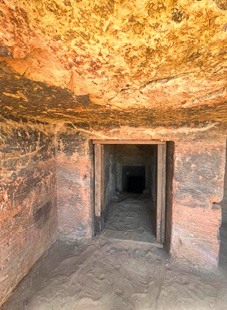
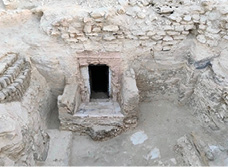
Field Marshal Lord Grenfell (1841-1925), whose family base lay in Swansea, eventually became Sirdar of the Egyptian army. He served with great distinction in the Sudan, but also became a keen Egyptologist, collecting antiquities and excavating at Aswan. He became President of the Egypt Exploration Society. Numerous artefacts from his collection and excavations can still be seen in Swansea Museum.


Qubbet el-Hawa, opposite Aswan, where Grenfell carried out the excavations of several Old Kingdom tombs. Image: Sarah Griffiths
Alexander Browne (1845-1898), born at Llanhamlach, near Brecon, was a soldier by profession, and his Egyptological connection arose simply through inheriting a large collection of antiquities, including Egyptian material, which was sold on his death. A much more distinguished member of this category is Thomas Edward Lawrence, better known as ‘Lawrence of Arabia’ (1888-1935), who was born near Porthmadog in North Wales. His archaeological interests were very much focused on Syria, but he spent most of the 1911-1912 season with Petrie at Tarkhan. His archaeological experience and good Arabic clearly made him a very valued member of the team.

Invalids
Another factor drawing people to Egypt was its dry climate, which was particularly attractive to those with health problems. Thomas Gwynn Jones (1871-1949) was born in Abergele, and became Professor of Welsh at Aberystwyth University. Ill health took him to Egypt in 1905, and he published a book on his experiences entitled Y Mor Canoldir a’r Aifft (The Mediterranean Sea and Egypt) in 1912. The artist and field archaeologist Ernest Harold Jones (1877-1911) had close connections with Carmarthen, but contracted tuberculosis and moved to Egypt in 1904 to alleviate his symptoms. He worked for John Garstang, and produced high-quality copies of monuments in the Valley of the Kings and elsewhere.
Lord Carnarvon (1866-1923) of Tutankhamun fame is a similar case. His health was permanently affected by a serious motoring accident in 1903, and on medical advice he subsequently regularly wintered in Egypt, becoming a keen amateur Egyptologist, collector, and patron of excavation. He was Anglo-Welsh by descent, the family name, Herbert, having been acquired in 1461 by his ancestor William ap William.

Lord Carnarvon with his daughter Lady Evelyn Herbert and Howard Carter at Tutankhamen’s tomb. Image: public domain, via Wikicommons


Academics
From the late 19th century, Egyptology began to become far more professional, with the establishment of academic posts in museums and universities. Here, too, Welshmen have been conspicuous by their presence, beginning with Francis Llewellyn Griffith (1862-1934).
Griffith is arguably the greatest Egyptologist Britain has yet produced. Though he was resident largely in England, his ancestors were originally from South Wales. Griffith acquired his consuming passion for Egyptology at school. He worked for the Egypt Exploration Fund (later the Egypt Exploration Society), to which he remained devoted for the whole of his life, and developed a close friendship with Flinders Petrie. He also worked for a time at the British Museum, held an honorary lectureship at the University of Manchester, and became the first Professor of Egyptology at Oxford. Through his first marriage he inherited a large fortune which enabled him to fund major research projects, such as the ‘Topographical Bibliography of Ancient Egyptian Hieroglyphic Texts, Reliefs, and Paintings’. In his will, he endowed the Griffith Institute at the Ashmolean Museum. Griffith was a superb Egyptian philologist who produced numerous publications of the highest quality, and established a reputation as the leading Demotist of his generation. He was also a pioneer in the study of Meroitic and Old Nubian.


No fewer than three heads of the Egyptian department at the British Museum have been of Welsh origin. The first was I E S Edwards (1909-1996), who was born into a Welsh-speaking family, and was in his early life a Welsh speaker. He became an Assistant Keeper in the Department of Egyptian and Assyrian Antiquities at the British Museum in 1934, but his area of expertise at this stage was Semitic Languages, not Egyptology, and his move in that direction was entirely a matter of circumstance. He eventually enjoyed a brilliant career in Egyptology. His successor, Harry James (1923-2009), was born in Neath and enjoyed an equally successful career in the department. He claimed that his interest in Egyptology was fired in his youth by a collection of cigarette cards displaying material from the tomb of Tutankhamun. He read Classics and Egyptology at Oxford. The third member of this triumvirate was Vivian Davies (born 1947), a Welsh speaker from Llanelli whose interest in Egyptology was ignited by a friend in a local chess club. Like James, Davies read Classics and Egyptology at Oxford and went on to a brilliant career in the department at the British Museum, where he held the post of Keeper from 1988 to 2011.
University College London (UCL) is an early example of an academic institution to boast a Welsh Egyptologist in the form of James Walker (1858-1914), born in Corwen, Denbighshire. After an initial career in medicine, he acquired great expertise in Egyptian and Coptic. He became Petrie’s right-hand man at University College, taking on teaching duties when Petrie was in Egypt, and working on his site publications. David Dixon (1930-2005) was another Welsh Egyptologist closely associated with UCL, where he served as a lecturer from 1967 to 1995. Born in Conwy, North Wales, he was a committed Welsh speaker all his life. A master at his school encouraged him to take an interest in Near Eastern languages, and he went to UCL to read Hebrew and Ancient Egyptian. He worked at Saqqara and Buhen, and was deeply involved with the curating of the Egyptian antiquities at the Wellcome Institute, and in their distribution to other institutions.


Ann Rosalie David (born in Cardiff in 1946) is another Welsh Egyptologist whose early Egyptological inspiration was inspired by a teacher. She pursued her Egyptological education at UCL and Liverpool University, where she took her PhD. In 1972, she joined the staff of the University of Manchester and remained there for the remainder of her academic career, becoming Professor of Egyptology. She was appointed OBE for services to Egyptology in 2003. Rosalie’s research initially focused on temple ritual, but she later established a new university specialisation, Biomedical Egyptology, in which she is a world-leading expert.

Professor Rosalie David OBE is a world-leading expert in Biomedical Egyptology, and is also Consulting Editor for AE magazine. Image: Rosalie David
Egyptologists of Welsh heritage have been very active at Swansea University. The Department of Classics at Swansea has been distinguished for the last 80 years by a close synergy between Classical and Egyptological studies. This began with the late Professor J Gwyn Griffiths (1911-2004), a Welsh-speaker who made a point from early in his career of including Herodotus’ Egypt-focused Book II in his Greek and Classics Honours syllabus. Gwyn’s lead was followed by his student, the present author, under whom Egyptology made further strides at Swansea with the development of Single and Joint Honours programmes, as well as the introduction of MA and PhD schemes of study. The university’s acquisition of part of the Wellcome Collection, and the creation of the Egypt Centre, have also done much to enhance Egyptological provision at all levels, with particular emphasis on teaching and outreach.

Nonconformist tradition or other factors?
Was the Nonconformist tradition the cause of Welsh interest in Egyptology? In the earlier 19th century, a major factor was the Grand Tour, which formed part of the educational ethos of the English/Welsh gentleman, but the travellers were ultimately drawn into the study of pharaonic Egypt by other factors, such as the romance of the exotic East, the culture’s unique fascination, and the influence of a Classical education, which many had enjoyed. There is little explicit evidence of the religious dimension, but the urge to find evidence to confirm biblical narratives will certainly have been present, and was clearly stated as a commitment in the foundation document of the Egypt Exploration Fund in 1882. In some cases, an Egyptological involvement was clearly the result of pure chance, such as a legacy, or the influence of a friend or teacher. Yet another factor was the need for a milder climate than that of Europe, particularly in winter, and this brought many to Egypt and provided a stimulus to the exploration of the remains of its millennial civilisations. Whatever the reason, the small country of Wales has played a disproportionately large role in the study of ancient Egypt.
Professor Alan B Lloyd is Professor Emeritus at the Department of Ancient History, Classics, and Egyptology at Swansea University, and Vice President of the Egypt Exploration Society. He is the author or editor of many publications on Egyptological and Classical subjects, including A Companion to Ancient Egypt (Wiley-Blackwell, 2010) and Ancient Egypt: state and society (Oxford University Press, 2014).
Further reading:
• J F Jones (1860) Egypt in its Biblical Relations and Moral Aspect (Smith, Elder and Co.; reprinted by the British Library in its General Historical Series).
• M L Bierbrier (2012) Who was Who in Egyptology (Egypt Exploration Society).
• T T Baber (2017) O Gymru i Wlad y Nîl: Teithwyr Cymreig yn yr Aifft (From Wales to the Land of the Nile: Welsh Travellers in Egypt), in N Cooke and V Daubney (eds), Lost and Now Found: explorers, diplomats and artists in Egypt and the Near East (Archaeopress), pp.25-47.