
Subscribe now for full access and no adverts
There is a telling sequence early on in the 1964 film Zulu when news of the disaster that has just occurred at the Battle of Isandlwana reaches the command at Rorke’s Drift. It’s a conflab between the upper-crust Lieutenant Gonville Bromhead of the 24th Foot (Michael Caine) and Lieutenant Gert Adendorff (Gert van den Bergh), an Afrikaner officer of the Natal Native Contingent and survivor of the massacre on 22 January 1879 that was the first major encounter in the Anglo-Zulu War. Bromhead (as depicted by Caine) is unable to get his head around the loss of an entire column of 800 men, declaring it ‘damned impossible’. Adendorff responds by pointing out that it was actually 1,200 men who were lost because ‘there were 400 native levies also’ – a consideration summarily and arrogantly dismissed by the British officer, beginning with: ‘Damn the levies, man!’ In response, Adendorff’s fury knows few bounds: ‘What the hell do you mean? …they died on your side didn’t they?’ The rather more grounded Lieutenant John Chard (Stanley Baker), of the Royal Engineers, realises that they will soon need every man they can muster: ‘Talk to our levies, will you?’ he tells Adendorff. ‘Tell them whose side they’re on.’
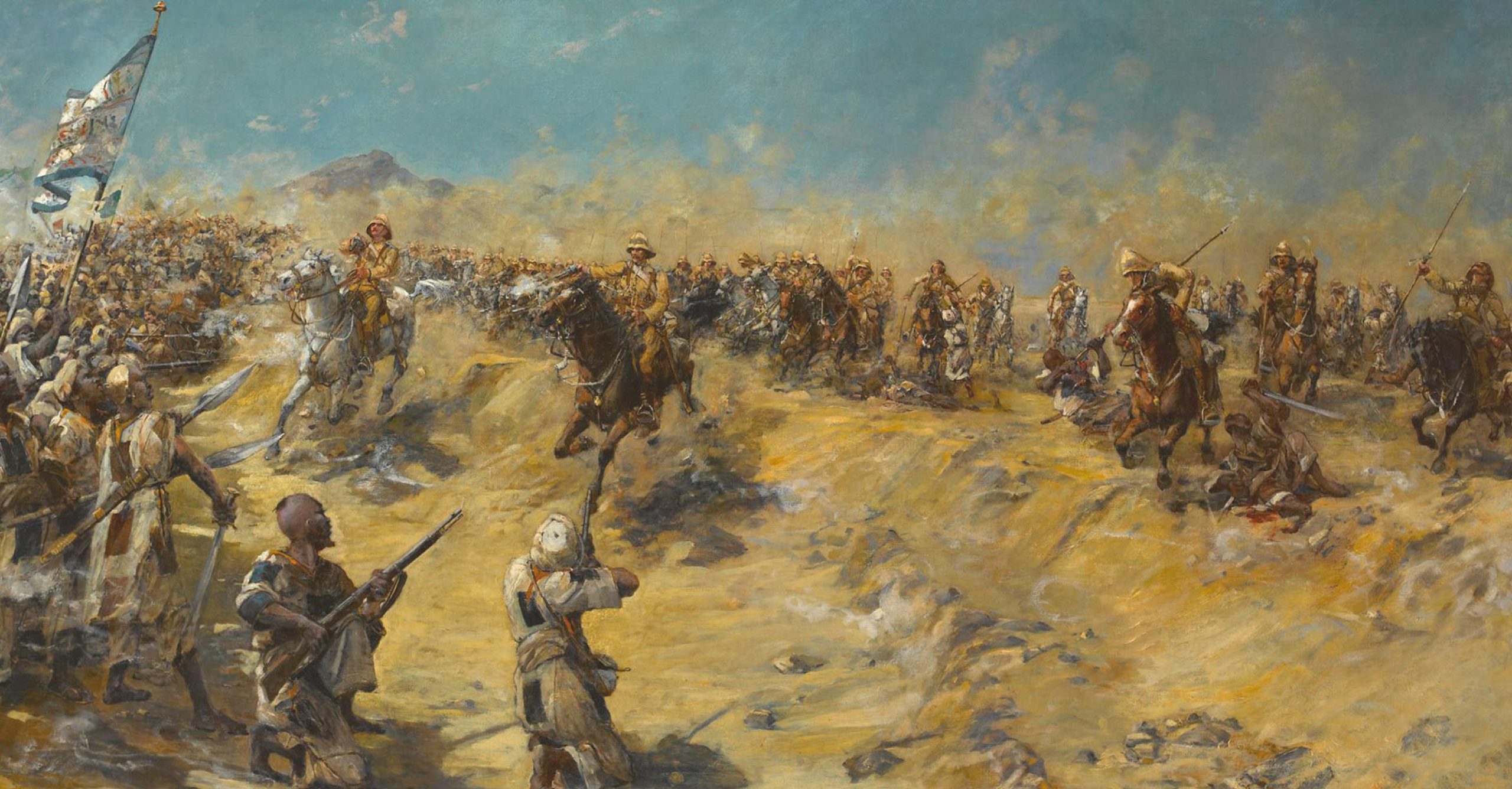
The subject of ‘native levies’ and ‘side’ first came to me when I was considering another famous battle of the British colonial era: Major General Herbert Kitchener’s standout victory over the Mahdi’s successor at Omdurman on 2 September 1898. Perhaps the best known image of the battle is Edward Matthew Hale’s painting The Charge of the 21st Lancers: the Lancers had defeated an enemy force that appeared on the British right flank. Fought during the Anglo-Egyptian conquest of Sudan, Omdurman was certainly not as straightforward as that vignette might suggest. It was a battle fought by a British-Egyptian expeditionary force against a Sudanese army of the Islamic Mahdist state, a Mahdist army having captured Khartoum 13 years before. This revenge mission culminated in a battle at which the British ‘regulars’ totalled only just over 8,000 men, with more than twice that figure, over 17,500, being Egyptian, a number which also included some Sudanese fighting against their fellow Sudanese. Opposing them was an army of more than 50,000, so ostensibly with a two-to-one advantage. Although we know immediately that the British forces were led by Kitchener and Hector ‘Fighting Mac’ MacDonald, we have no idea who commanded their native allies. They are ‘unknown Egyptian officers’, whose lot it was always to be disregarded; Caine’s Bromhead would probably have approved.
The cost of war
The utilisation of native levies was popular among past imperial powers, but still plays its part in the 21st century, as the U.S. military has become more and more serious about the raising and training of indigenous security forces in its so-called ‘War on Terror’. In both Afghanistan and Iraq, there would be tacit recognition that there would never be sufficient ‘Western’ boots on the ground to wage effective counter-insurgency, and that security needed to be outsourced to ‘locals’. Here is acknowledgement that even a powerful nation like the United States cannot do everything alone. This is nothing new.

As long ago as the 17th century, European states with extended ambition but limited resources – such as Portugal and the Netherlands – would train soldiers from local populations in order to build and maintain their burgeoning overseas empires. For the Dutch, just a couple of million of them in the 1600s, using home-grown troops in sufficient numbers was out of the question. By the 19th century, every European country with strategic reach was doing this – employing African mercenary armies, for example, to assist with the carving up of that continent. This applied to Belgium as much as to Britain. The trouble is that, when wars of empire are discussed, historians have tended to focus on those adorned in pith helmets, rather than those wearing turbans.

European powers such as France and Germany had another reason to avoid basing a significant army of its citizens abroad in the late 19th century, namely that they also needed to be ready for a war on their own continent. Lieutenant Colonel Joseph-Simon Gallieni, who commanded French forces in West Africa in the late 1880s, heaped praise on the Senegalese Light Infantry, whom he dubbed ‘the real soldiers of the Sudan’. In the same period of the late 19th century, the Belgian Congo was policed by just 200 European troops, but backed by several thousand native ‘regulars’. At the same time, Britain bigged things up with up to 300 officers and NCOs; however, that was for the whole of its African empire, which was considerable. It wasn’t just Western powers playing this game, however: the Ottomans had also proved adept at building an empire based around professionalised native levies.
The situation was the result not just of manpower but of cost, too. At the turn of the 20th century, it required around 2,000 francs per annum to keep a French marine infantryman anywhere in West Africa, but the sum for a locally sourced individual was just 980 – two-for-one with a bit of loose change. Another consideration was that the locals would cope far better with malaria and other diseases.
Indian zenith
It would be hard to dispute that it was the Indian subcontinent under British rule that saw the practice of deploying native troops reach its absolute zenith, with some two and a half million volunteers forming at its height the largest force of its kind the world had ever seen. This so-called ‘Sepoy army’ would then support its lords and masters not just in India but elsewhere, backing up British commanders including Roberts (Afghanistan), Kitchener (Omdurman), and Maude (Mesopotamia). Not only did the Brits recruit the Sepoys (the term is derived from the Persian for ‘infantry soldier’), they also separated them from native society with all its religious and cultural divisions. It was a policy that would pay off in 1857, during the unsuccessful rebellion against British rule known as the Indian Mutiny, when many more would stay loyal than rise up.
Separating the Sepoys and drilling them into a granite-hard force that was almost European in its attitude and efficiency was a remarkable achievement; the French had already tried something similar in India, training 4-5,000 natives in a European manner back in the late 1730s. The British took matters a step further, ensuring prompt payment of Sepoy salaries in the hope of guaranteeing their loyalty, and throwing in other incentives – including allowing families to join soldiers, further cementing separation from society at large, and providing death-in-service benefits and compensation for those disabled while fighting.
The significance of some of this was shown by the events of 1857. The Bengal Army, whose soldiers’ families remained in their communities, rose up, whereas the Bombay and Madras armies did not. The greater the separation from native society, the greater the loyalty to be called on, provided the cultures and identities of those men were respected and accommodated. Divide et impera (‘divide and rule’) was important too, especially post-1857, when the Indian Army was reformed along geographical lines to accentuate those divisions.
Adhesion to the British flag was also understandable when it looked to have permanence woven into it: once a Sepoy began receiving his pay, it seemed there was every likelihood that he could still draw it 40 years hence, if that was what he desired. But the British were being cute, too. Not only was this Sepoy army being galvanised to protect its interests in India and elsewhere, it was also aimed at preventing others – a native prince with expansionist ambition perhaps – from doing the same. Strategically, it is sometimes not just about fulfilling your own ambitions but spiking someone else’s.
Isandlwana, 1879
The appendices of David Clammer’s 1973 book The Zulu War are informative as far as the contribution of the native levies is concerned. The five columns (albeit two held in reserve) that made up the expeditionary force that invaded Zululand, in southern Africa, in January 1879 comprised a total headcount of 17,929 officers and men. Of these, there was a native contingent of 9,035, mounted natives in Lieutenant-Colonel Anthony Durnford’s No.2 Column totalling 315 men, and then an assortment of 1,910 conductors, drivers, and ‘foreloopers’ or voorloopers (men who walked at the head of a leading pair of oxen on an ox wagon): a total of 11,260 for the native levies. The ‘regulars’ on the other hand consisted of 85 staff, 263 artillerymen, 5,128 infantry, and 1,193 cavalry, giving a total of just 6,669. Some 62.8% of the overall invasion force therefore consisted of native levies, showing how dependent a stretched empire was on much-maligned personnel.
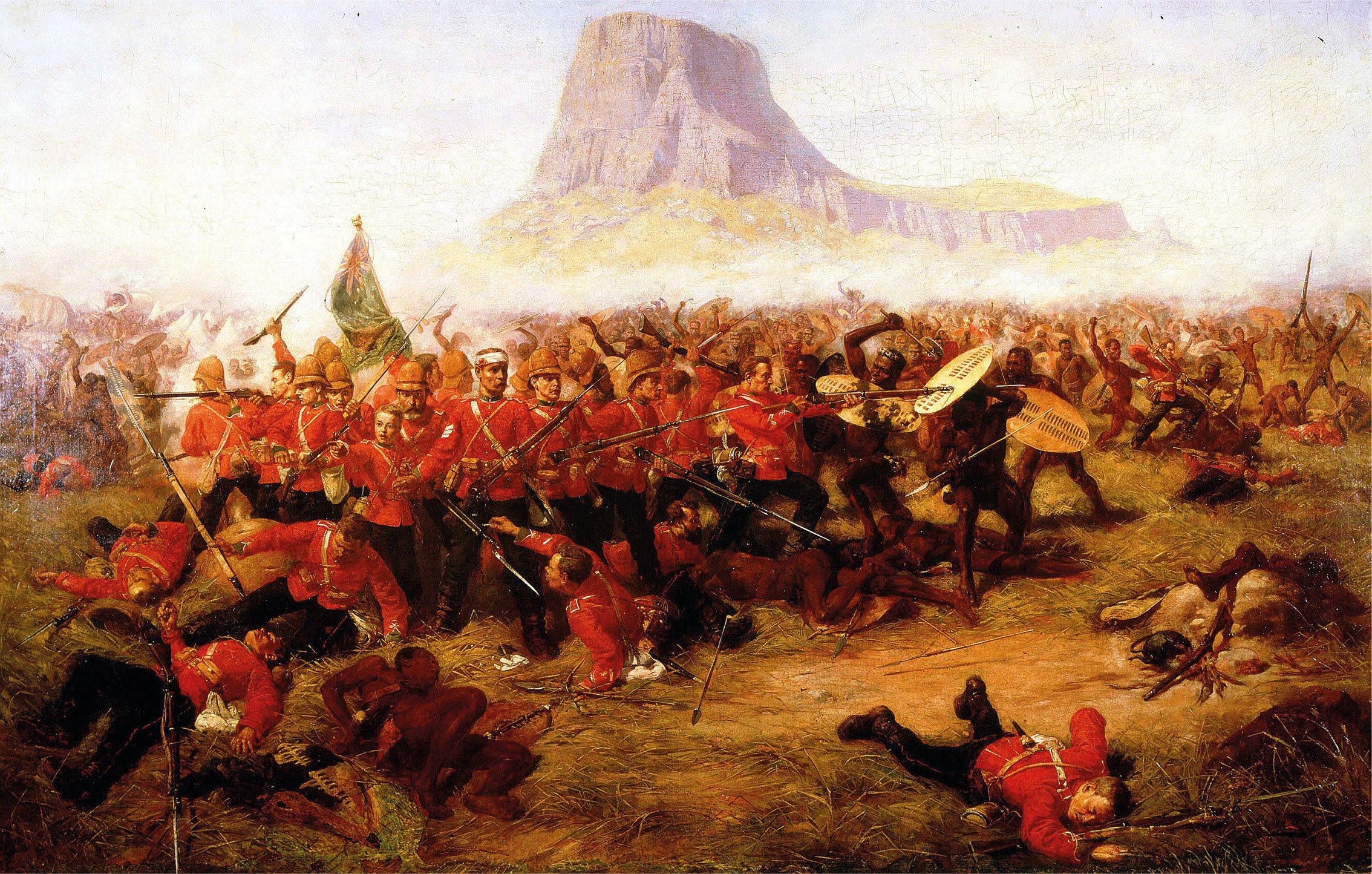
Lord Chelmsford, the force’s commander, had been singularly lacking in cavalry and looked to white colonists to make up the deficiency. Volunteer mounted units provided fine horsemen and shots, plus there were the paramilitary Natal Mounted Police. Together, these contributed some 400 to the cause, which was then boosted by further volunteer units: Baker’s Horse and the Frontier Light Horse from Cape Colony, the Border Horse from the Transvaal, and counter-intuitively even 40 Boer commandos, hardly the greatest fans of Queen and Empire. When all these disparate bodies were pooled, there was a total mounted force of some 1,000 providing the reconnaissance needs for three invading columns.
The only other source of manpower for Chelmsford, other than his regulars, would be the Natal auxiliaries, from the colony’s African population, who might be organised into an effective fighting force in the same manner as the Indian Sepoys. It wasn’t to work though. With the exception of Lieutent-Colonel Durnford’s 1st Regiment, the Natal Native Contingent (NNC) proved a fairly indifferent lot, but then they lacked adequate training, while an economy drive also saw off any hope of decent equipment or even uniforms. Durnford, clearly an inspirational leader of men, nevertheless formed three companies of the Natal Native Pioneers and the Natal Native Horse, an effective band of mounted troops drawn from the Basuto tribe.
Lieutenant-Colonel Henry Pulleine, commanding officer at Isandlwana, had five companies from his own regiment, the 1/24th (Royal Warwickshire), G Company of the 2/24th, a composite squadron of mounted troops, and two guns of N/5 Battery, but also four companies of the 3rd NNC and some members of the Natal Native Pioneers at his disposal. This amounted to 891 European troops and 350 African, a grand total of 1,241, according to one source. On top of this, there were camp followers and wagon drivers, bringing the total complement, including notional non-combatants, up to nearly 1,600.
The background was that when Lord Chelmsford had been preparing for his invasion of Zululand, he had approached Durnford, one of the few senior British officers in Natal with knowledge and experience of African levies, to recruit a body of auxiliaries drawn from the Colony’s African population. The infantry would be known collectively as the Natal Native Contingent, and would comprise a total of 7,000 men, formed into seven 1,000-strong battalions, which in turn were made up of ten 100-strong companies of Africans, each commanded by three white mounted officers and half-a-dozen white NCOs.

The NNC’s role, according to Chelmsford, was to protect the flanks of his columns and to help with wagons whenever they were in difficulties. If there was a Zulu attack, they’d form up on the British line’s flanks, with mounted troops safeguarding the rear. Once the Zulu had been beaten off, which was the expectation, the lightweight NNC would come into its own in the pursuit. But what had certainly not been factored into any of this paper-thinking was the possibility of the NNC being involved in having to withstand a full-blooded Zulu attack.
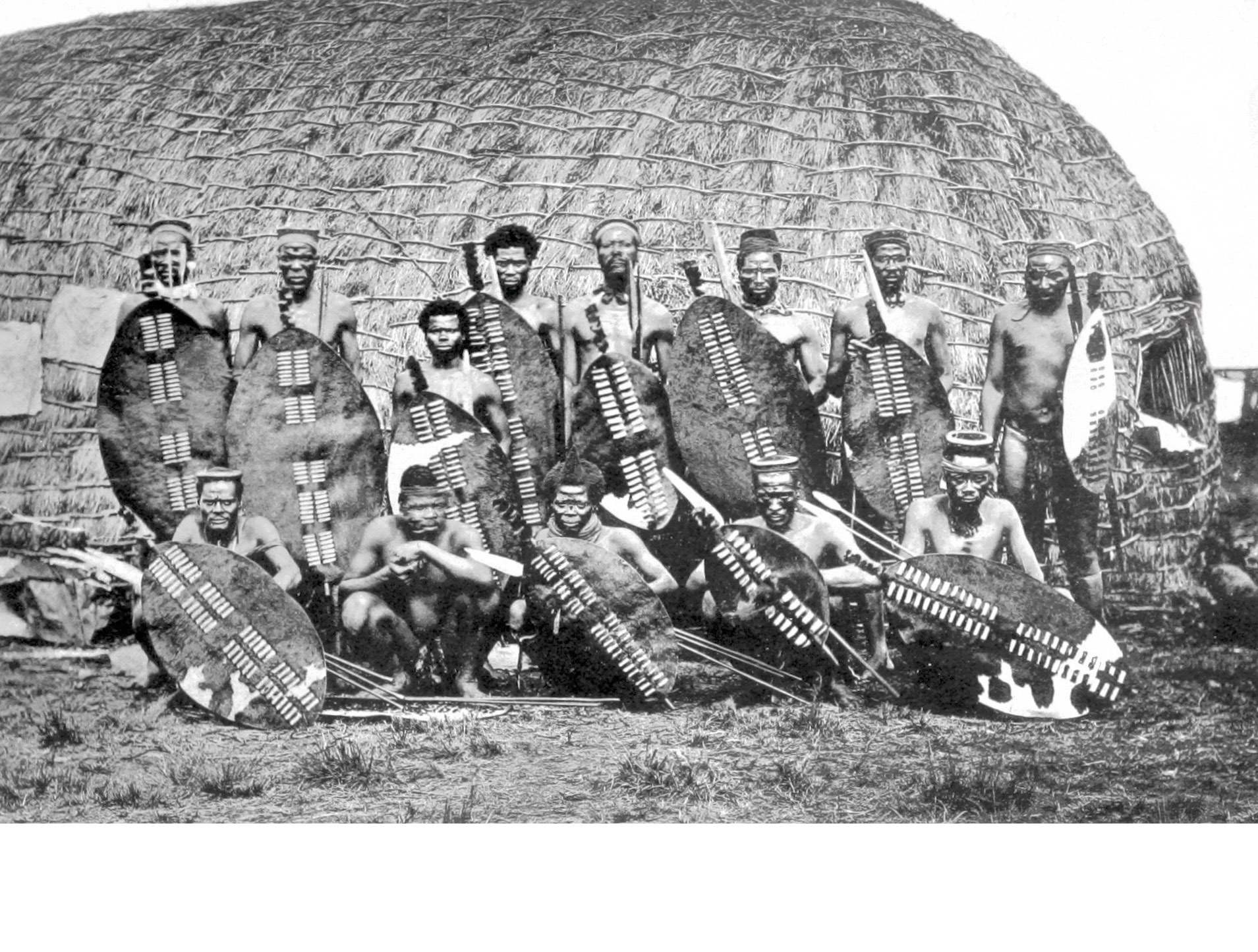
NNC companies were arranged tribally, although the battalions were not, which made it hard to foster the same loyalty to the body that would have been expected from a British battalion. In fact, there was a general concern about troop loyalty such that only the NCOs and one in ten of the African troops would be equipped with firearms, and out-of-date ones at that, and with just five rounds of ammo. For the rest, it would be the shield, the slender spear known as an ‘assegai’ (certainly not the sole preserve of the Zulu), and the billhook or the wooden club known as a ‘knobkerrie’. Another bone of contention was uniform. Durnford was keen to incorporate the Africans by donning them in scarlet, which not only would have allied them more closely to the army they were expected to fight with, but would also have made incidents of ‘friendly fire’ less likely. As it was, the only thing sartorially separating NNC troops from the Zulu foe was the red cloth bandana worn around their foreheads. Chelmsford had prevailed, preferring his Africans not to be weighed down by uniform. In consequence, many would be mistaken for Zulu and felled by their own side.
There was also the Natal Native Horse (NNH), the mounted auxiliary, of five troops of 50 men, which had been personally trained by Durnford into a far more effective force than the NNC, each man equipped with a Martini-Henry carbine and a uniform of yellow cord. Three of those troops (150 men) had been recruited from the Amangwane tribe, which was a sworn enemy of the Zulu, the British tapping into African fault lines for its native levies. These were known as ‘Zikali’s Horse’ – from Chief Zikali of the Amangwane. The remaining two companies (100 men) were made of Basutos and Christian converts. Finally, Durnford was also behind the Natal Native Pioneers, a force that could be employed as engineers, chucking up earthworks, repairing roads, and so on. There were 300 of these, who marched with the Natal columns. Equipped with rifles and something of a uniform, as well as the tools of the engineering trade, they represented the best of the African foot.
At Isandlwana, on 22 January 1879, first contact with the Zulu formations (known as ‘impi’) would fall to native patrols, including two troops of Zikali’s Horse, plus a company of 2/3rd NNC in support. The NNH did its best to conduct a fighting retreat, its black horsemen firing on the huge Zulu army that confronted it, but the sudden appearance of Zulu in such numbers spooked the lightly armed NNC company, which bolted for the safe haven of the camp – which proved to be anything but that.
It is not the purpose of this article to recount the whole story of the battle (see MHM 6, March 2011), except to say that NNH and NNC troops fought alongside British regulars as the line held before being overrun. When the carnage was over, just 55 Europeans and 350 African auxiliaries survived out of a total garrison strength of some 1,762 troops, comprising 922 Europeans and 840 auxiliaries (excluding approximately 350 wagon drivers and camp followers). Not one officer adorned in the British Infantry scarlet tunic survived Isandlwana: they had been sought out by the Zulu, who were under orders to focus their lethal force against British redcoats. Perhaps, in the end, Chelmsford’s reluctance to dress up his natives had saved a few of them.
Omdurman, 1898
Almost 20 years after Isandlwana, the Battle of Omdurman, contested on 2 September 1898, was a key part of the Anglo-Egyptian conquest of Sudan. The British-Egyptian army, commanded by Major General Herbert Kitchener, thumped a Mahdist Sudanese force led by the Khalifa, successor to Muhammad Ahmad, the self-proclaimed Mahdi (or messianic deliverer) of Muslim tradition. The Sudanese Mahdist state was considered a threat to British-occupied Egypt, so the British government opted for a pre-emptive strike in much the same way as it had over Zululand. The battle had a wholly different outcome to Isandlwana, however. Here, a well-prepared, disciplined army, equipped with the latest killing technology, was able to thrash a native force around twice its size. Less than a year later, on 25 November 1899, the Battle of Umm Diwaykarat would mark the final defeat of the Khalifa and the establishment of Anglo-Egyptian Sudan.
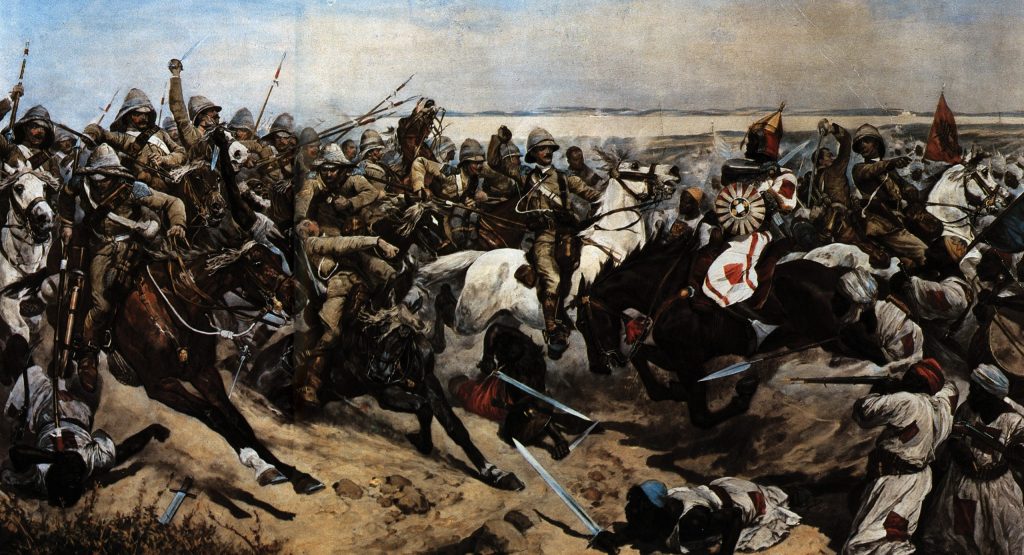
Omdurman closely mirrored the Zulu campaign in its strategic use of native levies. The British-Egyptian force of approaching 26,000 men consisted of 8,200 British and 17,600 Egyptian troops, of whom some were Sudanese soldiers; support for the Mahdist cause was not universal and divide-and-rule suited the British. The Khalifa’s army may have numbered as many as 50,000. Here again, the imperialist narrative of Victoria’s wars of empire bigs up the part played by the regulars to the detriment of the native levies who played their part, too. At Omdurman, that narrative is all about an outnumbered yet better-armed British force subduing a native horde, with a dashing cavalry charge by the 21st Lancers posited as the epitome of British soldierly skill and daring. Yes, there was such a charge, and it did defeat an enemy force that appeared threateningly on the British right flank. There was far more to this battle than that, however – and other key moments were decidedly less romantic.
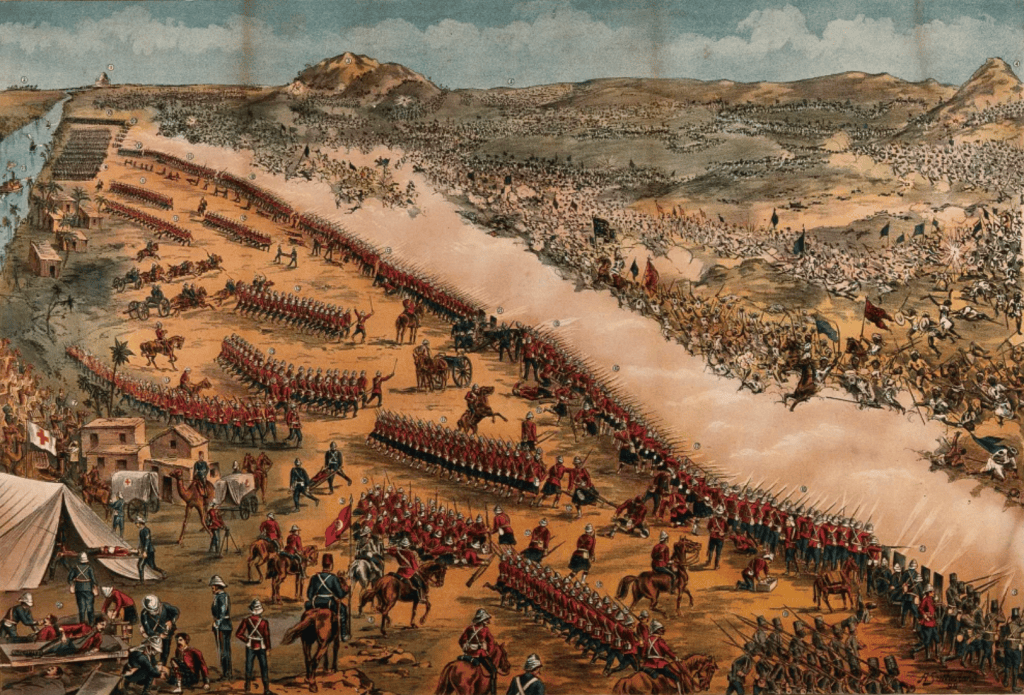
Again, it is not my purpose here to retell the story of a fairly well-known engagement (see MHM 117, August/September 2020), but instead to look at the role played by the ‘irregulars’. There were Egyptian as well as British cavalry, which between them protected Kitchener’s flanks. The British and Egyptian infantry utilised their superior firepower, protected by a ‘zariba’ (thorn fence) – but at Omdurman, unlike at Isandlwana, the line held. Kitchener then went on the offensive, which is when the famed charge of the 21st Lancers occurred. In spite of this show of élan, the battle was not conclusively won at this stage, with the Khalifa regrouping his forces for one last assault, which went in from two directions. It was the native levies who bore the brunt of this assault – a brigade of mostly Sudanese troops led by ‘Fighting Mac’, Hector MacDonald, and a brigade of Egyptians commanded by David Lewis, who showed their mettle by standing strong until reinforcements arrived. The advance on the city of Omdurman then continued, around five and a half hours after the battle had commenced in the early hours.

British attitudes of the time were perhaps best summed up in the speech made by A J Balfour, First Lord of the Treasury (but not Prime Minister at the time), on 8 June 1899, around nine months after the battle. Addressing the Speaker of the House of Commons, he trumpeted: ‘Sir, the British troops were but a third, or thereabouts, of the total force engaged on our side, but, as everybody will admit, though they were a relatively small fraction of the total force, they were an absolutely essential portion of it, and without the assistance of British troops it would have been insanity to have undertaken the final advance towards Khartoum, and any attempt to have made that advance without them would have been followed by signal disaster.’ The avowed primacy of British regulars was duly affirmed in ‘the mother of parliaments’.
Balfour did acknowledge, however, the part played by the native levies, or at least their British commanders. According to the official parliamentary record, he singled out Major General Archibald Hunter for his organisation of the Egyptian army over a 14-year period, congratulating him for the ‘degree of discipline and efficiency which that army has attained’; Major General Leslie Rundle, who had ‘long been honourably connected with the history of the Egyptian arm’; and finally Lieutenant General Grenfell, ‘because surely no man is more closely or honourably associated with the recovery of the Egyptian military force from the [earlier] disasters [such as the death of General Gordon during the Fall of Khartoum on 26 January 1885] which had reduced it to a nullity.’ The Brigade commanders of the Egyptians and Sudanese – namely, Colonel MacDonald and Colonel Lewis – are listed in Hansard, too. I guess it was a backhanded compliment to the men of the native levies themselves, who were never likely to have praise showered on them.
Stephen Roberts is a historian who has written several times for MHM, including cover stories on Edward III, the Siege of Leningrad, and the Battle of Aboukir Bay.
Further Reading:
• S David (2006) Victoria’s Wars: the rise of empire (Viking)
• S David (2004) Zulu: the heroism and tragedy of the Zulu War of 1879 (Viking)
All images: Wikimedia Commons, unless otherwise stated