

Subscribe now for full access and no adverts
The ancient Romans continue to excite the imagination, as the crowds that flock to the rugged beauty of Hadrian’s Wall or to the grim grandeur of the Colosseum attest. Such archaeological sites are a reminder that Rome’s greatness was built on the most overt and rapacious military imperialism imaginable. A new exhibition at the British Museum, Legion: life in the Roman army, examines the war machine that sustained such a darkly charismatic empire, through objects found throughout the Roman world. The focus of the show is on soldiers, their families, and the many other people who belonged to military communities in the first two centuries of the Roman Empire and the common era – but no examination of the Roman army could be complete without looking at the weapons of war that helped to make it such a formidable fighting force. After all, arms and armour are integral to the look of a Roman soldier in the popular imagination, even if the reality of that look away from the battlefield was little more than a sword and dagger on fancy belts.

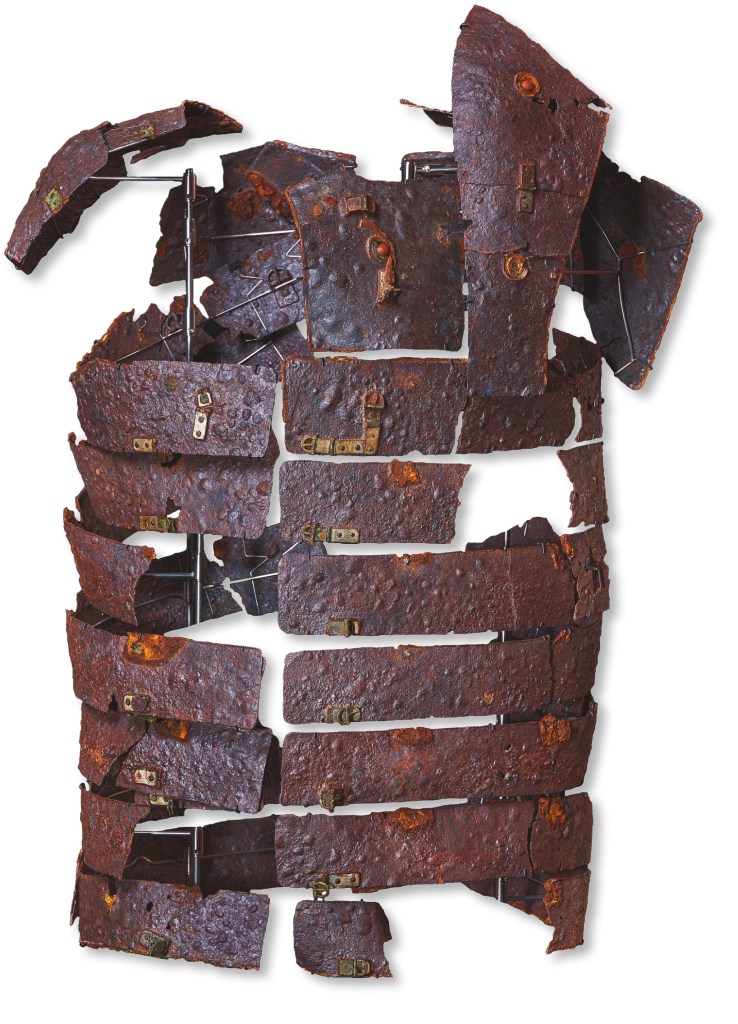
The earliest known fragments of segmental armour were found at the site of the landmark Roman defeat at the Battle of the Teutoburg Forest in AD 9.Image: Varusschlacht im Osnabrucker Land gGmbH – Museum und Park Kalkriese. Photo: Manfred Pollert
The Roman career soldier dates to the time of the first emperor, the social reactionary Augustus (r. 27 BC-AD 14), who ruled over 60 million people, barely 20 per cent of whom were citizens. The founder of the dual legion and auxiliary system, he seemingly thought citizen and non-citizen troops should be distinguishable by their equipment. This xenophobic snobbery, which colours the writing of the Roman senator and historian Tacitus, also seems prevalent in ancient artwork, particularly that of the metropolitan artists at Rome, who would have had little opportunity to see frontline regiments. However, there are reasons to believe that how a Roman soldier was kitted out was much more due to form and function, as well as finances – the social differences in Roman arms and armour were possibly less clear-cut than the artists’ chisels made them out to be.
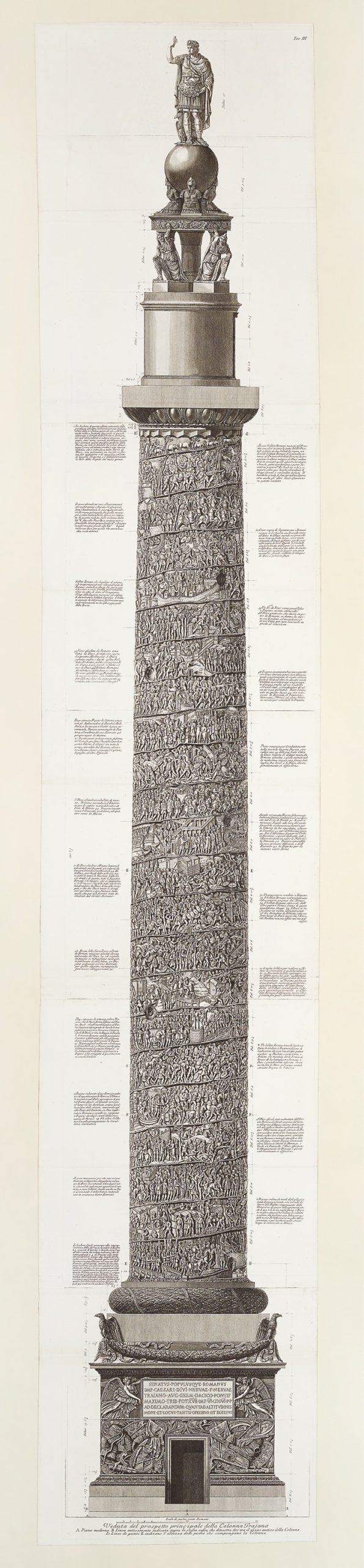
Above: Trajan’s Columnis not Rome’s only column haunted by imperial soldiers: the equally massive Column of Marcus Aurelius (below) also features a cast of thousands in its continuously spiralling frozen filmstrip. Both are seen here in etchings produced c.1774-1779 by the Italian artist Giovanni Battista Piranesi. Images: © 2024 Trustees of the British Museum, courtesy the Department of Photography and Imaging

Rome’s frozen filmstrips
Remarkably, Trajan’s Column is not Rome’s only column haunted by imperial soldiers: the equally massive Column of Marcus Aurelius (also known as the Aurelian Column) is another monument of the Roman army in a similar continuously spiralling frozen filmstrip with a cast of thousands. Trajan’s Column is from about 60 years earlier than its sibling, and has been the focus of a greater degree of study. It received its first local-authority protection order as far back as AD 1162, in the days when the death penalty could be conferred for vandalism. This lengthy scrutiny culminated in the French emperor Napoleon III commissioning a full monument cast in 1861, enabling a number of museums (including London’s Victoria & Albert) to display facsimiles. In contrast, casts of the Column of Marcus Aurelius were only taken at a relatively late stage, in the 1930s.
Perhaps it is the clarity of composition that has attracted more devotees in modern times to Trajan’s Column than to the monument of Marcus Aurelius. The former was made at the start of the 2nd century AD and has classically clean-cut Romans battling suitably shaggy barbarians, while the latter is from later in the century when fashionable Romans were as hirsute as their barbarian opponents. The Aurelian Column presents a hairy contest in quite another sense. It shows the turning point of empire, a grim, no-holds-barred struggle to maintain Roman supremacy in the face of ever more persistent and better-organised foes (it is this protracted contest that is briefly depicted in the opening scenes of the 2000 film Gladiator). It seems to have sparked a Roman tradition of stunningly detailed monumental battle sarcophagi, ever more crowded with similar nightmarish, writhing figures.
Some scholars have decried the artistic style of Rome’s second battle column, and seem to have been affronted by its emotionally candid portrayal of the horrors of war. In the case of Trajan’s Column, stock characters efficiently allow easy recognition on a monument that is intended to be gazed on from afar – but this also means that its pictorial evidence must be treated with a fair degree of caution and interpretation. It is a simplified reality, rather like a video game full of a limited set of repeated characters. On the face of it, the metropolitan artists who sculpted Trajan’s Column would have had little to go on. For example, soldiers did not normally wear hot, heavy, and uncomfortable armour on the streets of Rome – or anywhere off-battlefield for that matter – despite numerous Hollywood epics to the contrary. One cogent proposal is that the sculptors of the column got their models from a limited number of battlefield paintings carried along as part of Trajan’s subsequent triumphal procession in the capital.

Visibility, rank, and armour
To the Roman public, the intended viewers of Trajan’s Column, social recognition was paramount. Top-rank among the massed figures on the column was Emperor Trajan, instantly recognisable with his distinct features reproduced on coinage and other sculptural representations. Like other Roman officers on the column, he wears a paludamentum, or cloak, with his torso covered by the piece of armour known as a muscle cuirass. This consisted of a solid breastplate moulded to suggest superhuman muscles, fringed with strip-like defences known as pteryges to extend protection to the adjacent joints.
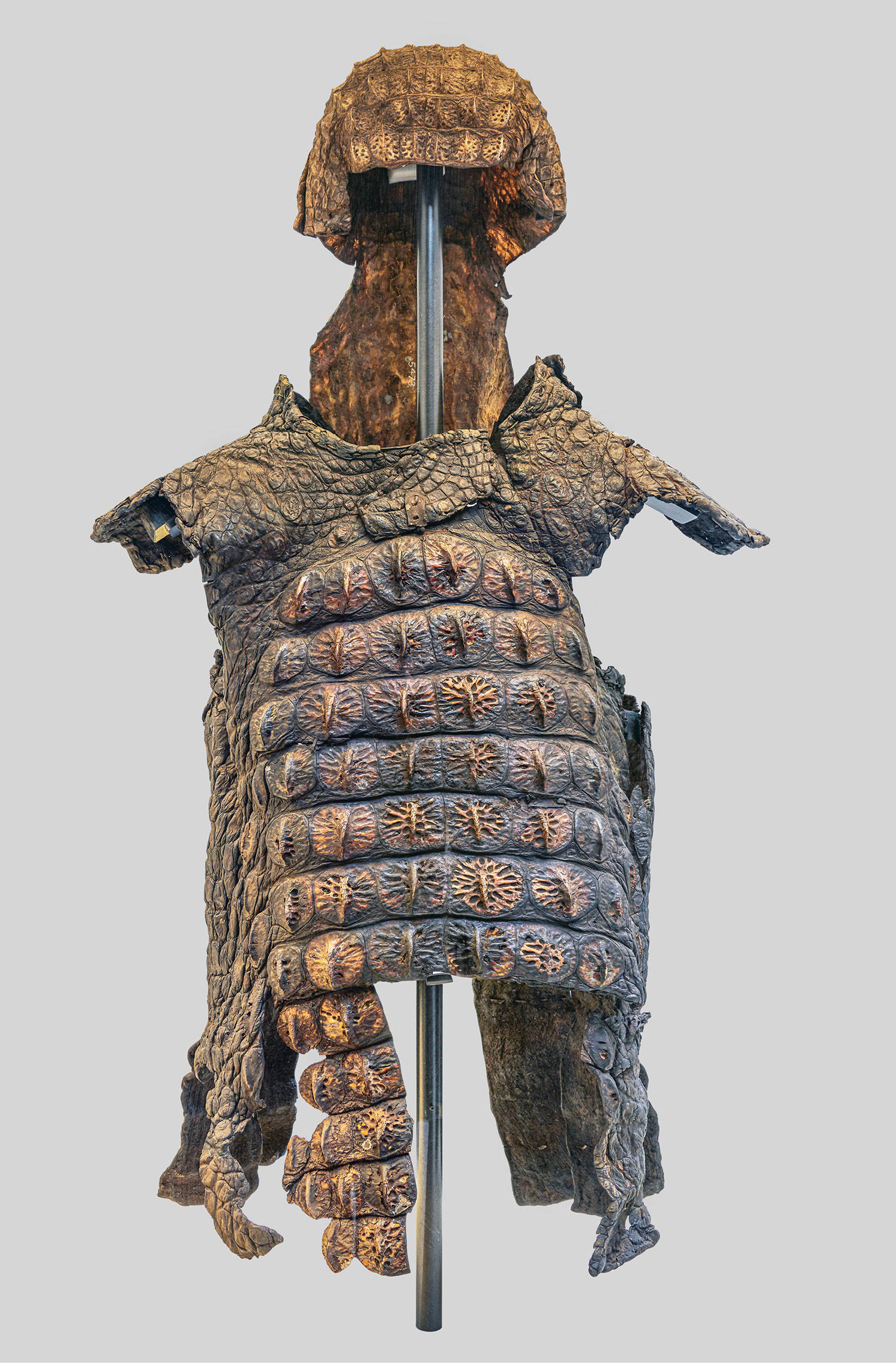
It remains uncertain whether the British Museum’s curious crocodile-skin ‘armour’ (on show at the current exhibition and possibly dating to the 3rd century AD) represents a pteryges-fringed under-layer to cushion a metal cuirass and extend flexible protection to the shoulders and thighs: an alternative dating is from a century later, when some troops abandoned metal armour, to the dismay of the Roman author Vegetius. Its crocodile scalp headdress could be either for protective or ceremonial use: it seems wide enough to fit over a helmet, so may even be a local adaptation of the tradition of Roman standard-bearers and trumpeters wearing skins of fierce animals over their helmets.
Next in the pecking order on Trajan’s Column after the aristocrats come the citizen soldiers: the legionaries. They are invariably armoured with segmental cuirasses (in later times given the unverified Latin name lorica segmentata). This has sometimes given rise to the misleading impression that this futuristic-looking armour was the ‘uniform’ for legionaries of the Roman Empire, but it was in fact more varied than that. Certainly, the segmental cuirass is the most distinctive form of Roman armour. Seen on an ancient monument from afar, the flexible overlapping metal strips give a sinister, skeletal-ribcage effect. It is characteristic of the epoch of the Roman principate (27 BC-AD 284): the earliest known fragments of segmental armour were found on the site of the Battle of the Teutoburg Forest (AD 9) and the latest artistic representations of it are to be seen on the Arch of Septimius Severus (AD 203), its presence in archaeological contexts thereafter petering out by the mid-3rd century AD. However, one need only look to the Column of Marcus Aurelius and other surviving monuments to observe groups of legionaries variously kitted out in a number of flexible cuirass options: chainmail (hamata), segmental armour, and scale armour (squamata – resembling fish scales, fixed on a flexible undergarment). Each had distinct advantages and disadvantages.
Notable was the skill of crafting a high-status muscle cuirass, while labour-intensive expense also went into the ‘knitting’ of countless metal links of chainmail. Chainmail was at least low-maintenance: a parade-worthy shine could be achieved by simply rolling it in a barrel of grit. Segmental armour strips were quicker to manufacture but the completed cuirass was operated by a complex web of leather strapping whose underparts were vulnerable to sweat and rain, and it presumably needed some degree of disassembly of its 30 or more plates to clean fully. Furthermore, the complex arrangement of hinges and washers would have been prone to battle damage and their repair no doubt a laborious task.
Regimental differences
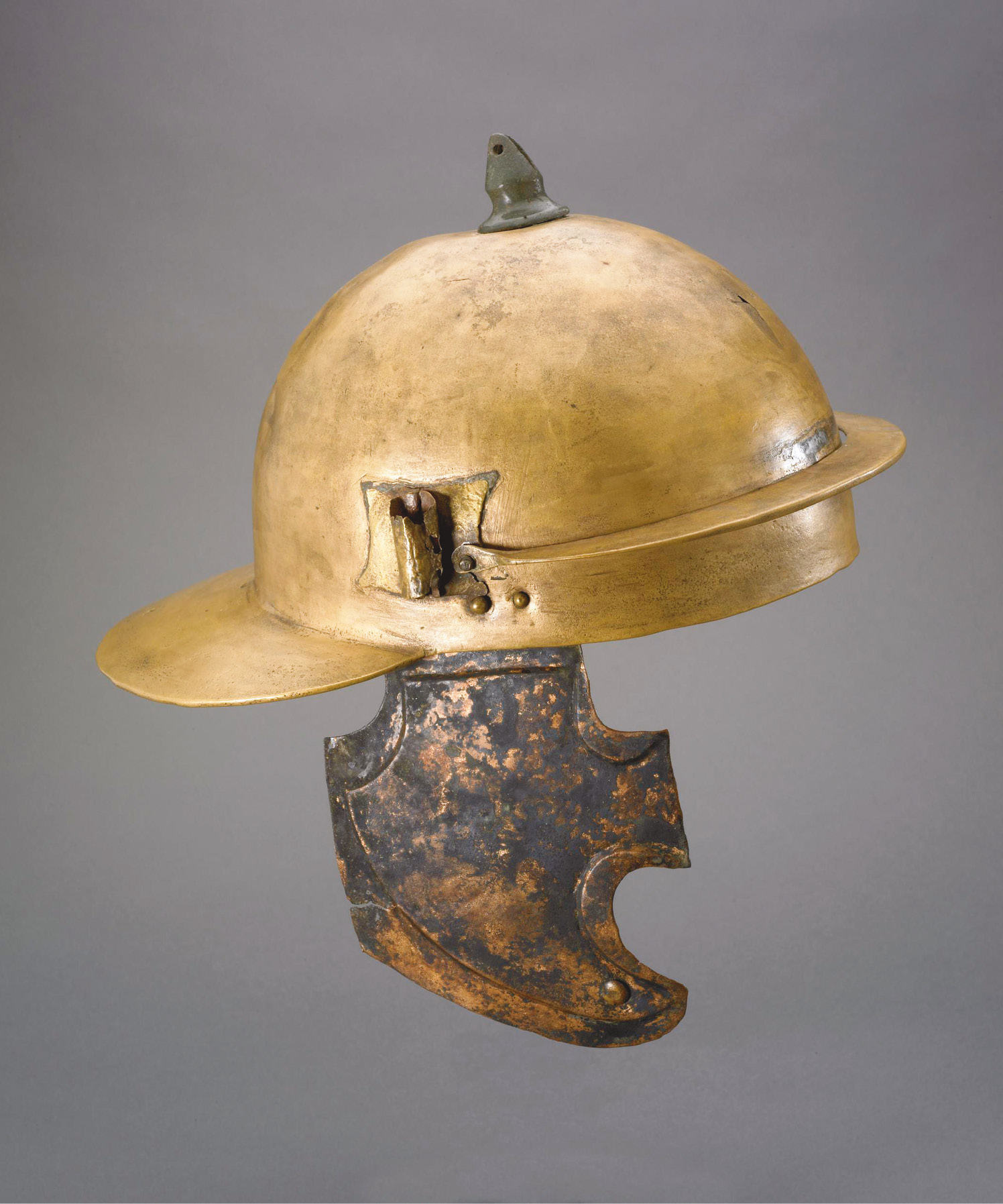
Tacitus, writing around the time of Trajan (r. AD 98-117), mentions that helmets and shields mark out auxiliary equipment from that of legionaries, but he does not mention body armour. Roman helmets, generally speaking, had the appearance of a metal baseball cap worn backwards – its brim or peak becoming increasingly flared as it evolved to protect the back of the neck – with the addition of cheek-pieces, which were hinged to allow the helmet to be lifted on and off the head. Helmets would have been worn over a beanie-like fabric hat for cushioning – a surviving example from Egypt had extra cheek panels and was woollen. Importantly, cavalry helmets had shorter nape protection to avoid a broken neck in a fall from horseback.
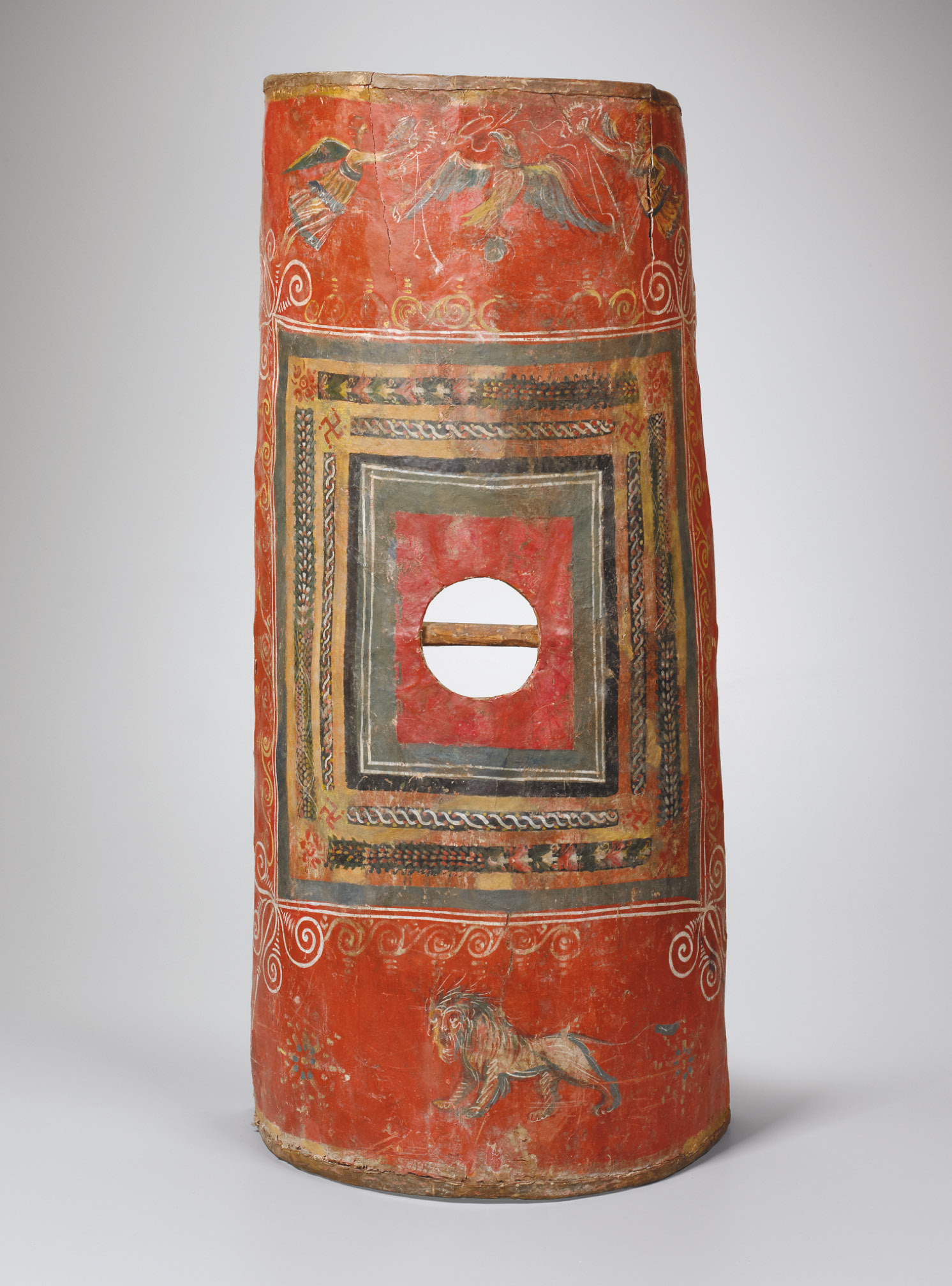
In his key passage, Tacitus also mentions specific insignia on equipment – although, regrettably, he does not offer any descriptions – and the late Roman author Vegetius records a general practice of painting regimental designs as well as the details of individual owners on shields. Yet beyond this there was a clear urge to employ spiritual designs imbued with victorious power. Winged thunderbolts can be glimpsed on shields on Trajan’s Column, alongside others emblazoned with alternative victorious designs such as wreaths, while winged Victories offer wreaths to Jupiter’s eagle on an exceptionally preserved shield from Dura-Europos, the Roman border city on the banks of the Euphrates.
Trajan’s Column seems to suggest that shield shape alone could be a basic indicator of Roman military class in this period. Legionaries have the scutum, a distinctive rectangular long shield with a semi-cylindrical curve, ideal for fighting with short swords in close ranks (such as the example from Dura-Europos). Auxiliaries have smaller, flatter, round or oval shields. On the Column of Marcus Aurelius, sculptors give some legionaries round shields, possibly to break up the repetition of the design, but perhaps in reality soldiers of whichever class might well grab shields best suited to the activity in hand. In addition to their pleasing shape to artists, round shields seem to be better for open-order tussles and to manoeuvre longer-reach weapons around them, such as longswords (spathae) in the case of cavalry or thrusting-spears in the case of both auxiliary infantry and cavalry.
Getting to the point
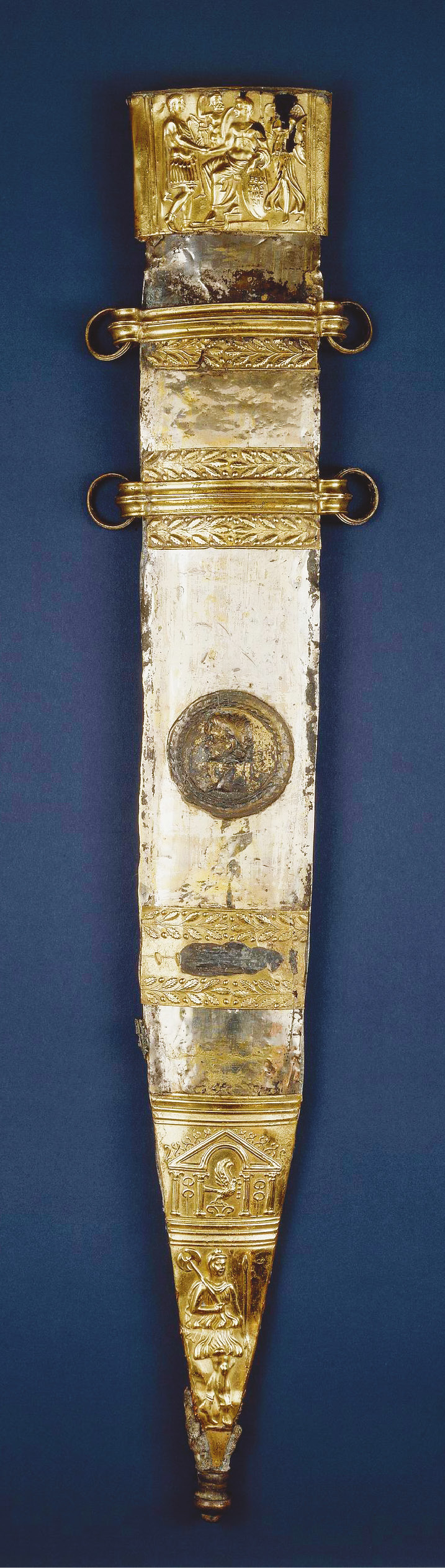
The British Museum holds a sword with a particularly finely decorated scabbard, with gilding and tinning, known as the Sword of Tiberius – though conclusions cannot be drawn from embellishment alone. It is the proliferation of official-looking imperial imagery on weaponry that conveys a sense of a presentational piece, given to someone of rank and privilege. Other than the showy scabbard, the Tiberius sword itself could have been carried by the humblest Roman soldier of the early imperial period, the waisted and leaf-shaped features of the blade seen all the way back to prehistory, and transmitted to the Romans via the Classical Greek shortsword known as the xiphos and the Celtiberian swords of Iron Age Spain.
The general impression is that legionaries were armed with javelin and shortsword (gladius), while auxiliaries were armed with thrusting-spear (hasta) together with shortsword (infantry) or the longsword known as the spatha (cavalry – though by the end of the 2nd century AD, spathae were common to infantry too). This division of equipment does also seem to be substantiated by a variety of other evidence, including effigy tombstones. The legionary pilum was a highly specialised Roman form of javelin or throwing-spear. The point was set on a slender, bendable iron rod of about 65 centimetres in length, ending in a weight to rebalance its centre of gravity, and fixed on top of a wooden haft. The long metal shaft was intended to punch through a shield to reach the enemy behind, or at least to bend in the shield to impede its subsequent use. Although it could be employed as a non-missile weapon, the potential single use of the pilum meant that two were brought to the battlefield by each legionary, despite being heavier than a regular thrusting-spear. Trajan’s Column originally bristled with spears and javelins, but since these were metal appliqué parts they have long since disappeared.
Before the end of the 2nd century AD, all foot soldiers had seemingly shifted to general use of longswords worn on the right-hand side of the body. It was certainly easier to draw a longsword with a blade more than 75 centimetres in length from the opposite side of the waist, but cavalrymen had been depicted up to this time with spathae slung on their right below the sword hand – which involved rotating the wrist backwards to an extreme degree. By around AD 200, lower ranks were permitted to copy the style of centurions and decurions in some aspects of dress and jewellery, so perhaps sword positioning was part of this democratisation of military fashion.
Evading the point
The classic rectangular legionary shield (scutum) took longer to die out, judging by the uniquely preserved example from the destruction layer of Dura-Europos, which was overrun and destroyed by the Sasanians in AD 257. Maybe the Dura scutum was already old-fashioned when it was left stripped of the metal boss that once protected its handle: a relic from an age when shortsword and long shield in combination could be put to highly effective use.
Its handle allowed it to be carried suitcase- like (hence the need for a cover with strap to sling it over the shoulder on the march), while the curved design and rectilinear shape, reminiscent of the curved Roman roof tile (imbrex), gave it a special function. Those standing behind the front line could hoist their shields up to give overhead protection to themselves and to the man in front who could still peer out of the arch formed by this roof. Interlock these ‘roof-tile’ shields back through succeeding ranks and a tank-like body of soldiers was created, protected from the missiles that were expected during advances on besieged fortifications. This is the famous ‘tortoise’ (testudo) manoeuvre seen on both of Rome’s famous battle columns. The testudo not only allowed for an advance under full cover, but the ‘roof’ of shields could subsequently form a ramp to conduct assault waves up on to the rampart.


Looking bigger and stronger
There are further aspects of artistic licence affecting all classes of Roman soldier depicted on Trajan’s Column. First, following Classical artistic tradition, clothing and equipment are tight – shrink-fitted for artistic anatomical interest perhaps, and also to give the impression of superhuman strength. Trousers depicted on the column seem skin-tight, although of course only modern stretch fabrics can automatically tailor clothes. The Romans could still produce tight trousers, but they were unusual enough to be singled out as wear for special occasions like cavalry sports displays (hippika gymnasia). Even less feasibly, helmets on Trajan’s Column had been shrunk too, while their cheek-pieces are narrowed so we can see more face, when in reality this would have compromised protection. Long shields also come up short on the column, no longer providing chin-to-shin protection on the exaggeratedly statuesque figures.
Many Roman helmets had fixings for crests (combs of brush-like hair or feathers) and side tubes for attaching further plumage, both of which served to aggrandise the appearance of the wearer. Trajan’s Column suggests that crests were reserved for the parade ground – at least in this period – since they are only evident during an imperial off-battlefield address. Instead of crests, standard-bearers and trumpeters elicited a more imposing appearance by draping their helmets and shoulders with the skins of fearsome animals. Bear and lion pelts were certainly used by standard-bearers in the legions, with perhaps some regional variations for auxiliary troops, such as wolf pelts for Germanic troops.
Changes with time
The appearance of Roman military equipment changed with time and experience of combat, usually to provide greater protection through reinforcement and coverage. Helmet cheek-pieces tend to widen and neck protectors flare, contrary to the artistic depictions on Trajan’s Column. Greaves to protect the shins of centurions became less exclusive, while the gladiators’ segmental arm-guard known as the manica, or ‘sleeve’ – familiar military kit since the previous century – seems to have been quite widely employed by soldiers. Indeed, the iconic Roman segmental cuirass itself might have evolved via a similar route, having also equipped a rare form of fully armoured gladiator, the crupellarius (who already existed in AD 21, when bands of them took part in a brief revolt against legionaries in Gaul – so quite close in time to the earliest known military segmental cuirasses of AD 9). With added thigh protectors along similar lines to the manica (and also employed by the crupellarius), the fully armoured horseman – the Roman version of the fearsome Sarmatian cataphract – was created. Sitting atop a horse-trapper (blanket) of scale armour, they were just as protected as medieval knights and every bit as hot, to judge by their alternative nickname clibanarius (‘cooking-pot man’).
Another important aspect that belies the artistic uniformity of Trajan’s Column, and indeed many other depictions of groups of Roman soldiers in general, is the evidence of heirloom kit, sometimes showing signs of adaptations and upgrades. Perhaps the Dura scutum had sat in the armoury for a long time before it was lost, and this is also one explanation for the different names on the set of Roman silvered bronze horse-trappings found in Xanten, Germany, and now on display at the British Museum. In a similar vein, the museum preserves a helmet found in the lost London river of the Walbrook, inscribed with four different owners serving under three different centurions. It could have seen many decades of use before deposition – also explaining how a helmet style of the time of Augustus or Tiberius could end up in a city that was only founded in the mid-1st century AD.
Under the Roman heel
A further Roman ‘weapon’ should be mentioned. All soldiers wore hobnail boots, either in their classically familiar open-strapwork sandal form (caligae) or as the distinctly modern-looking enclosed army boots (calcei) favoured by Roman marines. Army boots could look indistinguishable from footwear for women and children also found in forts – with the exception of rare survivals of slip-on styles of women’s shoes, and even those could sometimes still have hobnails for gripping the rough ground of a frontier fort. In a military context, the hobnailed sole, just like today’s rugby boots, provided a firm grip in the scrum of the battlefield. It was such a characteristic feature that Juvenal was inspired to describe the experience of a civilian before a biased military court as facing a ‘hobnailed judge’. Not all surfaces suited hobnails, as one centurion in the First Jewish Revolt found when he pursued rebels across the flagstones of the Temple of Jerusalem. Pursuit ended in a slip and fall, with the clattering of armour alerting the pursued to turn around and hack him to death. Hobnails could certainly be used offensively: even Roman civilians could find themselves on the receiving end of a kick or stamp, as Juvenal also found out to his cost. Any enemy who slipped beneath the advancing boots of the Roman battle-line was unlikely to survive. The motif of trampled barbarians is so common in Roman art that it is easy to overlook its original meaning: that the battlefield objective was to stamp a human being to death.
Richard Abdy is lead curator of Legion: life in the Roman army, running at the British Museum until 23 June; for details and ticket information, see http://www.britishmuseum.org. He is the author of the exhibition’s catalogue (British Museum Press, £45, ISBN 978-0714122939), from which this article is adapted.