
Subscribe now for full access and no adverts
Later prehistoric rock art in the western British Isles is usually associated with large and visually impressive monuments such as burial-ritual sites, standing stones, and stone circles – architectural innovations that transformed the landscape and hint at the Neolithic being a period of great social, political, and economic change. In Wales, these monuments were occasionally augmented by the addition of individual cupmarks (or cupules), cup-and-rings, and more elaborate motifs – for example, on the uprights of the passage graves of Barclodiad y Gawres and Bryn Celli Ddu, in Ynys Môn (Anglesey; see CA 211, and CA 310 and CA 318 respectively). Multiple cupmarks also occur, sometimes in great number, on the imposing capstones that precariously crown portal dolmens like Bachwen on the Llyˆn Peninsula, and Trellyffaint in Pembrokeshire (see CA 380).
As one moves forward in time to the Neolithic-Bronze Age transition and the Bronze Age proper, though, the attention of cupmark creators appears to have shifted from monuments to natural outcrops and boulders. Archaeological surveys (by the authors and others) have identified examples of ancient artwork at such sites scattered across north-west and southern Wales, with recent discoveries found in Flintshire and along the northern Marches, too. These markings occupy vast upland landscapes and span a broad period of time between c.3500 and 1500 BC.
Documenting these sites has been a long process: in 1999, according to seasoned rock-art specialist Stan Beckensall, the list for the whole of Wales numbered around ten rock-art sites. From such meagre offerings, one could suggest that Wales (and the western British Isles) was a prehistoric backwater – but by 2004, with the publication of John Sharkey’s The Meeting of the Tracks: rock art in ancient Wales, this figure had increased to around 43 sites, and since then, numbers have only continued to grow, with the current total standing at around 170 sites.
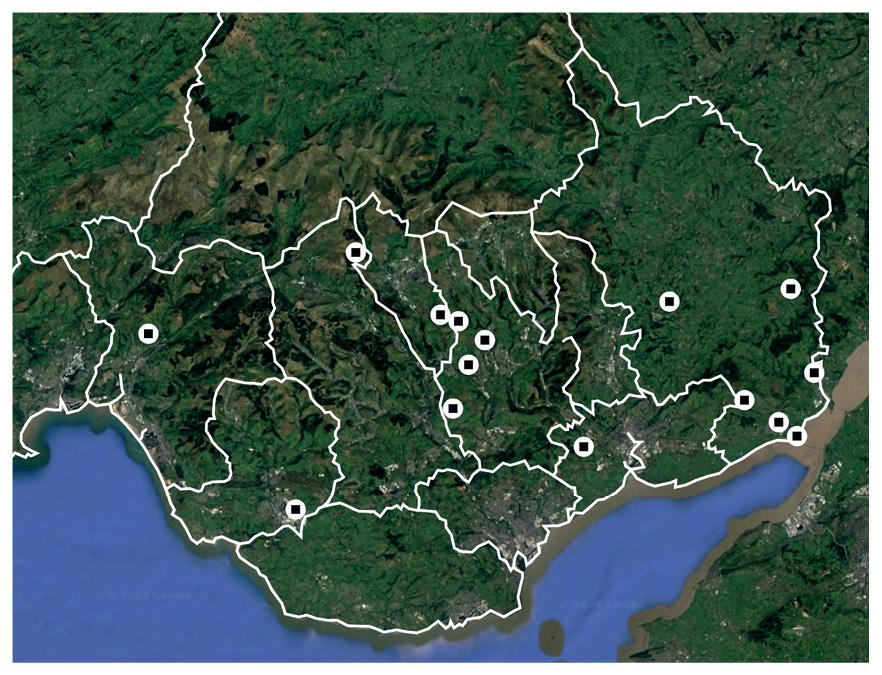
In this article, we will focus specifically on South Wales, where the number of rock-art sites on the current Historic Environment Record (HER) stands at 18, although other recently identified locations await evaluation and confirmation. Between 2017 and 2023, the authors – along with amateur enthusiasts – made a number of significant discoveries and verifications within the central and western parts of the South Wales valley region, on Rhos-gwawr, west of Aberdare, and on the summits of Eglwysilian Common and Mynydd Drumau, increasing the national site-list by seven. A handful may have been already known to nearby communities, perhaps acting as focal points or meeting places within a sometimes barren, hostile upland landscape. It is likely that many would have been incorporated into local myths and legends – something supported by placename evidence – but beyond these local connections they remained secret to the outside world until they became of interest to archaeologists and rock art specialists.
Statementing upland landscapes
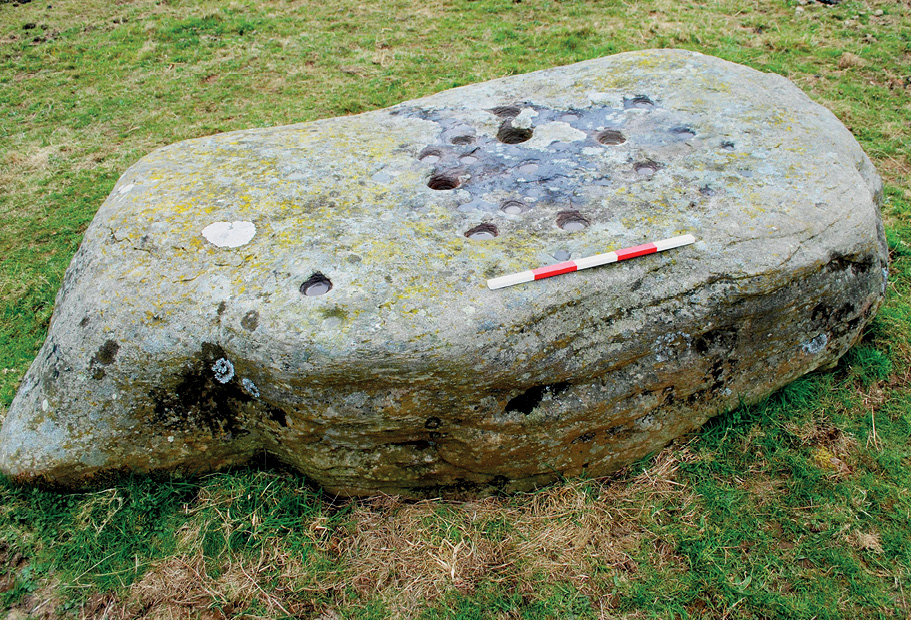
When the Royal Commission on the Ancient and Historical Monuments of Wales (RCAHMW; see CA 409) published its inventory for Glamorgan in 1976, only one cupmarked site was listed: Maen Catwg, near the village of Gelligaer. This is home to a large stone block, measuring 2.6m by 1.7m, which has at least 50 cupmarks on its upper and side surfaces. Despite the lack of other evidence for Neolithic activity within the immediate area, we suggest that it may have been the capstone of a now-lost Neolithic or Neolithic/Early Bronze Age transitional burial-ritual monument dated between 2500 and 1500 BC.
For almost 40 years, Maen Catwg would remain a lonely outlier in the listings for Glamorgan, but in 2017 an intense landscape survey identified another group of monuments, several marked with cupmarks, about 12 miles away on the summit of Rhos-gwawr, west of the town of Aberdare. Dispersed across this open, marshy upland landscape was a large Bronze Age cist cemetery – a remarkable survivor of later medieval and post-medieval field enclosure – which was organised into two distinct groups of 10 and 13 sites. There were also several recumbent standing stones, one of which bore a single cupmark.
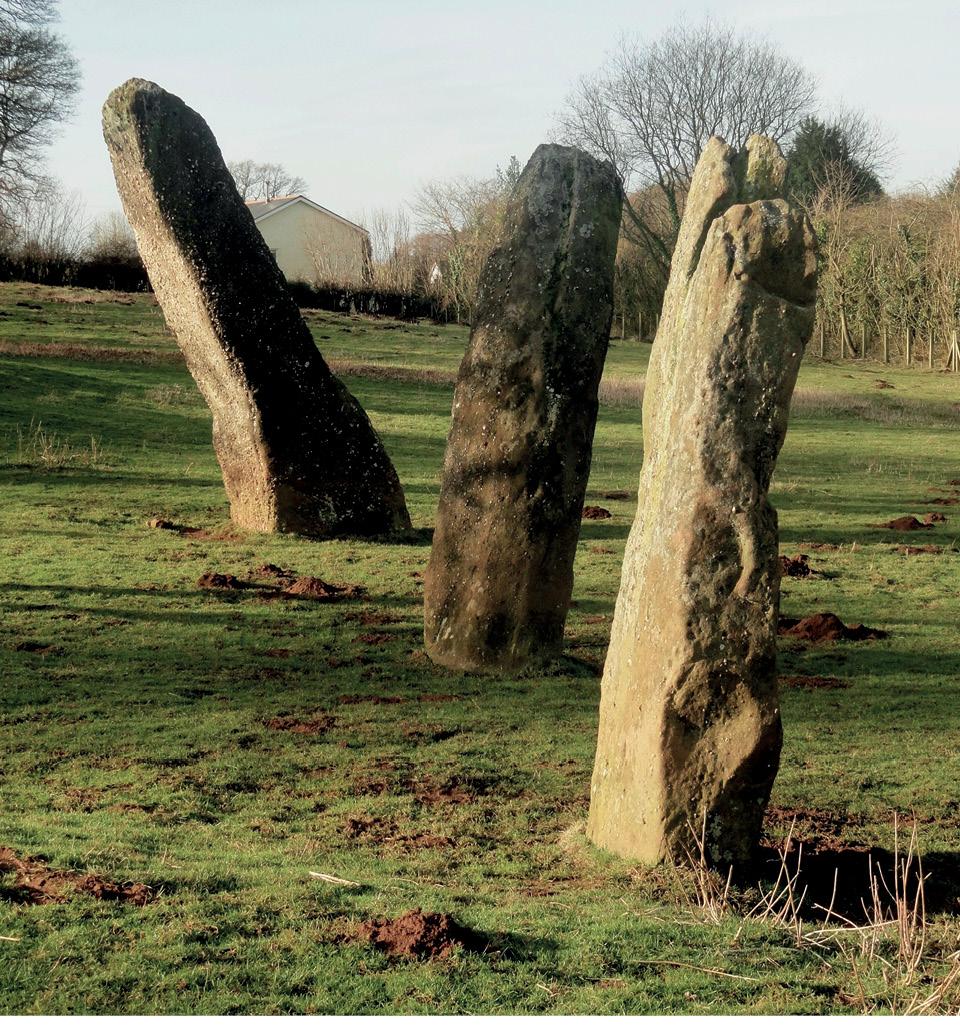
Over in neighbouring Monmouthshire, only a handful of sites were recorded in the RCAHMW inventory, among them the Harold’s Stones at Trellech. There, three large monoliths stand within view of the local parish church – though this significant alignment was originally longer, as a fourth stone is known to have stood into historical times. The currently central monolith, made from local sandstone and standing more than 2.5m high, has a large, smoothly polished cupmark on its south-east face, along with several smaller cupmarks along its shaft. Although one can suggest a rough date range for the alignment itself, it is not clear if the cupmark is contemporary or if it was carved on to the already-installed monolith at a later date. It is not uncommon for rock art, especially cupmarks, to be added to earlier sites, such as those involved with burial- ritual activity – what we would term ‘statementing’ monuments.
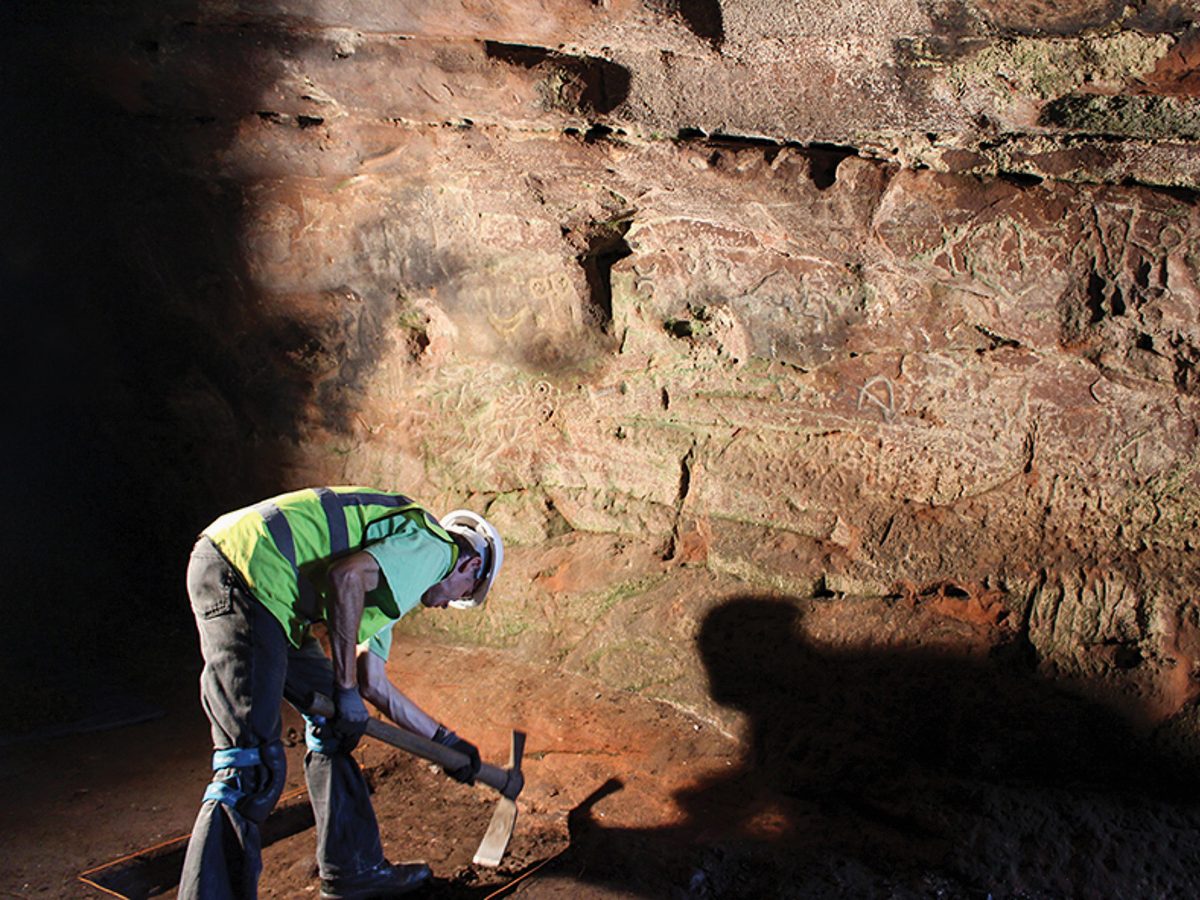
From such few documented finds, recent years of research have completely transformed our understanding of the distribution of later prehistoric rock-art sites across many of the upland landscapes of South Wales. Since the early 2000s, Dr Edith Evans and her community-led team have established a new baseline, recording many open-air sites, particularly on Gelligaer Common, which stands around 470m AOD between the settlements of Trelewis and Bargoed. Its landscape is littered with archaeological remains: Bronze Age cairns (including Cairn-y-Bugail), medieval house platforms, tramway inclines, quarry levels, trackways, and holloways, while a Roman road also cuts north-to-south through the common. Most significantly for our purposes, this area is surrounded by scattered rocky outcrops, some of which preserve single and multiple cupmarks. These appear to be associated with a large Bronze Age cemetery occupying the northern part of the common.
Expanding our understanding
More recent finds came in 2019, when prehistoric rock art was discovered by an enthusiast on two sandstone boulders sitting either side of a north-facing gully at Eglwysilian Common, within the Nelson Community. Known as Ffos-yr-Haidal 1 and Ffos-yr-Haidal 2, the panels are thought to be probably contemporary, their motifs created during the early to middle Bronze Age (c.2500-1600 BC). Ffos-yr-Haidal 1, which measures 1.3m east–west by 1.2m, includes at least ten cupmarks, the largest of which measures 80mm in diameter, together with several faint engraved lines; its neighbour, Ffos-yr-Haidal 2, lies 220m south–south-east, and its 1.37m by 0.84m surface preserves at least 35 cupmarks with many interconnecting lines. Their function is unknown, though there appears to be an association with other nearby monuments, including several burial cairns (Carneddi Llwydion and Cairnfield) – a common association that is repeated elsewhere in the uplands of the South Wales Valley region.
Both panels, along with several stone groups identified close-by, were reported to Cadw after a survey, resulting in their being scheduled in January 2020. Despite this statutory protection, Ffos-yr-Haidal 2 and other nearby stones were vandalised in early 2023. The culprit was arrested, fined £4,400, and given a four-month custodial sentence suspended for two years. The incident also assisted the authorities in establishing an effective Heritage Crime Unit in South Wales, but such callous acts remind us how vulnerable ancient artwork can be, despite such designs being ‘set in stone’.

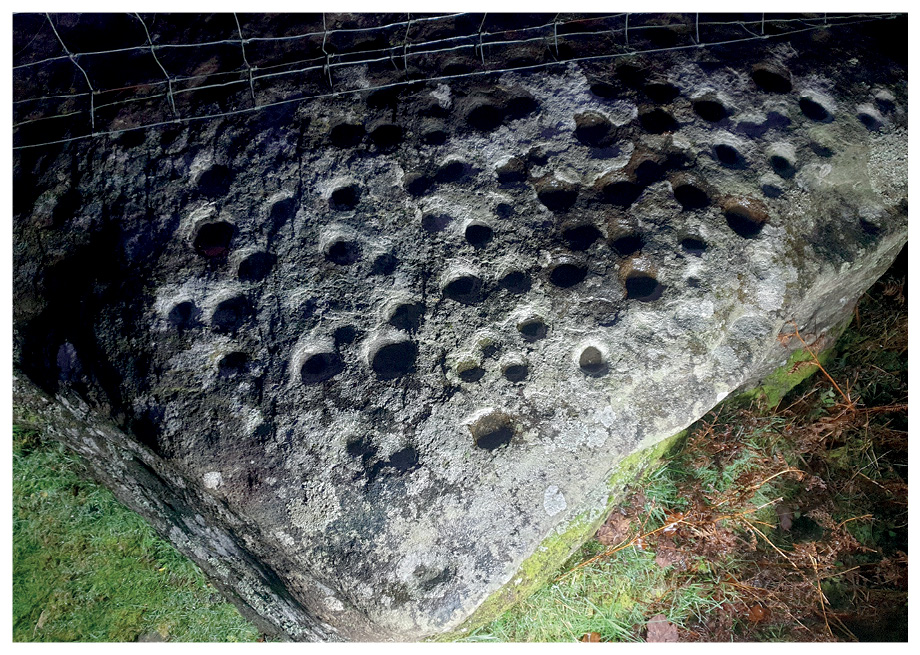
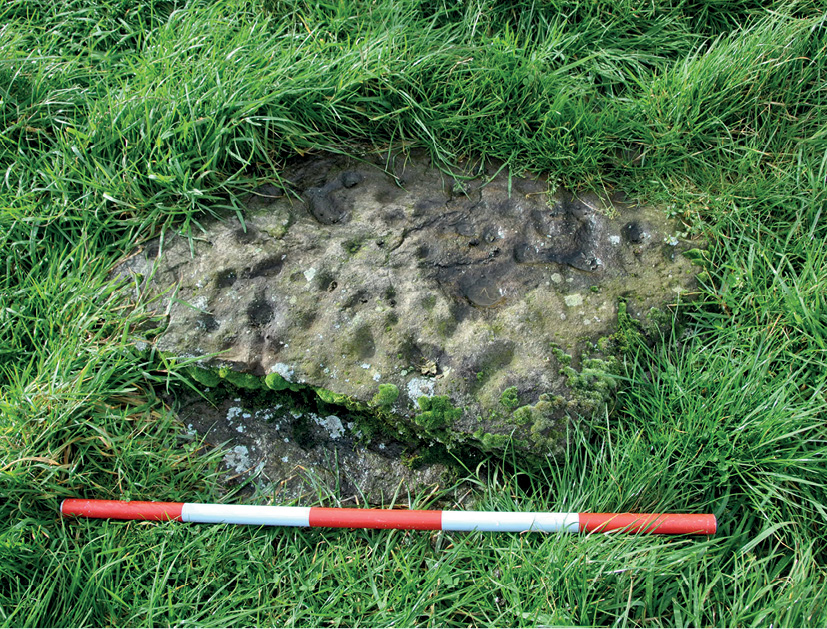
Another significant discovery was made in June 2022, when Kim Allen and her colleague Ian Jenkins discovered multiple cupmarks on a large boulder that had been incorporated into a more-recent field boundary between two historical farmsteads – Tai’r waun Isaf (west) and Tai’r waun Uchaf (east). The stone in question measures c.3.60m by 2.85m, and its upper surface contains more than 93 cupmarks, making it one of the largest assemblages of these markings on a boulder in the whole of Wales. While its cupmarks appear to be fairly randomly dispersed, closer inspection did reveal several crescents formed from three, four, or five markings – a pattern that has been found on other monuments in Wales and the Isle of Man.


Examination of the base of the stone, meanwhile, revealed that it is probably detached from the underlying bedrock, suggesting that it is a glacial erratic that had been moved into its current position. This relocation may have had ancient origins, however, as the subtly undulating surface all around the stone hints at the possible remnants of a cairn. It is possible to detect the faint remains of a mound measuring up to 14m (north–south) by 8m (east–west), and several other large stones/boulders within the field boundary could have come from a cairn as well. Perhaps the cupmarked stone was associated with a nearby Neolithic or Neolithic-Bronze Age transition burial-ritual monument, whose mound was later redeposited in this area in order to improve the agricultural quality of the field – a geophysical survey undertaken in 2022 proved inconclusive, however.
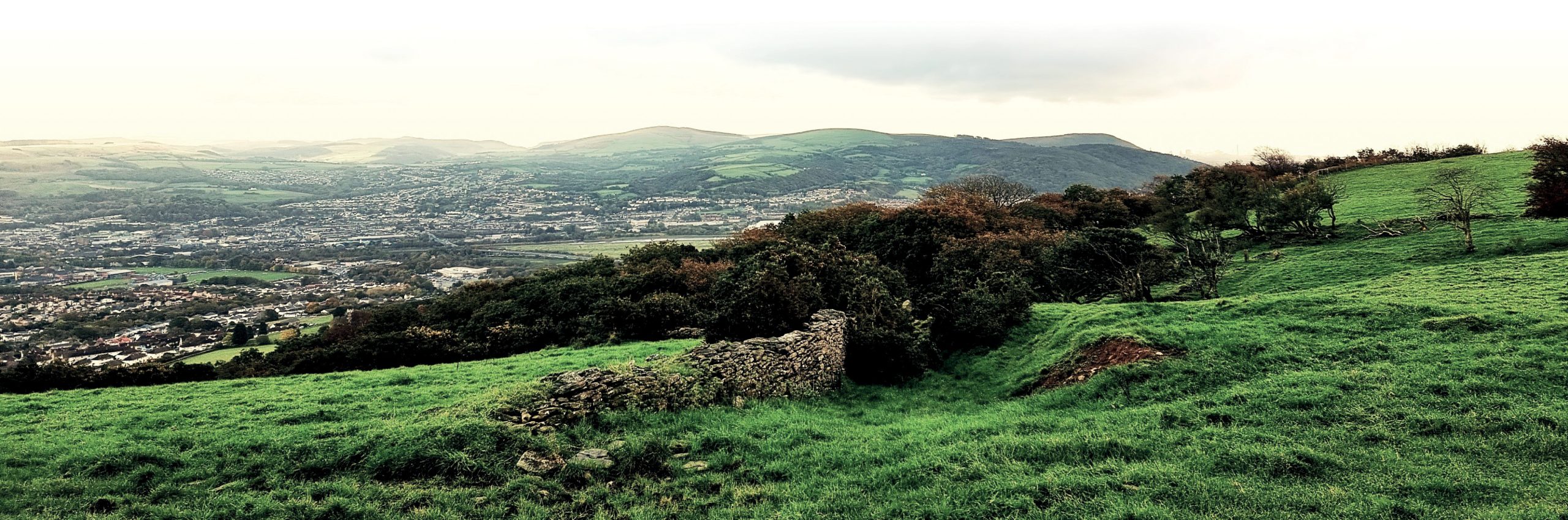
Finally, in late October 2023, we assembled above the Vale of Neath to explore the open uplands of Mynydd Drumau. Rising to a height of 260m, this landscape has, in its historical past, been enclosed by drystone-walled fields and a substantial holloway that occupies the eastern ridge of the mountain. Also present are the ruins of a farmstead that lies west of Darran Wood. As far as we were aware, there was only one rock-art site known, recorded on social media by Paul Blades. Our survey identified six prehistoric sites, three of which do not appear on the national Historic Environment Record database (known as Archwilio).
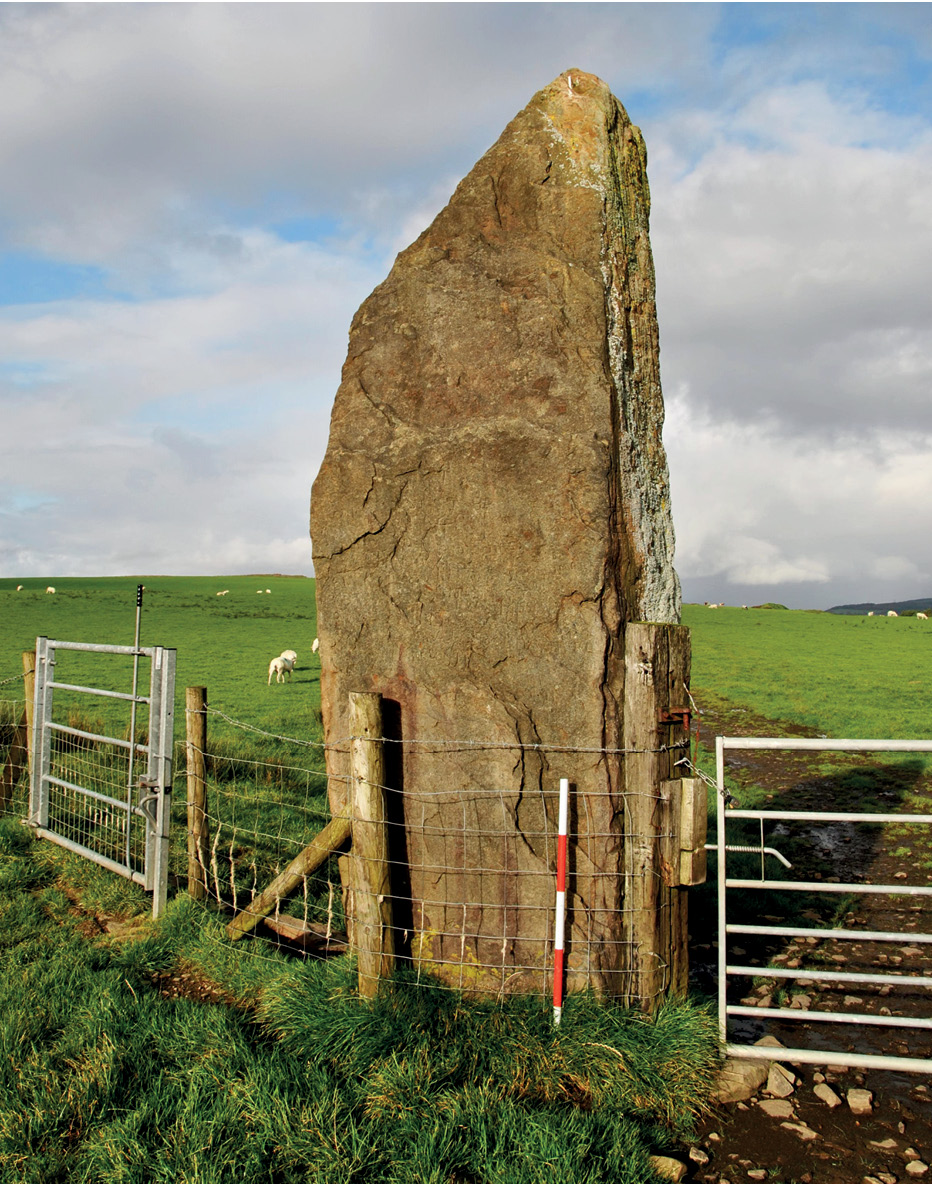
The most visible aspect of the known archaeology is the Careg Bica Standing Stone, a 4m-tall scheduled monolith. Approximately 50m to the north, we find a concentrated spread of rubble representing the remains of a Bronze Age cairn; and 300m to the south are two other, more-coherent cairns. On the north and south sides of the monolith, meanwhile, we documented two rock- art sites, now labelled RA 1 and RA 2 – the latter site having previously been noted by Paul Blades. One had been incorporated into a historical field boundary, while the other lies in a large, open field, probably reflecting the position of a now-lost Bronze Age burial-ritual cairn. We believe that this upland area formed a complex ritualised landscape, with Careg Bica representing a major focal point within a wider array of monuments, much of it falling victim to later landscape changes during historical times (or, more optimistically, still awaiting discovery).

The bigger picture
The temporal distance between when rocks of South Wales were being decorated with cupmarks and the present day represents at least 160 generations of community. Unfortunately, during this 4,000-year period, the motifs’ meaning has been lost. We can make some inferences, though, by looking at the distribution of open-air rock-art sites with other surviving stone monuments – in particular, burial-ritual sites that occupy the same landscapes along with standing stones, stone circles, and stone rows. It is possible that engraved rock outcropping, such as the multiple sites on Gelligaer Common or the two on Eglwysilian Common, represent landscape markers whereby local communities could approach a burial-ritual monument in a prescribed way.
What the cupmarks mean and how they were arranged, though, remains a complete mystery – although the idea that, when illuminated by either a setting sun or by ancient torches, multiple cupmarks may have represented celestial bodies such as stars and planets is appealing. The large sandstone boulder at Llanfabon with its 93-plus cupmarks could have depicted a bright and clear account of the cosmos, say, 4,500 years ago. Alternatively, each cupmark could have represented a deceased individual who was ceremoniously paraded using a designated corpse road to his or her final resting place.
It is clear from the research and fieldwork undertaken by our group, and sound baseline research by Dr Edith Evans, that the uplands of South Wales remain a potent potential focus for further discovery – and one that could tie into a much bigger picture. The humble cupmark is not just found in Wales, but is an archaeological phenomenon that extends along much of the Atlantic Façade of Europe, spanning 3,200km, from the Iberian Peninsula to Scandinavia, and is usually associated with identical monuments and places to those in South Wales. One might suggest that this simple motif was central to Neolithic and Bronze Age European identity, of which the communities of Wales formed an essential part. It is tempting to imagine that these markings, and how they interacted with other ancient artistry, had a universal meaning across this wide area and beyond.
Further reading: E Evans (2022) ‘Prehistoric Rock Art in Glamorgan and Gwent’, in A Mazel and G H Nash (eds), Signalling and Performance: ancient rock art in Britain and Ireland (Archaeopress, £40, ISBN 978-1803272511).
All images: George Nash, unless otherwise stated