‘By yon bonnie banks’: Exploring the archaeology of Ben Lomond

Ben Lomond is one of Scotland’s most famous mountains, lying on the edge of the Highland boundary fault, with its shouldered profile dominating the skyline of the Central Belt and the Trossachs. Over the last three decades, National Trust for Scotland staff have been unpicking the archaeological and historical stories preserved within this landscape, bringing them to the attention of the public once more. Derek Alexander and Alasdair Eckersall report.
Start
This article is from Current Archaeology issue 432


Subscribe now for full access and no adverts

Ben Lomond forms the central focus of Scotland’s first National Park, Loch Lomond and the Trossachs, which was established in 2002. As the most southerly Munro (a Scottish mountain over 3,000ft in height – Ben Lomond measures 3,196ft), it is often people’s first introduction to hillwalking in Scotland, climbed by more than 50,000 people every year, with another 40,000 passing its western foot as they walk along the shore-side, long-distance trail called the West Highland Way. The National Trust for Scotland looks after 2,173ha (5,370 acres) of the mountain, which has numerous natural heritage designations but no Scheduled Monuments. Over recent decades, however, archaeological fieldwork has documented an equally rich historic environment within the NTS estate.
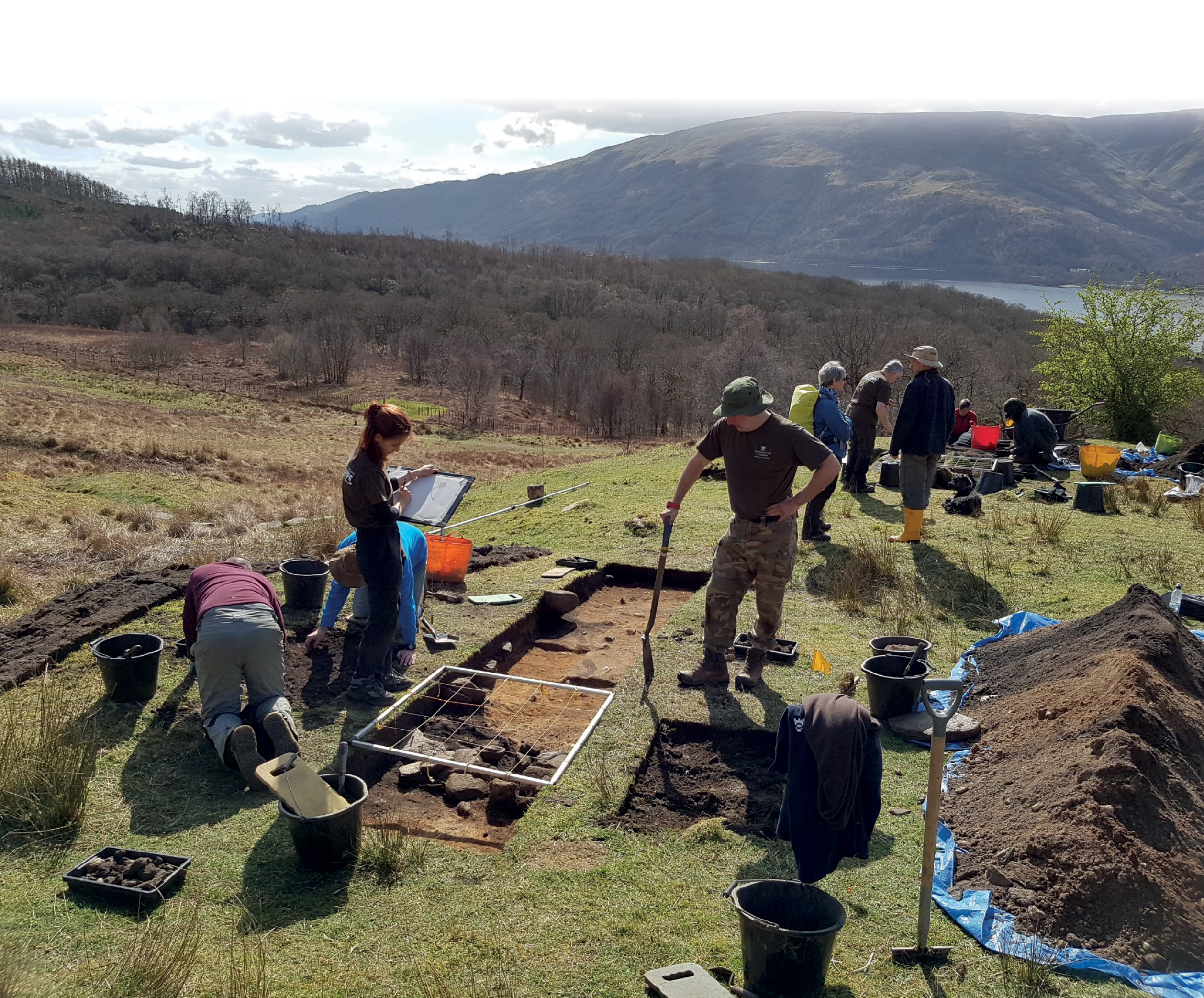
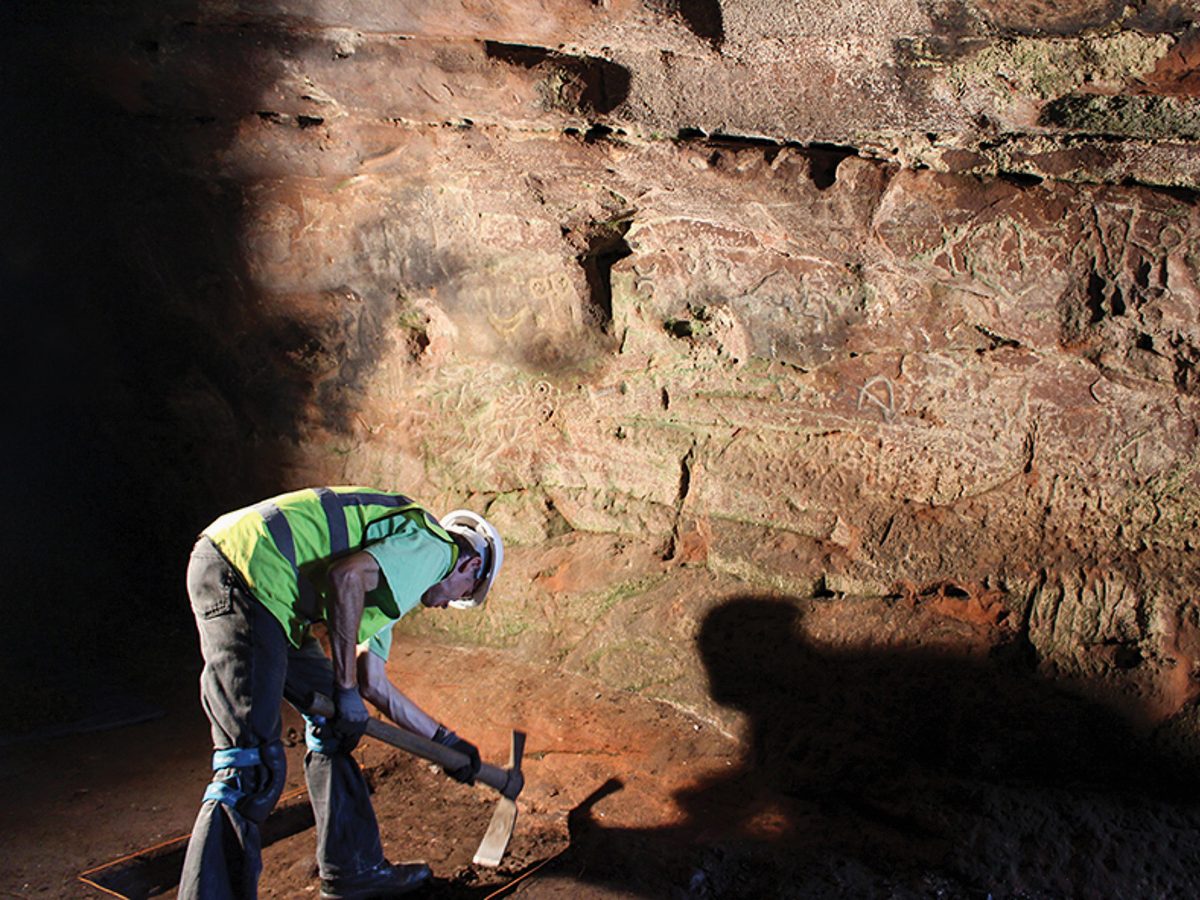
Digging the iron bloomery mound on the Ardess Hidden History Trail (Site 6).
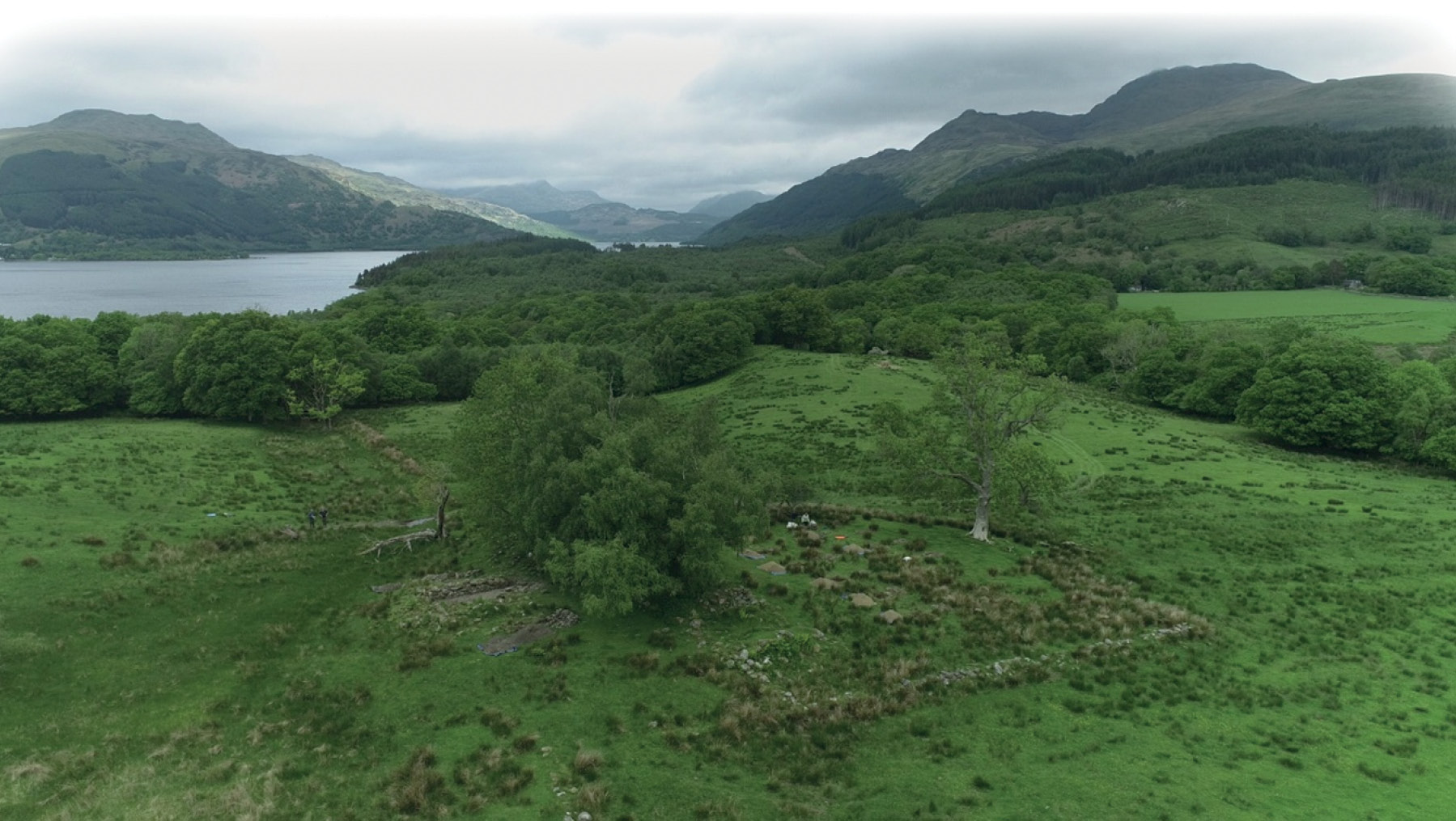
Ben Lomond can be seen in the top right of this drone photograph; the foreground shows the remains of a 19th-century farmstead excavated at Ross.

Our story begins back in 1995, when the Trust commissioned John Hunter and a team from the University of Bradford, and later of Birmingham, to undertake an archaeological walkover survey of Ben Lomond. This investigation proved remarkably productive, locating some 44 house sites concentrated around the lochside settlements of Blairvockie and Ardess, as well as five shieling groups higher up the hillside at Coille Mhor, Coire Odhar, Coire Corrach, Glashet Burn, and Tom Eas. There were also lengths of dyke and areas of ridge-and-furrow cultivation, while the team also recorded a number of bloomery mounds – small furnaces associated with iron production.

The results of this survey still form the core of the Trust’s Historic Environment Record for the property, and more recent excavations have added important details to this data set. Let’s explore some of the key findings, from the lochside up to the mountain’s summit.
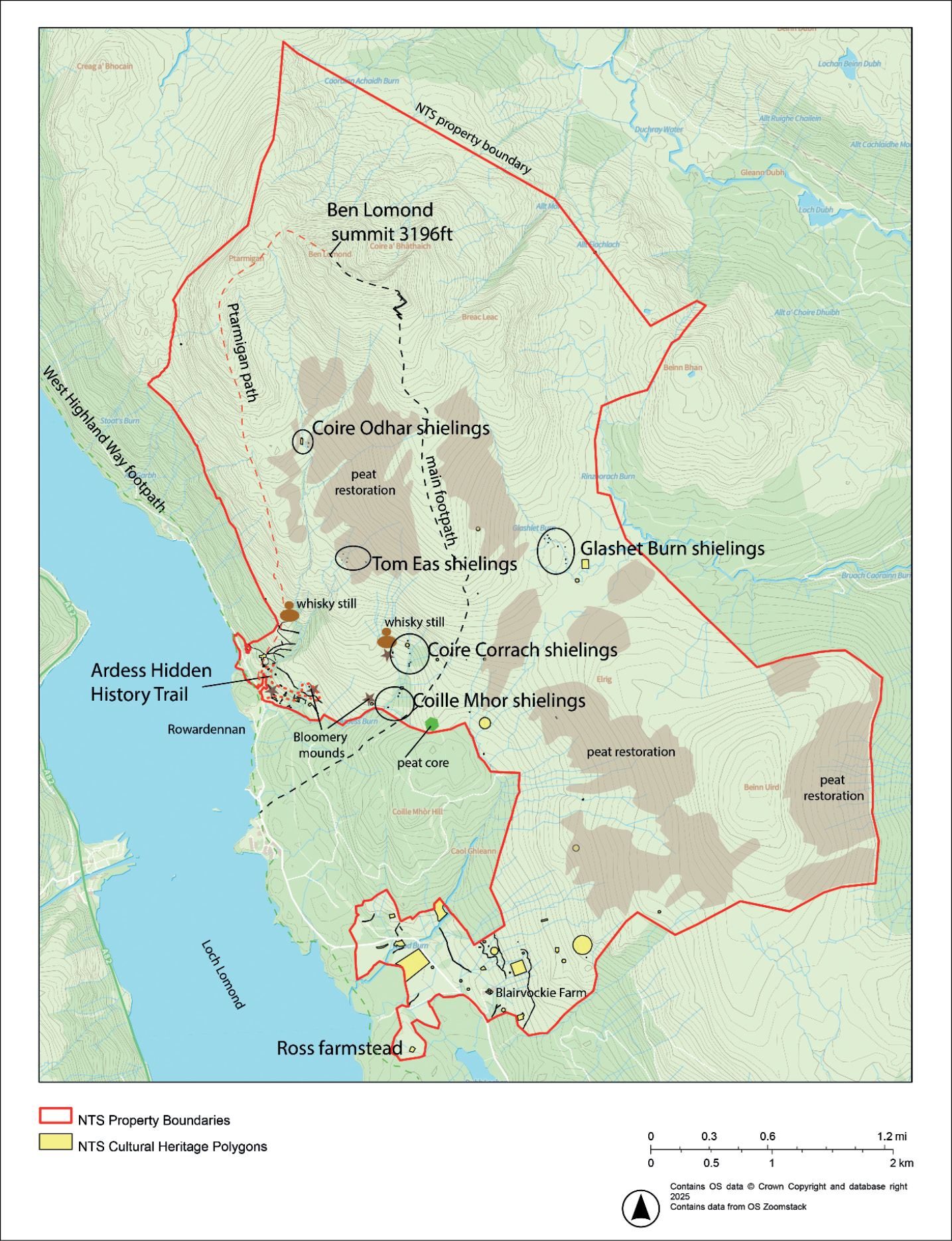
This map shows the NTS property at Ben Lomond and areas of archaeological interest.
 A plan of the Ross farmstead shown above.

Kailyard clues

The first site to be excavated in 1995 was a 19th-century farmstead at Ross, on the improved, low-lying ground beside the loch on what today is Blairvockie Farm. The fields in this area were known to have been a focus of settlement, with around 30 households spread across seven different townships by the early 1700s, though some had disappeared by the start of the 19th century. On this particular site, during the original investigation, the team produced an excellent plan of the surviving buildings, as well as carrying out a geophysical survey of the surrounding area and opening a number of small trial trenches.

There was still more to learn, though, and a couple of years ago the Trust revisited the site to open more trenches, as well as a grid of test pits in the kailyard (a kind of small, enclosed garden plot) to the north. Excavating in kailyards is a technique we have used at a number of locations (Ben Lawers, Torridon, Iona, and Glencoe); these gardens were used for winter vegetables, and the assumption is that waste material and rubbish would have been dumped on a midden heap before being spread over the enclosed plot – making them fertile ground for finds. Sure enough, at Ross the ten test pits excavated in the kailyard recovered a range of pottery, glass, and clay tobacco-pipe fragments. We opened two trenches, too, within the rectangular building lying to the south of the main farmstead block. Trench 1 revealed a well-built cobbled floor from which a clay tobacco-pipe bowl was recovered, while Trench 2 proved even more illuminating. Located within the western part of the structure, it revealed a floor surface on which lay horse shoes, part of a horse harness, and a gin trap. Perhaps this small space had served as a tack room.

Hidden history

The remains of the 19th-century farm at Ross are fairly typical of the area, but they lie in a rather unvisited spot on the Trust’s estate. Most visitors to Ben Lomond either follow the main footpath to the summit or take the loch-side route along the West Highland Way. Ben Lomond property manager Alasdair Eckersall recognised the need for a new low-level path that would allow more casual visitors to explore the lower slopes of the Ben and perhaps some of the archaeological remains that can be found in this area. The result was the Ardess Hidden History Trail, a footpath that was set up in 2001 and wound its way up from the Trust’s Ranger centre along 12 designated stops. Back then, none of the sites had been excavated – but that picture has completely changed over the past 25 years.

 The Ardess Hidden History Trail leaflet map.

During that period, all of the major elements on the trail have been examined archaeologically, among them a number of different domestic structures including a probable wash house built between two burns. The interior of the structure itself only yielded a single sherd of trailed slipware pottery and some bottle glass, but in the adjacent burn we found clearer clues about its function: an iron hoop from a tub or barrel, along with a solid iron for ironing clothes.

Meanwhile, at the northern end of the walk, there was a cluster of four buildings which may have formed part of a small township. Three of these had low stone foundations with rounded corners and are thought to date to the 18th century. Might they be linked to one of the area’s more infamous inhabitants? In 1711, Rob Roy MacGregor is known to have been the tenant of a farm at Ardess before he passed it on to a nephew when he was declared an outlaw. There was also a single better-built drystone structure with right-angled corners, which is marked as Tigh an Eas (‘The House at the Water’) on the first edition Ordnance Survey map of 1866. Excavation revealed a nicely paved internal floor surface very similar to that discovered at Ross. There is an extensive drystone sheepfold just up slope to the north, and it is likely that the excavated structure reflects the use of this part of the mountain as part of a sheep farm.

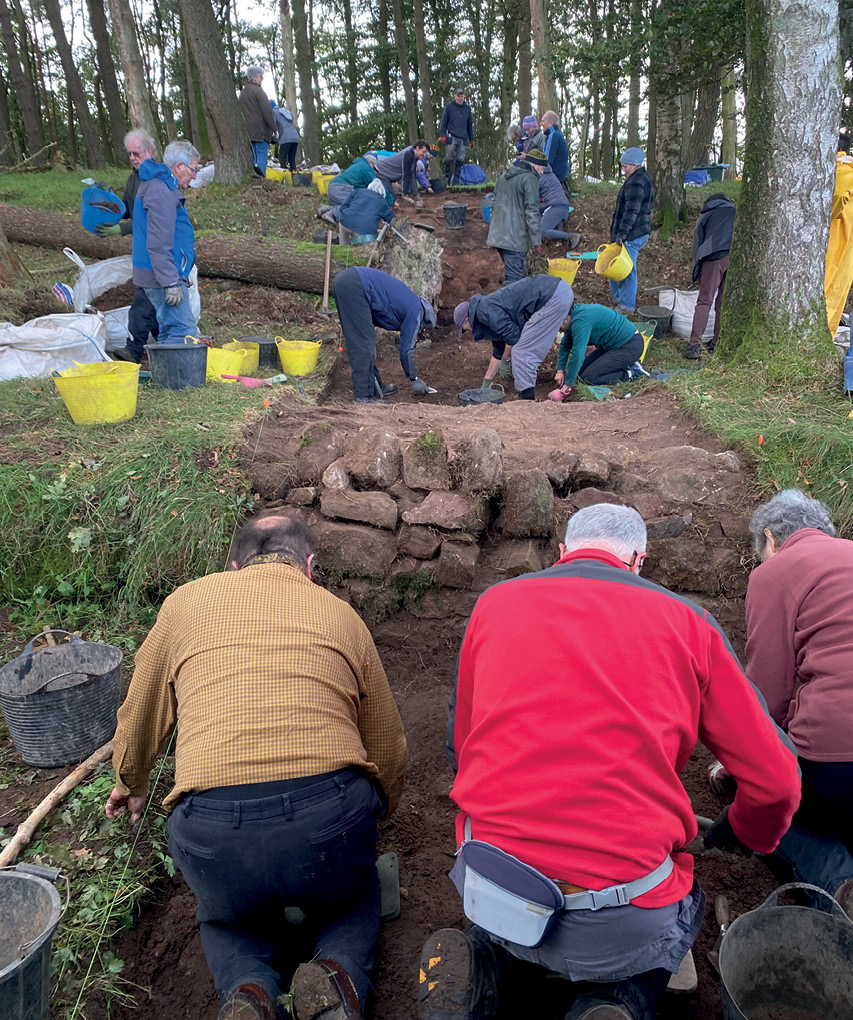
 Investigating the foundations of a small turf hut used by forestry workers in the 19th century (Site 9).

These 18th- and 19th-century buildings were associated with a cultivated area whose upper limit was marked (at approximately the 100m contour line) by a curved fieldbank, or head dyke. This feature was clearly faced with large boulders on the uphill side to prevent cattle and perhaps sheep from straying down into the ripening crops during summer months. Patches of ridge-and-furrow cultivation traces survive, and one area of woodland points to trees having been planted in the 19th century – probably by the landowner, the Duke of Montrose, either to replace ones that had been felled, or as a commercial venture. Wood harvested along Loch Lomond’s banks was used both for charcoal-making and for its bark, which was used in the production of turpentine.

On the current edge of the woodland, a small, turf-walled structure was initially thought to be an early turf house, possibly medieval in date (similarly sized turf buildings at Ben Lawers – another Trust property, on north Lochtayside – had been dated to the 11th-13th century), but excavation in 2006 only recovered 19th-century material. This did, however, include a rather nice piece of clay tobacco pipe decorated with an image of Stephenson’s Rocket locomotive of 1826. Rather than medieval, this seems to have been a 19th-century hut that was used as a small house, perhaps for a couple who worked in the woods.

A fragment of a 19th-century pipe bearing an image of Stephenson’s Rocket.

Iron and whisky

Despite the lower slopes of Ben Lomond feeling like an agricultural landscape with areas of natural woodland, this area has seen quite a bit of rural manufacture, although not necessarily on an industrial scale. One element of this was woodland management, and charcoal production took place there too, though archaeological evidence of this latter process can be quite slight. A single terraced ledge within the current wood line may have been a charcoal burner’s stance, and there were also several regularly sized hollows that showed evidence of being used for burning something, possibly during charcoal production, or perhaps as part of the ore-drying process. Iron production was certainly taking place, and perhaps more obvious are the bright green mounds that mark the locations of bloomery mounds in the open ground above the trees. Presumably the trees in this area had been removed and converted into charcoal to provide the fuel to smelt iron ore down to iron bloom.

Glasgow University undertook a geophysical survey around one of the most obvious of the bloomery mounds, and confirmed that a number of upright stones represented the remains of a small furnace. Trenches excavated into the mound recovered lots of iron slag and also located a cut-slot feature that may have been a flue or some other structure relating to the furnace. Meanwhile, the stone foundations of a building located only 50m away (160ft) must surely represent the remains of a charcoal store and shelter used by people working on the smelting process, although our excavation failed to locate any artefacts to confirm this purpose.

A mock-up of fire, still, and worm-tub arrangement at Coire Corrach, Ben Lomond.

Clearly, smelting and forestry were very thirsty work, as two illicit whisky bothies have been identified further upslope. One is situated on a rock shelf below a waterfall (which would have helped to disperse any smoke, or at least disguise smoke as spray), while the other lay beside the burn, up in Coire Corrach. Previously only suspected as the location of an illegal still, this latter site was confirmed by our excavation, which revealed a fire setting and iron fire-grate bars, as well as barrel staves and a lead patch for mending a barrel. These discoveries, among others, are discussed in greater detail in a previous article about our Pioneering Spirit project (see CA 421; Derek Alexander will be talking about the archaeology of early whisky production in Scotland, with Dr Daniel Rhodes, at the CA Live! conference on 28th February).

 Richard Tipping and Eileen Tisdall taking a pollen core.

Peatland past and present

The one site-type that we have yet to excavate at Ben Lomond is the shieling hut. These clusters of small turf-and-stone hut foundations are usually found higher up the hillslope, beside burns and often in corries or natural bowls where they could find a little shelter from the elements. Such shieling sites were occupied only seasonally, used when moving cattle to upland grazing above the head-dyke, away from the ripening strips of barley, oats, and potatoes lower down. Over at Ben Lawers, our excavation work has dated examples of such structures going back to the 15th century. It is likely that, in addition to dairying and the other activities mentioned above, one of the tasks undertaken when up at the shieling grounds would have been the cutting, stacking, drying, and transporting of peat for fuel.

It is difficult to be certain just how extensive the blanket peat deposits on Ben Lomond originally were, as their current extent has clearly been truncated, but the mountain’s upper slopes and the lower rounded slopes of Ben Uird to the south-east are covered in blanket peat of varying depth. Over the last decade, the Ben Lomond team have been working to map the 19th- and 20th-century drains running through this area, and have started to block them to prevent further drying and hag erosion, and encourage peat regrowth. We also obtained funding to take a pollen core from Coille Mhor Hill at a height of 230m OD, which revealed how the environment had changed. While the upper levels of the core had been removed, probably by peat-cutting, it was possible to identify a clear decline in birch woodland during the Bronze Age (see box above), which the team of palynologists from Stirling and St Andrews universities feel may be due to the trees’ exposed west-facing location, coupled with climatic deterioration, rather than any human causes (as is the case elsewhere in Scotland).

A 3D model of the cup-marked rock at Blairvockie.
An early Bronze Age barbed and tanged arrowhead found close to the Rowardennan Youth Hostel.

What’s missing?

The pollen core suggests that there was very little detectable human impact on the vegetation cover on the mountain’s higher slopes, but this surely is unlikely to have been the case down by the loch shore. Despite extensive survey work and multiple trenches excavated across the property over the years, however, very few prehistoric or indeed medieval artefacts have been recovered. Two notable exceptions are an early Bronze Age barbed-and-tanged flint arrowhead that was picked up from the sandy beach area beside the Rowardennan Youth Hostel, and a cup-marked boulder identified close to Blairvockie Farm. Another significant site in the immediate area, identified during earlier investigations, is a crannog: the most northern such site on Loch Lomond, and a substantial monument in its own right. Its presence suggests Iron Age occupation, and use of the adjacent hinterland area, to a similar extent to that which is known to have occurred at the same time around the more southern lands around the loch.

Of course, the point of many people’s visit to Ben Lomond today is to walk to the summit, and the same may have been true in the past: elsewhere on Trust properties, our Staff and Footpath Team have discovered traces of previous human activity in such upland settings. With around 50,000 modern hillwalkers attempting the route every year, the Trust’s greatest conservation challenge is to reduce the erosion caused by so many boots and to maintain the path network, and when Alasdair mentioned undertaking repairs to the erosion scars right on the summit, we thought we would tag along and monitor the work to see if we could find archaeological echoes there, too. So it was that, in April 2023, we helped with some path-work and did some metal-detecting at a height of 974m OD (3,196ft), about 15m (50ft) south-east of the Ordnance Survey triangulation pillar.

Footpath erosion repairs and metal-detecting on the summit of Ben Lomond.

This work located four copper coins – two Victorian pennies of the 1840s, and a penny and half-penny of George IV from the 1820s – in one spot, while other finds included more modern coins, corroded iron nails, two tent pegs, and pieces of dark green and clear bottle glass. Other highlights included the bowl of a clay tobacco-pipe with the image of a sailing ship on one side and thistle motif on the other, and a late 20th-century message in a bottle that had been buried beside the path. Visitors had modified the landscape itself as well: on the northern slope of the summit we found two flat terraces, aligned south-east/north-west and respectively measuring c.5m by 3m and 0.8m deep (16.4ft by 9.8ft by 2.6ft) and 3m by 2m and 0.5m deep (9.8ft by 6.6ft by 1.6ft). These had been cut into the hillslope, possibly for tents. It is perhaps not surprising that the greatest concentration of artefacts recovered on the property came from the very top of the mountain, and that they represent the 19th- and 20th-century tradition of hill-climbing and Munro-bagging. There is probably room for a whole subset of mountain archaeology in the future.

Four 19th-century coins from the summit.

Further reading:
• R Barclay et al. (2022) ‘Possible climatically driven, later prehistoric woodland decline on Ben Lomond, central Scotland’, Vegetation History and Archaeobotany 32: 1-15.
• S Boyle (2000) The Historic Landscapes of Loch Lomond and the Trossachs (Report for RCAHMS and Historic Scotland).

Source:
• Derek Alexander is Head of Archaeology for the National Trust for Scotland.
• Alasdair Eckersall is the Trust’s Property Manager for Ben Lomond. Having looked after the mountain for the last 34 years, he will step down from his post in 2026.

All images: National Trust for Scotland


By Country

Popular
UKItalyGreeceEgyptTurkeyFrance

Africa
BotswanaEgyptEthiopiaGhanaKenyaLibyaMadagascarMaliMoroccoNamibiaSomaliaSouth AfricaSudanTanzaniaTunisiaZimbabwe

Asia
IranIraqIsraelJapanJavaJordanKazakhstanKodiak IslandKoreaKyrgyzstan
LaosLebanonMalaysiaMongoliaOmanPakistanQatarRussiaPapua New GuineaSaudi ArabiaSingaporeSouth KoreaSumatraSyriaThailandTurkmenistanUAEUzbekistanVanuatuVietnamYemen

Australasia
AustraliaFijiMicronesiaPolynesiaTasmania

Europe
AlbaniaAndorraAustriaBulgariaCroatiaCyprusCzech RepublicDenmarkEnglandEstoniaFinlandFranceGermanyGibraltarGreeceHollandHungaryIcelandIrelandItalyMaltaNorwayPolandPortugalRomaniaScotlandSerbiaSlovakiaSloveniaSpainSwedenSwitzerlandTurkeySicilyUK

South America
ArgentinaBelizeBrazilChileColombiaEaster IslandMexicoPeru

North America
CanadaCaribbeanCarriacouDominican RepublicGreenlandGuatemalaHondurasUSA

Discover more from The Past

Subscribe now to keep reading and get access to the full archive.

Continue reading