Subscribe now for full access and no adverts
Plassey, on 23 June 1757, was the battle that gave the East India Company control of Bengal, which in turn foreshadowed British dominance over the whole of India. Local politics played its part. When the Nawab of Bengal, Ali Vardi Khan, died in 1756, he was followed by his great-nephew, Siraj-ud-Daulah, a succession that was opposed both within his own family and more generally. The British East India Company was busy, meanwhile, fortifying Calcutta, on the face of it because of the existential threat from the French, although the suspicious Siraj reckoned that the duplicitous British really had him in their sights – and therefore the territory of Bengal.
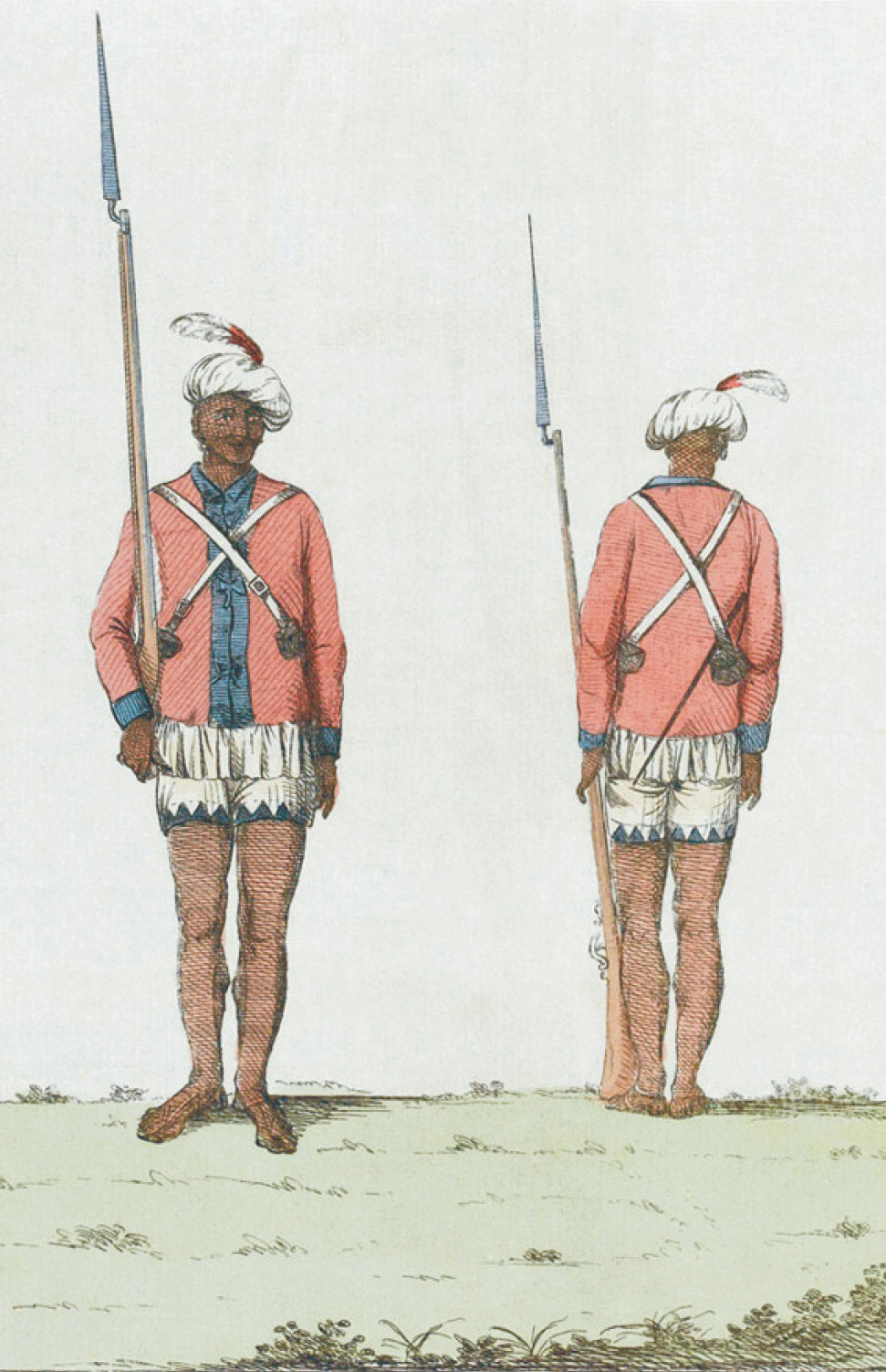
Siraj bombastically ordered the British Governor to take down the fortifications or the East India Company would be expelled. The Governor naturally refused, and on 20 June 1756 Siraj went on the offensive, taking Calcutta after feeble resistance. Then followed the vengeful and merciless episode of the ‘Black Hole of Calcutta’ (see previous article) – which the British would later use to justify their takeover of Bengal. In August 1756, news of Calcutta’s fall reached Madras (now Chennai), 1,000 miles to the south, and Lieutenant Colonel Robert Clive with his 900 British troops and 1,500 Sepoys set off to reclaim it. Conveyed around the Bay of Bengal to Calcutta by Vice Admiral Charles Watson, the troops wrested the trading post back from Siraj, displacing a garrison of 3,000 in the process. In the circumstances, the Nawab had no option other than to restore the East India Company’s trading privileges and cough up some compensation. But what transpired in India has also to be viewed against a bigger backdrop, as 1756 saw the outbreak of the Seven Years War, the first truly global conflict, in which Britain and France would contest not only the subcontinent but also Europe and the Americas.
The French had their own bastion with 300 troops and cannon at Chandernagore, near to Calcutta, but Clive attacked on 14 March 1757 and swept all before him. This victory alerted Siraj to Britain’s growing dominance and took him into the arms of France – an unholy alliance from the British perspective, leading Clive and Watson to resolve to remove Siraj by whatever means necessary. Siraj has been described as ‘cruel and debauched’ and unpopular as a ruler – so there were plenty of rivals eyeing his throne and several principal officers of his who were happy to parley with the British, asking Clive directly if he could help them get shot of this liability. Their spokesperson was Mir Jafar, the Nawab’s uncle: his prospective reward, a crown on his head. In return, Jafar pledged to keep the French out of Bengal and pay £500,000 to the East India Company. Clive duly left Chandernagore and plotted a course towards Siraj’s HQ of Murshidabad, 100 miles to the north. His force comprised 1,000 Europeans, 2,000 Sepoys (Indian colonial troops), and just eight cannon.
Plotting a coup
Sometimes a battle is won by greasing palms. During April and May 1757, Clive and his colleagues set about isolating their enemy, the Nawab Siraj-ud-Daulah, by recruiting to their cause Bengali dissidents, all of whom would gain in some way from the deposition of Siraj. Clive wasn’t just planning to win a battle, but also to effect ‘regime change’. Clive duly entered into a conspiracy with Hindu bankers and the Nawab’s own uncle, general, and noble Mir Jafar. Those bankers and money men – primarily the Sikh merchant Omichand and a pair of brothers who were the bosses of the Jagat Seth banking house – were dismayed at having a Nawab who was at loggerheads with the British, when they relied so heavily on British silver for their commerce.
All the co-conspirators would benefit from the enterprise, as Clive set aside large wads of cash to reward those about to stab the Nawab where it hurt. As for himself, Clive too was anticipating rich rewards, courtesy of a grateful Mir Jafar and others. He would surely be the principal British beneficiary of what was in effect a coup. It all puts one in mind of Shakespeare’s scene-setting ahead of the Battle of Bosworth: ‘Jockey of Norfolk, be not so bold, for Dickon the master is bought and sold.’ Here, Clive had done all the buying, and Siraj was well and truly sold up the Hooghly (as Calcutta’s river is known).
Towards Plassey
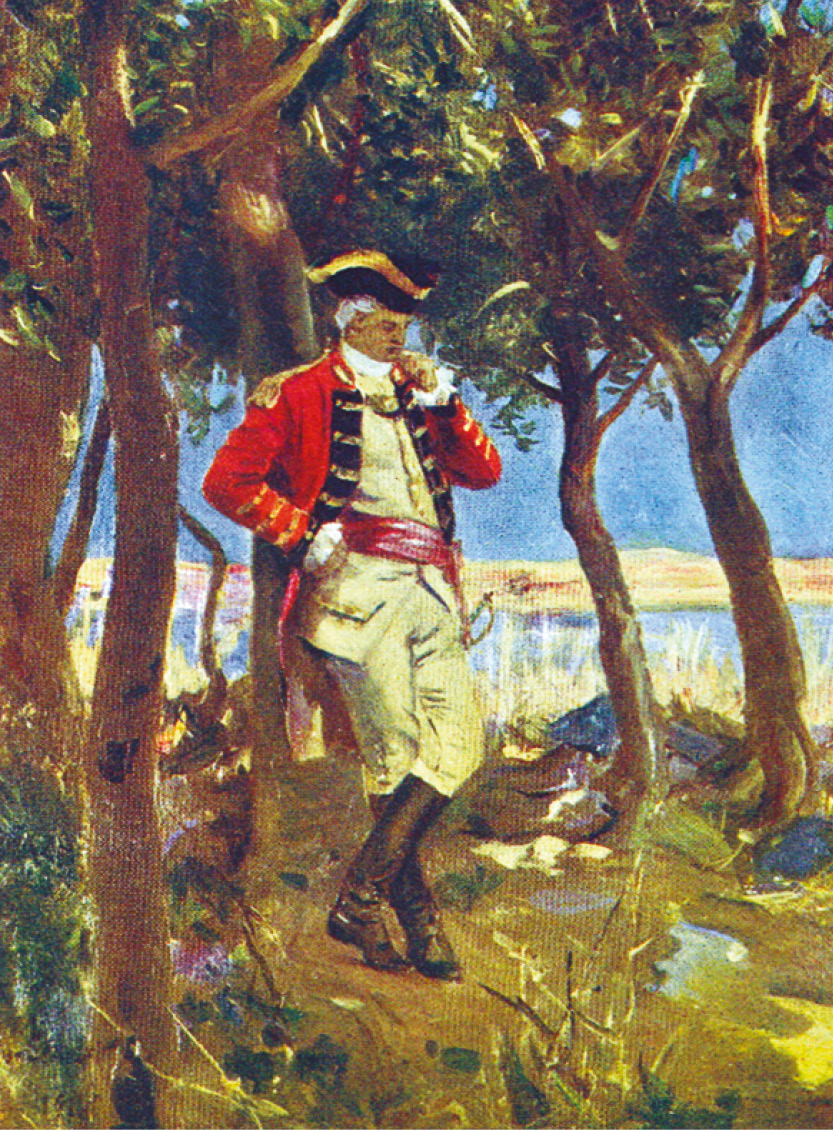
Having secured his allies, Clive now had to bring the plot to fruition by luring Siraj into a battle he couldn’t win. He was to be bested by a combination of the Company’s forces and those who had defected, led of course by Mir Jafar. Clive could count on around 3,000 troops and sailors, two-thirds Sepoys, who marched from Kasimbazar, close to Murshidabad. The white troops travelled by boat, which was a better bet for shielding them from the heat and a myriad of fevers. This polyglot force finally arrived at the village Clive pronounced ‘Plassey’ on the night of 22 June 1757, apparently camping in a grove of mango trees – which sounds idyllic, so rather at odds with what was in store the next day.
Siraj would field around 50,000 men, but crucially many of them had gone unpaid and were discontented. Clive, on the other hand, had learned how to inspire an army, particularly one largely made up of Sepoys. It was about leading by example and demonstrating to the men just what it meant to be brave. Clive would deliberately take risks under enemy fire so that his men would be inspired. They responded in kind and dubbed him ‘Sabit Jang’ (steady in battle); that meant everything. The ultimate test of these capabilities would come at the battle fought outside a village named Palashi in Bengal – ‘Plassey’ to the British.

Battle commences
Come daybreak on 23 June, the British discovered they had the Nawab’s army advancing on them. It was a considerable force of some 15,000 horse and 35,000 foot, whose artillery numbered north of 40 cannon. Their strength had been augmented, as if that were needed, by a French detachment which brought with it another four field-guns. Clive would be outgunned and outnumbered by more than ten-to-one, but resolved to maintain his boldness and penchant for taking risks, as he felt he had nothing whatsoever to lose by taking the initiative. Here, his strategy was to take out the one officer of Siraj’s who was known to have remained steadfastly loyal to him: Mir Madan Khan; targeting and hopefully eliminating him would surely see the rest fall in with Clive. It was an ominous sight, though, to have the Nawab’s army arrayed in an immense arc around the British.
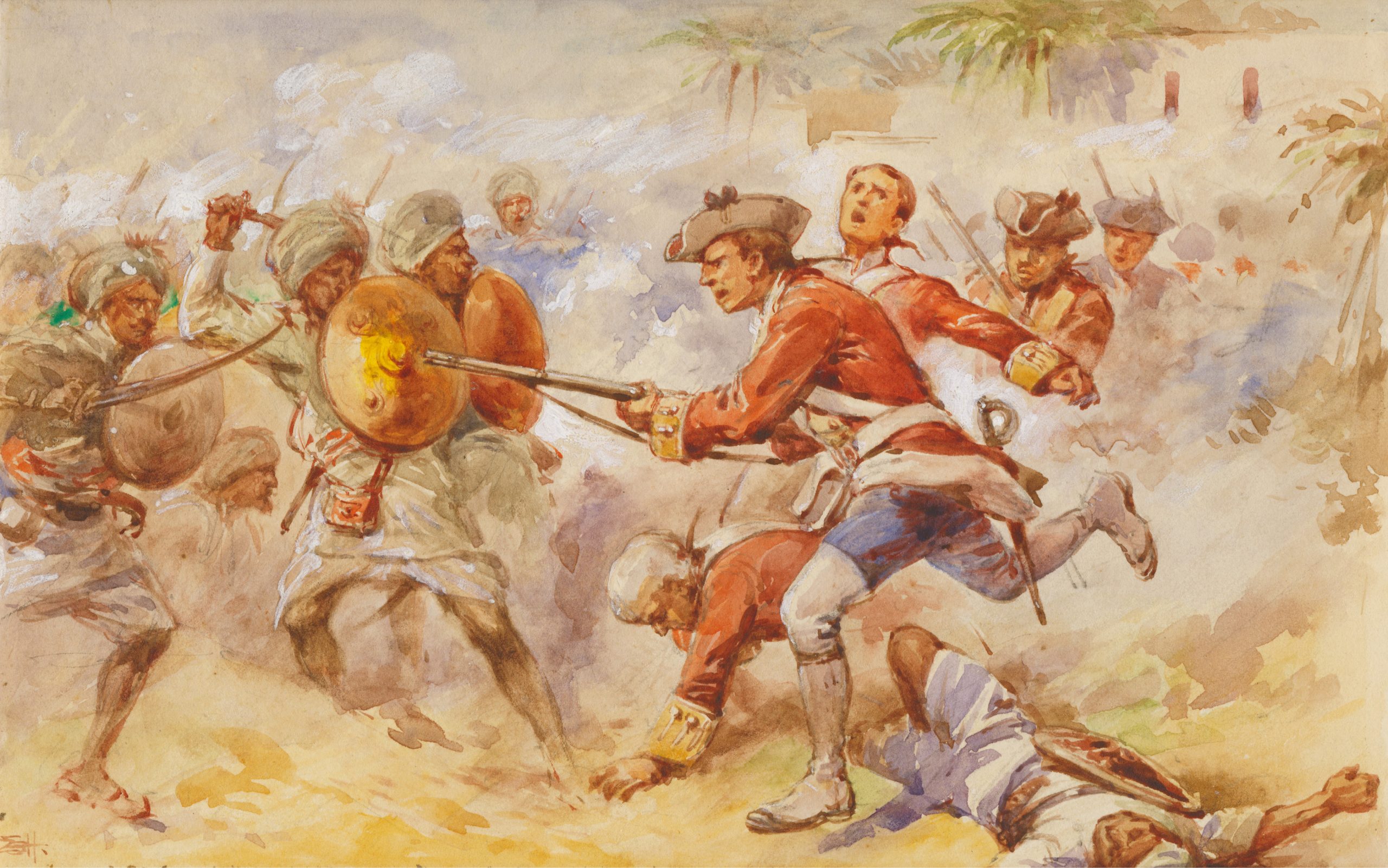
Much of the battle was taken up with an exchange of cannon-fire in which the Nawab’s Bengalis fared the worst. The French artillery had opened up, but was quickly nullified. The firing continued, however. As Clive himself said, the Nawab’s army ‘continued to play on us very briskly for several hours’. The Nawab held his artillery back at a safe distance and not bunched up, which made it hard for the British to attack it effectively and left Clive’s force with little option but to hunker down behind the mud banks surrounding the mango grove; not just idyllic, but now also indispensable to the British cause. Here, men kept their heads down while their precious guns were protected.
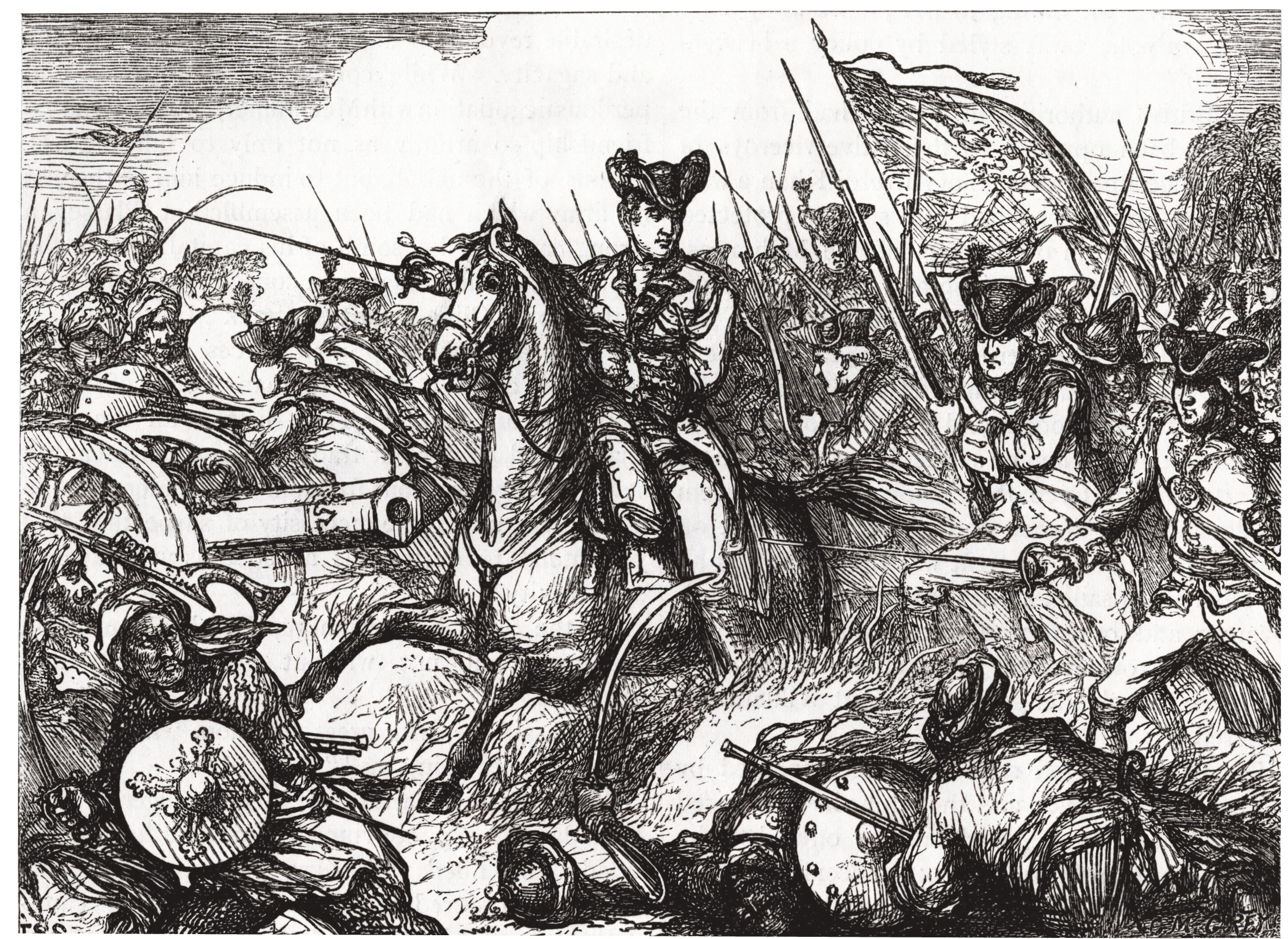
The Bengalis may have had big guns, but they were unwieldy: 24 pounders and 32 pounders, platform-mounted and hauled by 40-50 bullocks yoked together, and manoeuvred into their final positions by hefty elephants. This reliance on heavy beasts proved disastrous, the death of three elephants causing the remainder to become uncontrollable, while the oxen went on the stampede, taking drivers with them. The gunners also lacked expertise, it being reported that they managed to set fire to their own powder barrels, which must have discombobulated humans, oxen, and elephants. The Nawab’s troops meanwhile were left out in the open while the artillery duel persisted, and British artillery caused a thinning of their ranks.
Something of a miracle then occurred, with the heavens opening. The British were able to use tarpaulin to keep their powder dry, while the matériel of their foes was soaked – soon causing a cessation in the Bengali bombardment. It was now that Clive’s quarry, Mir Madan Khan, opted to attack, his men decimated by musket and grapeshot. Those who were not killed fled.
Mir Jafar had been watching the confusion in the Nawab’s ranks and sent message to Clive that the moment had arrived for him to defect – though, in the confusion of battle, Clive hadn’t the foggiest where Jafar was, which meant that he had already rained down some ‘friendly fire’ on him. Jafar’s messenger refused to take the message, given how hot the fire was between the two parties. In the end, it didn’t matter, as the Nawab’s army was about to disintegrate anyway. Siraj was a man without a Plan B and also, although he didn’t realise it, without a loyal lieutenant – fatefully and ironically asking Mir Jafar, of all people, for advice. The wily Jafar literally lied for Britain, telling Siraj he thought Clive’s position hopeless, and that the Nawab should therefore return safely and contentedly to Murshidabad while he, Jafar, conducted the mopping-up exercise.
For any army engaged in battle, especially when the outcome is still in doubt, the sight of its leader departing the tussle is likely to sow further dissension in the ranks. Clive, right on cue, attacked as Siraj vacated the field that he thought was won. Sending a detachment, including two cannon, to occupy high ground about 300 yards away from the grove from where the French had earlier been firing, he also saw the British seize further high ground near the Bengali camp. When the Bengalis tried to bring their own artillery to bear to save themselves, they were fired on by Clive’s more mobile guns. And when Siraj’s cavalry showed itself, it was sprayed with artillery fire, many horses getting killed in the process.

Siraj’s massive force, which had never been anything better than hesitant, now broke ranks and fled, with Siraj himself leading by example, galloping off on a camel. Although Clive had thought the Bengalis had four, maybe five, very capable officers, their army was now, according to the British commander, ‘visibly dispirited and thrown into some confusion’, as Clive’s forces made their advance. His army would go on to take the Bengali camp with a general rout then ensuing, the pursuit continuing for some six miles with more than 40 discarded cannon being passed along the way, as well as numerous carriages laden with baggage. Clive’s estimate of the enemy losses was around 500, with the British casualties slight by comparison: ‘Our loss amounted to only 22 killed and 50 wounded, and those chiefly Sepoys.’ Whether the latter aside suggested a disregard for the brave Sepoys is impossible to say.

Clive had routed those forces still remaining loyal to the Nawab at Plassey – which by European standards, despite the numbers involved, might be termed a skirmish, rather than a full-scale pitched battle, because of the relatively small number of combatants who lost their lives. His report to the Company directors glossed over casualty figures, which were low anyway, saying they were ‘chiefly blacks’. Again, we can’t really know whether the victor of Plassey was simply reporting the facts or whether there was some prejudice, unconscious or otherwise, in seemingly disregarding the fate of his Sepoys. By the same token, no one bothered to count the dead Bengalis, though an approximate and possibly conservative estimate might confirm Clive’s estimate, placing their dead at around 500. The bottom line was that this was a victory conceived by Clive, and which would be seen by many as a tribute to his daring and guile; his friend Stringer Lawrence would have been proud of the one-time Company clerk he had helped turn into a soldier.
Fateful aftermath
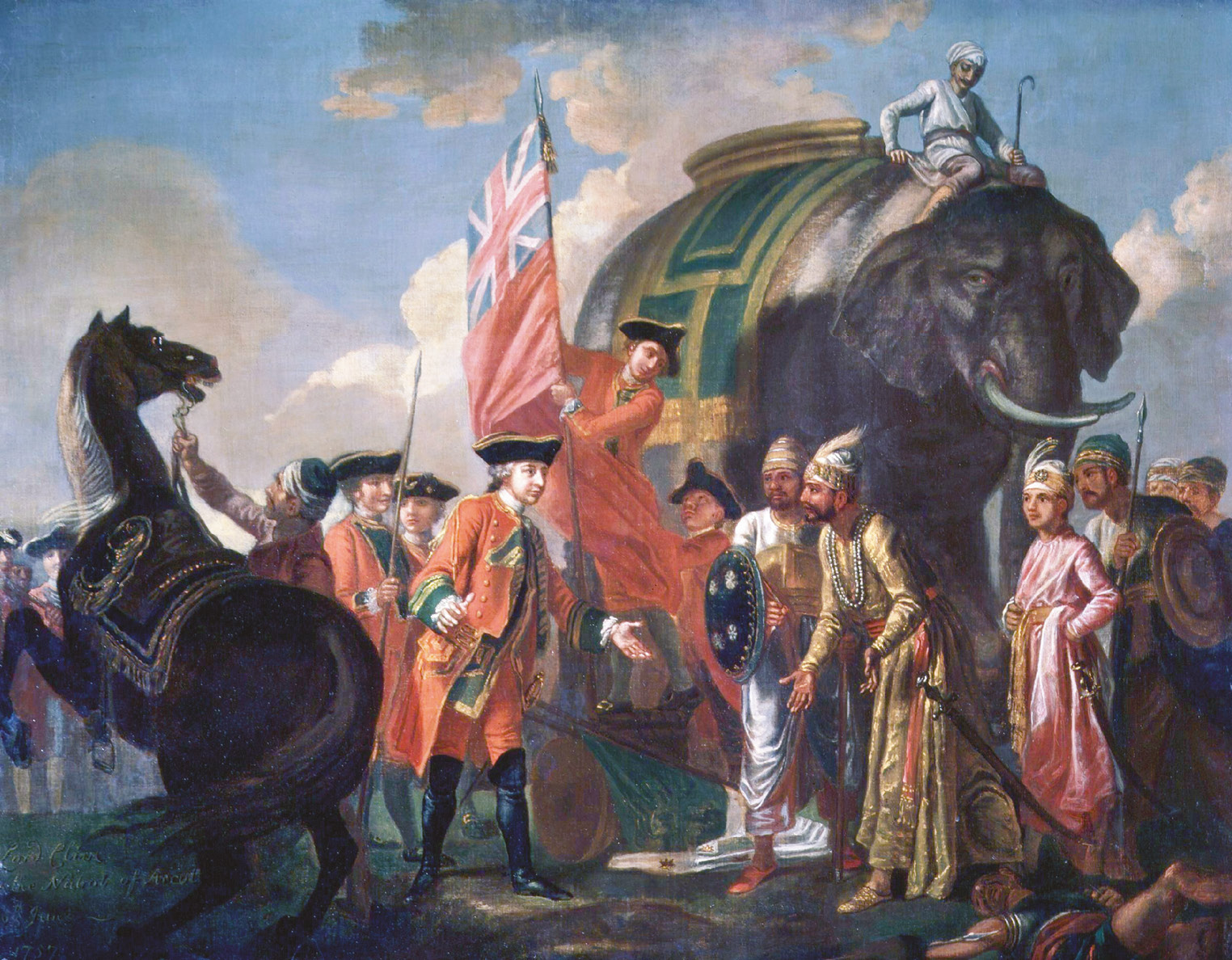
Chased by the son of Mir Jafar and others, Siraj was duly rounded up and stabbed to death by Jafar’s men – but that was merely a footnote to a battle that was much more significant than it may have appeared at the time, particularly to those who fought in it. What may have seemed like a pragmatic solution to a local problem, namely the security of Company operations in Bengal, would prove to be a defining moment in British and Indian history. Clive, meanwhile, reached Murshidabad on 29 June 1757, and true to his part of the bargain installed Mir Jafar as the new Nawab – although Clive (and later his successors) would be no more than a step away.
The horse-trading that had preceded the battle had filled the Company’s war chest with Jafar’s cash. In a despatch to the directors in August, Clive spelt it out that Jafar’s largesse meant the balance of power had shifted decisively away from the French in southern India, with particular advantage in Bengal where the Company could trade freely with the new Nawab in thrall to it. When George II’s Poet Laureate William Whitehead (1715-1785) wrote in 1759 that ‘commerce steels the nerves of war’, he had Plassey in mind: a battle fought for commercial advantage.
A certain amount of hindsight would be applied to the battle in the years that followed, ascribing to it a symbolic significance as, in essence, establishing British hegemony over India. Whether this was perhaps overstating its legacy, it was nevertheless a victory that transformed the fortunes of the East India Company, as it morphed from being a trade company of sometimes doubtful solvency to a first-rate imperial outfit with its own standing army and territory larger than the country that put it on the map. For all of its adopted importance, however, there was never really any attempt to commemorate the site of a battle of such perceived significance. For some Hindus, however, the Battle of Plassey and its date took on supernatural significance, as obscure Hindu scriptures appeared to foretell a British Raj that would last but 100 years – with the assault on Cawnpore on 23 June 1857 (during the Indian Revolt) deliberately timed for exactly 100 years after Plassey. By the time of the 150th anniversary of the battle in 1907, the glorious victory that had established British hegemony was regarded more as a source of embarrassment in British circles; there would be no Clive memorial.
One perhaps overlooked legacy of Plassey is that the Bengali treasuries opened up to the British by the victory helped fund the Industrial Revolution, which was then only just getting under way. Some of the leading lights of Britain’s mechanisation – including Scottish steam-engine pioneer James Watt (1736-1819), Notts power-loom inventor Edmund Cartwright (1743-1823), and James Hargreaves (c.1720-1778), the Lancashire illiterate who invented the spinning-jenny – were bankrolled by Bengali money, invested in their inventions by the East India Company. One could almost say that one battle and one Robert Clive transformed both India and Britain.
Further reading:
• The Battle of Plassey, 1757: the victory that won an empire (S Reid, Frontline Books, 2017)
• Plassey: the battle that changed the course of Indian history (S Chakravarti, Rupa Publications, 2020)
All images: Wikimedia Commons, unless otherwise stated