

Subscribe now for full access and no adverts
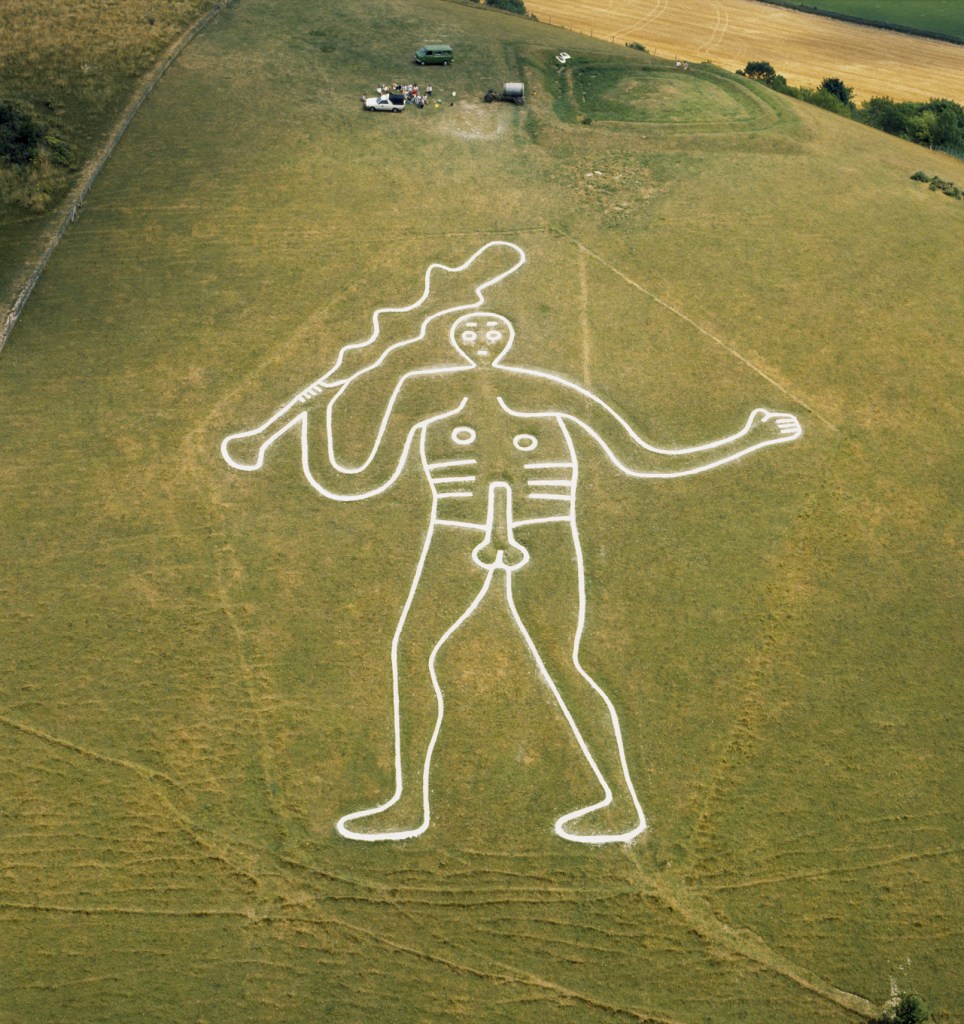
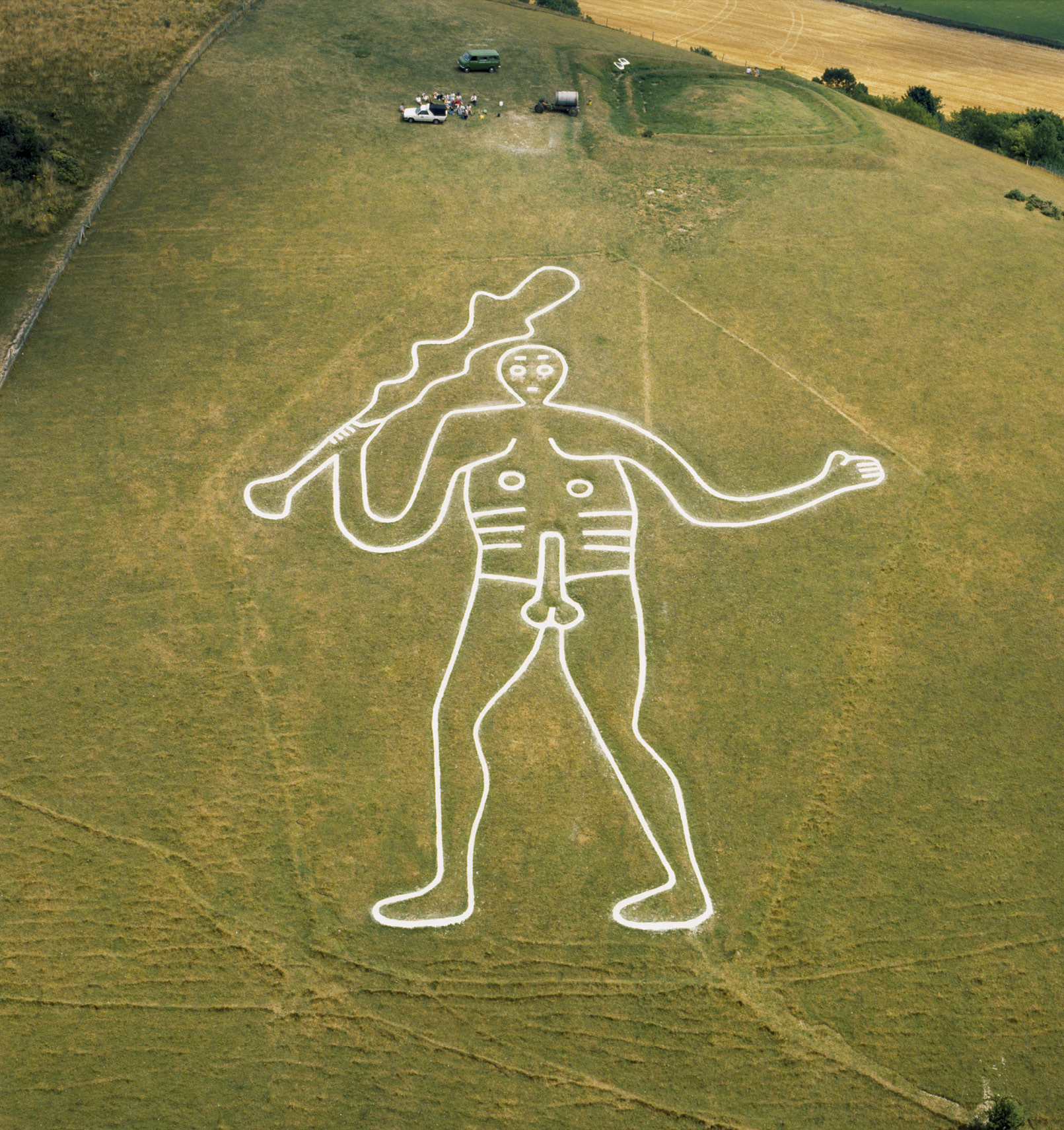
Picked out in gleaming chalk on a Dorset hillside, the Cerne Abbas Giant cuts an undeniably imposing figure. Depicting a priapic nude male, it has been in the care of the National Trust for more than a century, but its origins have long been obscure. Was it created in later prehistory, like Oxfordshire’s Uffington White Horse (CA 359), or might it be much more modern, like the Tudor Long Man of Wilmington in East Sussex (CA 234 and CA 379)? In CA 365, we described a small-scale excavation that set out to learn more.
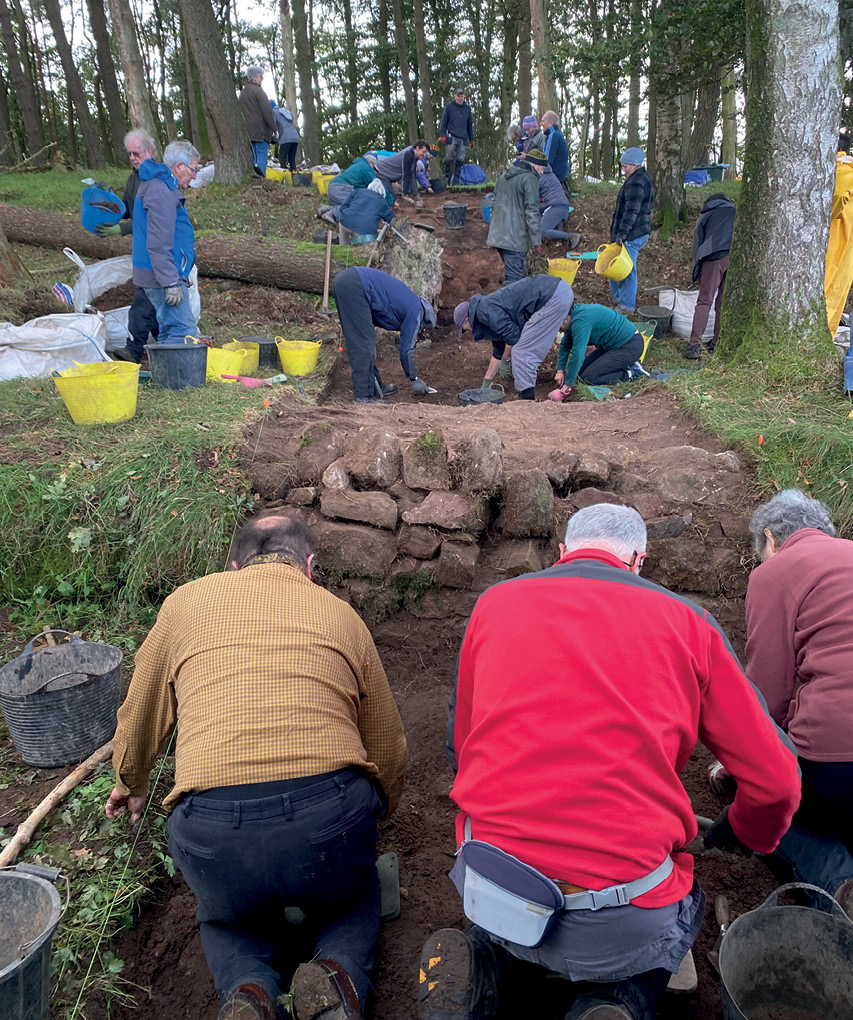
Led by Martin Papworth, the National Trust’s senior archaeologist in Wessex, this investigation saw four test-pits opened over the Giant’s outline, focusing on the crook of each elbow and the sole of each foot. There, we hoped, deposits would be deepest and would provide the best opportunity for OSL dating, which had helped to illuminate the age of the other hill-figures mentioned above. This work was undertaken in 2020 and, like so many other initiatives of the time, was stalled by COVID-19 restrictions – in our case, our samples had a lockdown of their own, stored safely but inaccessibly in a Gloucester University laboratory throughout this period. A year later, however, the results were in and, as described in CA 376, they indicated that the Giant was not prehistoric, Roman, or 17th-century, but had been created in the early medieval period. Backed up by my microanalysis of snail remains from the site, these findings represented an exciting development in our understanding of the hill-figure’s history, but one that raised as many questions as it answered, since the first-known written reference to the chalk outline does not appear until the end of the 17th century.
That is the ‘story so far’, at least in terms of what we have reported in CA – but our study of the Giant did not stop with the receipt of the OSL results in 2021. Since then, I have led further research and fieldwork to bring the project to completion, including a small ecological study in November 2023; geophysical survey in December 2023; and targeted augering in January 2024. This additional work has revealed a much more detailed picture of the Giant and how the hill-figure developed over time. In fact, this is a story of three Giants – and the white, chalk-filled outline familiar to us today may represent only a very late incarnation, essentially appearing in the 20th century.
The Giant’s origins, we now know, are actually Anglo-Saxon, with his initial creation dating to the 10th century when a shallow but broader outline was cut through the turf. There was then a pre-13th-century Giant more clearly outlined by a narrow, deeper trench, and this 2ft-deep outline persisted for a long time (it was reported, for example, by Reverend John Hutchins in 1774) until he was remanifested as the 60cm deep white-chalk-filled figure that we know, probably in the 20th century.
Questions of identity
Precisely who the Cerne Giant represents is more difficult to resolve with just site data and scientific archaeology, however; it clearly also requires a historical approach and a defined chronology that did not exist prior to the results of the 2020 excavation on the site. There have been so many previous suggestions and speculations over the years that we do not have room here to go into all of them, except to note that they have included biblical giants; warriors; Romano-Celtic gods (Mars, Sucellos, Nodens); the Anglo-Saxon deity Helis/Helith; a child- or sheep-gobbling giant or (Paul Newman suggests in his books) the mysterious folk-culture beast known as the Dorset Ooser; a derogatory depiction of local MP Lord Denzil Holles (1599-1680); Oliver Cromwell; and William III.
One of the most popular interpretations for the club-wielding Giant, however, has been the Classical hero Hercules, whether enacting one of his legendary Labours, or (as Brian Edwards, Visiting Research Fellow at the Regional History Centre, UWE Bristol suggests in CA 376) making the famous choice of Xenophon’s parable, between Virtue and Pleasure. William Stukeley suggested the link with Hercules as long ago as 1764, and Stuart Piggott reaffirmed this identification in a 1938 article in Antiquity. Would a Saxon image depict a figure of Greek and Roman legend, though – and how does the Giant stand up to our new results?
A key element of Hercules’ appearance is his lion-skin cloak. This feature cannot be seen on the Giant today, but was reportedly shown in the first geophysical survey of the hill-figure – indeed, one of the earliest such surveys in the country – which was undertaken by the late Tony Clark in 1979 for a Yorkshire Television programme, Arthur C Clarke’s Mysterious World. Nearly 45 years later, though, Tony’s former colleague Andrew David, along with current Historic England staff, have processed that data, and this has shown that the apparent geophysical anomaly is only surface deep, reflecting variations in the topsoil thickness and composition. Another geophysical survey of surface variations (that is, within topsoil depth) was undertaken by Rodney Castleden in 1989-1990, using a two-probe resistivity array; this was able to refine interpretations to such an extent that Rodney thought he could recognise ‘vertical folds’ in the anomaly – as a result of which he preferred to call it a ‘cloak’, rather than a ‘lion skin’.
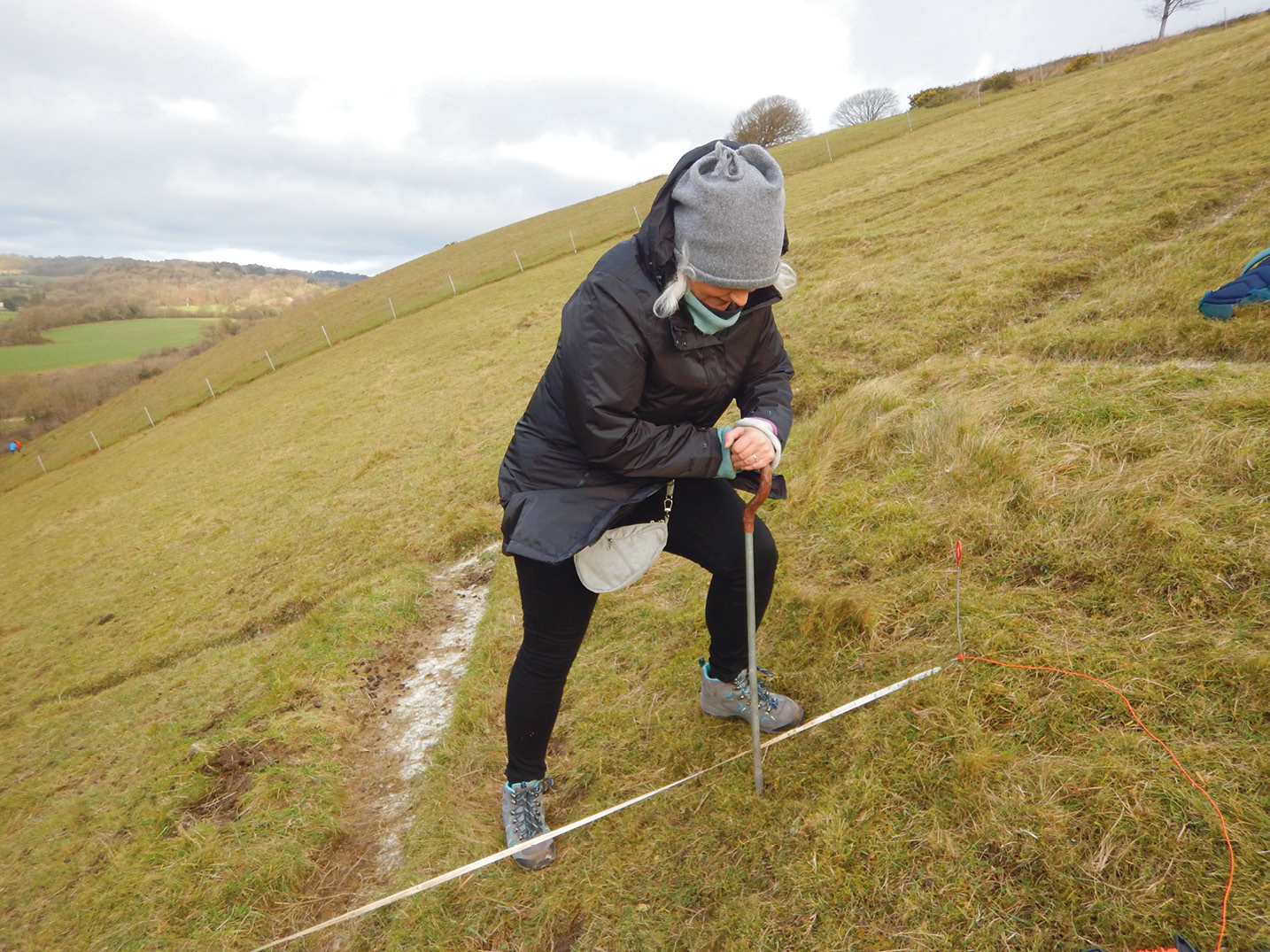
In order to investigate this enigmatic aspect more closely, we examined the unpublished archive for the site, and found a fantastic set of data from a gridded auger survey that had been led by the late Alister Bartlett, on the prompting of Tony Clark, who felt that such research would be essential to ‘calibrate’ the results of his geophysical survey and assist initial tentative interpretation. Bartlett’s survey – undertaken by English Heritage staff working in their own time – involved 125 auger points that primarily recorded soil depths down to the natural chalk, and occasionally noted their character. It revealed that the ‘cloak’ was apparently marked by an area of slightly thicker depth, comprising soil, chalk stones, and possibly colluvium – and so, at the end of 2023, we set out to conduct our own GPR survey to characterise this in more detail.
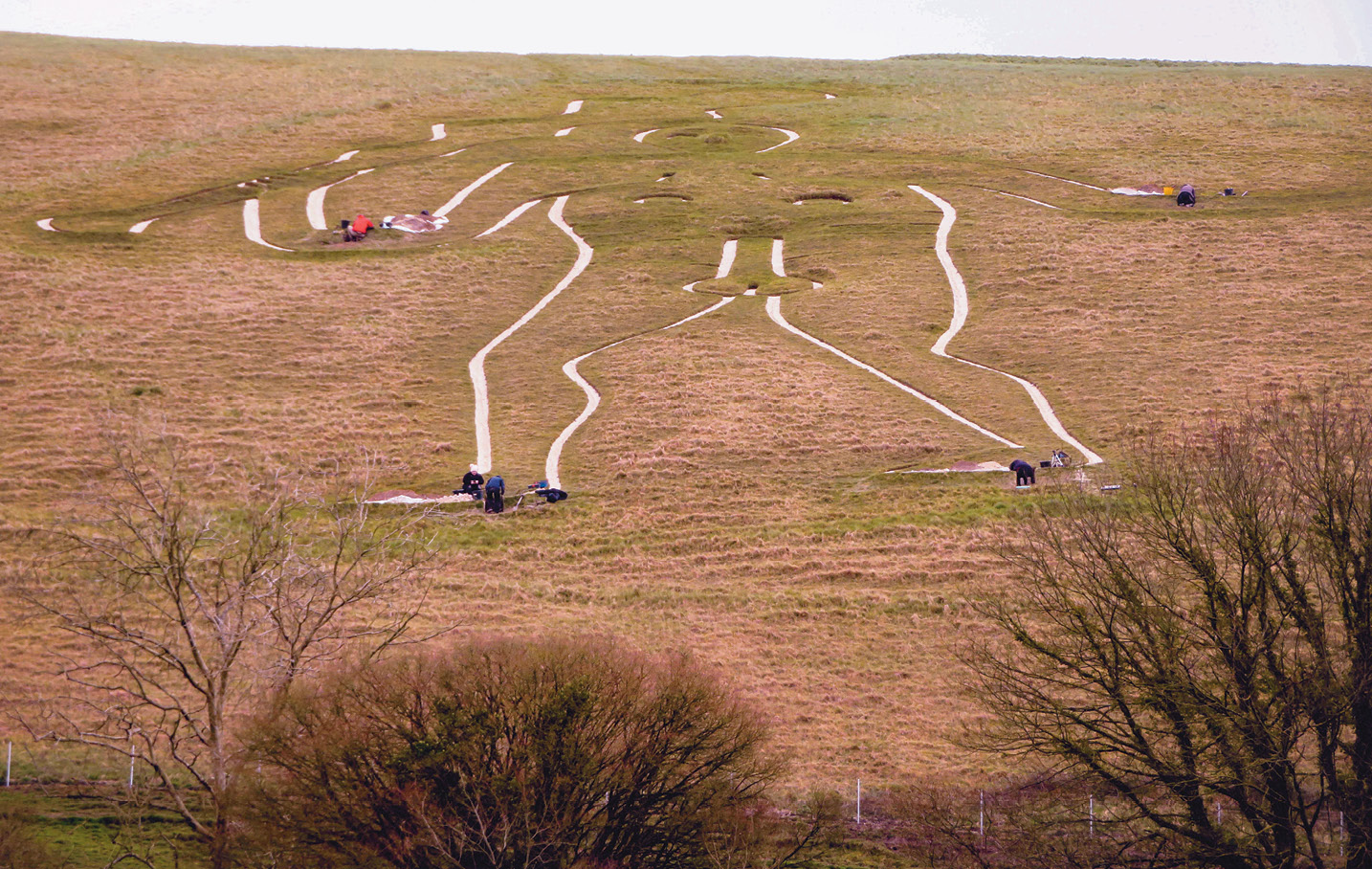
Led by Paul Cheetham of Bournemouth University, this work revealed that the thicker deposits were a heterogeneous mix of soil and chalk stones – similar in make-up to the low mound, sometimes interpreted as a ‘severed head’, that we augered in 2020. What can be made of this spread? Is it really a lion skin or cloak, as earlier geophysicists have suggested? Or could it be nothing to do with the original Giant’s design, but actually relate to later maintenance of the figure? To keep the Giant looking spick and span and white, he is ‘scoured’ at regular-ish intervals of about 8-25 years. During this work, much of the fine chalk rubble in the outline – which has become contaminated over time by soil, moss, weeds, grasses, roots, and germinating seeds – is taken out and replenished with up to 45 tonnes of new, fresh chalk. There have been numerous scouring events over the Giant’s lifespan: those in 1956 and 1979 were an almost industrial event conducted by a contractor, but since then in 1983, 1995, 2008, and 2019 the work has been largely undertaken by National Trust volunteers.
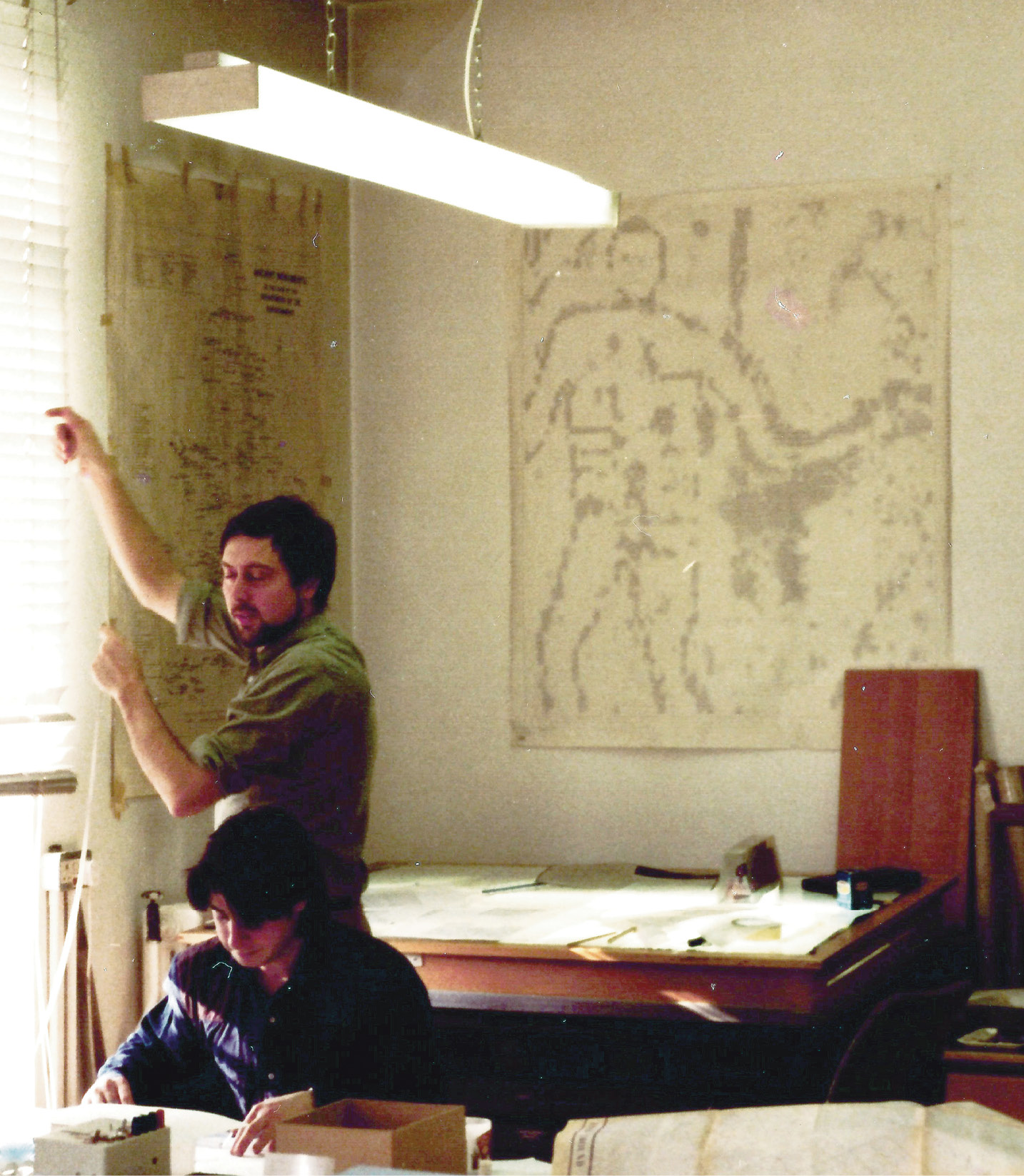
Could it be, then, that the spread previously interpreted as a cloak actually represents the remnants of a former spoil heap or heaps created during 20th-century scouring events? The area of the ‘cloak’ is the largest obviously open, clear space around the figure where such a mass of debris could be temporarily located; one former observer recalls large piles of soil and earth heaped up there during the contractor-led scouring events, and there are suggestions that spoil heaps were also located there during the 1945 works led by Stuart Piggott. The low broad mound of the ‘severed head’ could reflect the location of another, slightly higher, spoil heap, too – it was not, after all, mentioned by any antiquarian visitors. I would argue that the Clark survey, the Castelden survey, our GPR survey, the Bartlett auger survey, and my own auger record consistently concur with that suggestion. But, with no lion skin or cloak, can we still interpret the Giant as Hercules?
Hercules or helpful hermit?
If not Hercules, who? Another popular candidate is St Eadwold (reputedly the brother of the murdered East Anglian king St Edmund), who is said to have lived as a hermit in the Cerne valley and later became the main medieval saint associated with Cerne Abbey, which was founded nearby in AD 987. Tom Morcom and Helen Gittos have recently suggested that the Giant, representing Hercules and serving as a muster station for West Saxon troops, could have been reimagined in the 11th century as Eadwold. The idea of this hill-figure being a muster station is topographically and militarily questionable, though – and if the figure was indeed intended to represent Hercules, where is his lion skin? Rather, I suggest that this transformation should be seen the other way around: in other words, that the Giant, being contemporary with the nearby monastic community, was originally intended to depict St Eadwold, with his outstretched arm not draped with a lion skin, but pointing travellers to the abbey tucked out of sight in the nearby valley – and that only later he was reimagined as Hercules (a popular figure in early Christianity), an association that stuck.
For all the Giant’s grandeur he is, then, little more than a large signpost. Why, then, is he naked? Some authors have described him as pornographic, but that would suggest that he depicts erotic behaviour or was intended to create sexual arousal. Surely in his ithyphallic form he just represents leadership, authority, and manhood – all characteristics that we might expect in both St Eadwold as a leader and teacher, and Hercules the semi-divine warrior. From a Victorian or puritanical stance, he may be seen as shocking or obscene, but from an early historic perspective probably much less so. Rather, he stands proudly and authoritatively, surveying the green rolling downland of Dorset as a fine figure of a man, and politely showing the way to the refuge and safe harbour of the abbey.
These investigations have now culminated in a book embracing many facets of our work, and of the Giant (see ‘Further reading’ below for more details, and for other key references). The foundation of much of our research lies in Rodney Castelden’s previous fieldwork, and, looking further back, we can also appreciate the importance of the work of Tony Clark and Alister Bartlett (both of whom I worked for at the Ancient Monuments Laboratory, in Fortress House, London). The historical and documentary evidence that Brian Edwards provided to the project and publication was hugely significant too, not only in correcting long-established mistakes, but also in bringing new information to light.
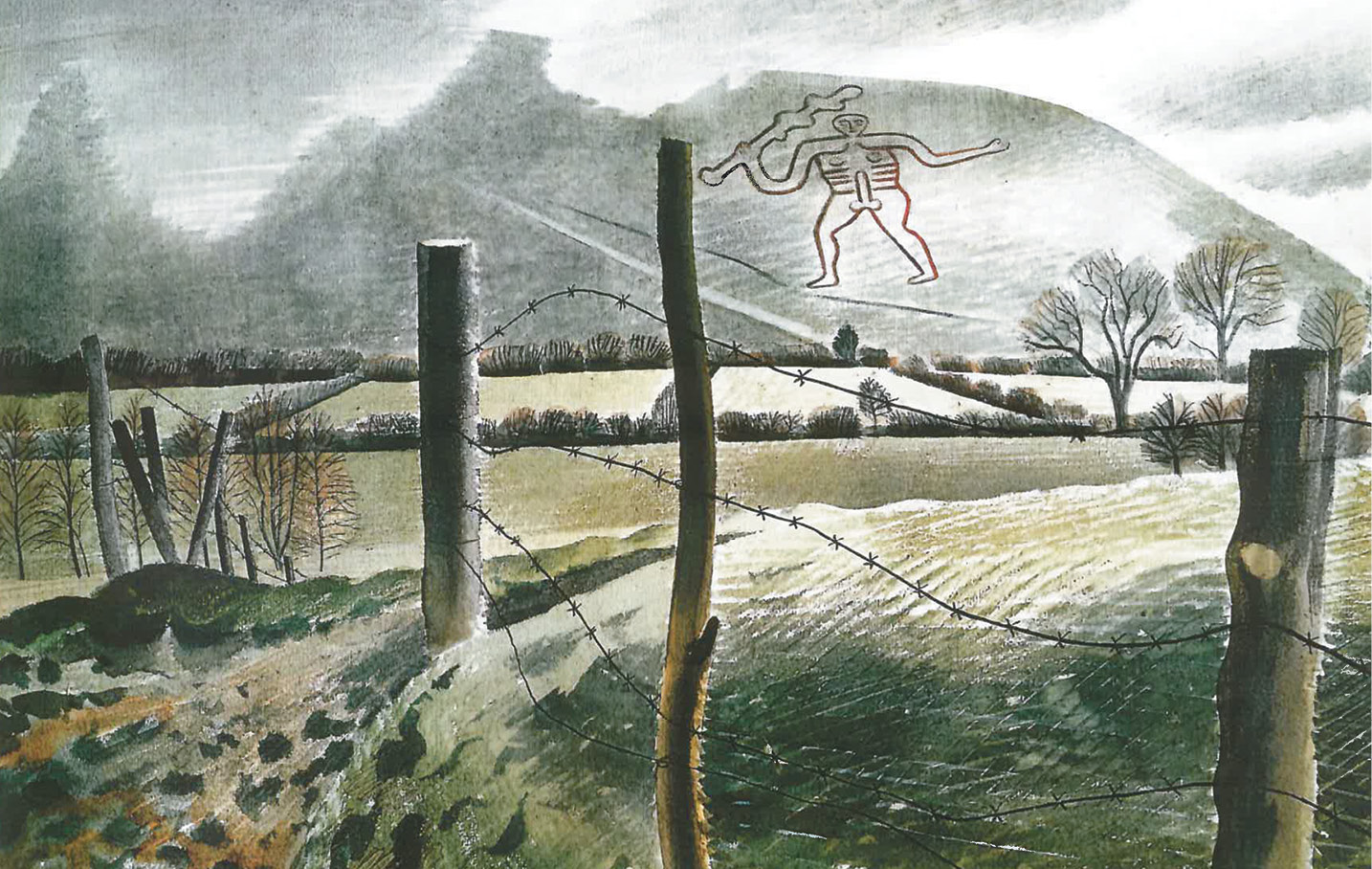
So perhaps our analysis now shows a new Giant, or the Giant in a new light for the 21st century. Our research has explored much further than the original remit of just providing a date for the hill-figure. Environmental analysis described in our book has addressed his apparent disappearance between his 10th-century creation and the first-known written reference in 1694. We also now know that, for most of his time on the hillside, the Giant was defined by deep open trenches, not a chalk-infilled outline. Notably, even as late as 1939, Eric Ravilious painted him with a brown trenched outline, unlike his images of the white figures of Uffington, Westbury, and the Long Man of Wilmington.
Further reading:
• M J Allen (ed.) (2024, forthcoming) A Date with the Two Cerne Giants: reinvestigating an iconic British hill-figure (Windgather Press, ISBN 978-1914427374; £24.95, pre-publication offer £19.95).
• T Morcom and H Gittos (2024) ‘The Cerne Giant in its early medieval context’, Speculum. A Journal of Medieval Studies 99 (1): 1-38.
• S Piggott (1938) ‘The Hercules myth – beginnings and ends’, Antiquity 12: 323-331.
• W Stukeley (1764) [The Cerne Giant] Minute Book of the Society of Antiquaries of London, vol.9, pp.199-200.
Upcoming events:
There will be a conference on the Cerne Abbas Giant (announcing many of the new discoveries made during post-excavation analysis) and other Wessex hill-figures at the Dorset Museum & Art Gallery in Dorchester on 28 September; for more details, see http://www.dorsetmuseum.org/event/cerne-giant-and other-wessex-hill-figures.
A lecture entitled ‘A date with the two Cerne Giants’ will also be held on 17 October at the Society of Antiquaries in London. Non-fellows are welcome, but pre-registration is essential. See http://www.sal.org.uk/event/two-cerne-giants for more information.