Subscribe now for full access and no adverts
Today, a friend sent me an article that stirred some fascinating memories. Published very recently, it described how the authors had discovered the earliest clear evidence that Neanderthals engraved designs on the walls of La Roche-Cotard, a cave that lies on the bank of the River Loire in north-west France (see CWA 121). A key point about this site is that its entrance was sealed before the first evidence for the presence in the region of anatomically modern humans. Moreover, all the stone tools found were Mousterian, and therefore made by Neanderthals. After many years of being portrayed as brutish and certainly not the sharpest of knives in the human drawer, Neanderthals have been rehabilitated. After all, we ourselves retain a modicum of their genes. We now have convincing evidence that they preyed on raptors and probably took the feathers as a form of personal decoration. They survived and even flourished as the climate cooled and continental glaciers spread across large tracts of Eurasia. Moreover, Neanderthal communities spread widely, certainly as far as the Altai Range, and coexisted with Homo sapiens for several millennia before leaving the centre stage they had occupied for so long.
So why did the discovery of a cave long concealed from human view stir those memories? I was taken back to the summer of 1956, when brother Richard and I joined a field project designed to upskill and train aspiring young archaeologists. It was at Arcy-sur-Cure, a complex of caves south-east of Paris, and it, too, was located on the bank of a river. The director, André Leroi-Gourhan, welcomed Rich and me when we arrived, dusty and tired after two long days travelling from London on our little moped bikes. We pitched our tent on the bank of the River Cure and enjoyed the first of many convivial dinners in the Trilobite Cave, a huge overhang and one of many caves that penetrated deeply into the limestone massif behind us.

The following morning, we were assigned to the Grotte de L’Hyène, the Hyaena Cave. This had a restricted entrance that led on into a cold and pitch-black chamber some 30m into the hillside. Illuminated by electric light, we began to trowel away at the deposits within, which had been laid down as floodwater swept through from the swollen river. They incorporated the occasional stone flake, some of which turned out to be complete artefacts and all of which had been made by Neanderthals. But these were not occupation deposits, so there were no exciting living floors nor the half dozen stalagmite stone circles as have been identified at Bruniquel Cave that date back about 176,000 years. It was quite a relief to get back in to the warm sunlight at lunchtime, or go for a swim at the end of the day’s digging.
Secrets of Reindeer Cave
After about a week, and attended by an element of relief, we joined the rest of the team in the adjacent Reindeer Cave. Now this was a very different story. It was a large rock shelter open to the elements, which contained cultural build-up of occupation layers that began with the Neanderthals and then proceeded through several phases of the Upper Palaeolithic occupation by modern humans known as the early Aurignacian. A fascinating aspect of this sequence is that the interface between the late Neanderthal and early Aurignacian contains a cultural assemblage known as Châtelperronian. The question was and remains, does this reflect the impact of the newcomers, with the quite distinct stone-tools industry and the making of bone tools and ornaments, or the Neanderthals whom they encountered and, presumably, interacted with?
We excavated with painstaking care, and every load of cultural material went down to the riverbank on a wire cable to be sifted and screened. As we progressed downward, so we traced a row of mammoth tusks embedded into earlier deposits, which we saw as a wall to screen the occupants from the icy winds that doubtless blew off the nearby ice sheet. A lot of animal bones turned up, including reindeer, cave bear, and woolly rhinoceros.
Then, one day, a young man turned up out of the blue. He told Professor André that he was a speleologist, whose girlfriend had just left him. He was in a very sorry state of distress and asked if there was anything he could do that was so dangerous it would take his mind off his sad loss. These were the days long before any consideration was given to occupational safety, and, full of empathy, he was directed to a hole in the cliff face of such obscenely small size that no one on our team had ventured within to explore. Our new friend rose to the challenge. He donned his exploration gear, which included a helmet with a torch, and with many of us thinking this would be the last time we would ever see him, he eased his way into the hole until the soles of his boots disappeared from view. We then returned to our assignments and hoped he would reappear in due course.
The hours passed, and we waited anxiously. And then, miraculously, he re-emerged with a seraphic smile on his face. We gathered to listen to what he had seen. He described how he had crawled through a series of threaded passages for about 50m, before he sensed that he had turned and was heading back towards the rockface, but by a different route. Then the tiny passage began to hollow out into a large chamber with a high roof. Incredibly, a rock fall had sealed the entrance to this cavern, leaving within an intact living floor abandoned when the early humans had left on one of their seasonal moves. There were the lost hearths, broken tools, and who knows what, where they had slept and cooked.
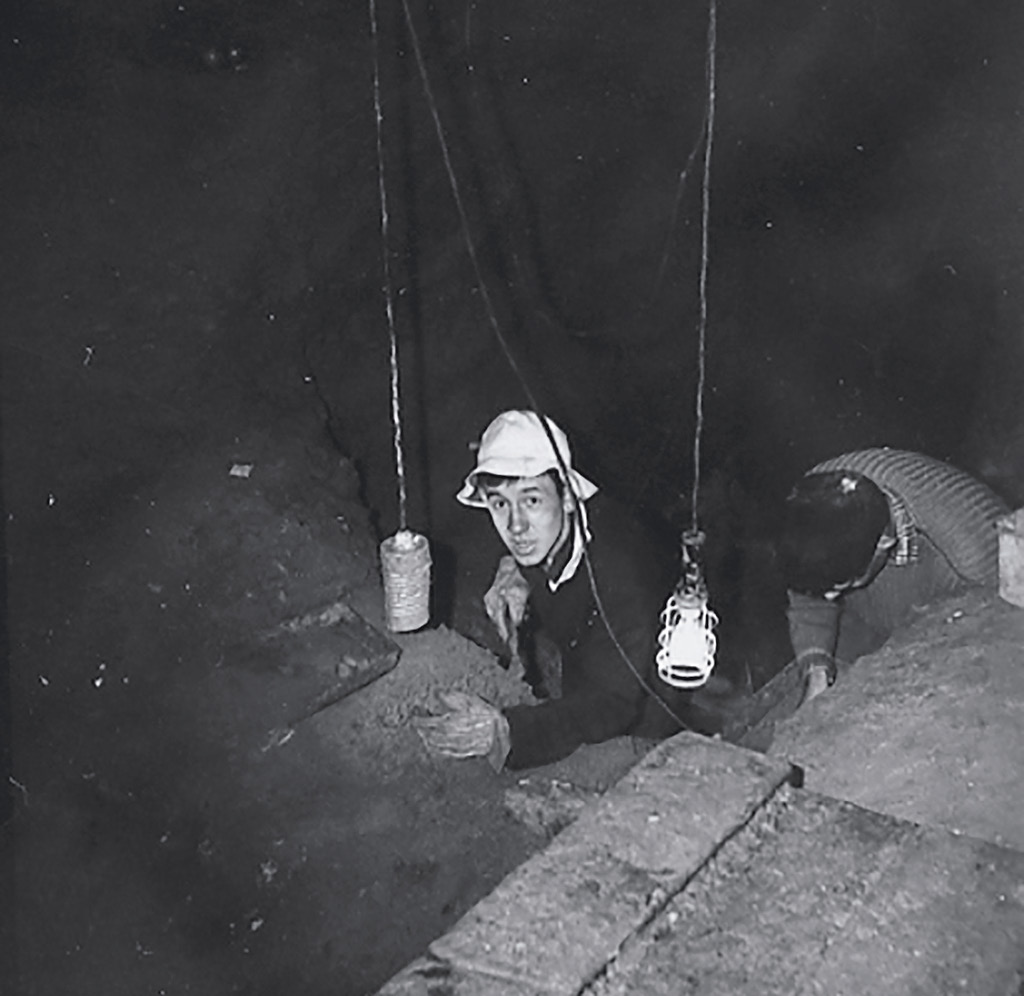
If my memory serves me correctly, this all happened more than 60 years ago. Professor Leroi-Gourhan, mercifully of slight build and an experienced caver himself, followed the now fully recovered jilted one into the darkness to see for himself. And thus this amazing discovery was confirmed. As far as I know, the living floor remains untouched. Perhaps it is simply too difficult to get an excavation team into it, and it has been bequeathed to a future generation of prehistorians.
La Roche-Cotard has not presented the same difficulties. The covering seal of sediments were quarried in 1846 to reveal the cave within, and the site was excavated extensively by the owner from 1912 onwards. Over a century later came the first inkling that the cave walls were engraved with patterns. First and foremost, the date for the sealing of the cave had to be defined. Radiocarbon dates are of little value, since the results showed the era lay beyond the reach of this technique, indicating a date earlier than about 45,000 years ago. Other techniques place Mousterian tools at between 65,000 and 99,000 years ago, and the event that sealed the cave at about 57,000 years ago.
The engravings themselves take two main forms. One is known as ‘finger fluting’, a procedure by which fingers were deliberately drawn across the soft surface of the cave wall to produce patterns. The second involved a concentration of circular dots engraved on to the rock in a panel measuring 1m by 60cm. How they were produced had not been determined, but perhaps by the fingers, or by a tool.
These are not, of course, on a par with Lascaux or Chauvet, the Sistine Chapels of cave art. However, they join other finds in the proper appreciation of our Neanderthal forebears. There are the engraved lines at Gorham’s Cave in Gibraltar. Neanderthals at Fumane Cave in Italy used flint blades to cut the bones of raptors 45,000 years ago to remove the long wing feathers. Notches were carved into a raven bone at Zaskalnaya on the Crimea. Every discovery leads to accumulating evidence that Neanderthals were much more like us than was once contemplated. One is left wondering, how many more hidden caves await discovery, and how many more remarkable insights will emerge from them?
Charles Higham is a Professor at Otago University in New Zealand, and an authority on Cambodia's Angkor civilisation and Ban Non Wat in Thailand.