Subscribe now for full access and no adverts
I have now examined the archaeology of every county in Britain bar one – Wiltshire. This was no accident, for I have a confession to make: Wiltshire’s archaeology terrifies me. There is so much of it, so many famous names, such passion aroused. It is the toughest archaeological nut to crack in the United Kingdom, and so I left it to last. To ease my burden, I will split my examination into four different parts, with two columns on the county and two others on Stonehenge and Avebury. Alas, Wiltshire is a case-study of famous sites like these eclipsing others that are less well-known but equally important. There is surprisingly little reported in the magazine, for example, on the Vale of Pewsey, and some notable urban absences. Bar mention of its excellent museum, for example, Devizes barely gets referenced. So I begin with a plea: if you’re working in Wiltshire away from you-know-where, then please let us know. We’d love to report more from the wider county.
Gathering Places
I will begin my explorations in what is, in a strange sense, the centre of not just the county’s but also the country’s heritage: Swindon. To explain, although Swindon is sometimes denigrated as a town, it has some excellent historical sites, and it is also a political powerhouse, with the head office of the National Trust a scone’s lob from the offices of English Heritage and Historic England, including the latter’s archive – what used to be known as the National Monuments Record (see CA 140, September 1994, and CA 371, February 2021). Take a weekday peak-time train through its station, and you stand a reasonable chance of bumping into the senior management teams of all these organisations. And all of them are based within the former GWR railway works, which originated in 1843 and continued in use until 1986, with much of the remains still in place and listed Grade II and II* (see CA 216, March 2008; CA 271, October 2012; CA 301, April 2015; and CA 367, April 2020).
Further afield, the wider Swindon area has no shortage of sites, among them an Iron Age enclosure on the northern edge of the town in Groundwell (see CA 177, January 2002); a hoard of 12 Iron Age cauldrons discovered immediately south of the town at Chiseldon (see CA 214, January 2008, and CA 229, April 2009); and an enigmatic Roman site at Blunsdon on the extreme northern edge of the town (see CA 163, June 1999).
Ups and Downs
As I head south-west from Swindon, first up is Yatesbury, halfway between Calne and Avebury. CA 171 (December 2000) paid a visit there to explore not its prehistoric origins but its later Saxon and Viking communities, which were at that time under examination by a team from University College London. Further west still lies Lacock, best known for its picturesque village and manor house. CA 296 (November 2014) focused not on these, though, but rather on the spectacular 15th-century silver drinking vessel long associated with the parish church of St Cyriac, diving into its origins and complex life history.
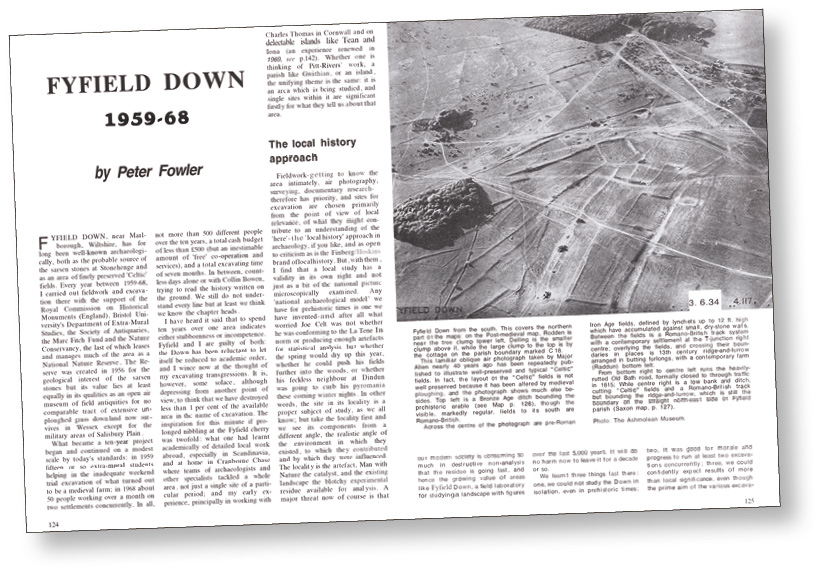
The next natural stopping-place on my itinerary would be Avebury, but as I mentioned in my introduction, I am saving that site for a column all of its own. Heading east along the A4, therefore, Fyfield Down is a fine place to pause. CA 16 (September 1969) includes an article well worth reading in depth, on fieldwork begun there in 1959 by Peter Fowler, which revealed a wealth of sites ranging from the Neolithic to the medieval period. This is the type of long-term interdisciplinary fieldwork that the magazine has championed from its outset, and the article is one of the finest expositions of such an approach, undertaken in a post-war, pre-rescue, pre-commercial period that now seems impossibly distant, but which produced results that stand the test of time. Immediately south of Fyfield are the West Woods, long thought to be the source of the Stonehenge sarsen stones. I will not dwell on these – Stonehenge, like Avebury, will get its own column in due course – but for those of you who are interested, the major mentions come in CA 311, CA 345, and CA 367 (February 2016, December 2018, and October 2020).
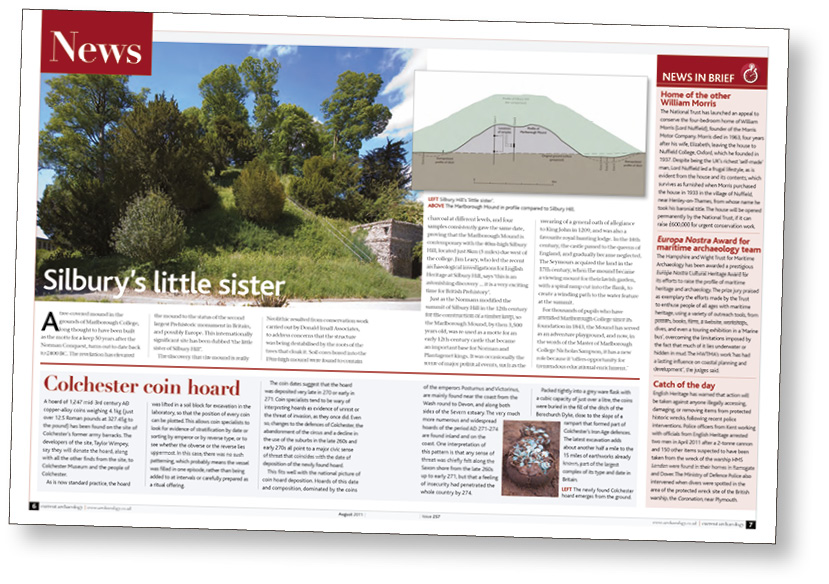
In Marlborough itself is the extraordinary Neolithic mound in the grounds of the eponymous college, second only to nearby Silbury Hill in terms of height. I am ashamed to admit that this site was new to me – as I mentioned in the introduction, the risk in a county like Wiltshire is that the famous sites obscure others equally deserving of attention, as was the case here. Thankfully, there is a charitable trust devoted to its care – see http://www.marlboroughmoundtrust.org. CA 257 (August 2011) visited the site when its early origins were first being properly appreciated (it had previously been thought to be a late 11th-century motte associated with the Norman Conquest), and CA 337 (April 2018) usefully puts it in its wider perspective, examining the large round mounds of England.