Subscribe now for full access and no adverts
Continuing last month’s exploration of high medieval monasticism, this month I will visit sites across the country, both well known and less well known, that reflect the profound impact the Church had on society during this era, and the discoveries made by modern-day archaeologists which highlight this. It is a fascinating spread of locations that ranges from upland Yorkshire to lowland Hampshire, and everywhere in between.
Yorkshire Gold
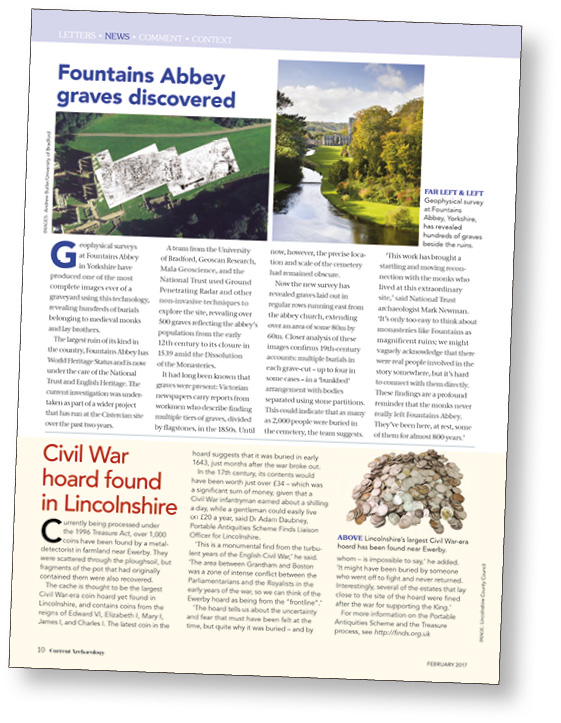
If there is a spiritual home in Britain of high medieval monasticism, then ‘god’s own country’ – Yorkshire – has a strong claim to this crown. Some of the richest and most powerful houses were built there in this period, and some of the most famous and picturesque ruins remain visitor favourites today. Intriguingly, Current Archaeology’s coverage of these houses has been sporadic: while Fountains, Roche, and Rievaulx feature, other ‘great names’ including Kirkstall, Byland, and Jervaulx do not. And even those sites that have been visited make at best fleeting appearances: there are no large-scale reports akin to those (witnessed in last month’s column) from Cheshire and London, despite such fieldwork having taken place. For example, Fountains Abbey (founded in 1132 near Ripon in North Yorkshire) first properly features only in CA 323 (February 2017), at the time of a comprehensive geophysical survey of the site. This work revealed a wealth of information, not least the existence of 500 – and potentially as many as 2,000 – medieval burials there, long known due to Victorian reports but never properly identified before. There are then passing mentions of Fountains in CA 338 (May 2018) and CA 364 (July 2020), until only the second and most recent detailed reference in CA 382 (January 2022), reporting on the find of a medieval tannery, the largest of its kind in a monastic context. This is slim pickings indeed for a site that is rich in history, in the care of the National Trust, and a World Heritage Site to boot.
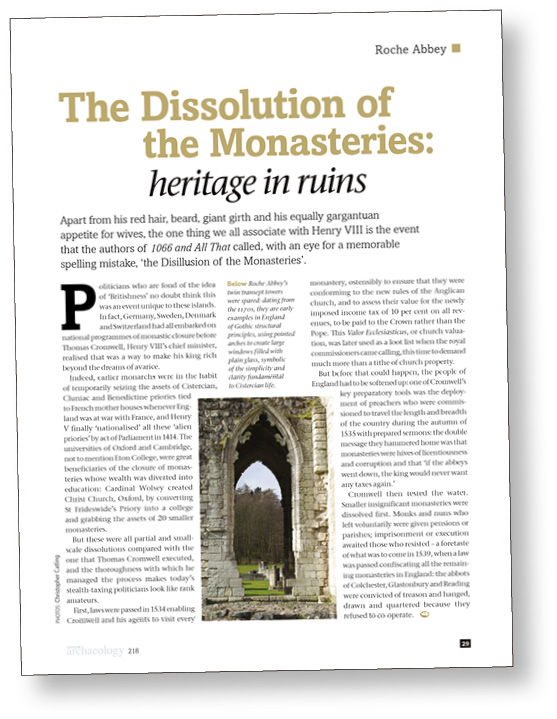
Other Yorkshire monasteries are even more sparsely featured: Rievaulx Abbey, near Helmsley in North Yorkshire (founded in 1132 and the first Cistercian outpost in the north of England), manages only a single passing mention in ‘Sherds’ in CA 370 (January 2021). Lesser-known Roche Abbey near Rotherham, South Yorkshire (founded in 1147), fares marginally better with a visit in CA 218 (May 2008) exploring its pre- and post-Dissolution history; and Gisborough Priory, an Augustinian rather than Cistercian house in Redcar and Cleveland, North Yorkshire (founded in 1119), makes an ‘Odd Socs’ appearance in CA 351 (June 2019). But this is the lot in the magazine for Yorkshire’s bountiful monasteries. If anyone would like to rectify this absence, then please let us know – we would love to feature fieldwork at such sites in future issues.
Kings Hidden in Plain Sight
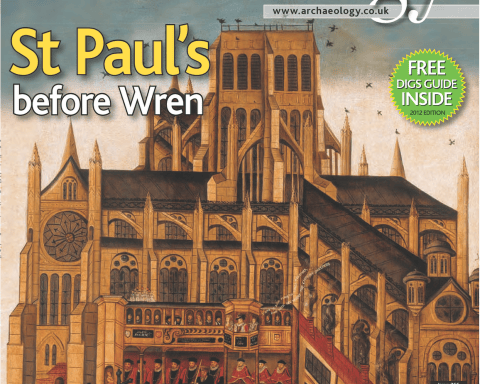
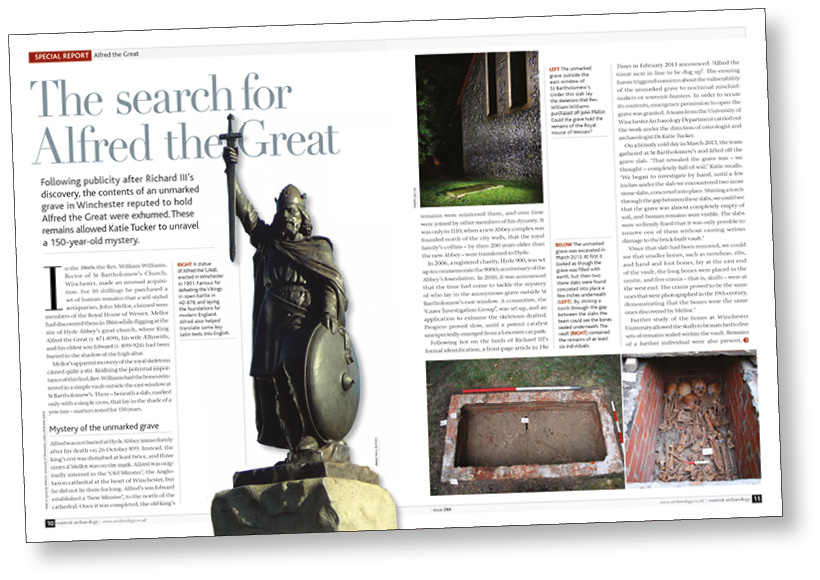
Hyde Abbey in Winchester, Hampshire, is a relatively little-known foundation with a serious pedigree. A Benedictine monastery founded in the early 10th century by Edward the Elder (c.870-924), it managed to weather the storms of the Norman Conquest and a change in the royal regime, so much so that in 1109 Henry I (1068-1135) ordered the New Minster to be removed from the city centre to the suburb of Hyde Mead to the north in order to give it more space and architectural prestige. When the new abbey church was consecrated in 1110, the bodies of Alfred the Great (849-899), his wife Ealhswith, and Edward the Elder (his son) were carried in state through Winchester to be interred before the high altar. This made Hyde both a popular pilgrimage destination and a royal favourite long into the high Middle Ages, until its dissolution in 1538. After that time, the site gradually faded from view, despite its regal pedigree – and, crucially, the locations of the three royal burials were lost. Current Archaeology’s interest in the site commenced in issue 165 (October 1999), when the first modern search for these graves began (there had been previous, poorly recorded, antiquarian searches in the 19th century). CA 288 (March 2014) returned with a proper report on the search and the site in context, and two useful companion pieces then appeared in CA 300 (March 2015) and CA 344 (November 201) on the Saxon royal minster in the heart of the city. Subsequent issues have kept readers up to date with excavations at Hyde Abbey – see CA 334 (January 2018), CA 380 (November 2021), and, most recently, CA 406 (January 2024) – and while Alfred remains elusive, the community archaeology project has revealed a wealth of information about the layout of a fascinating site, worthy of archaeological attention, and should the royal graves ever be discovered, then this would be an international news story on a scale only witnessed before around the burial of Richard III in Leicester.
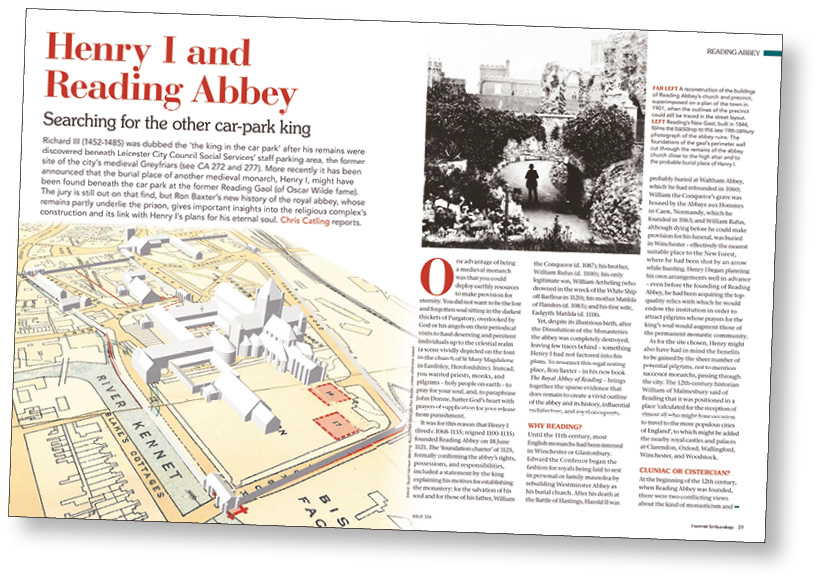
Another abbey with impressive royal connections is that of Reading in Berkshire, founded as a Cluniac house in 1121 on the orders of Henry I, later serving as his burial place in 1135. Unlike Hyde, the site (lying right in the centre of the town) was never ‘lost’, with substantial upstanding remains still present, but by the late 20th century it was seriously neglected, and the location of Henry I’s grave, which is said to lie in front of the high altar, is still not to this day confirmed. CA 93 (August 1984) first visited at the time of nearby waterfront redevelopments, but the next occurrences was not for another 30 years, coming in CA 317 (August 2016) and CA 320 (November 2016), when the search was on for Henry I’s burial (which has not yet been discovered). CA 336 (March 2018) provides a recent in-depth analysis both of this search and the site’s wider context – including, happily, its resurrection by the local community and authorities, gaining significant investment and improvement: see CA 341 (August 2018) for more on these conservation and improvement works. As at Hyde, the search for the burial of Henry I, if ever successful, would make global news headlines.
One final ‘lost’ royal monastery is also worthy of mention here, although it has only appeared once in the magazine, albeit as a cover story in CA 382 (January 2022). This is Syon Abbey, which is located adjacent to the later grand house of the same name (the seat of the Dukes of Northumberland) in modern-day west London, just north of the Thames opposite Kew Gardens. This was a Bridgettine nunnery, founded and royally endowed by Henry V (1386-1422) in 1415, which grew rapidly to became one of the most influential and endowed religious communities in the country in the century before its dissolution. Foundations of the monastic church located to the immediate east of the later Syon House were partially excavated between 2003 and 2004, including by Time Team, and subsequent excavations took place between 2004 and 2011, which were summarised in CA 382.
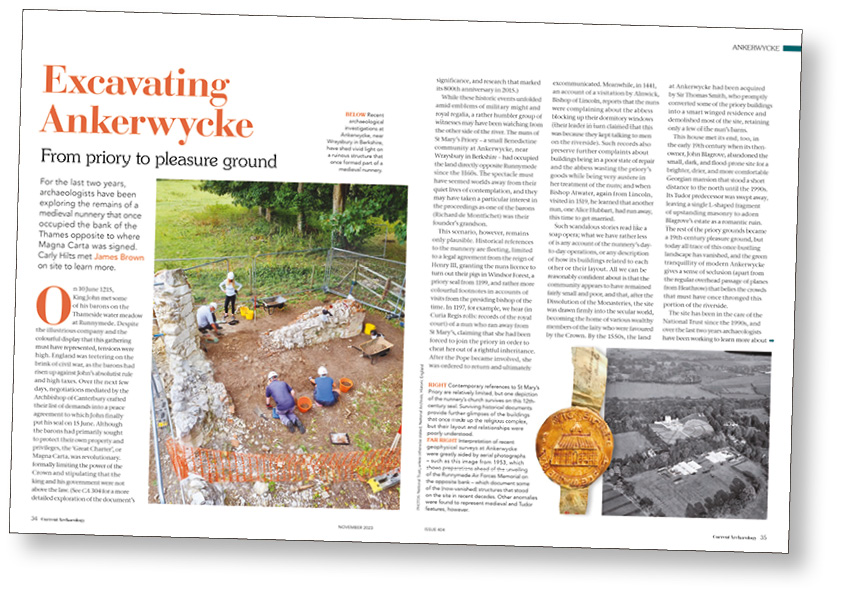
My final site for this month’s column lies a dozen or so miles upstream along the Thames, further west of Syon Abbey, and sharing more than just geographic similarities with it. Ankerwycke Priory is a nunnery founded in 1160 in modern-day Buckinghamshire, now in the care of the National Trust as part of its Runnymede estate. Since 2022, as part of the NLHF Runnymede Explored Project, the priory has been surveyed and partially excavated, as reported in CA 396 (March 2023) and CA 404 (November 2023). The project, like that at Syon, has shed light on a site never quite lost but certainly long forgotten, and on the lives of their female religious communities, often overlooked by documentary and archaeological records alike. This seems like a fitting place to end this review of monasticism in Britain – but, for more on this topic, see also CA 419 (February 2025).
All of the sites discussed in this column are open to the public, see: http://www.nationaltrust.org.uk/visit/yorkshire/fountains-abbey-and-studley-royal-water-garden, http://www.english-heritage.org.uk/visit/places/rievaulx-abbey, http://www.english-heritage.org.uk/visit/places/roche-abbey, http://www.english-heritage.org.uk/visit/places/gisborough-priory, http://www.hyde900.org.uk/home, http://www.readingmuseum.org.uk/your-visit/reading-abbey-quarter, https://syonpark.co.uk, and http://www.nationaltrust.org.uk/visit/surrey/runnymede-and-ankerwycke.
Discover old issues :
Read a selection of the articles discussed by Joe for free online at www.archaeology.co.uk/archive440. They will be available for one month from 1 October:
CA 323 https://reader.exacteditions.com/issues/54819/spread/11
CA 382 https://reader.exacteditions.com/issues/98609/spread/9
CA 218 https://reader.exacteditions.com/issues/52769/spread/29
CA 165 https://reader.exacteditions.com/issues/52716/spread/21
CA 288 https://reader.exacteditions.com/issues/52839/spread/11
CA 93 https://reader.exacteditions.com/issues/52644/spread/19
CA 336 https://reader.exacteditions.com/issues/61704/spread/18
CA 341 https://reader.exacteditions.com/issues/64088/spread/59
CA 382 https://reader.exacteditions.com/issues/98609/spread/30
CA 404 https://reader.exacteditions.com/issues/112942/spread/34
Print subscribers can add digital access to the entire back catalogue of CA for just £12 a year – simply email us at subs@currentpublishing.com and quote ‘DIGI440’.