Subscribe now for full access and no adverts
The Bayeux Tapestry has gone on display at the British Museum at last, despite the fears of some conservators that transporting it to London would cause irreparable damage. In the event, two threads were found to be broken when the Tapestry was inspected after arriving in London. The British Museum was quick to point out that this damage could have occurred at any stage since September 2025, when the historic embroidery was removed from display, and its unpacking in July 2026.
Nevertheless, French opponents of the loan declared this to be vindication of their worst fears. Under the headline ‘Darn it’, The Times reported that the inch-by-inch examination of the Tapestry and the determination of the French to find recent damage was like ‘returning a hired car’. One witty commentator asserted: ‘it’s a stitch-up: the French will be after compensation’; another suggested that, to avoid further damage on the return journey, the Tapestry would obviously have to remain at the British Museum.
Tickets for the exhibition sold out in 24 hours, though there are plans for a further release on 21 October (6 October for British Museum members). Those who fail to get tickets could head for Reading Museum to see the facsimile. This, however, is not an entirely faithful copy as the 35 ladies of the Leek Embroidery Society who created the replica in 1886 took exception to the 93 penises visible in the original; their version adds stripey trousers to the naked human figures and omits the equine protrusions.
Separating fact from fallacy
The BBC reported that a debate was ‘raging amongst historians’ over exactly how many male appendages are depicted in the Tapestry. In an article published in History Today in 2018 (and reported by Sherds at the time), Oxford academic Professor George Garnett counted 88 belonging to horses and five to humans. Dr Christopher Monk claims to have found one more belonging to a man depicted running with something dangling beneath his tunic. Professor Garnett believes this potential 94th penis is actually the scabbard of the man’s dagger, but Dr Monk disagrees and points to the fact the ‘scabbard’ has testicles.
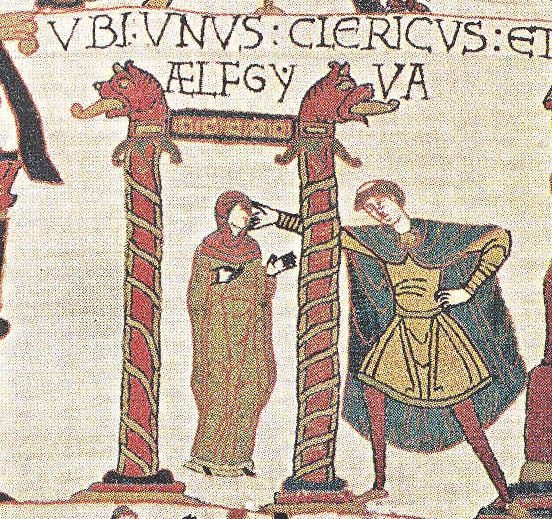
This rather over-hyped debate fed a more meaningful discussion about phallic symbolism in the Tapestry. The fact that William the Conqueror’s black stallion is especially well-endowed needs no further explanation, but what are we to make of the figure in the so-called ‘Ælfgyva scene’? This shows a tonsured cleric caressing the cheek of a nun-like figure, framed by two fluted columns topped by dragon heads. A priapic figure in the bottom register of the Tapestry appears to be mimicking the cleric’s gesture and a very phallic tower separates this scene from the next. The lacuna in the accompanying text adds to the mystery by lacking a verb: it simply says ‘ubi unus clericus et Ælfgyva’ (‘where a cleric and Ælfgyva…’).
Professor Michael Lewis, one of the two curators of the British Museum exhibition, has suggested that the scene might be a subtle allusion to an alleged affair between Emma of Normandy – wife to two successive kings, Æthelred the Unready and Cnut, and the mother of Edward the Confessor – and Alfwin, Bishop of Winchester. The scholarly consensus is that the reference to this sexual scandal was intended to contradict William the Conqueror’s claim to the English throne, based on consanguinity. This seems unlikely, given that William himself was illegitimate and was known throughout his life as William the Bastard. His mother Herleva (also called Arlette) was the daughter of a tanner from the town of Falaise, and his father was Duke Robert I of Normandy.
A tangential sexual scandal involving his great-aunt Emma was hardly going to be the means to undermine William’s authority. It is more likely that the scene depicting the breaking of marital and clerical vows is a harbinger of Harold Godwinson’s alleged perfidy in breaking his pledge to support William’s claim to the English throne.
Roman resemblances
Only three women are depicted in the main central frieze of the Tapestry (plus three more in the borders). Apart from Ælfgyva, there is Emma, wife of Edward the Confessor, shown weeping at his deathbed, and a woman and child fleeing a building that two Normans are setting alight. The similarity of this scene to a carving on the column of Marcus Aurelius in Rome has leant weight to the suggestion, made by Professor Howard Clarke in a paper published in the journal Anglo-Norman Studies in 2012, that Abbot Scolland was the mastermind behind the Tapestry’s design.
Appointed abbot of St Augustine’s monastery in Canterbury in 1070, Scolland was head of the scriptorium at Mont Saint-Michel earlier in his career. That island is depicted in the Tapestry in the scene where Harold and William together cross the quicksands of Mont Saint-Michel’s bay and Harold rescues two Normans, carrying them to safety. In the border above, a seated figure points to the scene as if to say: ‘I witnessed this’.
According to Professor Clarke, the seated figure is Scolland, who visited Rome in 1071-1072, giving him the opportunity to see the columns of both Marcus Aurelius and Trajan. Professor Clarke goes on to suggest that the Tapestry’s narrative structure and format was inspired by such monuments. There is an even stronger resemblance between the Tapestry’s depiction of five powerful figures – Edward the Confessor, Duke William, Bishop Odo, Robert of Mortain, and Guy of Ponthieu – and the seated figures portraying early Fathers of the Church in Mont Saint-Michel manuscripts produced between 1040 and 1066.

Obscure origins
Clearly Mont Saint-Michel was influential in the Tapestry’s design, and those who believe that Lanfranc was a much more likely candidate for producing the Tapestry’s overall narrative point out that, between 1039 and 1041, he was the master of the cathedral school at Avranches, a mere 20km (12 miles) from the aforementioned tidal island, at a time when his Lombardic compatriot Suppo was abbot. Lanfranc went on to become a highly influential political figure. It was Pope Alexander II (Lanfranc’s pupil and close friend) who gave papal endorsement to the Norman Conquest – a point reinforced by the papal banner shown in the scene towards the end of the Tapestry, when William lifts the visor of his helmet to show that he is still alive, rallying his troops to victory.
Lanfranc was a committed supporter of ecclesiastical reform (and a promoter of clerical celibacy, which might throw further light on the Ælfgyva scene), who set about reorganising the English church as soon as he became Archbishop of Canterbury in 1070. This brings us to the purpose of the Tapestry. This undoubtedly served as political propaganda and as a visual narrative legitimising William’s invasion of England by portraying King Harold as an oath-breaker. In addition, it elevates the role of Bishop Odo, who wished to curry favour with his half-brother William. But might Lanfranc have had a more specific audience in mind?
Professor Benjamin Pohl of the University of Bristol, in a paper called ‘Chewing over the Norman Conquest: the Bayeux Tapestry as monastic mealtime reading’ (Historical Research, https://doi.org/10.1093/hisres/htaf029), asks where the Tapestry was between its making in the 1070s-1080s and its first attested presence at Bayeux Cathedral in an inventory dating from 1476. He suggests that it was intended to be hung in the refectory at St Augustine’s, Canterbury, as a moral aid and focus for contemplation during mealtimes. This would explain the scenes in the Tapestry’s borders that draw on Aesop’s fables to offer moral messages.
Professor Pohl belongs, however, to the school of thought that has Abbot Scolland as the driving force behind the creation of the Tapestry. He notes that Scolland instigated the construction of a new refectory building for the monks at Canterbury. This was not completed until some 50 years after Scolland’s death, so the Tapestry might never have been mounted on the walls. The remarkably good and surprisingly unfaded condition of the Tapestry suggests that it was kept in storage and forgotten for 400 years.
All these different perspectives show that the Tapestry still has much to teach us and (like Stonehenge, to which the media has been comparing it in terms of its fame) much will forever elude explanation – yet another reason for striving to get tickets to the British Museum exhibition or, failing that, to visit the renovated Tapestry Museum in Bayeux when it reopens in time for the 1,000th anniversary of the birth of William the Conqueror late in 2027.