Subscribe now for full access and no adverts
The theme of this year’s forum was technology and society. As it happens, this is right up my street…
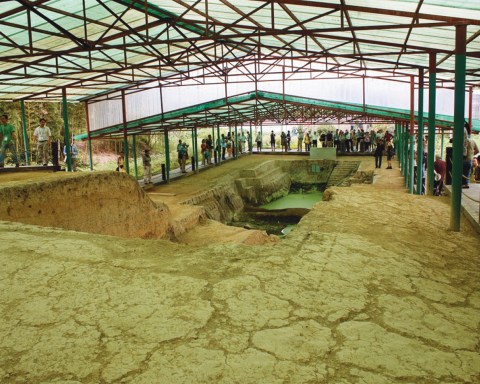
The 6th Shanghai Archaeological Forum has just drawn to a close, and it is time to reflect on its many highlights. This year, the field trip was scheduled on the first day, and we were given the choice of visiting freshly uncovered shipwrecks and the new Shanghai Museum, or to take the bus south to visit two key sites: Jingtoushan and Hemudu. I opted for the latter, because I am currently writing a paper on the importance of fishing in the Neolithic diaspora south from this region, and Jingtoushan is a key site for this. It took quite some time to navigate the busy Shanghai roads, with the prospect of traversing the mighty Hangzhou Estuary bridge. This amazing structure is fully 36km- long and it took the bus, travelling at pace, 20 minutes to cross it. Jingtoushan exceeded my expectations. Dating back to about 8,300 years BP, it was a very early site documenting rice and pig domestication, but much reliant on harvesting the rich resources of the wet lowland habitat. After abandonment, it was covered with a thick layer of anaerobic marine sediments, leading to the preservation of an unmatched range of organic artefacts. There were the wooden hafts of stone axes, paddles, fishing traps, mats, house posts, and a monumental amount of fish, shellfish, and plant remains, some still stored in baskets. It was possible to descend into the depths to see the site, now safely roofed, as well as the on-site lab to inspect the many finds. The second destination, Hemudu, I have been to before. This is an iconic site for early rice farming, but now there is a new museum, featuring a remarkable area you can walk into and experience the virtual reality of visiting the village as it was 7,000 years ago.

This day out was the hors d’oeuvre to the opening ceremony hosted by the Mayor of Shanghai, during which the awardees were presented with their certificates, before each gave us a description of their research. We all recollect the fire that nearly destroyed Notre-Dame, and, over breakfast that morning, I chanced to meet Christophe Besnier. Our conversation turned naturally to what he did, and he told me that he had directed the archaeological research in the cathedral in the aftermath of the disaster. And what incredible finds he made! Christophe showed us the medieval sculptures buried during 18th-century renovations, and lead coffins that, when opened, revealed the remains of prelates he illustrated with contemporary paintings of them in vivo.
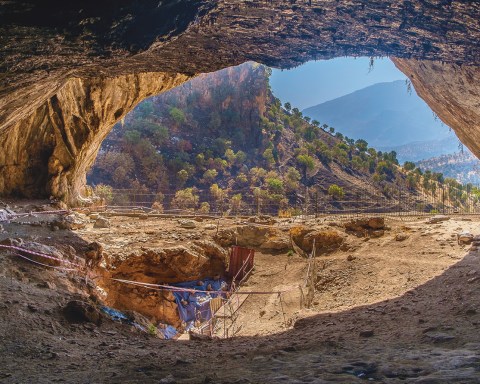
Typically for the Forum, we moved from one continent to another, and from the recent to the distant past. I am very interested in the Denisovans, the mysterious new human species that has been identified in the Altai Mountains, the highlands of Tibet, and northern Laos. Naturally, I was all ears when Fu Qiaomei told us how she had taken a minute fragment of dental plaque from the near complete skull from Harbin, extracted the DNA, and identified for the first time what a Denisovan would have looked like. She then went on to describe her further DNA findings that cover human evolution in East Asia over the past 100,000 years.
Schöningen in Lower Saxony is another site that fascinated, like Tianluoshan, because of the preservation of organic material. Dating to the Middle Pleistocene, I was already familiar with the discovery there of wooden spears, but Nicholas Conard told us much more. It was not just a hunting site for horses, there were also the remains of elephants. The hunters used throwing sticks, too, probably to down aquatic birds. Nicholas found human footprints in the mud that seemed in size to fit a woman and two children. As he concluded, there is no similar site of this date anywhere else.
As the day unfolded, we moved from Madagascar to the Inca frontier, from Cyprian Broodbank’s work on the Neolithic of Morocco to Kaminaljuyu in Guatemala, then lost cities on the Silk Road described by Michael Frachetti and a newly discovered Shang city on the Loess Plateau of north-west China. So it was a large gathering of sated archaeologists that assembled for the welcome banquet that evening, before returning to the magnificent hotel base to ponder all the new findings.

Technology and society
The theme this year was technology and society. As it happens, this is right up my street, as I have been reading up on the transmission of copper-base technology from its home in the Balkans to China and then down south to where I work. Over the following two days, this was explored by successive speakers. One of these, Peter Biehl, described the impact of a weather event on the sequence at Çatalhöyük 8,200 years ago. The rapid onset of dry conditions led to the abandonment of the settlement on the west mound there, and foundation of a new town on the east mound. There was no hiatus in occupation, as once thought, but the relocation involved a series of integrated changes in behaviour that led, for example, to a new type of house with two storeys and changes in the subsistence base to adapt to the changing environment.
One session was devoted to recent advances in Chinese archaeology. Having been to Sanxingdui last year, and met there the leading archaeologists, it was not only good to see Li Haichao again, but also to hear his views on the reasons why that city was abandoned in favour of a new one at Jinsha. He suggested that it was a disruption of exchange networks that took place when the Zhou toppled the last Shang king in 1046 BC. Increasingly, Chinese archaeology is moving out from the sequence in the Central Plains of the Yellow River to explore entirely new patterns of settlement in, for example, the Loess Plateau, where there are now several large and socially complex cities appearing. There is also a concentration of research in the middle reaches of the Yangtze River, where sites like Panlongcheng were established to secure access to the rich copper and tin ores that were vital for supplying the foundries of the Shang capital at Yinxu. After all, it takes a lot of copper to cast a ding food vessel weighing 800kg.
In the evening, I was driven to the huge new Shanghai Museum where, after a sumptuous dinner of local specialities, I gave a public lecture to a large and animated audience on the social impact of bronze technology as it spread across Eurasia and into the already sophisticated and complex states of China. My point was that, when they came into contact with metal, the Chinese developed their own technique of piece mould casting to replicate in bronze the traditional food and drink vessels hitherto made in ceramics. I was able to show images of the tomb of Fu Hao, consort to the Shang king Wu Ding, which is the only intact royal Shang tomb to survive unscathed from looting. Afterwards there were many penetrating questions, deftly handled by my friend and translator for the evening, Zhichun Jing, whose knowledge of the Shang, of course, vastly exceeds my own.
The final day was divided into six parallel sessions, and I found myself moving from one room to another to take in the papers that were of most interest to me. Oliver Pryce described his new initiative to explore the southern Silk Road linking Yunnan with Myanmar and India. Miljana Radivojevi´c gave a fascinating résumé of the origins of an interest in brightly coloured ores in the Balkans, leading to the first experimental smelting of lead and copper from at least 5200 BC. There were so many other papers I wanted to listen to, but inevitably all came to an end with a farewell to many friends old and new, who had enjoyed the privilege of being in Shanghai for this unique event in the archaeological calendar.
Charles Higham is a Professor at Otago University in New Zealand, and an authority on Cambodia's Angkor civilisation and Ban Non Wat in Thailand.
Images: courtesy of Charles Higham