Subscribe now for full access and no adverts
One pit held nearly 400 tusks, one of which came from… a superb elephant with tusks 1.85m long.
I have already described here the new discoveries at Sanxingdui, the great city that commanded the Sichuan Plain in China from 1200 BC (CWA 110). However, I cannot refrain from returning to it, because a couple of months ago a most welcome and unexpected email arrived. It invited me to fly up to Chengdu and attend a three-day symposium to celebrate the 90th anniversary of the discovery of the jades that led to the recognition of the site as one of supreme importance in the rise of early civilisations in China. Of course, I accepted without hesitation, and I write this on my flight home. Once again, I was taken aback by the scale of any visit to China. A huge new airport awaited me at Chengdu, a luxurious room in a 30-storey hotel followed, and then up-to-the-minute facilities at Sichuan University. We began with two days of talks, all but two in Chinese with simultaneous translation. Most centred on interpreting the contents of the sacrificial pits that were excavated in 2020-2022. Within were layered first, ash and then elephant tusks, bronzes, and finally jades and gold. One pit held nearly 400 tusks, one of which came from what must have been a superb elephant with tusks 1.85m long.
What came through with particular clarity was the importance of ritual and performance that underlay the conspicuous consumption and destruction of these treasures. Sun Hua from Peking University, for example, summarised his evaluation of engravings on a jade sceptre. There is a group of four standing men on the upper register, while down below they are matched by four kneeling men, all with their arms positioned to hold an artefact of presumed significance. From this pattern, he skilfully reconstructed a ceremonial procession flanked by court shamans leading to a raised temple. Kazuo Miyamoto from Kyushu University looked in detail at the motifs on the bronze ceremonial vessels and compared them with the contemporary repertoire from the Shang civilisation capital at Anyang on the Central Plains. Placing Sanxingdui in a world context, Wang Haicheng, who teaches at the University of Washington, gave some fascinating insights into parallel instances from the Maya to Sumeria and other early states, for gold masks, deities, temples, and rituals.
I have to admit a feeling of being somewhat upstaged when my own contribution followed Ran Honglin’s description of the newest bronzes from the pits. I related the Southeast Asian contribution to trade with early Chinese states in, for example, the provision of treasured cowrie shells, and in return, the very rare presence of Chinese jade sceptres in Vietnam. However, when I turned to the social impact of the first Southeast Asian bronzes, my socketed axes, bangles, and bells looked decidedly provincial set alongside the rich fare from Sanxingdui.
Sacrifice and display
The final day involved a much-anticipated field trip to Sanxingdui. This certainly fulfilled a long-term ambition of mine, and I can now remove it from my must-do list. The drive took an hour, and we were first taken to the building housing the eight pits, where we could take in their size and close proximity. We then joined a throng of Chinese visitors at the brand-new Sanxingdui Museum, and I can only say that it is absolutely staggering in its size, layout, and of course its contents – on the brink, surely, of World Heritage inscription. An early exhibit showed the layout of the city as known at present. The palace area has been opened by excavation. Many graves were found, but they were of the populace at large. The finding of the elite royal tombs is for the future. There was also a jade workshop precinct, but where the bronzes were cast is another discovery to come.
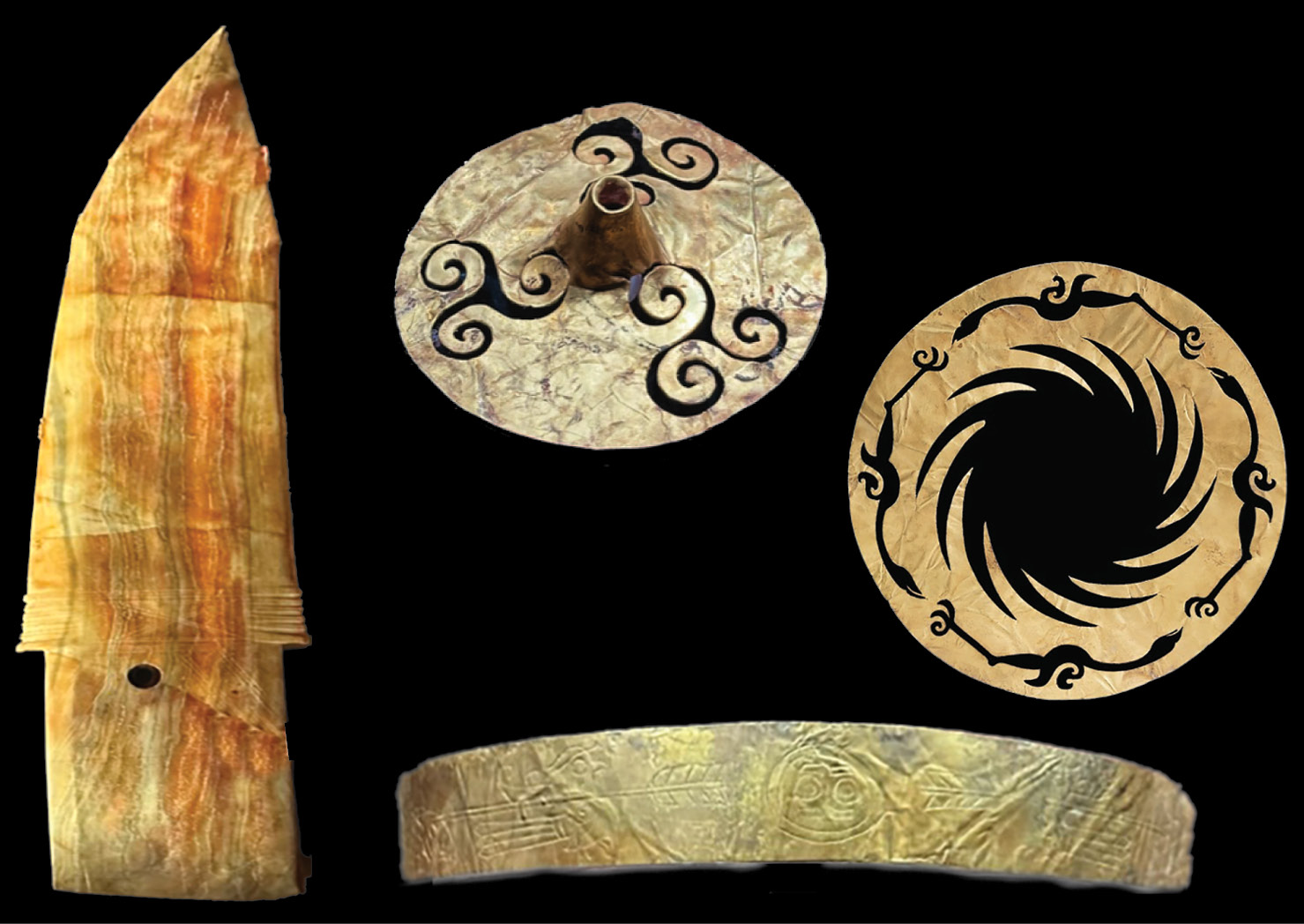
Many of us will have read about and seen images of the bronzes, jades, and the goldwork, but it is something new to see them all. I will not go into detail, having already described them in a former issue, save for just three items. Our visit culminated in the room containing the massive bronze figure of a shaman/priest/king standing over 3m high, hands in position to hold a sacrificial offering that may well have been an elephant tusk. I waited until the last to see the 4m-high sacred tree, which took three years to reconstruct from hundreds of component parts. It has seven branches with a bird perched on each. I had never previously noticed that the tree is associated with a snake, its body curling up into the branches, but half its length has yet to be found. Finally, I couldn’t take my eyes off the row upon row of magnificent jade yazhang blades or sceptres that so clearly played a key role in the elite rituals enacted there.
I find museums tiring, for their combination of walking, thinking, and absorbing new information, so the sumptuous lunch came as a welcome pause in the events of the day, during which I asked my friend Jie Fu, with whom I have collaborated on his fieldwork in Yunnan on early copper mines, ‘What next?’ I had forgotten that the schedule said that the afternoon would be spent at Jinsha. Now, Sanxingdui was abandoned sometime after 1000 BC. The Yangtze and several tributaries descend on to the Sichuan Plain, and one of these flowed through the ancient city. The rich soils surrounding the city were probably irrigated, a situation making the area vulnerable to flooding. This is one possible reason for the end of Sanxingdui and a move to Jinsha.
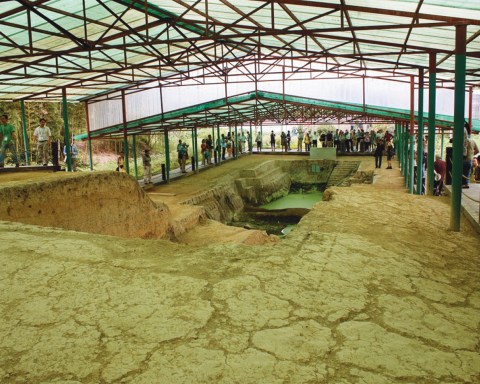
We were fortunate that, being a Monday, the Jinsha museum precinct was closed to the public and we had a private viewing. The site was the natural successor to Sanxingdui, and only discovered when a bulldozer on a building development about 20 years ago unearthed a scoop of elephant tusks. The huge excavated area has been left open under the protection of a roof. We followed walkways down into the sacred area where offerings of hundreds of elephant tusks had taken place, and where some of the most precious golden artefacts from early China once lay. One of these is now counted among just 148 that, under state law, must never leave the country. It is a gold sun disc. The sun in the centre has 12 rays – one speculates one for each month of the year – round which fly four celestial birds. We saw the place where, miraculously, it had survived intact, before moving on to explore more, all under the most helpful guidance.
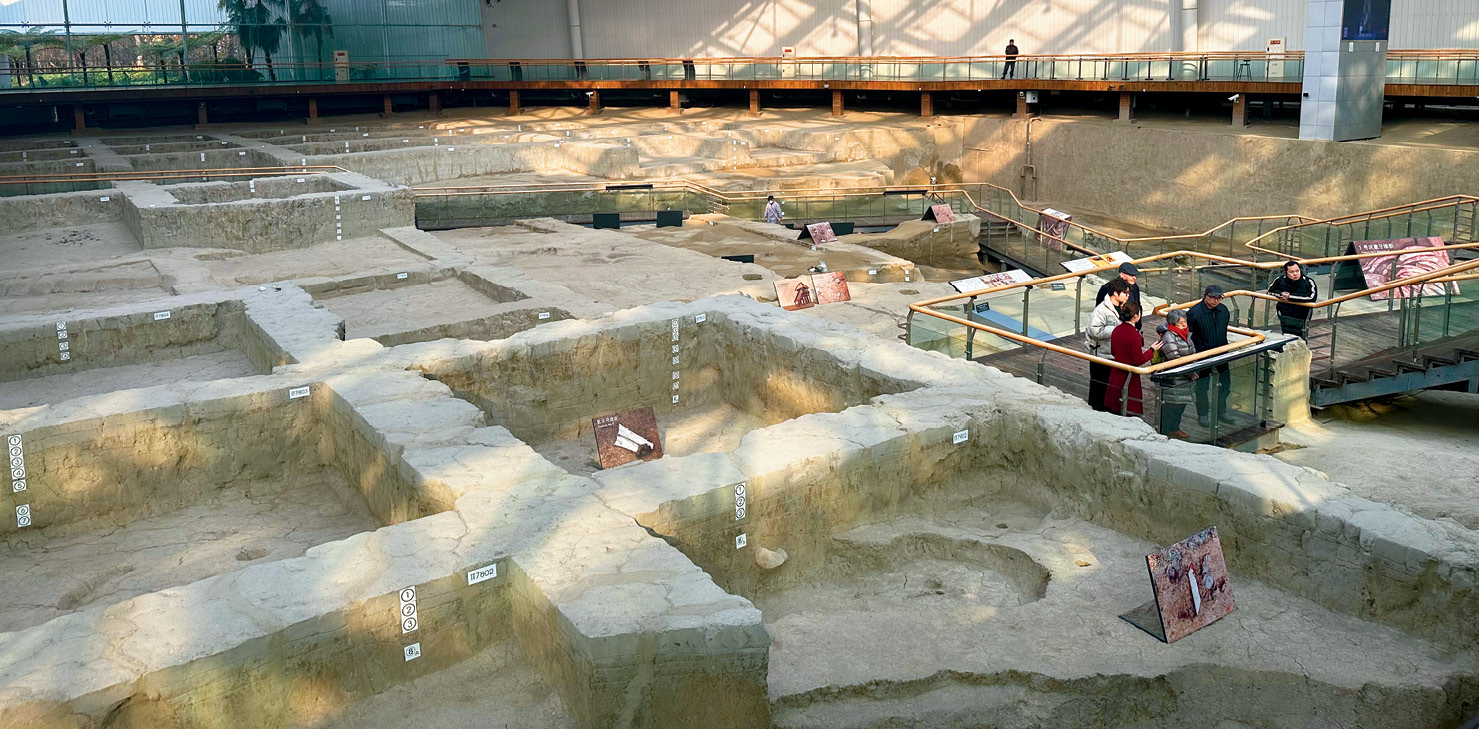
The parkland that now covers the extent of ancient Jinsha has been planted with the trees and shrubs that would have flourished there more than two millennia ago, and we walked through the autumn colours to the museum. Many of the bronzes are clearly closely related to the earlier ones from Sanxingdui, albeit on a smaller scale. There were the same gold human masks, bronze vessels, and human figures. A gold diadem was engraved with a pattern commonly seen at Sanxingdui, involving an arrow piercing a bird and impaling a fish. What particularly struck me was the continuity in the manufacture of jade sceptres. Some of these are of the most superb patterned jade and of vast size. Others were miniatures, no more than 6cm in length. Someone at Jinsha was an antique collector, for a jade cong from Liangzhu was found during the excavation. This ceremonial artefact has a circular interior within a square exterior and is the hallmark of the Liangzhu state of the lower Yangtze region from 3200 BC. Weak at the knees by now, but determined to keep going, I stopped to admire a golden disc with three almost Celtic patterns cut into the surface. However, the real denouement came with the famous sun disc. This has been adopted across the entire country as a symbol of China’s unmatched cultural heritage. One sees it at the Great Wall and the Forbidden City. At Jinsha, its reconstruction fills the entire circular stairwell, such that it reflects the sun on the walls.
As in all archaeological endeavours, there are unanswered questions. The Shang Dynasty was contemporary with Sanxingdui and used oracles to predict future events for the Emperor. The oracles would take a thin bone, and heat its underneath until the surface cracked, before interpreting the cracks by scratching their prediction in the original Chinese writing. One wonders how it came about that the Shang had written records and their contemporaries at Sanxingdui did not. Adding to this mystery, oracle bones with scorched depressions have been found at Jinsha, but never with any writing.
I left Chengdu this morning with an invitation to return and give a series of lectures on Southeast Asian prehistory. I cannot wait.
Charles Higham is a Professor at Otago University in New Zealand, and an authority on Cambodia's Angkor civilisation and Ban Non Wat in Thailand.
All images: Charles Higham