Subscribe now for full access and no adverts
He accuses her of pride, duplicity, savagery, adultery, and lust, but… she, too, is a powerful leader.
Women of power
Tacitus, in his book on the life and character of his father-in-law Julius Agricola, the Roman Governor of Britain from c.AD 77 to 84, makes the often-quoted observation that ‘Britons make no distinction of sex in their leaders’. In his Annals (XIV.35), the same author depicts Boudica (AD 30-61) rallying her supporters with the cry: ‘we British are used to women commanders in war’. In his Annals and Histories, Tacitus gives a less flattering portrait of Cartimandua (c.AD 43-69), whom he accuses of pride, duplicity, savagery, adultery, and lust, but the fact remains that she, too, is presented as a powerful leader of her people, the northern British Brigantes.
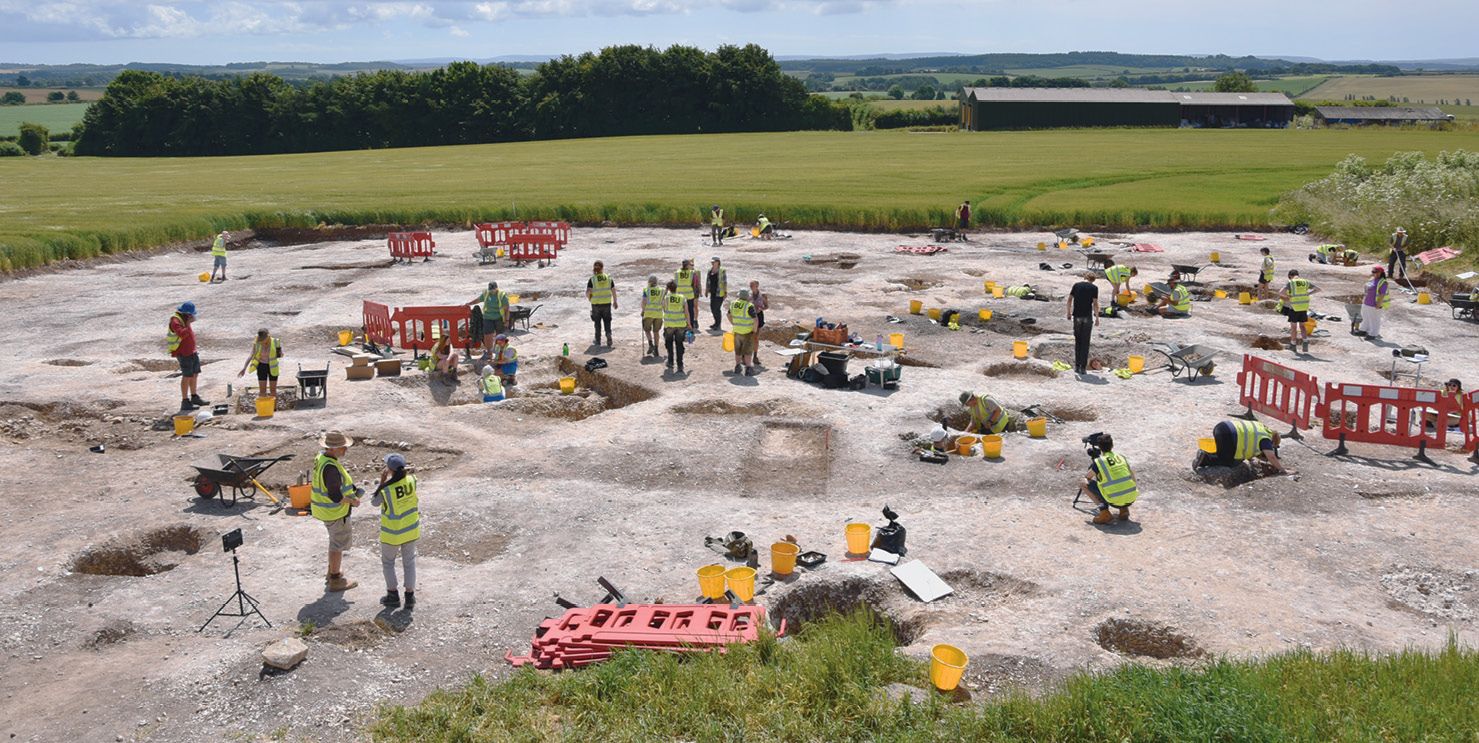
It is therefore not entirely surprising that researchers analysing the DNA of 57 of the individuals buried in richly furnished graves in the Iron Age cemetery located near Winterborne Kingston in Dorset should have concluded that land and power in this community was potentially passed down through the female line.
Publishing the results of their study in the journal Nature (https://doi.org/10.1038/s41586-024-08409-6), the authors found that many of the women shared the same matrilineal DNA. Together they formed a kin group of four generations descended from a common female ancestor. By contrast, the males in the cemetery were unrelated to each other or to the women, suggesting that they had moved into this late Iron Age community as marriage partners. Dr Lara Cassidy, of the Department of Genetics, Trinity College Dublin, Ireland, said that ‘this is the first time this type of system has been documented in European prehistory, and it predicts female social and political empowerment’.
The research team wanted to find out whether other matrilocal communities could be detected anywhere else across Britain, so they investigated human remains from 150 archaeological sites. This resulted in the interesting discovery that ‘patterns of haplotype sharing’ for most of Britain for the 2,000 years from the Early Bronze Age to the Iron Age ‘show majority genomic continuity’ – in other words, reflects little admixture from other communities.
In southern Britain, however, the pattern is different, with genetic links extending across the Channel to the Continent. The researchers concluded that there is ‘persistent cross-Channel cultural exchange’ within this region and ‘evidence of population influx in the Middle Bronze Age but also during the Iron Age’. They added that ‘this is asynchronous with the rest of the island and points towards a staged, geographically granular absorption of Continental influence, possibly including the acquisition of Celtic languages’.
Other archaeologists not involved in the research have described the findings as intriguing, but needing further study – for example, isotopic analysis of the unrelated men buried at the site would reveal where they might have migrated from. Lindsay Allason-Jones, of Newcastle University, said that it was hard to assess how prevalent matrilocal communities were in Iron Age Britain because there are very few burials in proportion to what we know of the size of the population from the large number of Iron Age farmsteads, enclosures, and settlements. The evidence from Boudica, Cartimandua, and Tacitus suggests that matrilineal communities might have been more common and more geographically widespread than we currently know, and that women did indeed have a powerful leadership role in late Iron Age societies in Britain.
Reproductive barrier despite shared culture
By contrast, another DNA-based study in Nature (https://doi.org/10.1038/s41586-024-08418-5) shows the impact of patrilineal patterns of marriage on early medieval communities in central Europe. This research looked at the people buried in two neighbouring cemeteries south of Vienna (Austria) dating from the 7th and 8th centuries. The burial goods and markers of social status were similar in both cemeteries and shared the distinctive cultural traits of the Avars – people of eastern Eurasian Steppe ancestry who settled in the Carpathian Basin (mainly modern Hungary) in AD 567 after the Turks destroyed the Avar empire in present-day Mongolia.
According to written accounts, the Avars came to dominate eastern Central Europe, repeatedly raiding Roman provinces in the Balkan Peninsula, culminating in the failed siege of Constantinople in AD 626. Their rule then continued in a more peaceful fashion until Frankish armies destroyed Avar hegemony c.AD 800.
During this time, the people of the two cemeteries remained separate and show little biological relatedness even 200 years after the original migration. The ancestry at one site (Leobersdorf) remained predominantly East Asian while the other site (Mödling) shows local ancestry. This eight-generation-long genetic barrier was probably maintained, say the report’s authors, by systematically choosing partners with similar ancestry from other sites in the region. The Leobersdorf burials had more biological connections with the Avar heartlands further east, while those in the Mödling cemetery had links to other sites in the Vienna Basin with European-like ancestry. Mobility between sites was mostly due to females moving to their husbands’ communities, and this acted as the main driver to maintain the genetic barrier.
The lack of genetic interaction was not reflected in the archaeological record, however, and in the past, before the age of genetic science, one would have found little difference between the two cemeteries based on material culture. Both are characterised by inhumation in separate burial pits in rows of roughly west–east oriented graves and with at least basic grave goods in most burials. The most conspicuous male markers of status common to both sites are multi-part belt sets with almost identical cast copper-alloy fittings, often adorned with griffins and ornamental decorations. Female graves are frequently more modest, but some contain exceptional prestige items, such as diadems, neck-rings, silver bracelets, and coat clasps.
This funerary practice is different from that practised in the Frankish and Longobardic kingdoms further west, where furnished burial had already ceased under Christian influence, and in the Slavic areas of eastern Central Europe, where cremation of the dead was practised without grave goods or sacrificial objects. Thus, shared cultural references did not lead to genetic admixture – at least not immediately, for it seems that the genetic differences disappeared later. This is something, say the authors, that requires future study.
Sutton Hoo warriors
Another recently published article that challenges current thinking says that some of the rare and exotic objects found in lavish early medieval graves in southern Britain – including Sutton Hoo – were acquired as trophies or souvenirs by warriors who fought in what are now Armenia and Syria.
Writing in The English Historical Review (https://doi.org/10.1093/ehr/ceae213), Helen Gittos, Associate Professor of Early Medieval History at Oxford University, argues that one characteristic of these burials is that they contain very unusual types of objects made in the eastern Mediterranean that are different from the kinds of material that was commonly acquired through trade or gift-giving.
In the case of the Sutton Hoo burial (Suffolk), they include textiles from Syria, silver spoons, and the Anastasius dish, a huge silver plate stamped with the monogram of the Byzantine Emperor Anastasius (AD 491-518), probably made in Constantinople and belonging to ‘that class of objects which the Emperor gave on special occasions to the holders of high imperial rank or to barbarian kings’. The so-called Prittlewell Prince (Essex) was buried with a copper flagon from the shrine of St Sergius, the 4th-century soldier saint, in Sergiopolis (Syria). At Taplow (Berkshire), a man was buried with a pedestal bowl so rare that only three comparable examples are known, all from Egypt.
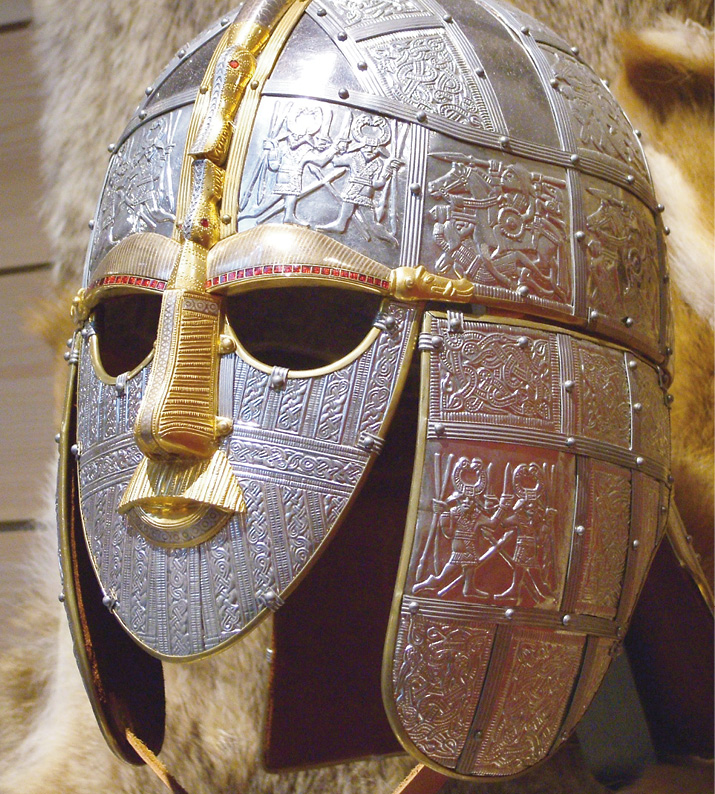
Professor Gittos argues that the men in these princely burials were members of an equestrian elite. The Prittlewell Prince was buried with a scythe, plausibly for cutting fodder for animals. The drinking horns placed in his burial chamber were decorated with small finely modelled horses’ faces. The helmet from Sutton Hoo Mound 1 is decorated with images of spear-wielding warriors on horseback. The warrior in Sutton Hoo Mound 17 (c.590-600) was buried next to his horse: the horse’s saddle, bridle, and bran tub were placed by his master’s head, while the horse had a body harness, with gold and silver pendants that would have glinted in the sun.
They were, Professor Gittos surmises, experienced cavalrymen, who were enlisted to fight against the Sasanians as part of a major Byzantine army recruitment campaign in western Europe conducted by Tiberius in AD 575. They were buried with military equipment and armour associated with their military status at a brief period in history when elite males were buried in unusually ostentatious ways. In her conclusions, Professor Gittos argues that we have underestimated the degree of direct contact between people in post-Roman Britain and the wider world, suggesting that early medieval society was more cosmopolitan and interconnected than is often thought.
Chris Catling is an archaeologist and writer, fascinated by the off-beat and the eccentric in the heritage world.