Subscribe now for full access and no adverts
For the first time in human experience, a substance could be melted and converted into something new.
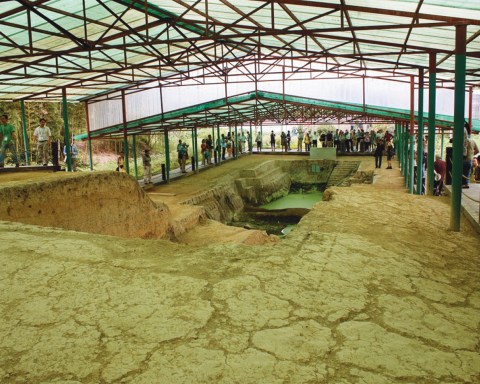
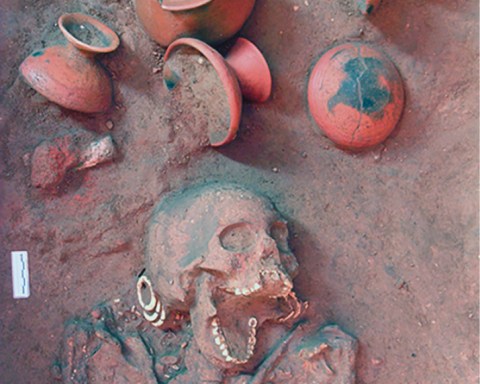
If you set off by car from the Volga River to Hungary, you will have to drive for 32 hours and cover a distance of about 2,500km. A man undertook this journey 6,500 years ago, and it would have taken him much longer. With isotopes and DNA, we can now track such journeys, and what comes home to me is the remarkable mobility of prehistoric individuals. Last year, I wrote about humanity’s interest in brightly coloured red ochre, and, since then, I have been researching other colours: the green and blue of copper ores. My exploration of the origins and spread of copper base metallurgy has been stimulated by my discoveries at Ban Non Wat, where, just as the first copper axes and ornaments reached the site in about 1050 BC, there was a rapid but temporary surge in the wealth of all mortuary offerings. We even find infants interred with thousands of shell beads, dazzling pottery vessels, and copper axes. Adults wore exotic marble and shell beads and bangles, copper base anklets and bells, and were accompanied by their axes, chisels, and awls. For three or four generations, these aggrandisers seem to have secured privileged access to valued prestige objects before the next stage, when bronzes were no longer found in graves and uniformity prevailed. I am interested in the impact, if any, of copper base metallurgy on the social lives of those who initially encountered this remarkable substance that, for the first time in human experience, could be melted and converted into something new.
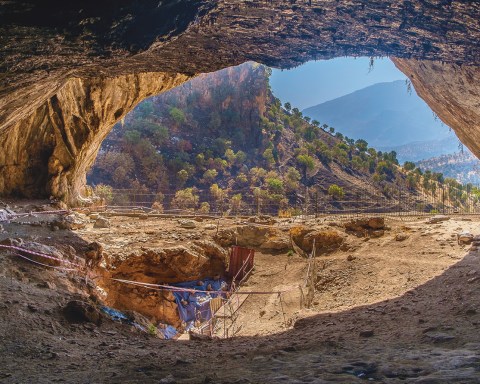
So I started in Anatolia, with its combination of abundant sources of copper ore and the innovative prehistoric communities that constructed Gobekli and Karahan Tepe, began cultivating wheat and barley, and domesticated sheep and goats. Hallan «emi is a small hunter-gatherer settlement located in the upper reaches of the River Tigris. Occupied for a few centuries from 9700 BC, its occupants had access to a range of habitats that sustained broad-spectrum gathering and hunting. The interior layout of the site included a central space for communal feasting, but there were also sunken buildings that contained copper ore, exotic to the vicinity and obtained through exchange. The copper ore was probably prized for use as a decorative pigment.
Further insights into the acquisition and manipulation of both naturally occurring native copper and copper ore come from the key site of Gre Fılla in the valley of the Ambar River, a choke point for exchange and movement in the region of the upper Tigris River. Between 8800 BC and 7500 BC, this village comprised stone-walled houses with intervening lanes. By this early date, a bar-shaped object made of pure copper was found in one of the houses, as well as a copper chisel with a bone haft. Recent excavations in public and private buildings have also recovered both copper ore and worked copper tools, including beads, fish hooks, chisels, and pendants. Boncuklu Tarla, the name means ‘field of beads’, is in the same region. There, more than 3,500 copper beads have been found, as well as labrets (which are ornaments affixed to the body by puncturing the skin). These early examples of acquiring copper did not involve smelting and casting. Instead, they sought out the naturally occurring native copper that could be heated and shaped, or converted malachite ore into beads.
We can turn to the DNA of the first farmers in Greece, to find that they came from Anatolia into Thessaly and Macedonia, thence north into the Balkans. Bringing with them their domestic crops and animals, they founded small village settlements located by preference beside rivers and lakes, with access to fertile soil. They arrived, too, as heirs to a long tradition of shaping native copper and copper ore into ornaments and small tools. I excavated at Nea Nikomideia in Macedonia in 1961, finding wattle-and-daub houses built c.6200 BC that contained a few hammered copper beads, rings, and pins.
Casting copper
A millennium later, we come to the vital step from shaping copper minerals to applying heat to smelt them and cast metal. I have closely followed the research at Belovode in Serbia, by my friend Miljana Radivojevic. She has found that from first settlement in the area about 5350 BC, brightly coloured green copper minerals were being sought in order to craft beads and pendants. By 5000 BC, the inhabitants were importing and smelting ore from a mine 10km away, seen in the presence there of copper slag. The smelting process has been reconstructed from the ephemeral concentrations of ash and the slagged sherds. It involved a simple hollow dug into the ground and lined with pottery sherds to take the charge of ore. These Balkan communities were well accustomed to exchanging desirable commodities such as obsidian, salt, marine shell, and now, copper. Information also sped along these trade routes. Almost at once, copper as a source of personal ornaments spread across the late Neolithic communities of the Balkans and beyond.
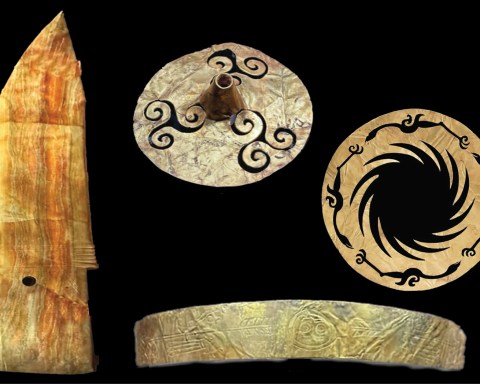
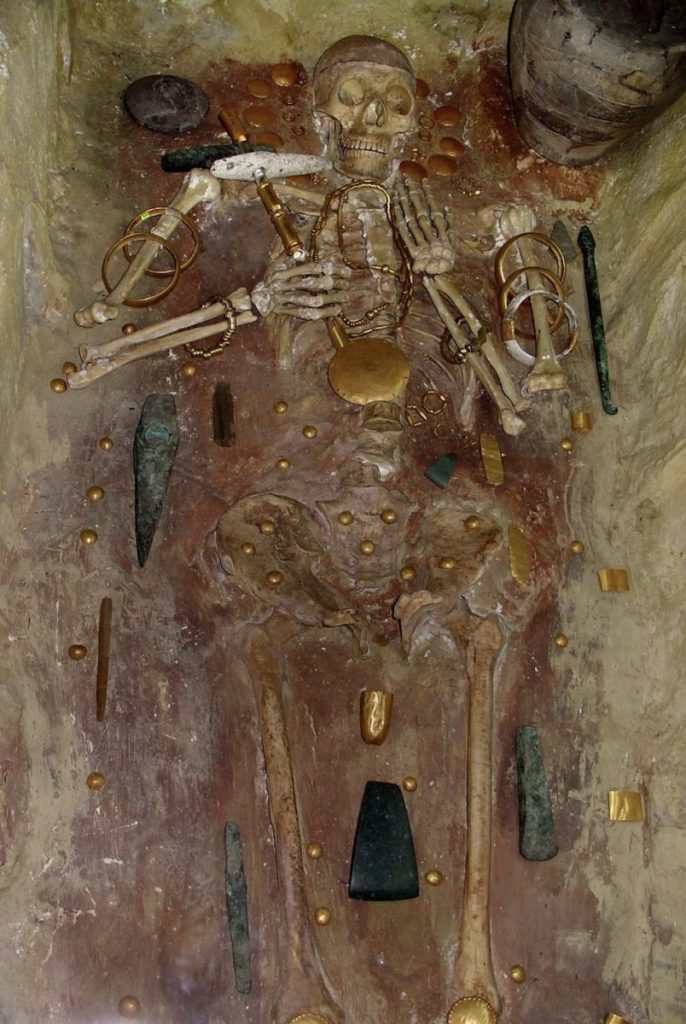
Indeed, during the 5th millennium BC, there was a surge in the quality and quantity of copper artefacts in circulation. These joined other items that had to be obtained from exotic sources, to be transformed by specialist craftworkers, best illustrated in the cemetery of Varna between 4600-4400 BC. This site was located strategically on the shore of the Black Sea in Bulgaria, where Spondylus shells came from the Mediterranean, and salt was processed and fed into trade networks. Graphite was sourced and exchanged for the decoration of ceramics. Serpentine, marble, and carnelian were valued as jewellery. When I visited the Varna museum, the sight of Burial 43 took my breath away. It contained the skeleton of a man who lived to between 50 and 65 years. His robust bones reflect an active physical life that could well have involved hunting, fighting, or manufacturing. In particular, his well-developed arm muscles suggest that he was more an artisan than a social leader divorced from the workplace. A bow and quiver, both with gold fittings, were among his grave goods, along with a copper spearhead. He was also buried with copper adzes, chisels, hammer axes, awls, and ornaments, while the gold included a sceptre, decorative discs attached to a headdress, bangles, rings, and a probable tuyere for metalworking. Ownership of copper and gold per se might not have stimulated the hierarchy of wealth seen at Varna, but they were surely deployed to advertise his social status in death.
To the east, the Pontic-Caspian steppe stretches from north-east Bulgaria, across extensive lands north of the Black Sea to the Volga River, a land of open grassland, interspersed with gallery forest along the river margins, making it a natural corridor for migratory expansion. Moreover, its chernozem soils are renowned for their fertility. The western part of this region, from north-east Romania through Ukraine to the Dnieper River, was occupied by the Cucuteni-Tripolye culture. Although many settlements have been examined, cemeteries are virtually unknown. However, burials have been identified at Verteba in western Ukraine, and their mtDNA reveals that, from about 5100 BC, there was an expansion of Anatolian Balkan farmers eastward.
What amazes about these migrants, as I learned from John Chapman at the Shanghai Archaeological Forum in 2015, is the colossal size of some of their settlements. By c.3900 BC, Taljanki, the largest, covered 350ha with a population estimated at 15,000, while Nebelivka and Maidanetske were respectively 280ha and 200ha in extent. They are remarkable for their precise planning, with houses set out in concentric rings, divided into suburbs by roads. The regular size of the dwellings suggests an absence of a hierarchical social structure, despite their concentration of people. Central larger structures have been interpreted as places of assembly and, indeed, these towns of unmatched size could well have been foci for social gatherings involving those living in the peripheral smaller communities. Assuredly, they were keen to source exotic imports, such as salt and graphite and other pigments for their outstanding output of painted ceramic vessels, with marine shell used for ornaments as well as copper. In the enigmatic absence of cemeteries, we turn to a series of hoards to find out what they did with copper. The answer is heavy shaft-hole axes, and thousands of beads and other ornaments. And with this we reach the Volga, and a man who travelled all the way west to end his life in a cemetery in Hungary. Perhaps next time I will continue this story across the steppes and into China.
Charles Higham is a Professor at Otago University in New Zealand, and an authority on Cambodia's Angkor civilisation and Ban Non Wat in Thailand.
Images: courtesy of Charles Higham