
Subscribe now for full access and no adverts
The name Jean-Pierre Minckelers (1748-1824) is commemorated by street names in a number of towns in the Netherlands and Belgium, and his statue in Maastricht shows him in clerical cassock holding a wand emitting an ‘eternal gas light’. Turning from the study of theology and philosophy to a life of science, Minckelers worked with colleagues at the University of Leuven on the production of gas, principally as a means of floating the air balloons that were all the rage at the time. Almost as a side interest, he invented a system for coal gasification – the process of heating coal in a retort (oven) in the absence of oxygen to produce a flammable mixture of carbon monoxide and hydrogen. He used the resulting gas to light the university’s lecture theatre in 1785.

Murdoch moves in
The paper that Minckelers published on the subject encouraged others to experiment – notably Archibald Cochrane, 9th Earl of Dundonald (1748-1831), whose primary interest was in producing coal tar, a gasification byproduct, for use as a sealant for the hulls of Royal Navy ships. He used the surplus gas for lighting his family estate from 1789. Another pioneer was the Scottish engineer and prolific inventor William Murdoch (1754-1839), whose house in Redruth, Cornwall, in 1794 was the first domestic residence in the world to be lit by piped gas. (Grade II-listed Murdoch House is now a cultural centre housing the Cornish Global Migration Project archive.)
Murdoch went on to build a gasification plant at the Boulton & Watt steam-engine foundry in Smethwick, West Midlands, known as the Soho manufactory. Built in 1795, this Grade II–listed foundry was the world’s first integrated steam-engine manufactory, and the assembly-line production methods pioneered there anticipated many of the mass-production practices later credited to Henry Ford. The original oil-and-tallow lighting was gradually replaced by gas from 1800.

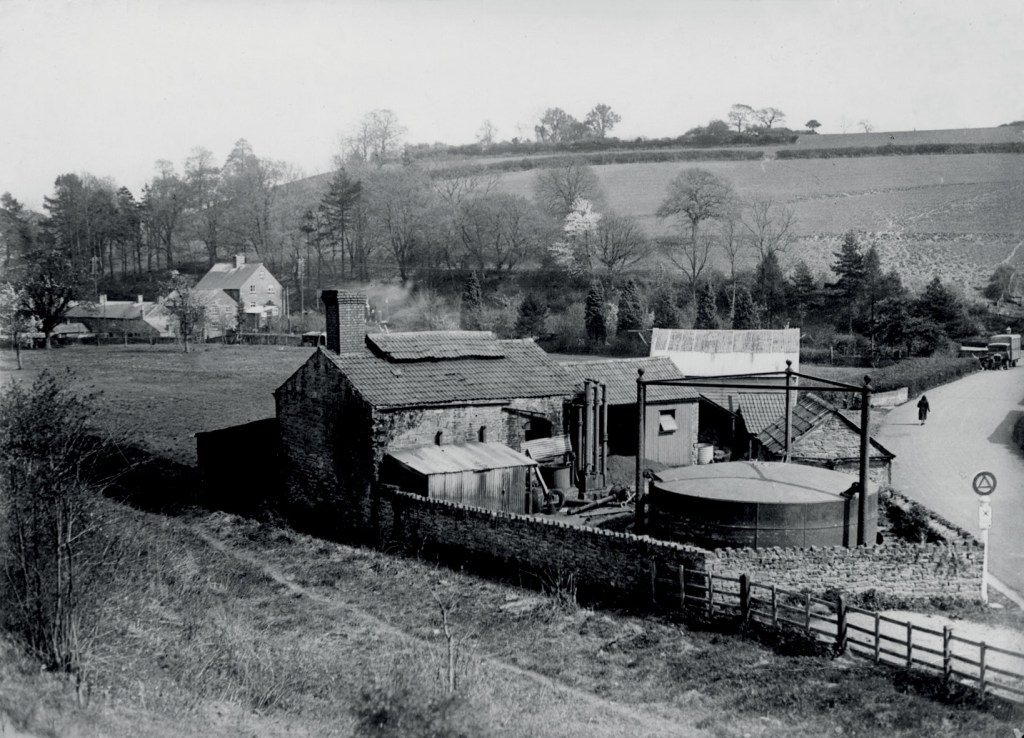
Murdoch’s domestic lighting system lacked a means of storing gas; instead, the gas passed directly from the retort to the light. James Watt Jr (1769-1848) was aware that Antoine-Laurent de Lavoisier (1743-1794) had invented a gazomètre (‘gas meter’) for measuring gas volume during experiments in his Paris laboratory. Watt adapted this to create the world’s first ‘gasometer’ at the Soho manufactory in 1798, and thus was born a key structure in the history of the gas industry. Gas no longer needed to be produced continuously: now it could be made and stored for release on demand, such as on the occasion in 1802 when the exterior of the Soho foundry was illuminated during public celebrations for the Treaty of Amiens, marking a 14-month ceasefire in the war with Napoleon.
Murdoch went on in 1803 to build a gas plant to light two floors of the (now demolished) Phillips Wood & Lee Cotton Twist Mill on Chapel Street, Salford. Soon the entire eight-storey factory was to be lit in this way, as were parts of Chapel Street – the first recorded use of gas for street lighting in the world.