Subscribe now for full access and no adverts
New research into a man buried at St Peter’s in Barton-upon-Humber almost 1,000 years ago has shed new light on the complexity of society in Britain during the Norman Conquest.
The unusual burial was first excavated almost 50 years ago, but – with the Bayeux Tapestry exhibition opening at the British Museum (see here) – English Heritage, together with researchers from Historic England, the Crick Institute, the British Geological Survey, University of Southampton, muVIS, and Face Lab, have worked to tell its story.
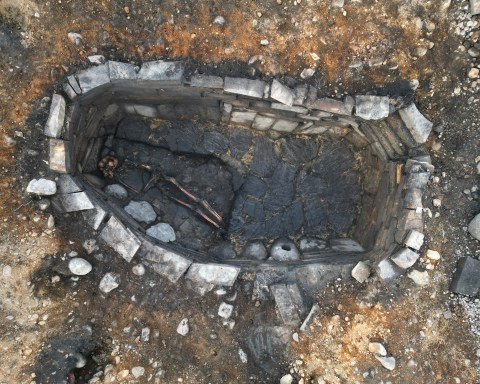
Previous research had determined that the burial was that of man aged 50-60 years old when he died and, while muscular, was quite short, standing at just over 5ft (1.5m). He had been buried with his arms folded and his head resting on a grass pillow, which was kept from falling sideways by two lumps of locally sourced chalk. Dendrochronological analysis of the wood from his coffin found that it was made from an oak tree felled c.1079. Intriguingly, he was buried alongside three apple-wood staffs – grave goods that are normally associated with Scandinavian traditions.
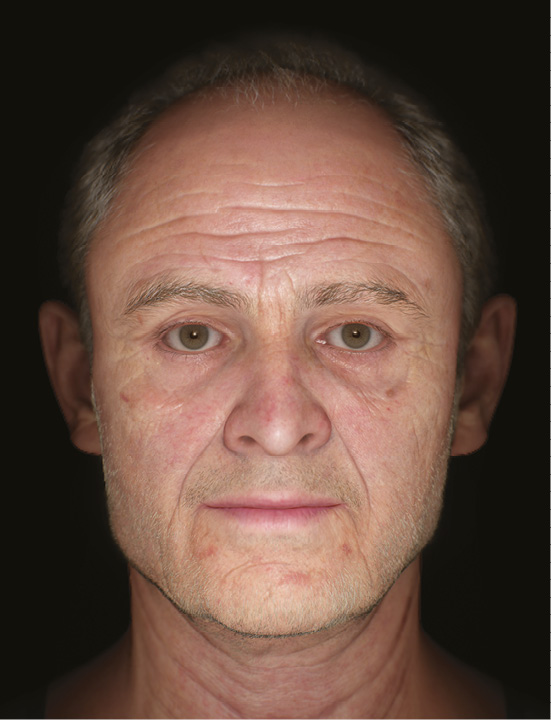
This most recent research involved osteological, aDNA, and isotope analysis alongside a digital facial reconstruction (above). The results showed that this man could not easily be categorised as either a ‘Norman’ or an ‘Anglo-Saxon’. The DNA indicated he was primarily of continental European ancestry; however, the oxygen isotopes present in one of his teeth were consistent with having spent time in a cold climate as an adolescent, perhaps tying in with his Scandinavian grave goods. His strontium isotopes, meanwhile, indicated that he had then spent time in the area around Barton-upon–Humber before his death.
Commenting on this enigmatic individual, Kevin Booth, the Head Curator of Collections at English Heritage, said: ‘I’ve been fascinated by this individual – this man of the Conquest – for 20 years. It makes us think of his role at the time of the Conquest: his loyalties and anxieties. The classic way of understanding the Battle of Hastings is binary; “them and us”. But what Conquest Man illustrates is so much richer than that. We don’t know if he was “Saxon” or “Norman”. He may have been neither – a man of continental, Scandinavian influences – but then, what many of us don’t realise, is that this was true of both “sides” at the Battle. By the 11th century, we were an Anglo-Scandinavian nation, and there was a similarly strong Scandinavian influence in Normandy. Anglo, Scandinavian, and Norman interests were closely connected. He’s a fascinating survivor of a cataclysmic period in history. Born in the reign of Viking King Cnut, he survived the Norman Conquest to be buried with honour next to a pre-Conquest church, part of the new Norman world.’
Text: Kathryn Krakowka / Image: Liverpool John Moores University