Subscribe now for full access and no adverts
The CARD Fund, founded and sponsored by Archaeological Research Services Ltd and Scottish Universities (SUERC), was established to help projects in the volunteer sector gain access to radiocarbon dating. In ten years of operation, the Fund has provided a total of 118 radiocarbon dates, and in the last year a number of community excavations benefited from this support.
Our first project takes us to Trearddur Fossil Forest in Anglesey, where a submerged prehistoric fossil forest has been revealing its secrets. Although the site was swamped by changing sea levels at the end of the last Ice Age, the community team discovered tree stumps, roots, and peat deposits, as well as a bone from an aurochs, a type of wild cattle that became extinct in Britain by the Late Bronze Age. A sample of a fossilised tree stump from the upper forest floor, identified as oak, was dated to 5311-5211 cal BC, placing it in the Late Mesolithic period after the Storegga Slide tsunami (see CA 179), at a time when shorelines were recovering.
Staying in Anglesey, an evaluation of Rectory Field, Llanfechell, by the Llanfechell History Group identified the possible remains of cob walls forming a rectilinear enclosure and a linear wall. It was hoped that dating of these structures could reveal an earlier history for the village, and a fragment of cherry tree charcoal was dated to cal AD 1492-1643, placing the enclosure’s final phase in the 15th-17th century.
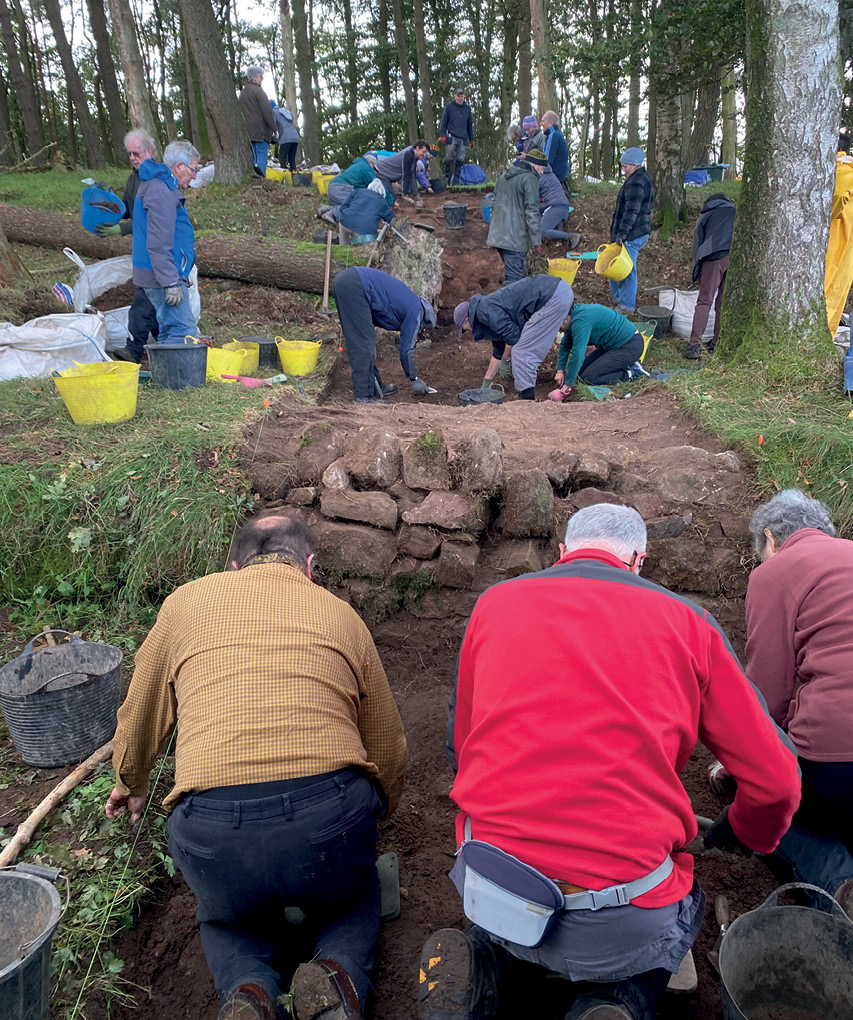
We next move across to Medmerry in West Sussex, where coastal erosion has revealed further evidence of a medieval fish trap. First reported in 2023, the remains of an exposed 225m-long (740ft) intertidal fish trap were recorded by members of Archaeology South-East and Chichester & District Archaeology Society (CDAS). Additional timber uprights with wattling in-between, forming a ‘pound and leader’-type trap, have recently been exposed on the beach and these have also been documented by CDAS. Radiocarbon dating indicates that the structure dates to cal AD 1277-1388, which places it earlier than previously discovered examples.
Moving inland to Gloucestershire, where GlosArch (Gloucestershire Archaeology) have been undertaking investigations at Armscroft Park, a piece of horse jawbone was recovered from a stony surface that, it was hoped, might represent the route of the original Roman Ermin Street between Cirencester and Gloucester. The jaw was discovered alongside Roman and medieval pottery sherds, and scientific dating placed the deposit in cal AD 774-855, suggesting that the excavations may have further to go before reaching in situ Roman deposits. This new evidence might, however, hint at continued use of the Roman road system into the Anglo-Saxon period.
Digs, ditches, and dogs
Excavations by Brighton and Hove Archaeological Society (BHAS) identified a 12th- to 14th-century manorial complex at Hog Croft in Ovingdean, Sussex, and more recent investigations have revealed features (post-holes, beam slots, pits, an oven, and a well) beneath the boundary banks of the complex, which, along with pottery finds, are indicative of Middle Saxon settlement. Ericaceae (berries and fruits such as blueberry and cranberry) charcoal from an oven dated to cal AD 995-1155 places this phase of activity in the Late Saxon to post-Norman Conquest period.
An excavation by Dorset Diggers Community Archaeology Group hoped to further understand a defensive-style ditch on the west side of Waddon Hill Roman Fort. The group was finding mounting evidence for the hill also having been used as a hillfort during the Iron Age, and they anticipated that the ditches could either be Roman, proving that the fort did occupy the full hilltop, or Iron Age. A fragment of unburnt animal bone from the ditch was dated to cal AD 126-238, placing its deposition firmly in the Romano-British period, though the cutting of the ditch could have an earlier origin.
Over in Hampshire, Basingstoke Archaeological and Historical Society (BAHS) have been investigating the Iron Age and Romano-British villa site of Stanchester for the last ten years. A carefully arranged dog burial dating to 167 cal BC-cal AD 5 was discovered, and the group note that both metacarpals on the inside of each front paw had been broken and reset badly. This may have been a deliberate act to disable the dog to a certain extent, which Professor A C King of the University of Winchester notes is comparable to a practice that existed until early modern times in the New Forest, to prevent dogs chasing deer and other game.

At Woodend Motte in Balfron, Scotland, a recent community excavation explored an undated enclosure that produced no pottery but did contain a thin, charcoal- rich deposit. A sample taken from this deposit indicates use during the period 2017-1778 cal BC, in the Early Bronze Age. These results are important to Balfron at a local and regional level, and represent progress in dating prehistoric enclosures in the Stirling area.
Meanwhile, at Wrottesley Lodge Farm, Wolverhampton Archaeology Group have uncovered what looks to be the remains of Neolithic activity on a large scale. Evidence for several structures – including a potential Neolithic long cairn and long houses, a road or trackway, and part of a robbed field system – have proved difficult to date due to a lack of pottery and flint material, but charcoal taken from one of the buildings has been dated to 2916-2783 cal BC.
The final project that we will discuss here takes us to Street House in Loftus, North Yorkshire, on the Cleveland coast, where an excavation by the local community and students from the University of Waterloo in Canada has exposed a circular monument, which was hoped to be Early Bronze Age. Deposits from the ditch, however, proved to be aceramic, with no food vessels or beakers to indicate a date. Other finds from the site, comprising an antler pick, jet beads, a battle-axe, and rock art also suggest Early Bronze Age activity, but hazel charcoal returned a date of 3947-3712 cal BC, pointing instead to the Early Neolithic.
If a radiocarbon date for your archaeological excavations could help answer key questions, then please apply to the CARD Fund – the 2026 funding round is now open, and volunteer and community groups are warmly invited to apply before the closing date of 30 November. For more information and to apply, please visit http://www.cardfund.org.
ARS Ltd are also excited to announce the launch of the CAP Fund – the Community Archaeology Prospection Fund. It aims to support community projects in accessing free high-resolution surveys by making the best in modern scientific techniques available. The fund will provide for specialists from ARS Ltd to visit your site/landscape, either before excavations or alongside your community group activities, to undertake any or all of geophysical magnetometer, earth resistance, or ground-penetrating radar survey, as well as high-resolution LiDAR, and multispectral and photogrammetric drone survey if required, to prospect and help identify targets for excavations, or to better understand your site and the landscape in which it sits. Keep an eye out for further announcements via their website (https://archaeologicalresearchservices.com); applications will have the same closing date as the CARD Fund.
Source: Kimberley Teale is Head of Specialist Services at Archaeological Research Services Ltd.