
Subscribe now for full access and no adverts
Today, Attingham Park and its estate are cared for by the National Trust, but this landscape – which is located at Atcham, between Telford and Shrewsbury – has been shaped by over 4,000 years of human activity. Nestled within a fertile valley in which the River Severn and its tributary, the Tern, converge, its rich, productive soils have long been attractive for farming and settlement, and still bear traces of Bronze Age occupation and Iron Age field systems. The estate also contains a significant portion of the remains of Viroconium Cornoviorum (Roman Wroxeter, a regional capital and one of the largest urban centres in Britannia), while a major recent geophysical survey revealed contemporary farmsteads, roads, and two rural villas (see CA 414). Excavations in 2017 revealed an Anglo-Saxon great hall complex, too, while medieval open field systems reflect an even later episode in the landscape’s story.
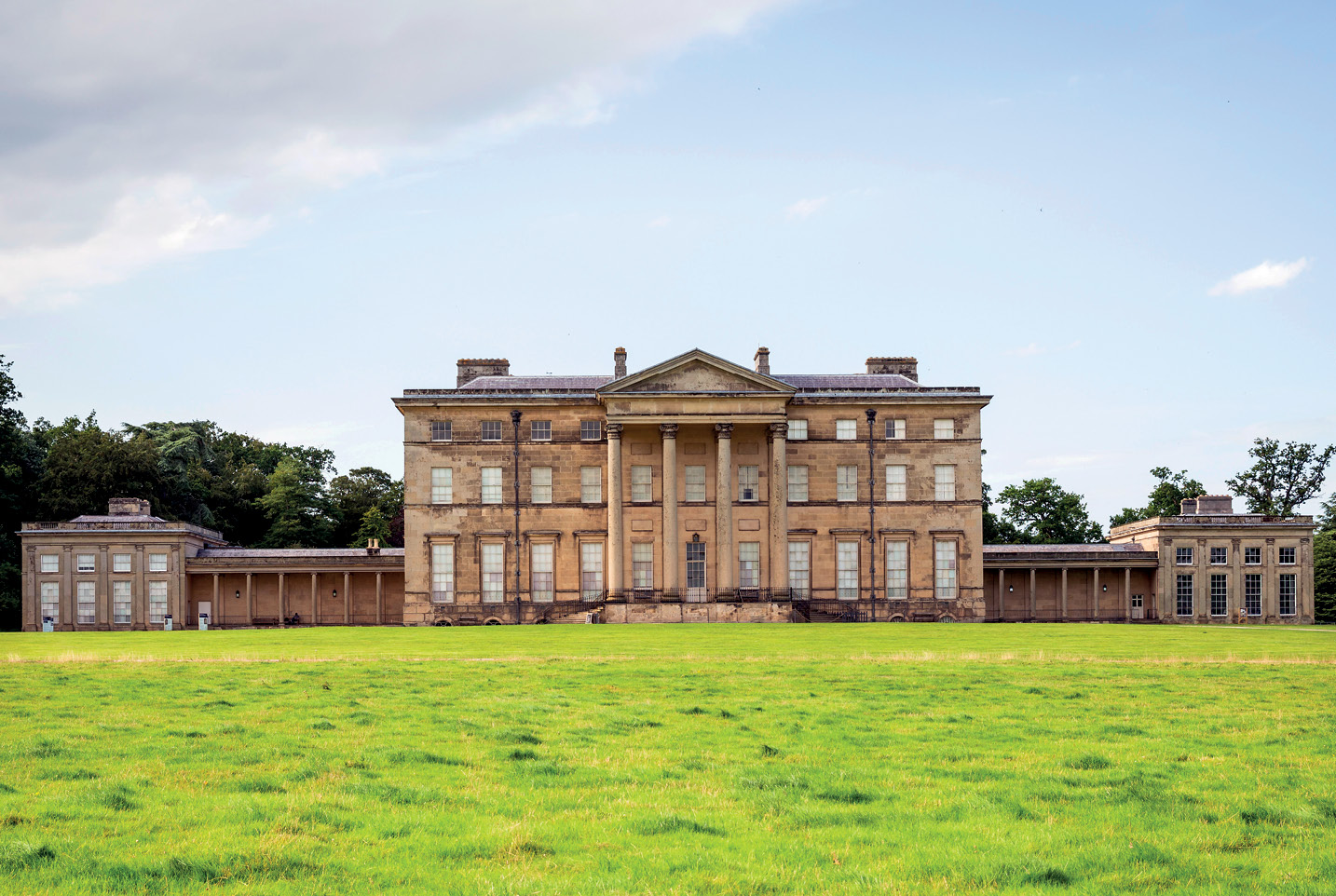
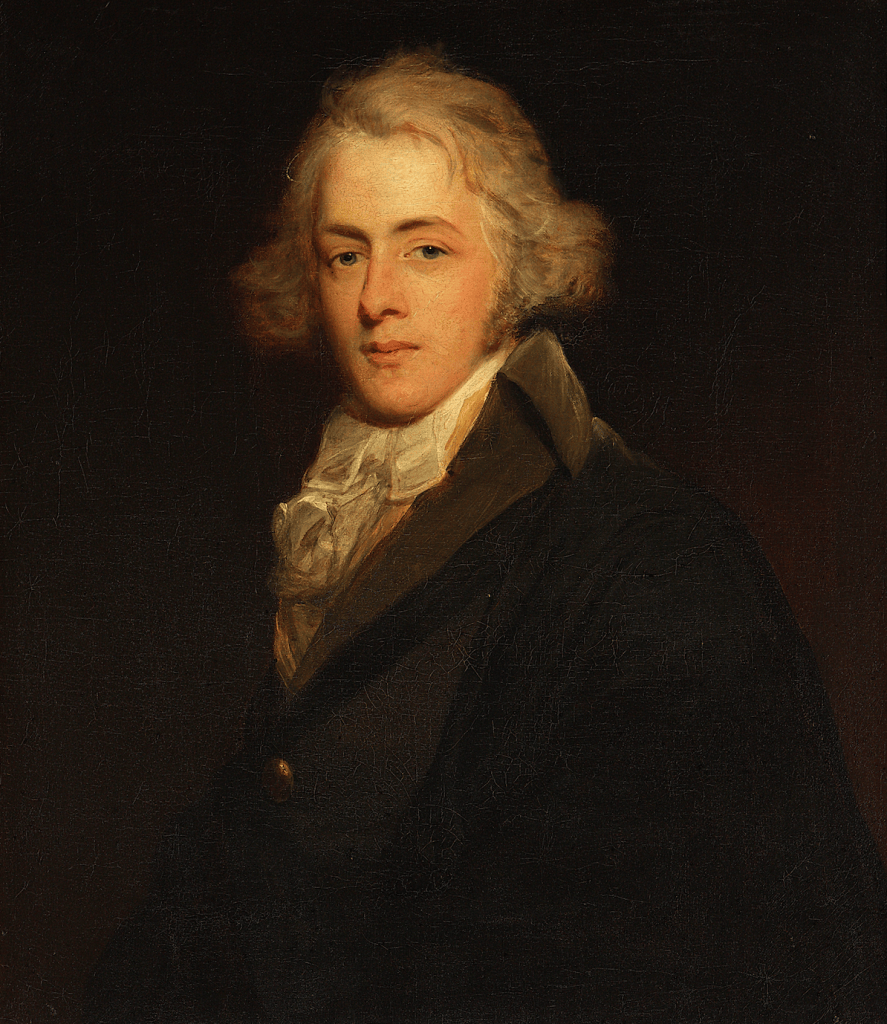
Roman villas and the middle Saxon hall speak of high-status individuals who once called this area home, and the estate’s more recent history has a distinctly aristocratic flavour as well. It was owned by the Hill family, long-established Shropshire gentry from nearby Hawkstone, and in 1701 Richard Hill built a new house at Atcham called Tern Hall. This was later bequeathed to his nephew Thomas Harwood Hill, and when Thomas’ son Noel Hill was made the first Baron Berwick in 1784, the property’s fortunes were transformed. The following year, Tern Hall was replaced by a much grander residence – the present Attingham Hall – and this mansion and its surrounding parkland remained in the same family for over 160 years, with successive Lords Berwick acquiring additional land until the estate covered more than 8,000 acres, extending right up into Shrewsbury. This expansion could not continue forever, however, and in the early 20th century around half of these lands were sold to fund sorely needed restorations of the hall, which had fallen into decline. These works were spearheaded by Thomas Henry Noel-Hill (the eighth Baron Berwick) and his wife Teresa, and in 1947 he bequeathed the hall and remaining estate to the National Trust.

In recent years, the Trust’s Attingham Re-discovered project has been working to conserve the mansion’s interiors and restore its collections to public display – but while these sumptuous rooms bear eloquent witness to the rise and fall of the family’s fortunes, and their roles as spenders, savers, and saviours, it is an obscure, secluded corner of the park that has recently yielded illuminating archaeological evidence. There, between 2018 and 2023, archaeologists and a team of willing volunteers gradually revealed the remains of a virtually undocumented ‘pleasure garden’ dating to the early 19th century. Supervised by the National Trust archaeologist Viviana Caroli and led by local independent archaeologist Dr Nigel Baker, this project has, from its outset, been designed as one where historical research would be matched by wider public benefits – directly involving National Trust volunteers, local groups, and the visiting public in the processes of discovery and interpretation. The project was funded by the Attingham property and the Robert Kiln Fund, with a contribution from the Shropshire Archaeological & Historical Society. So, what did we find?
Pathway to the past
Our story begins in 2018, when the Attingham Park ranger team were preparing to restore an old pathway by the Walled Garden. Before any work could be done, checks had to be completed to ensure that the restoration would not damage any underlying archaeology – as part of this, we took the opportunity to investigate a small depression in an area of recently felled woodland that had been noticed on a LiDAR survey, and was also visible on the ground. Protruding bricks suggested that a building had once stood there – but nothing was mapped on the site at any point from the 1790s to the present day. Garden staff had assumed it was a short-lived structure of Second World War vintage, like many in the park, associated with the adjacent Atcham Airfield. It would soon prove to relate to a rather earlier period of the estate’s past, however.
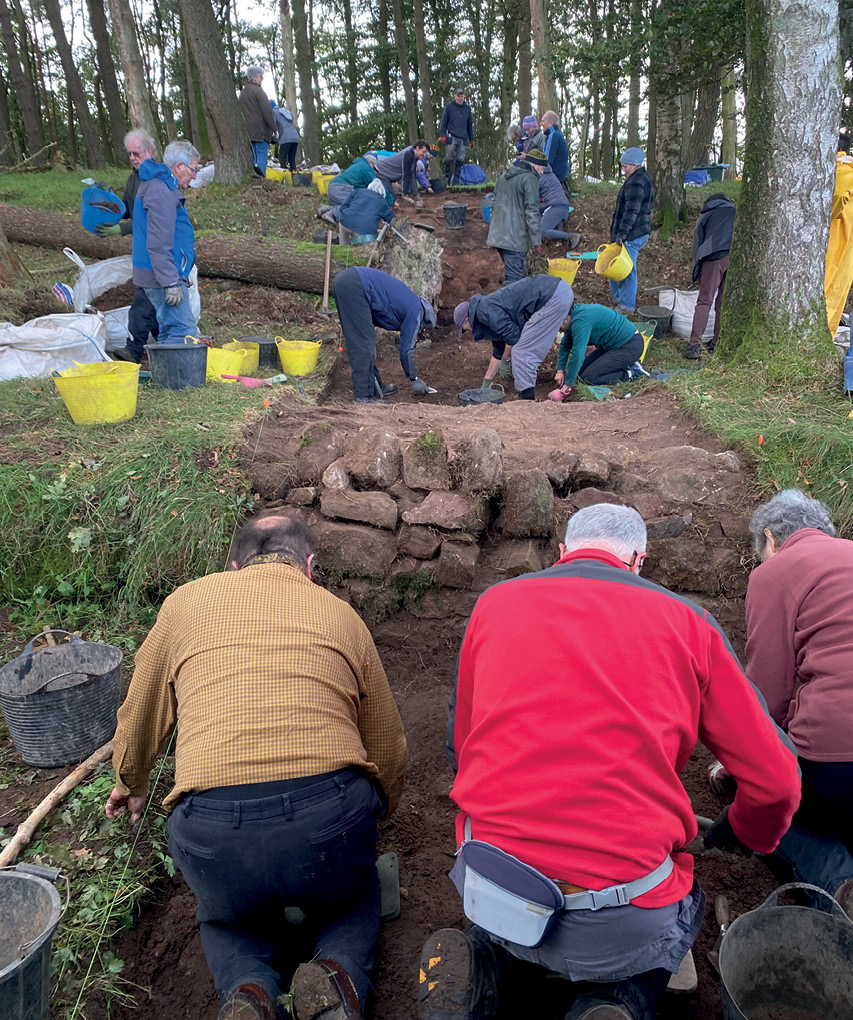
An initial evaluation revealed wall remains from a brick building roughly 5m (16.4ft) square, with footings that included stone blocks extending to the west and east, suggesting that this structure had once been flanked by wings. A two-week evaluation then followed, carried out by a team of National Trust volunteers at the height of the summer season in order to show visitors the archaeological process in action. We soon learned that the building had once had thick brick walls clad in the same fine-grained pale ashlar sandstone that was used on Attingham Hall itself in the late 18th century. The structure had originally had a planked floor, and demolition rubble had later been thrown into the cavity revealed by its removal, partly filling the space and creating the depression that had survived to this day. The rubble also contained crucial clues to the building’s date, including most of the Purbeck marble facia and mantelpiece of a small fireplace, together with door- and shutter-fittings, and scatters of both plain and hand-painted glass, all of late 18th-/early 19th-century character.
Later, specialist analysis of the glass, carried out by Cecily Cropper, revealed that it was likely to have come from the studio of John Betton, a Shrewsbury glazier and glass artist who is known to have carried out major glazing works on the estate – including the roof of the mansion’s Picture Gallery – during the first decade of the 19th century. Many of the fragments represented materials discarded during the building’s demolition, but there were also relics of its construction in the form of a significant number of strips, some deposited on the underfloor surface, indicating that glass-cutting had taken place within this structure prior to its completion. The glass in question came from recycled plain panes that had most likely come from elsewhere on the estate, probably in 1806-1807 when a lot of its glazing had been replaced with new ground-glass panes. The majority of the recovered glass is of the crown type that was used prevalently during the 18th and early 19th centuries, but there was a small amount of cylinder glass, too, which was not introduced until the 1830s – its presence might be related to ongoing glazing of the garden structures.

Grand designs
What, then, was this building for? From its form, fixtures, and fittings, the structure could reasonably be identified as a summerhouse – a comfortable, private, daytime retreat where the hall’s owners could relax and perhaps entertain guests. Its location was secluded but not distant from the hall, and probably enjoyed scenic views to the south, overlooking the parkland towards the Shropshire hills beyond. As for when it was built, in addition to the clues provided by the glass fragments, we also learned from a retired National Trust craftsman that its foundations were identical in structural detail to those of the hall’s main buildings. Combined with artefactual evidence, it seems most likely that the summerhouse was built sometime in the first or second decade of the 19th century – the apogee of Attingham’s fortunes, during the tenure of the second Lord Berwick, Thomas Noel-Hill.
After returning from a Grand Tour in Europe, Thomas splashed his inheritance on commissioning the celebrated landscape designer Humphry Repton to transform the grounds in front of the house, enhance the parkland, and incorporate new lodges that were probably designed by John Nash, one of the foremost architects of his day. The Baron’s extravagant spending only intensified after 1812 when, at the age of 41, he scandalised society by marrying Sophia Dubochet, a 17-year-old former courtesan. As well as rebuilding his London townhouse, Thomas continued his improvements at Attingham, and Sophia also indulged her newly acquired wealth by spending profusely on furniture and personal items, as well as on creating ponds, islands, and aviaries within the hall’s grounds. Together, the pair depleted the family’s finances to such an extent that, in 1827, they had to hold a 16-day sale of the mansion’s contents, and were urged to move to Italy, where Thomas died in 1832. Thankfully, his younger brother William, who became the third Lord Berwick, was able to repurchase many of the furnishings and artworks and return them to the hall.

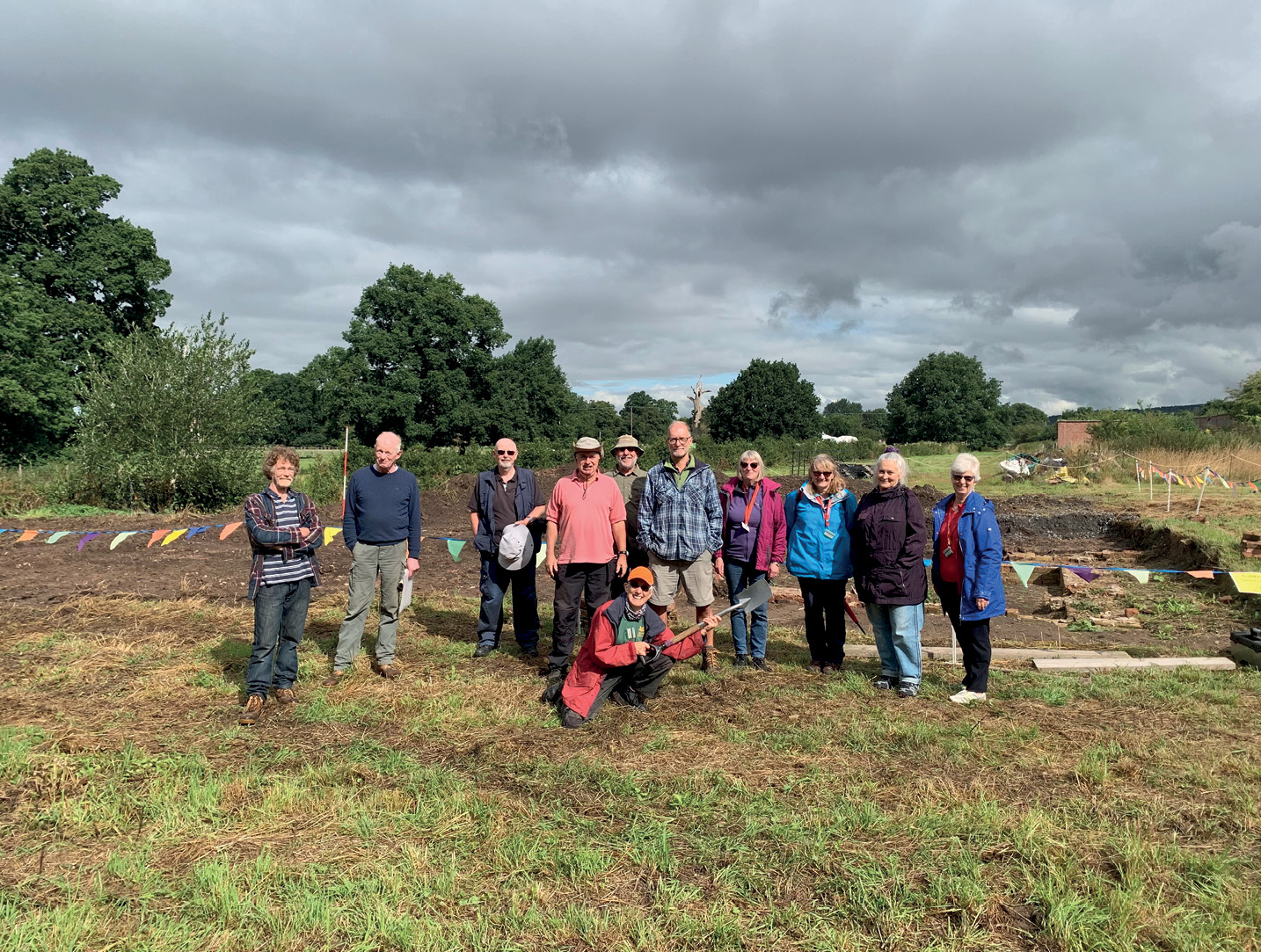
Might the summerhouse represent one of Thomas and Sophia’s expensive improvements to the estate? If so, it appears to have formed only part of a carefully designed garden, as to the south we found the remains of a boundary wall built from bricks of the same dimensions as those used in the structure. In 2019, we set out to learn more, opening a series of metre-square test-pits across the site with the help of volunteers from two local community organisations: the Home Education Group of parents and children from the Telford area, and Telford & Wrekin Care Leavers. Some of these pits were able to trace the line of the boundary wall to the south-west, confirming that it joined with a section of north–south wall that still stands, and that it also continued to the north-east, where it began to curve northwards. Another test-pit, dug to the north of the summerhouse, came down on to demolition rubble, hinting at a second structure. It was by now apparent that the summerhouse lay within a walled enclosure. The next question was: what else might be in it?
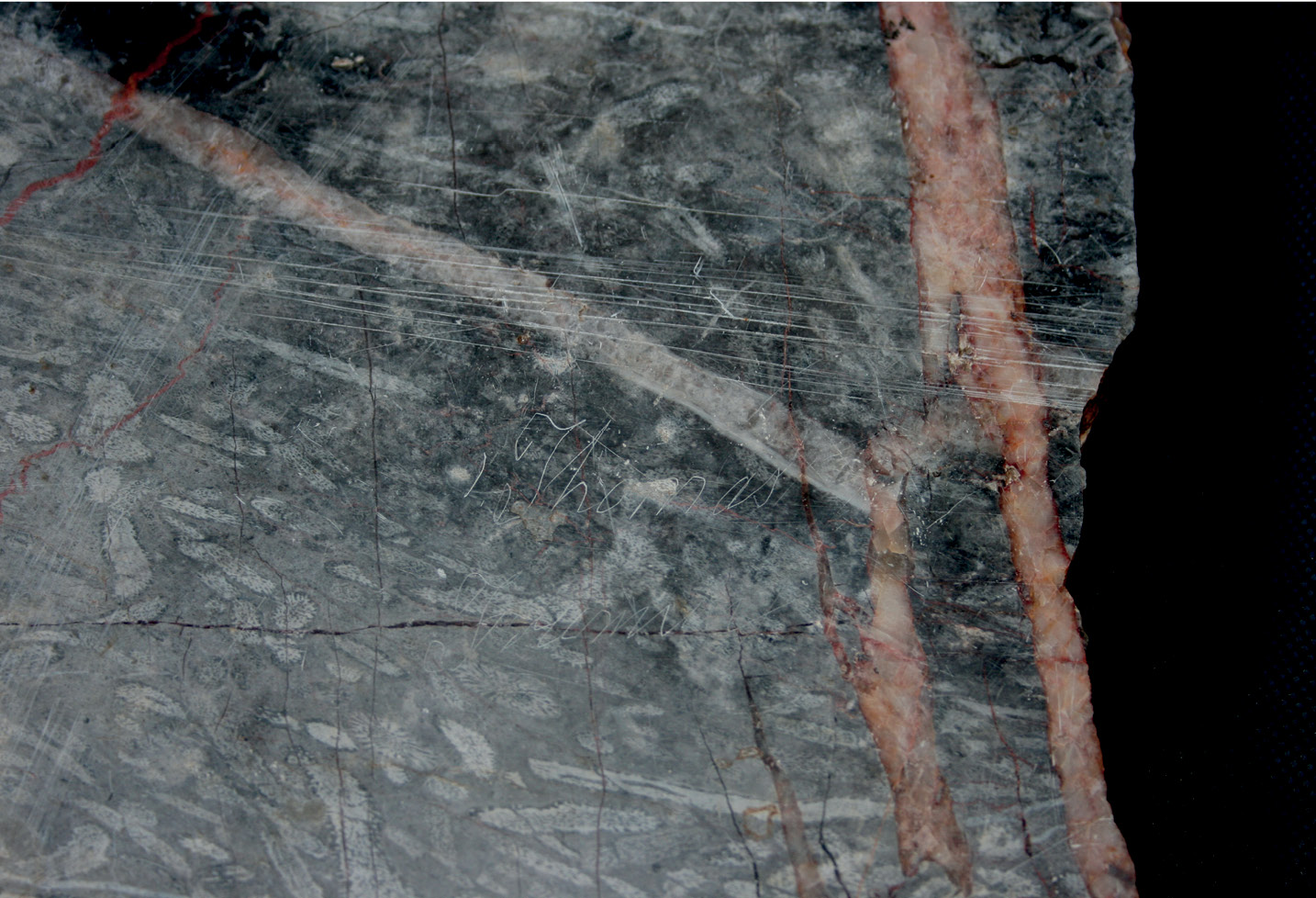
The apparent absence of the summerhouse from any known maps or documentation, and the lack of any received tradition that there had once been such a building in this undistinguished area of the park, made it a real mystery which intrigued excavators, volunteers, and visitors alike. Unfortunately, the 2020 COVID-19 pandemic put a halt to our fieldwork, but the countryside manager was able to continue exploring the estate archives – and a significant addition to our understanding of the site came when he discovered a previously unseen edition of the 1848 tithe map showing the summerhouse, the western part of the enclosure and, on its north side, another small feature, perhaps an unroofed building or a yard.

Meanwhile, National Trust historical research volunteers were also hard at work, and they, too, made an exciting breakthrough when they found a builder’s design drawing of 1909 showing a small pump-house that was never actually built, but was intended to reuse Neoclassical-style stonework from the otherwise unheard-of ‘summerhouse in the woods’. Adding to this, the team then discovered two account items for the year 1814: one was the repair of lead in the summerhouse roof, and the other for hanging its curtains. The evidence now firmly pointed to the summerhouse’s construction falling sometime between 1808 (the date of the last estate map to show the site undeveloped) and 1814 – in other words, the years either side of the second Lord Berwick’s marriage. The tithe map also confirmed that the summerhouse was still standing in 1848 – and that it was not alone within the enclosed area.
A second structure
When COVID-19 restrictions loosened in 2021, we were able to carry out another excavation on the site, this time investigating a second surface depression spotted by LiDAR, which lay about 10m (32.8ft) north-west of the summerhouse. This proved to contain an oval brick structure measuring 5.5m east–west by 3.6m north– south (18ft by 11.8ft). It was about 1m deep, with a puddled-clay bottom and a ceramic water supply pipe entering from the north. Speculation among the (by now very highly informed) volunteers suggested it might be a cold-water plunge pool – a fashionable feature in wealthy Georgian country parks – but, when no steps or means of draining the pond were found, we wondered if it was instead an ornamental garden feature. The oval was built of the same type of brick as the summerhouse and enclosure wall, suggesting it was part of the same episode of work: another feature of the garden that we were gradually piecing back together.

We returned once more in 2022, this time focusing our attention to the north of the summerhouse, where a test-pit had revealed demolition rubble in 2019. This also happened to be the area of the second, unidentified, building shown on the tithe map, and by the close of the season we had excavated one end of a long, 5m-wide building with thick brick walls and a chimney base. Expanding this trench in 2023 revealed almost the whole footprint of a substantial hothouse measuring 16m long by 5m wide (52.5ft by 16.4ft). We also uncovered evidence of its heated back wall, a retaining wall for a flowerbed, the probable footings of a heating duct, and socketed stone blocks laid precisely along its central axis, which would have supported a single-pitch glazed roof and perhaps accommodated trellis-work for trailing vines. On the north side of the hothouse was a lean-to extension with a floor made of the same bricks as those in the enclosure wall. With an oven and a fireplace, it may have had a kitchen role, possibly servicing the site as a whole.
Where there is a hothouse, you would expect plant pots, and we recovered just over 18kg of these… most had been made locally over a short period.
Where there is a hothouse, you would expect plant pots, and we recovered just over 18kg (c.40lbs) of these, mostly from the aforementioned structure, and some from the pool. Assessment by historical ceramics specialist Stephanie Ratkai revealed that most had been made locally over a short period. They were generally plain rather than ornamental, and there were no specialised types, other than a base-sherd with a side drainage hole. Found in the pool, the pot that it came from could have been used for display, or sunk into the water to contain an aquatic plant. The others appear to have been designed for raising or propagating plants; the hothouse may have been used to cultivate ‘exotics’ for display elsewhere, or to grow produce out of season. In the period 1800-1850, which encapsulates when the hothouse is thought to have been built and used, popular exotics raised by nurserymen for sale to aristocratic clientele were China roses, dahlias (see CA 405 for more about Victorian ‘dahlia-mania’), chrysanthemums, bird of paradise plants, and yuccas. As for food plants, the most common size of pots that we found could easily accommodate pineapples and bananas.
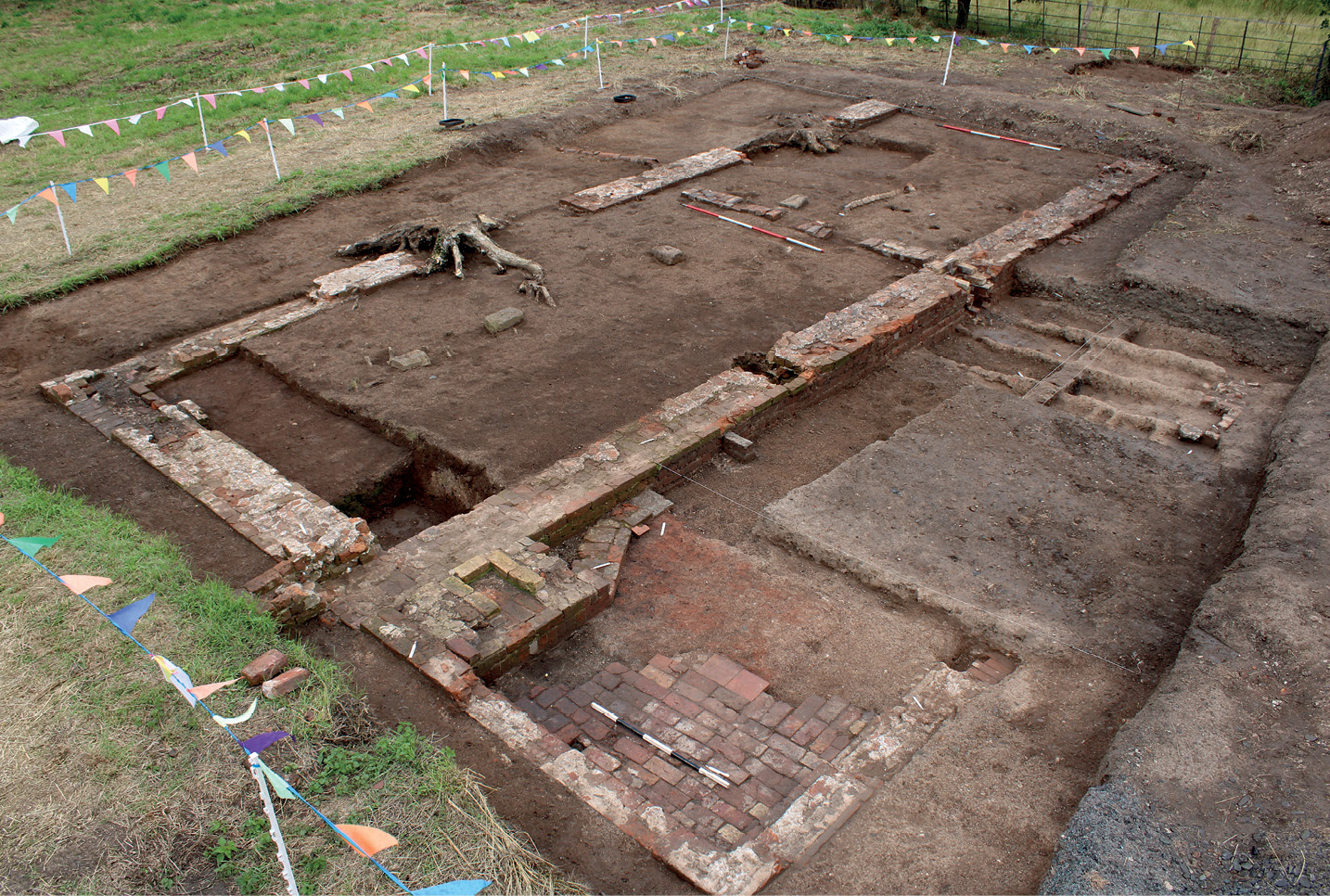
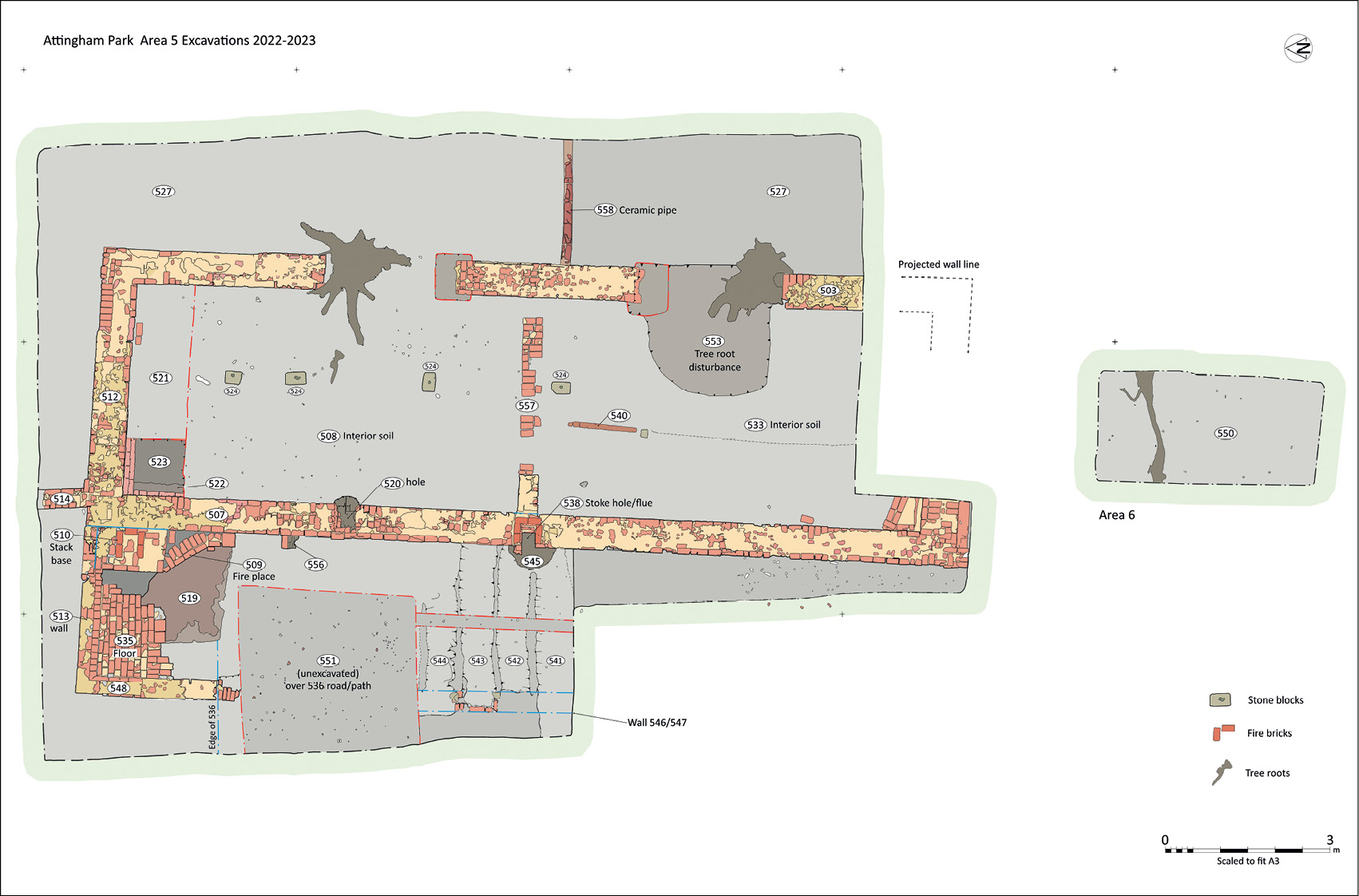
By its completion, this volunteer-staffed project had discovered, in the middle of a much-visited historic parkland, a previously unknown, roughly 1,800m2 enclosure containing a summerhouse that had stood for at least 34 years and undergone a series of design changes, an oval brick pool, and a large hothouse, all of which were built contemporaneously. Although never documented as such, this space appears to have been the private pleasure garden, perhaps a flower garden, of the second Lord Berwick and his young wife Sophia. One wonders if its construction may have contributed to the couple’s financial difficulties. However, the Pleasure Garden (if that is how it was known) has been bringing pleasure once again – and to a very much wider audience this time. The excavations helped us to devise engaging ways to inspire the public to explore the property, including new information boards, a linked heritage trail, and dedicated volunteer guides. A marquee for finds-processing and displays became the heart of the site, delivering activities that made the emerging stories more tangible, finds-tray by finds-tray. For over 200 years this site has lain silent, waiting to be discovered and for its stories to be shared once again. It is a reminder to present and future generations of the beauty of history, heritage, and nature, their fragility and their worth.
Further information: See www.nationaltrust.org.uk/visit/shropshire-staffordshire/attingham-park for more information about Attingham Park and visiting the estate.