Subscribe now for full access and no adverts
The name Jean-Pierre Minckelers (1748-1824) is commemorated by street names in a number of towns in the Netherlands and Belgium, and his statue in Maastricht shows him in clerical cassock holding a wand emitting an ‘eternal gas light’. Turning from the study of theology and philosophy to a life of science, Minckelers worked with colleagues at the University of Leuven on the production of gas, principally as a means of floating the air balloons that were all the rage at the time. Almost as a side interest, he invented a system for coal gasification – the process of heating coal in a retort (oven) in the absence of oxygen to produce a flammable mixture of carbon monoxide and hydrogen. He used the resulting gas to light the university’s lecture theatre in 1785.

Murdoch moves in
The paper that Minckelers published on the subject encouraged others to experiment – notably Archibald Cochrane, 9th Earl of Dundonald (1748-1831), whose primary interest was in producing coal tar, a gasification byproduct, for use as a sealant for the hulls of Royal Navy ships. He used the surplus gas for lighting his family estate from 1789. Another pioneer was the Scottish engineer and prolific inventor William Murdoch (1754-1839), whose house in Redruth, Cornwall, in 1794 was the first domestic residence in the world to be lit by piped gas. (Grade II-listed Murdoch House is now a cultural centre housing the Cornish Global Migration Project archive.)
Murdoch went on to build a gasification plant at the Boulton & Watt steam-engine foundry in Smethwick, West Midlands, known as the Soho manufactory. Built in 1795, this Grade II–listed foundry was the world’s first integrated steam-engine manufactory, and the assembly-line production methods pioneered there anticipated many of the mass-production practices later credited to Henry Ford. The original oil-and-tallow lighting was gradually replaced by gas from 1800.

Murdoch’s domestic lighting system lacked a means of storing gas; instead, the gas passed directly from the retort to the light. James Watt Jr (1769-1848) was aware that Antoine-Laurent de Lavoisier (1743-1794) had invented a gazomètre (‘gas meter’) for measuring gas volume during experiments in his Paris laboratory. Watt adapted this to create the world’s first ‘gasometer’ at the Soho manufactory in 1798, and thus was born a key structure in the history of the gas industry. Gas no longer needed to be produced continuously: now it could be made and stored for release on demand, such as on the occasion in 1802 when the exterior of the Soho foundry was illuminated during public celebrations for the Treaty of Amiens, marking a 14-month ceasefire in the war with Napoleon.
Murdoch went on in 1803 to build a gas plant to light two floors of the (now demolished) Phillips Wood & Lee Cotton Twist Mill on Chapel Street, Salford. Soon the entire eight-storey factory was to be lit in this way, as were parts of Chapel Street – the first recorded use of gas for street lighting in the world.
Fuelling the competition
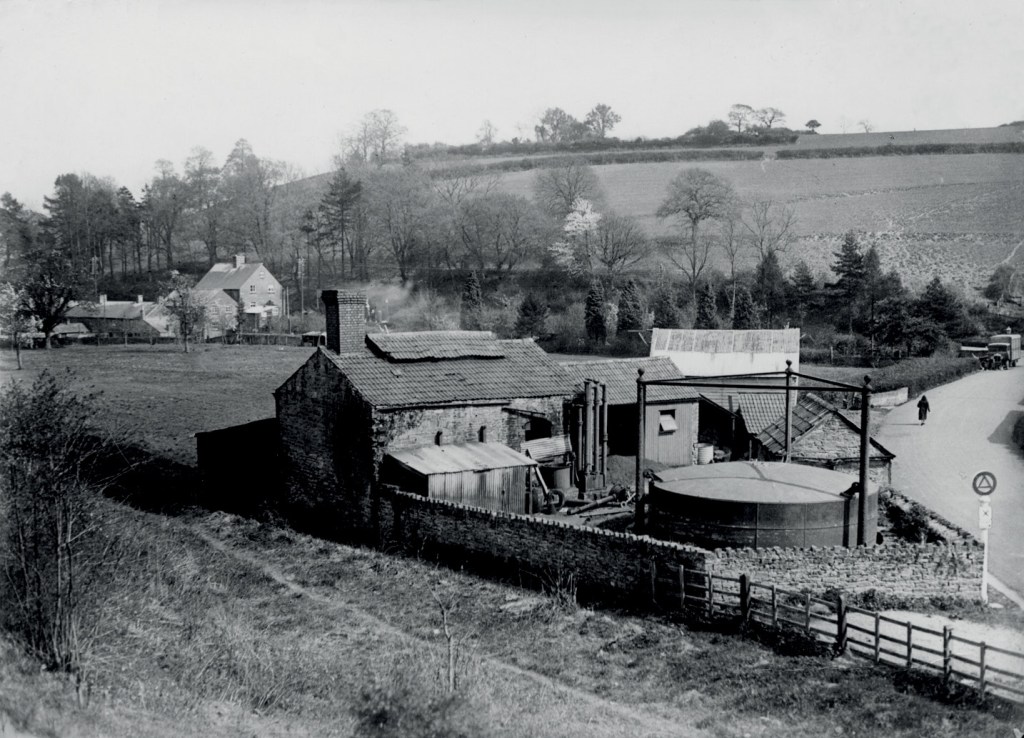
Murdoch’s failure to patent his inventions encouraged others to set up in competition, including his own former apprentice – Samuel Clegg (1781-1861) – who embarked on a business supplying gas lights to factories such as the Willow Hall cotton mill, at Sowerby Bridge, West Yorkshire, and Dolphinholme worsted mill in Lancashire. Built in 1811, Clegg’s Dolphinholme gas works saved the mill’s owner the cost of 1,500 candles a night. The Soho gasholder no longer survives, so it is Dolphinholme that enjoys the title of oldest surviving gasholder in the world, though it is preserved only as an enclosing wall – the gas container has gone. The exceptionally rare site was designated a scheduled monument as recently as July 2020.
It was for public street lighting that Clegg and others first exploited this new technology, being encouraged by the authorities to do so as a means of deterring crime. The German entrepreneur Friedrich Winzer (aka Frederick Winsor; 1763-1830) built a gas works at 100 Pall Mall, in London, where a plaque now records that the world’s first public piped gas supply was used to light 13 gas lamps installed along the length of this prominent London thoroughfare in 1807. (Pall Mall continues to be one of the few remaining streets in central London to be lit by historic gas lights.)
Winsor went on to set up the Gas Light and Coke Company in 1812, the world’s first gas company set up to supply domestic consumers, with its works on Great Peter Street in Westminster. Using bored timbers as pipes, this supplied gas to the lights on Westminster Bridge that were switched on for New Year’s Eve in 1813. Clegg later joined the company as chief engineer, supervising the installation of a gas works at the Royal Mint in 1817 and the laying of some 290 miles of pipes to supply around 50,000 premises by 1819.

It is astonishing to think that such central London streets as Pall Mall and Great Peter Street once had gas works, but these were small-scale structures, typically comprising a coal store, a retort house for the extraction of gas, plant to remove impurities, a gasholder, and an administrative building. The size of gasholders was limited to 6,000 cubic feet (170m3) because of safety concerns.

For the same reason – to contain potential leaks – early gasholders were placed inside buildings, known as ‘gasholder houses’. This practice was abandoned when it was realised that trapping any escaping gas within an enclosed and poorly ventilated space increased the likelihood and consequences of an explosion. Only one example of an enclosed gasholder now survives in the UK, where it forms part of a practically complete Grade II- listed gas works dating from 1822 at No.86 Saltisford, in Warwick. Though the gasholders themselves have long gone, the two large octagonal pavilions that enclosed them, with rooftop ventilators, can still be seen.

Gas giants
From the 1820s, gasholders would be located in the open air. A typical early gasholder consisted of a storage vessel, or ‘lift’, open at the bottom, where it sat on a tank of water that acted as a seal to hold the gas. Gas passed from the retort in a pipe that passed through the water to the lift; another pipe drew gas from the lift, passing through the water again, to form the supply to street and consumer.
Early lifts were similar to barrels, built of wood with iron hoops, though lifts made from cast-iron plates, known as ‘bells’, soon followed. The bell had guide rods (and later wheels) attached to it, and these ran on the vertical rails of a guide frame, designed to keep the bell upright as it rose and fell when gas was added or removed. Counterweights were employed to offset the gas pressure in the lift and to supply consumers with gas at a constant mains pressure.

The oldest surviving gasholder in the world of this type – and the only Georgian example – is Gasholder No.2 on Imperial Road, Sands End, Fulham, London, designed by John Kirkham and built in 1829-1830 by the Imperial Gas Light and Coke Company. It is listed at Grade II, and it broke new ground in terms of size, being twice the diameter of most contemporary gasholders, with a capacity of 226,000 cubic feet (6,400m3).
The list description singles out the remarkable craftsmanship of the ironwork of the 12 free-standing tripods standing 30ft (9.1m) high in a 100ft (30.5m) diameter ring, used to provide lateral guidance for the wrought-iron bell. To support such a large bell, the interior was strengthened with a lattice of wrought-iron trusses tied into a central cast-iron tubular ‘king post’. That interior bell frame has survived, even if the original wrought-iron outer sheets have been replaced twice (in 1882 and 1949), enabling the bell to remain in continuous use for 140 years until it was retired in 1971.

The Sands End tripods were the forerunner of the more familiar gasholder guide rails that were developed from about 1835, consisting of a circular frame, comprising a ring of columns linked around the circumference by horizontal cross-braced trusses and diagonal bracing. The vertical columns were elaborately decorated – often designed to incorporate one or more of the five orders of Classical architecture with capitals, fluted pillars, and pinnacles. Filigree lattice work and floral reliefs were used to adorn the horizontal trusses, as well as the badges and emblems of the gas works company.
A fine example of this type is Joseph Clarke’s gasometers constructed in 1866 on the site of the Shoreditch Gas Works in Bethnal Green, London, on land that now forms part of Haggerston Park. This was another enterprise of the Imperial Gas Light and Coke Company. Each of the two storeys of Clarke’s structure has classical capitals – Doric then Corinthian. It is partnered by the even larger four-storey gasholder designed by George Trewby and completed in 1889. This huge construction is 200ft (61m) in diameter and the same in height (50ft, or 15.2m, below ground, and 150ft, or 45.7m, above). A much-loved part of the local townscape, the two have been aptly compared to Rome’s Colosseum and were recorded in detail by Archaeology South-East in 2022. A sense of their sheer scale is indicated by the fact that the frames of the two gasholders no longer surround a bell, but rather a development of 555 homes.

From lighting to listing
By now, gas industry pioneers had worked out the best temperatures when heating coal for gas to be produced, and the means to wash and purify the gas to remove impurities, such as cyanide and sulphur, before the cleaned gas was stored in gasholders, ready to distribute to consumers. Soon, towns all over the UK began to see a distinctive new type of building: the cylindrical gasholder, a key piece of equipment that sat alongside the retort house, where gas was produced. It acted as a buffer between manufacture and supply, storing gas at times of low demand, and releasing it when needed.
Some of these gasholders were relatively small in scale, but others became major feats of civil engineering. Among the finest ever constructed were those at King’s Cross (officially the Pancras Gasworks), a feature of the north London skyline from the 1850s, when the first of what would eventually become a cluster of 23 gasholders and guide frames was built by the Imperial Gas Light and Coke Company. They remained in use until they were decommissioned in 2000, and some eyebrows were raised when English Heritage proposed that at least some of them should be preserved from the angle-grinder and the scrapyard.


Eventually, four of the gasholders were chosen for preservation as part of the King’s Cross regeneration scheme – gasholders Nos 8, 10, 11, and 12. After being dismantled and stored on site for many years, the frames were cleaned and restored by Shepley Engineers in Yorkshire, and No.8 returned in 2013. It now stands next to the canal, railways, and Coal Drops Yard surrounding a small public space – Gasholder Park – which incorporates mirrors that offer multiple views of the ironwork.
The other three Grade II-listed gasholder guide frames were originally constructed in 1867. They now surround 145 ultra-chic apartments (with penthouses priced at £7.5 million). These were the first gasholders to be reused in development projects in the UK, though other schemes have since followed or are under construction, including those at Battersea, Kennington, Bethnal Green, Old Kent Road, and Bromley-by-Bow in London. They are among the 12 listed gasholder sites that Historic England has designated for preservation (outside London, they are the Carlisle gas works in Cumbria, Great Yarmouth in Norfolk, and Hendon in Sunderland), all of which consist of the more decorative mid-Victorian examples.

Later innovations
The period from the 1870s to the 1890s saw fundamental changes in the design of gasholder guide frames, as the older cast-iron columns and bells reached the maximum size achievable with such weighty materials. Engineers experimented with lighter guide rails: I-section and T-section instead of circular or square; tapering rather than straight; and latticed rather than solid. Wrought iron was used in place of cast iron, and later gasholders adopted steel.
Of much less visual interest than earlier gasholders, these aren’t as likely to be held in affection, and most have now been cleared to create space for new developments – even those as innovative as the East Greenwich gas works of 1886, which was built by the South Metropolitan Gas Company with the largest capacity of any gas-holder in the UK at the time (some 12 million cubic feet, or 339802.2m3) – and dismantled in 2020.


Several new designs emerged towards the end of the 19th century. One was the spiral-guided gasholder, which dispensed with the need for a guide frame. Instead, the bell rose and fell in a spiral or corkscrew motion, guided by helical rails, curving round the gasholder tank at an angle of 45°. The first example was built at the Nantwich gas works in Cheshire in 1890 to a design patented in 1887, and by the 20th century this became the predominant type, not just in the UK but worldwide.

Waterless gasholders developed first in Germany, at the Augsburg Gasworks, in 1915. This consisted of a rigid polygonal tank, built over a concrete slab from vertical girders and horizontal steel sheets, and riveted to form a rigid gas-tight shell. The gas was stored below a moving piston, which rose or fell within the shell. The first example in the UK was built at Ipswich, Suffolk, in 1927, and the one built at Southall was well-known as a navigation landmark to airline pilots landing at Heathrow.

Gasholder design did not take place in isolation from other forms of engineering – indeed, these helical or geodesic structures were to influence Barnes Wallis’ designs for aeroplane frames in the 1930s, Buckminster Fuller’s domes in the 1950s, and even London’s Gherkin skyscraper, completed in 2003. All this innovation came to an end, however, when the gas network underwent a massive conversion process following the discovery of natural gas under the North Sea in 1965. Some gasholders continued to be used for storing natural gas, but they needed constant maintenance and repair, suffered from corrosion, and required regular painting.

Natural gas is thus not only transported via pipeline: it is often stored within the pipes or in underground reservoirs. As a result, gasholders began to be demolished in large numbers from about 2000 onwards, and today only people who live in London regularly see what was once a prominent industrial feature of every town – unless you are a cricket fan, in which case you will be very familiar with the gas works (constructed in 1853) forming the background to the Vauxhall End of The Oval cricket ground in Kennington.

Further reading:
• Gasworks and Gasholders: introductions to heritage assets is available online at https://historicengland.org.uk/images-books/publications/iha-gasworks-gasholders/heag296-gasworks-gasholders.
• National Grid plc, Russell Thomas, and Timur Tatlioglu (eds) (2024) Gasholders: a history in pictures (Liverpool University Press for Historic England, ISBN 978-183553 8494, £32).
• George Demidowicz (2022) The Soho Manufactory, Mint and Foundry, West Midlands: where Boulton, Watt and Murdoch made history (Liverpool University Press for Historic England, ISBN 978-180034-9285, £39.20).
All images: Historic England Archives, unless otherwise stated

You must be logged in to post a comment.